To those who have found true love, only to have had it slip away, there’s perhaps no song more powerful than The Promise by Tracy Chapman, about the eternal hope that one day you’ll be reunited with your soulmate.
I sometimes think only black people can produce music this powerful. The rest of humanity lost that ability tens of thousands of years ago, but blacks preserve it because they were the first to branch off the human evolutionary tree, as Rushton noted.
Campbell and Tishkoff (2010) Figure 2. The Recent African Origin model of modern humans and population substructure in Africa.
So turn off the lights, turn up the volume and let this black woman’s talent take you home to the very soul of our collective humanity that began in Mother Africa.
Although the song seems to be about romantic love, it can also be applied to the love a parent has a child.
I’m 44 and I have recently been diagnosed with a stage 2 glioma (brain tumor) and have been told that I have perhaps 1 year left, I think this is the saddest song I’ve ever heard, I love this song so much and want it to be played at my funeral but I worry it will upset my daughter to much, it scares me to think of my daughter on her own and that I won’t be here to comfort and support her and it breaks my heart that I will never see my daughter graduate university or that I won’t be there to walk her down the Isle on her wedding day or meet my grand children, I love you Esmee to the moon and back and am so proud of the beautiful, intelligent and courageous young woman you have become, I know that one day (many many) years from now we will meet again, Esmee those day’s will be truly glorious fore we shall walk hand in hand through the fields of paradise as we listen to a choir of angels having shed the sins and struggles we carried for all those years, god bless you all, please be kind to one another and cherish your loved ones because life is just to short and far to precious to waste on bitterness and hate
The video below, from The Oprah Winfrey show 20th anniversary DVD, paints a rare glimpse of Oprah’s talk show roots. In the mid 80s she was hired to host a local morning low budget talk show in Chicago, that was airing in the same time slot (and right down the street) from the great Phil Donahue, who at the time, was the number one (daytime) talk show in the country.
No one in their wildest dreams thought Oprah would ever beat Donahue. For he was the best in the country and she was black (which was considered really bad in the 1980s), female, and overweight.
“I don’t know another overweight jheri curl person who can say ‘I made it!'” laughs Oprah.
Not only did she make it, but she would go on to become the World’s ONLY black billionaire and the most influential woman on the planet.
Not bad for an overweight jheri curl!
When Oprah first arrived in Chicago she had so little clout she had to bribe strangers on the street to sit in her audience with heat and doughnuts.
My favorite part of the below clip is when she says “We were successful IMMEDIATELY! We were so successful, so quickly, it was STUNNING…”
Your brain consists of two types of tissue, gray matter and white matter. In your first decade of life, the gray matter grows and expands rapidly as many new synapses, or connections between nerves, are being made. The gray matter grows as you learn and are exposed to new experiences as a child.
Then, as your body prepares for puberty, your brain starts to prune back some of that gray matter and amp up its production of white matter, which allows different parts of the brain to share information better and faster, said Dr. Jess Shatkin, a child and adolescent psychiatrist at the Child Study Center at NYU Langone Medical Center….”The brain volume, the total volume, doesn’t really change, but we lose about 1% of gray matter starting around 13 and we gain about 1% of white matter at the same time, and that trade off keeps going,” Shatkin said.
However it seems that in both autism and schizophrenia, this process goes wrong, with autistics ending up with not enough white matter and schizophrenics ending up with not enough gray matter.
Researchers say white and gray matter are both necessary for general intelligence, but they perform different functions. Gray matter represents information processing centers in the brain, and white matter represents the network or connections between those processing centers.
The lack of white matter might explain why autistics tend to have narrow interests. If white matter allows different brain parts to share information, which is needed for broad interests, those lacking this may be forced to focus on a single topic.
This may also explain why autistics lack social skills. Reading people requires integrating verbal and non-verbal cues and thus using different parts of the brain at once.
Perhaps this research also reveals why autistics tend to come from high IQ families (or at least higher class ones) or why high people often show a dash of autism. Having a lot of gray matter is linked to high IQ, but if your kid inherits only your gray matter genes without the developmental timing to prune that gray to make room for white matter, he might be severely autitsic.
Meanwhile the high white to gray ratio of schizophrenics may help explain their delusions. Sharing information between unrelated brain parts might lead to a lot of creative theories, but if you lack the gray matter to test these theories with logic, you soon could lose contact with reality.
Research into gray and white matter is further evidence of Crespi and Badcock’s theory that autism is the opposite of schizophrenia.
It also supports Simon Barron Cohen’s extreme male brain theory of autism, in that males tend to have higher gray/white matter ratios than females.
Sometimes the younger generation of African Americans doesn’t appreciate the Genius of older black icons. They may think these elder icons are overrated.
One young woman attending a taping of The Oprah Winfrey Show had that attitude towards the great Toni Morrison, and Oprah was having none of it. Oprah got in her face like only Oprah can.
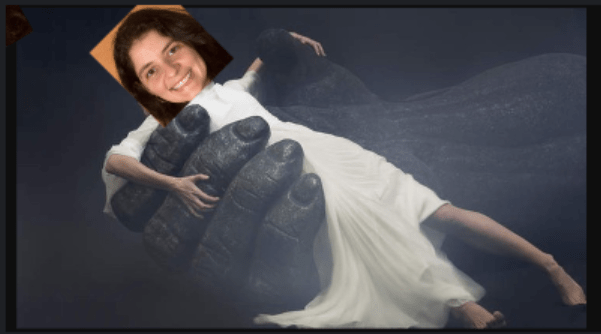
My photo-shopped image of Suzana Herculano-Houzel in King Kong’s hand
According to Brazilian neuroscientist Suzana Herculano-Houzel the reason humans are so smart is not because humans have the biggest brains for our body size per se, (highest encephalization quotient) but rather because we have both a big brain and a primate brain. SHH’s theory is that primate brains are especially densely packed with neurons, so even though our brains are small compared to whales and elephants, the primate packing density gives us more cerebral neurons.
Well King Kong has a far bigger brain than humans do, and King Kong is also a primate, so by SHH’s logic, he should be smarter than people. And yet King Kong seemed no smarter than your average gorilla, which makes sense because King Kong’s huge body guarantees it would have a much smaller encephalization quotient than people do.
So while cerebral neuron count might be roughly as accurate as EQ when predicting the intelligence of real life species, it fails when it comes to fiction.
IQ tests are considered valid because they have both construct validity and predictive validity. They have construct validity because a statistical technique called factor analysis proves that all mental tests are influenced by a general factor dubbed g, and that IQ tests load high in g. They have predictive validity because IQ tests better predict important life outcomes like education, income and occupational status than any other single measurable trait.
However IQ skeptics like our very own Race Realist (RR) argue that this validity is just an artifact of test construction. In other words, all IQ tests correlate with g, not because they measure a factor common to all mental abilities, but rather because only tests that are positively correlated are included in test batteries.
Similarly, he’d argue that IQ tests predict success in school and life, not because high IQ people learn faster, make wiser life choices and are more productive, but rather because only test items that good students did well on were included in the tests.
There’s some truth to RR’s view. Tests of general knowledge only became used in IQ tests after WWI testing found them to correlate highly with the total score of other subtests. In addition, David Wechsler would present potential test items to people of “known intelligence” and primarily those items that discriminated well between people with known Binet IQs of different levels were included. A question about a non-Christain religion was included in the general knowledge subtest after Wechsler found it to distinguish those Americans with superior from average IQs.
Given that IQ tests owe at least a small part of their validity to test construction, it’s interesting to ask whether IQ tests would still have the same construct and predictive validity if we remove the selective bias in picking subtests and test items.
What is needed is a random sample of mental abilities, not one pre-selected by psychologists. The closest thing we have to such a sample are board games. Thus, instead of the 10 subtests Wechsler arbitrarily chose for his original scale, we could simply pick the 10 “most popular” board games of all time:
chess
checkers
Backgammon
Scrabble
Monopoly
Clue
Othello
Trivial Pursuit
Pictionary
Risk
An ideal study would be to take 2000 random teenagers with very little experience playing any of these games, and send them to a summer camp where all they did was play these 10 games everyday (though no special strategies would be taught), culminating in a tournament where all 2000 were ranked on each game, and then given an overall ranking that reflected their combined performance across all ten games. This combined ranking would be converted into full-scale IQ, such that the best overall player (out of 2000) would be assigned a full-scale IQ of 150 and the worst would be assigned a full-scale IQ of 50.
If there really is a g factor, we should expect that while some people are great at chess but terrible at Pictionary, in general people who are good or bad at one game would be good or bad at any other.
Further, if g has predictive validity, we should find that 30 years later, those with the highest full-scale IQs would have more education, more prestigious occupations, and higher incomes (even after controlling for family background) than those who performed poorly.
Humans are far and away the smartest animal on the planet. We’ve always known this, but we’s struggled with how to prove it.
We don’t have the largest brains. That would be the sperm whale.
Well, then maybe we have the largest brain/body size ratio, scientists must have thought. Wrong again! that honor seems to go to small ants.
Well then maybe we have the largest brain/brain expected for our body size ratio? Bingo! What most distinguishes the human brain from that of all other animals is that it’s 7.6 times larger than statistically expected for a mammal of our size and probably well over 8 times larger than for an animal of our size.
No other creature comes close.
Our huge encephalization quotient allowed humans to conquer the World, accumulating more biomass than any other species except for cattle whose body-mass we’ve deliberately grown as our food supply.
Of course there’s far more to intelligence than just brain size adjusted for body size, but when comparing vastly different species who differ enormously on this metric, it seems to be a strong indicator.
Enter Brazilian neuroscientist Suzana Herculano-Houzel who commenter Race Realist has been blathering on about for years. While she agrees that humans are the smartest animal on the planet, she felt she had a more direct way of measuring it than brain size adjusted for body size. Indeed, she felt we could just ignore body size completely, and simply count the number of neurons in the cerebral cortex, and she came up with a very innovative way of doing so: using detergent to dissolve brains into a homogeneous soup of cell nuclei.
At first this method looked promising. By simply counting the number of cerebral neurons and ignoring body size completely, it seemed Herculano-Houzel had found a simple brain property that ranked humans in first place. In 2017 she wrote:
the human cortex, with an average 16 billion neurons…, has almost three times as many neurons as the twice-larger elephant cerebral cortex, with not even six. The second-largest primate brain, the gorilla, has about nine billion. Even the largest whales don’t have more than three or four billion. Most mammals have less than one billion.
Thus, the human brain has by far the most neurons in the cerebral cortex – that part of the brain responsible for personality, temperament, pattern finding, logic reasoning and planning for the future, making behaviour more than simply reacting to stimuli. That, I believe, is the simplest explanation for our remarkable cognitive abilities.
Herculano-Houzel’s star began to rise. Seeing a Brazilian woman make such a monumental scientific discovery was inspiring. She gave a TED talk and commenter Race Realist began drinking the kool-aid (or should I say brain soup).
However a 2014 study found ” the long-finned pilot whale neocortex has approximately 37.2 × 10⁹ neurons, which is almost twice as many as humans”.
Thus despite Herculano-Houzel’s Herculean efforts, encephalization quotient remains the single best neurological proxy for intelligence at the inter-species level, or at least the only one that puts us humans where we belong: at the top.
Morrison’s first appearance on The Oprah Winfrey Show in 1996. Morrison’s readership increased more from Oprah’s endorsements than it had from the Nobel Prize.
Earlier this month, the literary world was rocked by the death of Toni Morrison. She was 88. In 1993 Morrison won the Nobel Prize in literature, making her arguably the most academically accomplished African American of all time; certainly of her generation.
Morrison was part of the Silent Generation, one of the 58 million Americans born from 1925 to 1945. As much as 16% of this generation was black (9.28 million).
Today the correlation between IQ and academic success is only about 0.55, but in the mid-20th century, when Morrison was coming of age, it was a potent 0.7 and was likely about the same in the black population.
It was once suggested by Garth Zeitzman that when estimating IQ from the 0.7 correlation between IQ and academic achievement, the academic Nobel Prize is the pinnacle of the latter.
Thus if there were a perfect correlation between IQ and academic success, Morrison’s IQ would be 78 points above the black mean (one in 9.28 million), but given a correlation of 0.7 in Morrison’s day, we’d expect:
Morrison’s IQ = (0.7)78 + U.S. black mean
Morrison’s IQ = 55 + 85
Morrison’s IQ = 140 ( 95% confidence interval 119 to 161)
Further evidence of Morrison having a 140 IQ is her schooling a BBC reporter on the difference between a porch and a terrace, the fact that she has a very good long-term memory for her childhood (according to Fran Lebowitz), the fact that she excelled at typing when young, and like her biggest fan Oprah, she learned to read by age three.
Indeed Oprah was such a huge fan that she chose not one, not two, but four Morrison books for her coveted book club, and loved Beloved so much she bought the movie rights.
photo by Marion Curtis/Getty
Winner of the Pulitzer Prize in fiction, Beloved is based on the true story of Margaret Garner, an escaped 19th century slave who loved her baby so much, she killed it rather than allow it to live a life of slavery. In Morrison’s brilliant vision, once slavery is over, the baby returns as a flesh and blood ghost to live with her now free mother (played by Oprah in the movie).
It’s a testament to Morrison’s high IQ writing style that Beloved is considered way too difficult for university undergads, and Oprah was warned by director Jodie Foster that it was way too literary a novel to ever become a film.
Nonetheless, it became arguably the most underrated film of all time.
I’ve never read the book, but I loved the film for its sheer beauty, originality, haunting score, and how the simplicity of the 19th century characters captured the Flynn effect, especially the mesmerizing scene of the escaped slave men clumsily dancing to Baby Sugg’s preaching.
Or the white girl Amy Denver who dreams of going to Boston to buy “the pertiest velvet”.
There was a childlike innocence about the characters that revealed the Flynn effect, juxtaposed against the stunning beauty of pre-industrialized America with its vast wilderness, traveled by horse and canoe.
Sadly, despite being promoted by Oprah and directed by Jonathan Demme, the film flopped at the box office, perhaps because the average moviegoer is too low in IQ and too high in psychopathy to appreciate such emotional non-linear symbolism.
Morrison’s first book was The Bluest Eye, inspired by a beautiful little black girl Morrison knew as a child. The girl became an atheist after her years of praying for blue eyes went unanswered. So powerful was racism that this girl would rather look like a freak than accept her natural black beauty.
Future editions would have more sophisticated cover art, but there’s something about the original primitive drawing above that remains haunting
Like a lot of black Americans who were raised in segregated times, there was an anger lurking beneath Morrison’s soft-spoken eloquence.
In one book she imagined a U.S. town without white folks.
“What would it be like if they just weren’t there?” Morrison asked.
The title of the book: Paradise.
When a white interviewer asked Morrison why she didn’t include more white characters, she reacted with a calm yet defensive rage.
Despite the fact that Morrison was a Nobel Prize winning literary giant who exudes gravitas with every breath, there’s something about the white woman’s smug gaze that made even Morrison look small.
A character in the film Beloved said it best, when describing a white man riding a horse:
There’s a look that white folks get. Righteous look…
To learn more about this American legend, I strongly recomend the following BBC documentary:
HBO has done it again. First they gave us Six Feet Under (the best TV series of all time), then they gave us Leaving Neverland (the best documentary of all time), then came Euphoria (one of the best teen dramas) and now: Years and Years (also airing on BBC One in the UK).
Years and Years tells the story of Vivian Rook, a rising British politicians in the late 2020s, told through the eyes of a random British family that watches her rise over the years on TV. Rook is played by the brilliant Emma Thompson.
When I was a teenager I was sent to a high school that had a program for brilliant students and because the students were so bright, the teachers had to be incredibly bright to stay one step ahead. I remember my English teacher had such an intimidating intellect that you didn’t want to even raise your hand in class for fear of looking stupid. And yet this man absolutely worshiped Emma Thompson. She just exudes a certain sophistication, and she does a great job playing Britain’s maverick future leader, a character that seems very vaguely inspired by Donald Trump.
The show portrays a dystopian future where bankers have wrecked the economy, the government is pursuing genocidal policies in refugee camps, and all the cool kids are becoming trans-human.
A scene commenter illuminaticatblog might like:
The first season ends with one of the characters deserting her physical body completely and being the first person to get her mind downloaded, though we’ll have to wait for season #2 to see if this risky new technology works.
Even if it is possible one day to download our entire consciousness on to computer, does that really mean we live forever, or does it simply mean an another us (that thinks, remembers, and feels exactly like we do) just takes over in our place?
I decided to look at an excellent study that Lynn had cited. In this study you had 14 pairs of identical twins (one born undernourished, the co-twin born well nourished as measured by birth weight; twin pairs were raised in the same homes). At an average age of 13, they had their head circumferences measured and were given the WISC IQ test.
The heavier twins had crania that were 0.64 cm bigger than their undernourished co-twin. At age 13, the within sex standard deviation for head circumference appears to be 1.31 cm, so that’s a difference of 0.49 standard deviations.
When it came to verbal IQ, the well-noursihed twins and the undernourished twins had the exact same average IQ. And when I saw the exact same average IQ, I mean the exact same average IQ: 98.29 vs 98.29 (unadjusted for old norms)
However when it came to performance IQ, the well nourished twins scored 7.07 IQ points higher than their undernourished co-twins. That’s a difference of 0.47 standard deviations, virtually identical to the 0.49 standard deviation difference in head circumferences.
So it seems that Richard Lynn was half-right. Brain size gains caused by prenatal nutrition do perfectly parallel IQ gains caused by nutrition, but only when it comes to Performance IQ. Prenatal nutrition seems to have virtually zero impact on Verbal IQ, though given the small sample size (only 14 twin pairs), these conclusions are tentative.
It’s amazing how well this study of identical twins perfectly parallels the difference between North American young adults in the 21st century vs circa WWII.
21st century North American young white adults are to their circa WWII counterparts as well nourished identical twins are to their less nourished co-twin in that their head circumference and Wechsler Performance IQs are both about half an SD larger, while their verbal IQs are about the same.
Because humans are cultural creatures, I believe the brain evolved to prioritize verbal ability during times of malnutrition (which as Lynn noted, includes disease since disease prevents the body from using nutrients), so when sub-optimum nutrition shrinks the brain, mostly spatial IQ suffers, and then when prosperity returns you get a genuine Flynn effect, but it’s 100% concentrated in spatial ability. Spatial ability is a luxury of the well fed.
One might wonder why, with all the increasing education and media, I did not find any verbal Flynn effect on the Wechsler. It’s likely that 21st century education gave us an unfair advantage on verbal tests especially Similarities, but this advantage was negated by the fact that a test created in the 1930s was biased against us (especially in tests of specific knowledge). In other words, two conflicting cultural biases cancelled each other out, thus exposing our true verbal intelligence as unchanged since WWII.