Of the dozens of people who have taken the KAMIKAZE, there were 8 who self-reported math SAT scores. These were:
The correlation between KAMIKAZE scores and the SAT derived math IQs was a moderate 0.39 which isn’t terrible considering how restricted the range of ability is. Even the lowest scoring person in the sample (Loaded?) scored in the genius range.
When I placed KAMIKAZE scores and math IQs in rank order, I got the following equivalencies:
Using this same sample of 8, I arranged the items in order of difficulty based on how many of them passed each one.
Last week commenter Kiwi-Anon left me the following message about the KAMIKAZE which you can take here.
Alright, I’ve just finished my final draft. I added some floor extension items that I know a mathematically challenged kid I tutor can solve, so hopefully everybody should be able to get at least one correct. I think 6-7 correct should be about average among normal people. Looking over the test again, the ceiling is probably not as high as I originally thought, but should still be high enough for this blog – there will probably be a few stray Feynmans who breeze through it, but most won’t hit the ceiling. BTW, it’s probably a good idea to separate out both people who have a math/physics background and people with math competition experience with a demographic questionnaire. Let me know if any of the questions are ambiguous or if any of my answers seem wrong (I have checked them, but I am very sleep deprived right now so there’s a chance I made a mistake). Feel free to rearrange the questions into whatever you feel is a better order of difficulty (they are already loosely in such an order), and of course, you don’t have to keep the silly name for the test. You may want to try the test for yourself to see if my time limit seems right; I want fairly smart people to have at least 9 minutes for the last 3 questions.
Here’s the test, hopefully it meets your criteria:
The Kiwi-Anon Mathematical Intelligence, Knowledge, And Zeal Examination (K.A.M.I.K.A.Z.E.) (hey, acronyms aren’t my strong suit!)
[update 2022-04-15: an earlier version of this article reported the number of people who had passed each item on the TAVIS. This data was based on the response summary. However thanks to an anomaly spotted by commenter kiwianon, I did more research and it now appears that summary reported everyone who answered the question, and not just those who did so correctly]
As of today, there have been 746 responses to the TAVIS. Of these, 625 answered at least one item. This is not to imply that even the easiest item was too tough for 121 people, since many respondents did not properly start the test or did not bother taking it, and of those who took it, some likely took it multiple times strategically answering only one question as part of an attempt to infer answers.
A score of only 14 out of 24 puts you around the one in 4,000 level or even one in 42,000 level, depending on which (if any) of my three normings you believe. Not a single person (out of 625) has scored above 19.
When a test’s ceiling is so much higher than it’s hardest item (which hopefully wont be the case here), it’s sometimes a sign of low reliability. On a perfectly reliable test, the percent of people answering the hardest item perfectly matches the percent of people with a perfect score .
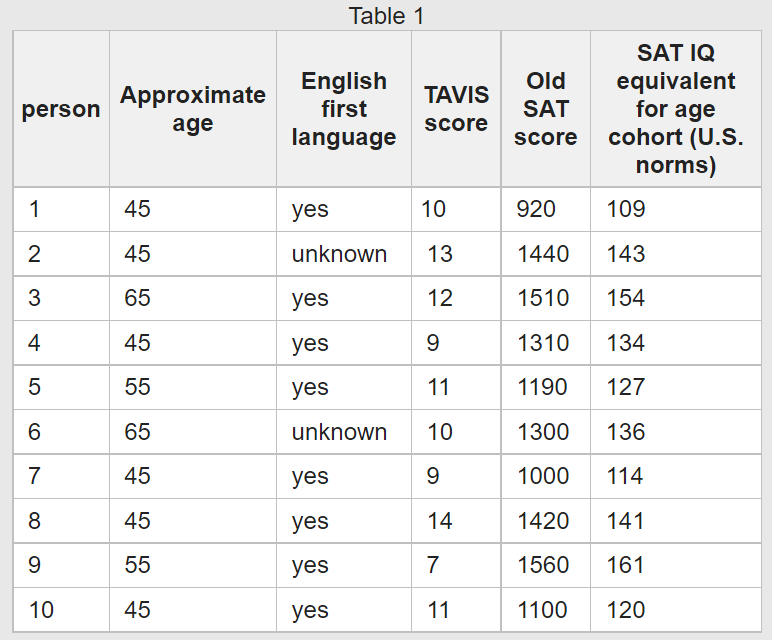
Digging through the hundreds of TAVIS test submissions, I have slowly found 10 TAVIS takers with self-reported SAT scores (old scale; pre-April 1995). I’m sure there are many more, but this is a start:
Old SATs were converted to IQ using this article. 45-year-olds were assumed to have taken the old SAT in the mid 1990s, 55-year olds in the mid 1980s etc.
The correlation between TAVIS and old SAT scores was a disappointing 0.04. The person with the highest SAT score (1560) got the lowest TAVIS score (7). But given the small sample size, this needn’t alarm us, and indeed if we eliminate that one anomalous person, the correlation jumps to 0.60.
If we put TAVIS scores and IQ equivalents in order from highest to lowest and place them side by side, we get the following preliminary IQ equivalents:
I love movies about a pair of upper middle class couples in their 30s isolated in remote, beautiful cozy location. I started watching this movie with the sister of my mother’s friend. The sister went to bed early, saying the film was “too slow”.
But I love slow movies. I love horror films but I’ve realized it’s not the horror part I love about them. I love all the parts leading up to the horror. The long drive to the secluded location. The excitement of the characters about the fun weekend they have to look forward to. The scenes where the characters step out on the deck overlooking a cliff, overlooking an ocean and say “isn’t it beautiful?”
Usually the horror starts the night the characters get to the location, but in this film, they apparently arrived on a Friday afternoon, and the horror didn’t start until Saturday night so they had time to go for a walk on the isolated beach, get drunk, make out in the jacuzzi, go for a hike etc.
The film is about two white brothers and their girlfriends (wives?). One brother has a high IQ and works in an academic profession while the other brother had spent time in jail for fighting and lacks general knowledge (implies humans were alive near dinosaur times). But the lower IQ brother has a high IQ Middle Eastern girlfriend who also happens to be the high IQ brother’s work partner. The low IQ brother fears his high IQ wife might leave him for a smarter guy, but he never suspects that smarter guy might be his own brother.
When the Middle Eastern girlfriends tries to rent their vacation destination she is declined, only to find her lower IQ white boyfriend is able to rent it an hour later raising questions about racism, but that’s the least of their problems as they discover someone is videotaping their showers and trying to kill them.
This film was directed and co-written by Dave Franco (the younger brother of James Franco) who cast his wife as the high IQ brother’s wife. Well worth watching on Amazon Prime.
In the late 1990s Oprah did a show on mad cow disease and during the show she was alarmed to learn that U.S. cattle were being fed some kind of beef derivative. “But cows are herbivores,” remarked a concerned Oprah. She turned to the audience and said “now doesn’t that concern y’all just a little bit. It has stopped me COLD from eating another burger!”
Shortly after the show aired beef prices hit their lowest point in ten years and that feeding practice was banned, improving the safety of U.S. beef. Citing her enormous influence, Texas cattleman blamed Oprah for the drop in beef prices and using an obscure veggie libel law, were able to sue her for $10 million, arguing that she slandered U.S. beef to get ratings. Even worse, the law suit would take place in Amarillo Texas, the beef capital of America. Even worse for Oprah, there were people in the town with bumper stickers that said “The only mad cow in America is Oprah”
As a black woman entering an all-white Southern pro-beef Texas town, Oprah was entering enemy territory.
“She messed with the wrong state,” one Texas redneck told Entertainment Tonight.
Early on Oprah reached out to Dr. Phil who though not famous at the time, was important in legal circles for how a court room psychologist. At first they did not get along because Oprah could only spare an hour to meet with him.
“It’s not my ass being sued, if that’s all the time she has, I want to know part of this”
When she decided to give him more time she said, “a lot of people think I should settle this case, what do you think?”
“Absolutely not”, he replied, explaining “the line-up at the sue Oprah window gets a whole lot shorter if you take this all the way to trial and send them home with nothing”
“Boy I like the way you think,” replied Oprah. Dr. Phil’s gift for delivering homespun common sense in succinct sound bites resonated with Oprah.
During her time in Texas, a mysterious old black lady dressed in black handed Oprah a note then quickly vanished before Oprah had a chance to enquirer. When Oprah opened it up, it said:
Did you ever think you’d see the day when a black woman was on trial for having too much influence?
During the trial Oprah slipped into a depression. She kept asking “why is this happening? Why am I being sued over burgers? How can this be happening?”
Dr. Phil took her aside and said “It IS happening, and you need to get in the game, and fast, or those good old boys are going to hand you your ass on a platter!”
“No they wont,” replied a defiant Oprah, and Dr. Phil knew in that moment that she would win.
During the trial, Oprah was the best witness Dr. Phil had ever seen in decades as a court psychologist. The louder and more hysterical the cross examiner would get, the calmer Oprah would get.
“Free speech not only lives it ROCKS” shouted Oprah when she won the trial. Beaming with superhuman charisma, she held a newspaper on her show with the headline “OPRAH WINS”
After the trial Oprah said to Phil “over the years I’ve had every psychologist in America on my show and none of them have made as much sense as you. And I don’t want to be selfish with that, I want to share it with millions”
At first Oprah’s audience hated Phil and flooded her show with complaints and her producers strongly urged her to drop him. But Oprah used her marketing savvy to turn it around. She began calling him “tell it like it is Phil” and told anecdotes about how Phil had told her like it is.
Before long, Tuesdays with Dr. Phil became the highest rated shows of the week.
Other TV producers began offering Dr. Phil his own talk show, but he was smart and loyal enough to not stab Oprah in the back the way Joan Rivers allegedly did to Johnny Carson. He would tell Oprah about the offers and she would say “anytime you want your own show, let me know.” But since Phil already had a successful litigation company in Texas, he didn’t have time to become a full time TV personality.
But after several years of being a popular weekly guest, Oprah decided he was finally ready to have his own show so her company Harpo, partnered with Paramount to give him one.
Oprah recruited the King brothers, the big husky rednecks who helped Oprah get so rich, to syndicate Dr. Phil’s show too. The King brothers took a gamble syndicating an overweight black woman like Oprah all over America at a time when the country was anti-black, and to repay them, Oprah was now taking a chance on a big husky redneck Dr. Phil at a time when the country was increasingly anti-working class white.
The big husky King brothers made all TV stations who wanted to air Dr. Phil sign a contract that he would never be aired opposite Oprah. As a result, Oprah remained #1 and Phil instantly became number two. By owning the most popular talk shows in syndication, Oprah became the World’s ONLY black billionaire for THREE STRAIGHT YEARS and the most influential woman on the planet.
“What better partner can you ask for than Oprah?” gushed Phil. “She is insightful, committed and UNBELIEVABLY INTELLIGENT!”
Many times on this blog I have claimed that the correlation between IQ and years of educations (indeed IQ and academic success in general) is 0.65. I have based many arguments on this figure which I had assumed was correct since it came from none other than the late great Arthur Jensen who cited it on page 279 of his 1998 book The g Factor. Well it turns out the figure is no longer true, and hasn’t been true for at least several decades. The standardization sample of adults (age 25+) on the WAIS-III revealed the correlation between full-scale IQ and years of education has sunk to 0.55. It seems back in the 1950s, when the first WAIS was standardized, the correlation between IQ and years of education was about 0.7, but by 1978, when the revised WAIS was normed, it had already sunk to the mid 0.5s.
It turns out this is only true when you look at all adults lumped together:
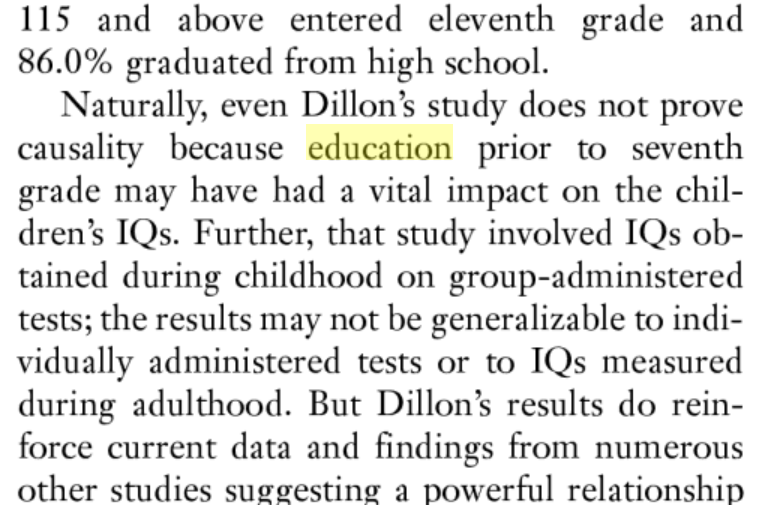
The massive correlation between IQ and years of education appears to be because high IQ people stay in school longer. It seems not at all because school raises IQ. This was proven by Dillon (1949):
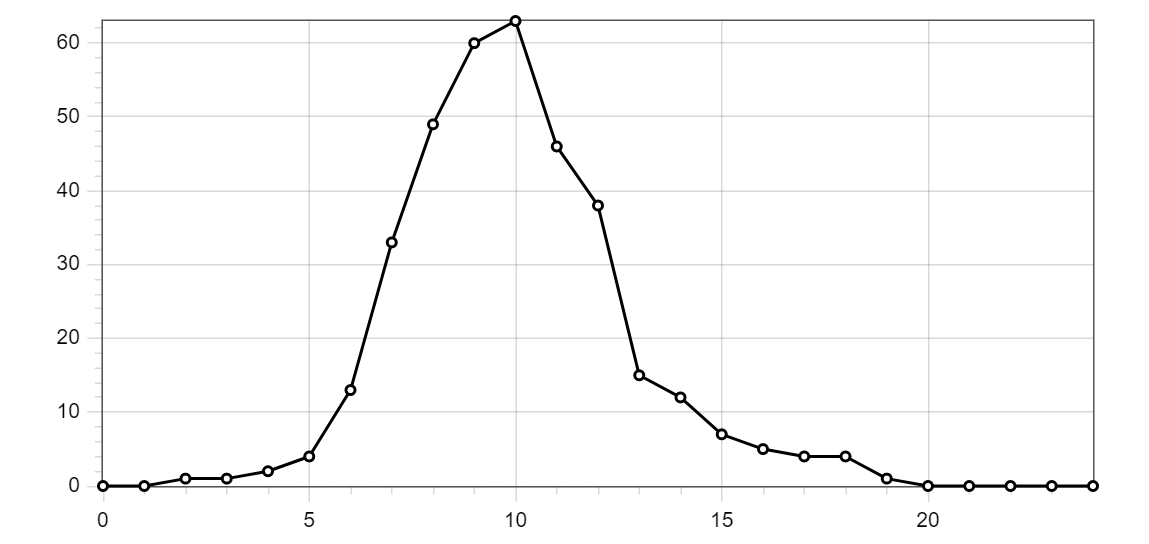
The TAVIS has now been taken at least 358 times (excluding people who clicked on the link but didn’t submit, or who submitted their answers without attempting any questions, or who answered only one question (a hard one) because they were likely trying to confirm if a guess was right).
Below are the 358 scores that are likely legit (though it’s possible the highest scores are from people involved in the above mentioned monkey business).
Since the first norming, the mean and SD have both increased slightly (they’re now 9.98 and 2.62 respectively) and the distribution has become more bell shaped:
There are more people with extreme scores than a perfectly normal distribution would predict, especially at the high end. It’s unclear why this is but several possibilities come to mind:
The test items did not increase in difficulty in a sufficiently linear way.
A bias in the sampling
Some of the people tested are not part of the biologically normal population
Monkey business
To normalize the distribution, each raw score was converted into a percentile rank which in turn was converted to the expected IQ on a perfectly normal curve. But because research suggests my average reader is two standard deviations smarter than the average American, 30 IQ points were then added.
These norms look plausible at the high end but seem too generous at the very low end. Future normings will use equipercentile equating with self-reported SATs, ACTs and Wechsler IQs to see if that gives different results.
What follow’s is a guest post written by Ganzir, only lightly edited by Pumpkin Person:
You are invited to participate in Ganzir’s research by taking a survey. You will read a description of a disease’s symptoms, then rank each of 12 different descriptions of personality traits according to how much they resemble those symptoms. This quiz has no right or wrong answers. You shouldn’t see a score or a pass/fail message, but if you do, it’s an artifact, not part of the survey. Your answers will be manually transcribed into my statistical records. If you intend to take this survey, do not read the comments on this post before you do.
Once I have enough responses, I will post an analysis of the results on my blog at ganzir.info. I will release my first report on it once I have 25 responses or at the end of March, whichever comes first: Link to the survey
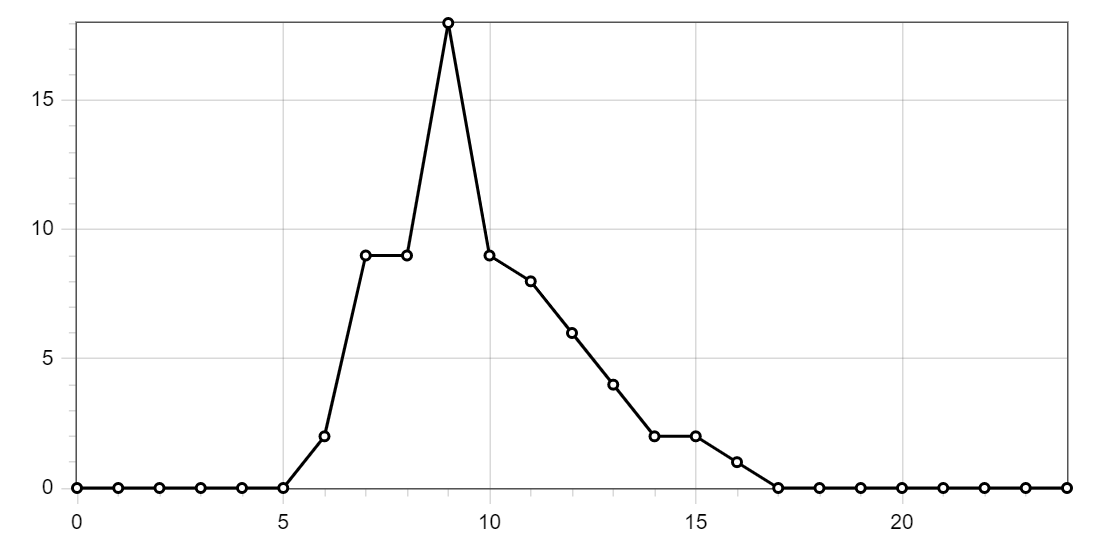
Of the hundreds of people who clicked on the TAVIS link, 70 submitted their answers (excluding obvious retakes from the same person). The mean TAVIS is 9.79 with a standard deviation of 2.25. The distribution looks approximately normal.
However previous research suggests Pumpkin Person readers are approximately 2 standard deviations smarter than the average American. Assuming my readers have the same variability as the general U.S. population (it’s actually higher but that leads to absurd conclusions) and assuming TAVIS scores are roughly linear, we get the following IQ equivalents:
TAVIS 0 = IQ 65 Educable (mild) Retardation
TAVIS 1 = IQ 72
TAVIS 2 = IQ 78 (Borderline retardation )
TAVIS 3 = IQ 85 (Dull)
TAVIS 4 = IQ 92
TAVIS 5 = IQ 99 (U.S. average)
TAVIS 6 = IQ 105
TAVIS 7 = IQ 112 (U.S. University graduate average)
TAVIS 8 = IQ 119
TAVIS 9 = IQ 125 (Borderline genius)
TAVIS 10 = IQ 132 (Mild genius)
TAVIS 11 = IQ 139
TAVIS 12 = IQ 145 (Moderate genius)
TAVIS 13 = IQ IQ 152
TAVIS 14 = IQ 159
TAVIS 15 = IQ 166 (Promethean)
TAVIS 16 = IQ 172 (Mega society)
Much more research is needed to confirm these IQ equivalencies but it’s a start. In future article(s), I’ll explore equipercentile equating TAVIS scores with scores on well normed tests like the SAT.






 Pumpkin Person