Sex differences in IQ by ethnicity

Previously I displayed a table showing sex differences in IQ in a general British sample where the mean and standard deviation (SD) of the sex-combined population was set at 100 and 15 respectively:

lynnsex

If we look at 16-year-olds in table 2, what we see is that with respect to the sex-combined distribution,  males have an IQ Z score of +0.05 with an SD of 1.04, and females have a Z score of -0.05 with an SD of 0.95.

In a previous article I noted that the sex-combined distributions for U.S. whites, blacks and Asians were 100 (SD = 15), 83 (SD = 15.4) and 103 (SD 16.6) respectively (white norms).

If we assume that within each ethnic group, men and women have the same Z scores with respect to the group’s sex-combined distribution, we get the following stats:

Asian American males: 104 (SD 17.3)

Asian American females: 102 (SD 15.8)

White American males: 101 (SD 15.6)

White American females: 99 (SD 14.3)

African American males: 84 (SD 16)

African American females: 82 (SD 14.6)

Ethnic differences in IQ

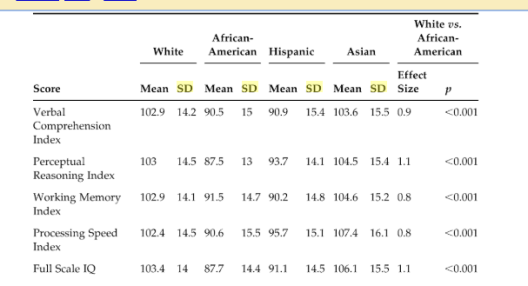
Here’s some data from the WAIS-IV IQ tests about U.S. ethnic differences in IQ

raceIQ

Contrary to popular stereotypes, Asian Americans are not lopsided intellects who only outscore whites in mathematical or spatial ability, but actually outscore them in every index, including verbal.  Of course Asian Americans are not a representative sample of all Asians.

And contrary to the stereotype that whites are the most cognitively variable ethnic group, their full-scale IQs in this data-set actually show the smallest standard deviation of any U.S. ethnic group, though this could be be because Asian Americans are not a single race.

The scores above use U.S. norms, meaning 100 and 15 are scaled to be the mean and standard deviation for all Americans.  If we instead use white norms, (i.e. set the white mean and SD at 100 and 15 respectively), we find that  African Americans have a full-scale IQ of 83 (SD = 15.4), Hispanics score 87 (SD = 15.5), and Asian Americans average 103 (SD = 16.6).


Gossip Girl (2007 to 2012)

Pumpkin Person rating: 7.5/10

So after the absurd rumor that this show was about me, I decided to watch it.

The only thing this show has in common with me is that it’s narrated by a popular sassy blogger but while I blog about evolutionary psychology and horror, Gossip Girl blogs about teenagers attending an exclusive prep school on Manhattan’s Upper East Side.

This is the perfect show for Lion of the Blogosphere to blog about because it’s all about New York’s super upper class and the importance they place in getting into an Ivy League school, but not just any Ivy League school, the “holy trinity”:  Harvard, Princeton, and Yale.  Lion could simply stream the whole series on Netflix.

The show’s female villain, the manipulative scheming spoiled Blair Waldorf  is obsessed with getting into Yale and scores a 2200 out of 2400 on her SATs which by my formula equates to a Richard Nixon IQ of 145 (U.S. norms); 143 (white norms).

The show’s male villain, Chuck Bass (the son of a corrupt billionaire) simply hires some bookish boy to pretend to be him and write the SAT  with a fake ID in Chuck’s name (even though being black, the bookish boy looks nothing like Chuck)

Chuck does the same for his stepsister, the show’s star Serena van der Woodsen,  played by the extremely charismatic Blake Lively.

blake

Serena is too low on psychopathy to use the SAT score Chuck bought for her so decides to take the big bad test herself at a later date.  We’re never told how she scores, but Yale does send her a hand written letter asking her to visit the campus, but this has more to do with her celebrity status as a a New York socialite than her academic record.

We never see Gossip Girl but her mischievous voice narrates every episode with  oneliners such as “Lordy, Lordy, look who’s 40” when one of the teenage boys is dating a much older woman.

The show seems to be aimed primarily at teenagers, especially teenage girls, but since teenage girls sometimes watch TV with their moms, there are some subplots about the romances of the parents of the show’s teenagers.

“And who am I?” teases Gossip Girl at the start of every show.  “That’s one secret I’ll never tell”  Maybe the secret was revealed in the show’s final season but please place a spoiler alert if you’ve watched that far.

Each show ends with Gossip Girl saying “you know you love me, XOXO”

The autism paradox

Here’s a must-skim paper by Bernard Crespi about a paradox I myself noticed a long time ago.  A lot of autistic people have all the signs of  high IQ (intellectual interests, high IQ genetic variants, incredible talents, high social class, big heads, hyperlexia, photographic memory, calculating ability) yet are below average in IQ.

In an attempt to resolve the paradox, Crespi argues something like autism is unbalanced high intelligence.   But unbalanced high IQ usually leads to a lot of subtest scatter around an overall high composite score, it doesn’t lead to the below average or even mentally retarded IQs often found in autism.

Of course as commenter Swank noted,  autistics are often good at what they practice.  So if you have the genetic potential to have an IQ of 170, but spend all your time thinking about toothpicks, you might end up with a took pick IQ of 250 and IQ of 60 in everything else, and since toothpicks aren’t on the IQ test, your overall IQ will appear to be impaired,  even though it would actually be in the genius range if a high ceiling toothpick subtest could be added.

So perhaps autism isn’t so much a cognitive disability as an interest disability.  Autistics are born not being interested in people or their culture, and thus don’t develop the parts of the brain that our valued by society.  This assumes of course the neuro-plasticity model where cognitive abilities can be exercised like muscles which is true up to a point (though IQ tests try to include abilities no one’s had a chance to exercise because they’re so novel).

But why should autism be more common in high IQ or at least upper class families as some (though not all) studies suggest?  Perhaps because iin our high tech society, it helps to have enough non-social interests and abilities to acquire a lucrative high-tech job,  where you meet others with equally non-social interests.  But when two non-socials mate, they risk having a baby that is pathologically non-social, to the point where it doesn’t even care to learn basic social skills and language, and thus is considered autistic.

And of course if you don’t learn the language, the autistic will fail even the IQ test items he’s brilliant at because he wont understand the instructions.

Sex differences in IQ part II

I found a nice paper by Richard Lynn and Satoshi Kanazawa discussing sex differences in IQ.  The point of the paper is that females mature earlier than males so females are smarter in childhood, but after puberty males are smarter.  This fits Lion of the Blogosphere’s theory that puberty stunts certain parts of intelligence.  As to why females mature earlier, the authors speculate that perhaps females had to compete for mates during evolution, but males not so much.

Here are the scores of the males and females in a large UK sample:

lynnsex

Here are the tests they took with the respective g loadings:

lynnsex2

Interesting that reading and math skills should each have such high g loadings.  Maybe the SAT’s more g loaded than I think.

I’m sure the sex differences (after puberty) were much smaller than Lynn would have liked since he virtually pioneered the men are smarter than women theory, overturning a near century consensus that the sexes were equally intelligent.

Lynn might argue that the lack of spatial tests at age 16 underestimates the male advantage.  I would counter that the lack of social cognition tests overestimates the male advantage.  Perhaps just testing reading and math is a good compromise, since these were probably selected because they’re the most valued cognitive skills in modern society and not because they favor or don’t favor one sex or another.

Sex differences in IQ

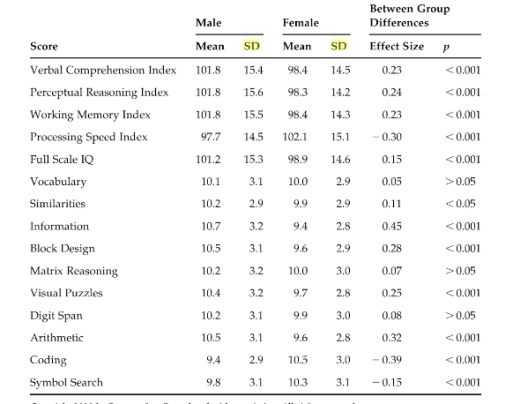
The following shows how men and women compare on the latest edition of the Wechsler Adult Intelligence scales (Note: the index scores and IQ are expressed on a scale where the sex combined mean and standard deviation (SD) of Americans are 100 and 15 respectively, while the subtests use a scale where the mean and SD are 10 and 3 respectively):

sexdiff2

If we take this at face value, the best measure of intelligence is full-scale IQ and here we see men are a little smarter than women (mean IQ 101.2 vs 98.9) and a little more variable (SD = 15.3 vs SD = 14.6).

Unfortunately we can’t take this at face value because at least in earlier versions of the WAIS, there were attempts to eliminate sex differences by removing (or at least counterbalancing) items or even subtests that favored one sex over the other.

So how then can we find the true sex difference?

One partial solution is to look at content-free subtests like digit span and block design. Unlike a general knowledge subtest where you can arbitrarily select items that favor men (knowledge of sports) or women (knowledge of fashion), you can not select a series of digits or an abstract visual diagram that favors (or fails to favor) one sex or the other.  Thus content-free subtests are not amenable to arbitrary attempts to eliminate or create sex differences.

With the exception of the three subtests that makeup the Verbal Comprehension index (Vocabulary, Similarities, Information) all the WAIS-IV subtests are content-free.   Thus by averaging the remaining three indexes that makeup the Full-Scale IQ (Perceptual Reasoning, Working Memory, Processing Speed), we might get a less biased measure of the sexes.

When we do this, men average 100.4 (SD = 15.2) and women average 99.6 (SD = 14.5).  A trivial difference.  Indeed rounded to the nearest whole numbers, both sexes are 100 with an SD of 15.

Ironically by looking only at subtests where they couldn’t remove sex differences, I found even fewer sex differences!

Does this mean sex differences in IQ are virtually non-existent?  Not necessarily, since the subtests themselves may have been selected to have small or counterbalancing sex differences, even when sex differences on specific items within said subtests can not be removed.

Neanderthal brains & autism

Fascinating article by Jon Cohen at sciencemag.org:

Alysson Muotri, a geneticist at the University of California, San Diego (UCSD) School of Medicine, described his group’s Neanderthal organoids for the first time this month at a UCSD conference called Imagination and Human Evolution. His team has coaxed stem cells endowed with Neanderthal DNA into pea-size masses that mimic the cortex, the outer layer of real brains. Compared with cortical minibrains made with typical human cells, the Neanderthal organoids have a different shape and differences in their neuronal networks, including some that may have influenced the species’s ability to socialize. “We’re trying to recreate Neanderthal minds,” Muotri says….

Muotri focused on one of approximately 200 protein-coding genes that differ between Neanderthals and modern humans. Known as NOVA1, it plays a role in early brain development in modern humans and also is linked to autism and schizophrenia. Because it controls splicing of RNA from other genes, it likely helped produce more than 100 novel brain proteins in Neanderthals. Conveniently, just one DNA base pair differs between the Neanderthal gene and the modern human one

Muotri and his co-workers start with skin cells from a “neurotypical person”—someone without any known genetic defects linked to neurological disorders—and manipulate their genomes to turn them into pluripotent stem cells. Using CRISPR, the team then targets NOVA1 and swaps in the Neanderthal base pair to replace the modern human one. To avoid being misled by the “off-target” DNA changes made by CRISPR as well as genetic errors that can occur from producing the stem cells, they sequence the resulting cells and discard any that have unintended mutations.

It takes several months to grow the Neanderthal DNA–containing stem cells into organoids—”We call them Neanderoids,” Muotri says. Comparing them with modern human brain organoids made under identical conditions, his team found that the neuronal cells with the Neanderthalized NOVA1 migrate more quickly within an organoid as they form structures. “We think it’s related to the shape of the organoid, but we have no idea what it means,” says Muotri, noting that the Neanderoids have a “popcorn” shape, whereas modern human cortical organoids are spherical. The Neanderoid neurons also make fewer synaptic connections, creating what resembles an abnormal neuronal network.

Several of these differences mirror what Muotri has found studying neuronal development in the brains of children with autism. “I don’t want families to conclude that I’m comparing autistic kids to Neanderthals, but it’s an important observation,” says Muotri, who has a stepson with autism. “In modern humans, these types of changes are linked to defects in brain development that are needed for socialization. If we believe that’s one of our advantages over Neanderthals, it’s relevant.”

Muotri has developed the modern human brain organoids to the stage where his team can detect oscillating electrical signals within the balls of tissue. They are now wiring the organoids to robots that resemble crabs, hoping the organoids will learn to control the robots’ movements. Ultimately, Muotri wants to pit them against robots run by brain Neanderoids.

So it seems like a single base-pair change in the NOVA1 gene means the difference between popcorn brain and sphere brain.

popcorn

Could this be the single mutation Richard Klein claimed caused behavioral modernity to fully blossom some 50,000 years ago?  Perhaps before 50,000 years ago, both modern humans and Neanderthals had popcorn brain but after 50,000 years ago, modern humans suddenly mutated sphere brain, which allowed them to conquer Neanderthals and create representational art?  Seems too simple to be true.

I guess the way to test this would be to see how long ago the mutation occurred and whether there was a selective sweep for the human variant around 50,000 years ago.

However since the NOVA1 gene seems related to both autism and schizophrenia, my guess is that it has something to do with executive functioning,  the most elusive of cognitive abilities, and the impairment shared by both autistics and schizophrenics.

Richard Klein noted that before 50,000 years ago, humans were incapable of organizing their camp sites,  They would eat, sleep, cook and defecate everywhere.  After 50,000 years ago they suddenly started organizing campsites into cooking areas, eating areas, sleeping areas etc.    Perhaps this was the dawn of executive functioning?

Btw, this is not the first time Neanderthal DNA has been linked to autism.   Steve Hsu quoted scientists making the following claim:

Of particular interest is the modern human-specific duplication on 16p11.2 which encompasses the BOLA2 gene. This locus is the breakpoint of the 16p11.2 micro-deletion, which results in developmental delay, intellectual disability, and autism5,6. We genotyped the BOLA2 gene in 675 diverse human individuals sequenced to low coverage as part of the 1000 Genome Project Phase I7 to assess the population distribution of copy numbers in homo-sapiens (Figure S8.3). While both the Altai Neandertal and Denisova individual exhibit the ancestral diploid copy number as seen in all the non-human great apes, only a single human individual exhibits this diploid copy number state.

Open thread: Happy Friday the 13th!

[Please place off-topic comments in open threads like this one, and not in the main articles]

One of the ironies of the Friday the 13th movies is Jason is supposed to be mentally retarded, and yet he has the most creative kills of any slasher in the genre.  Indeed comparing the way Jason kills people to the way any pre-1980s slasher kills people is like comparing humans before and after 50 kya (the date when some scientists think behavioral modernity blossomed).

Before 50 kya, humans generally could only make artifacts out of only stones.  After 50 kya they suddenly started making them out of bone, antler, ivory and shell.

Similarly before 1980, U.S. slashers could only kill with knives, saws, and their hands.  After 1980, they started killing with axes, pitch forks, machetes, cork-screws.  You name it!

Of course the one killing weapon no self-respecting slasher will use is as a gun.  Watching Halloween IV with a large group of people, there was one scene where it looked like Michael Myers was about to shoot someone with a rifle.  People watching the movie were booing, moaning and hissing.  “C’mon man” complained one black guy.

But when the crowd realized Michael had other plans for the gun besides shooting it, the crowd went wild with approval.

The question is why don’t we want our slashers using guns?  Here’s my just-so story:  Guns have only existed for a short period of time, by contrast primates have been slabbed, slashed and hacked for millions of years, so there’s been far more time to evolve an innate fear towards these methods of violence, and so they better fit the scary atmosphere horror fans seek.

At the 47 minute mark in the below video (hat-tip to commenter Bruno), Richard Dawkins and Stephen Pinker talk about how what we fear has more to do with what was threatening in our prehistoric past than what is threatening to us today, implying these fears are not rational, but hardwired instincts.  I think most of us fear even harmless snakes because our ancestors spent millions of years being eaten by snakes in the Africa Savannah:


Preserving your brain might kill you, but it could it help you live forever

The talk about brain preservation in the comment section reminded me of this excellent discussion on CBC radio about preserving your brain long after your body is dead and the progress scientists are making to solve this problem.

Apparently, the only way to salvage your brain for posterity is for it to preserved while you’re still alive, thus killing you.  Waiting until after you’re dead will cause the chemical interactions that are your thoughts and memories to atrophy.

These scientists reject commenter RR’s belief that our minds can not be reduced to our brains.