• About

Pumpkin Person

~ The psychology of horror

Pumpkin Person

Author Archives: pumpkinperson

Who was the first person?

18 Monday Jun 2018

Posted by pumpkinperson in Uncategorized

≈ 4 Comments

The Bible claimed Adam was the first person but what does science say?

Scientists sometimes speak of the mitochondrial Eve or the Y chromosome Adam, but these were not literally the first humans, but rather the only humans whose maternal or paternal lineage still live on in every man and woman today.

According to Richard Dawkins, there was no first person because evolution happens so gradually that no single individual was sufficiently different enough from their parents to be considered a member of a new species (i.e. Homo sapiens).

But if there was no first member of a species, how can scientists measure how long a species has existed (a standard measure of evolutionary success)?

The simplest definition of a species is a group of organisms that are reproductively compatible.  How reproductively compatible?  At least more compatible than modern humans and Neanderthals were since these are often considered different species:  The male offspring of such unions were infertile if they had a Neanderthal father.

So a species has clear boundaries when used on contemporaneous populations.  We can often draw geographic lines telling us where one species begins and ends in space, but how do we draw such lines in time?  When does a species begin and when does a species end?  If everyone is the same species as their parents (in the sense that they’re technically reproductively compatible if close enough in age), then drawing a line between parent species and daughter species seems arbitrary and unscientific.

I propose that the first member of a species is he or she who could not produce fertile offspring with any fertile member of the parent species.  So if modern humans evolved from Homo heidelbergensis, the first modern human is the first fertile person who could not produce fertile offspring of both sexes with at least some (likely the most archaic) fertile H. heidelbergensis.  Similarly, the first heidelbergensis is the first fertile one who can produce fertile offspring of both sexes with at least some fertile erectus etc.

Share this:

  • Share on X (Opens in new window) X
  • Share on Facebook (Opens in new window) Facebook
Like Loading...

Defining species and other taxonomic categories

18 Monday Jun 2018

Posted by pumpkinperson in Uncategorized

≈ 170 Comments

Biologists like to divide life forms into Kingdoms (plants vs animals) then subdivide those Kingdoms into Phylums and then subdivide those Phylums into Classes (reptiles vs mammals) etc.  The taxonomic hierarchy (ranked from broadest to most specific)traditionally looked something like this:

Kingdom > Phylum > Class > Order > Family > Genus > Species > Race

What I always found odd was that the only one of these ranks to be clearly defined was species and species is commonly defined as a group of organisms that can produce fertile offspring.  However I think that definition is probably too inclusive.  After all Neanderthals could interbreed with modern humans yet were not considered part of our species morphologically.

Thus I would use that definition for genus and use a more exclusive definition (a group that can produce fertile offspring regardless of the subgroup of father or sex of offspring).  This should exclude Neanderthals from our species yet still keep them in our genus since there’s evidence that male Neanderthal hybrids fathered by Neanderthals were infertile.

This got me thinking: why not use the concept reproductive compatibility to easily define all the taxonomic categories (at least for sexually reproducing life)?  Thus the taxonomic hierarchy could go from the most inclusive to most exclusive levels of reproductive compatibility.  For example:
Kingdom: A group that does or does not reproduce sexually
Phylum: A group that could use each other as sex dolls
Class: A group that could technically have sex, but would not enjoy it
Order: A group that could enjoy having sex, even though no offspring are possible
Family: A group that can produce any offspring at all, fertile or not
Genus: A group that can produce fertile offspring
Species: A group that can produce fertile offspring regardless of offspring’s sex and what subgroup the father is
Race: A group that can produce fertile offspring of both sexes without increased risk of infant prematurity or low birth weight

Share this:

  • Share on X (Opens in new window) X
  • Share on Facebook (Opens in new window) Facebook
Like Loading...

SAT correlation with WAIS

18 Monday Jun 2018

Posted by pumpkinperson in Uncategorized

≈ 15 Comments

I’ve discussed this before but given that I now have better data on the old SAT, I thought I’d revisit it.

Because the SAT has generally only been given to the college bound elite, nobody really knows how well it correlates with IQ in the general U.S. population.

But because it’s generally assumed that roughly 100% of Americans capable of scoring very high on the SAT actually take the SAT, I decided that the best way to estimate the SAT’s correlation with IQ among all American young adults is to find a subset of Americans selected for extremely high SAT scores and then see how they score on official IQ tests.

Because people selected for high SAT scores will regress to the U.S. mean on IQ in direct proportion with the correlation between the SAT and IQ in the full U.S. population (if all Americans young adults took the test), I use the degree to which they regress as an estimate for said correlation (assuming a bivariate normal distribution).

Perhaps the single best study was referred to me by a commenter named Andrew.  In this study, data was taken from the older more difficult SAT, and participants took the full-original WAIS.  In this study, six samples of  seniors from  the extremely prestigious Dartmouth (the 12th most selective university in America) averaged 1357 on the SAT just before 1974. Based on my latest research, an SAT score of 1357 if all American 17-year-olds circa 1974  had taken the SAT, the mean score would have been 770 (SD = 223) which means 1357 would have equated to an IQ of 139 (U.S. norms); 138 (U.S. white norms).

Assuming these students are typical of high SAT Americans, it is interesting to ask how much they regress to the mean on various subtests of the WAIS.

Averaging all six samples together, and then adjusting for the yearly Flynn effect from the 1950s through the 1970s (see page 240 of Are We Getting Smarter?) since the WAIS was normed circa 1953.5 but the students were tested circa 1971.5, then converting subtest scaled scores to IQ equivalents, in both U.S. norms and U.S. white norms (the 1953.5 norming of the WAIS included only whites), we get the following:

iq equivalent (u.s. norms) iq equivalent (u.s. white norms) estimated correlation with sat in the general u.s. population inferred from regression to the mean from SAT IQ 44 points above U.S. mean.
sat score 139 138 39/39 = 1.0
wais information 128.29 127.2 28.29/39 = 0.73
wais comprehension 122.22 120.9 22.22/39 = 0.57
wais arithmetic 120.37 119 20.37/39 = 0.52
wais similarities 119.16 117.75 19.16/39 = 0.49
wais digit span 117.37 115.9 17.37/39 = 0.45
wais vocabulary 125.93 124.75 25.93/39 = 0.66
wais picture completion 105.87 104 5.87/39 = 0.15
wais block design 121.82 120.5 21.82/39 = 0.56
wais picture arrangement 108.33 106.55 8.33/39 = 0.21
wais object assembly 113.65 112.05 13.65/39 = 0.35
wais verbal scale 126 125 26/39 = 0.67
wais performance scale 116 114 16/39 = 0.41
wais full-scale 123 122 23/39 = 0.59

Conclusion

The degree of regression from the SAT to the WAIS in an extreme sample suggests a 0.59 correlation between the two tests in the general U.S. population.

The SAT seems to be a reasonable proxy for verbal IQ (an implied correlation of 0.67) but only a moderate proxy for performance IQ (an implied correlation of 0.41). There are generations of visually brilliant people who did not get into a good college thanks to the SAT, but nonetheless may have earned high incomes as artists, tradesmen, fashion designers and film makers.

Not surprisingly, the SAT correlated best with the Information and Vocabulary subtests (implied correlations of 0.73 and 0.66 respectively) since these are direct measures of facts taught in school.

The real question is how well does the SAT correlate with g (the general factor of IQ tests)

Arthur Jensen argued that the correlation between two tests is a product of their factor loadings, so if the WAIS correlates 0.9 with g, and correlates 0.59 with the SAT, then the SAT should correlate 0.59/0.9 = 0.66 with g.

However since the SAT and WAIS share other factors besides just g (i.e. verbal), then 0.66 might overestimate the g loading.

On the other hand some would argue that deducing the regression slope from only high ability people might underestimate the correlation between the SAT and WAIS (ceiling bumping, Spearman’s Law of Diminishing Returns), and correcting WAIS scores for the Flynn effect might be overcorrections particularly at the high end.

Perhaps both factors cancel out, leaving 0.66 as a good estimate of the SAT’s g loading in the general U.S. population.

Is the SAT an IQ test?

If one defines an IQ test as any psychometric test with a high g loading in a general national or global population, and if one defines a high g loading as 0.7+, I’d say the SAT is a borderline IQ test.

 

Share this:

  • Share on X (Opens in new window) X
  • Share on Facebook (Opens in new window) Facebook
Like Loading...

Pumpkin beats Lion in the ratings

17 Sunday Jun 2018

Posted by pumpkinperson in Uncategorized

≈ 49 Comments

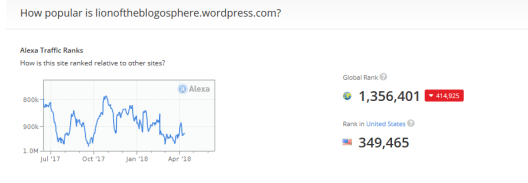
For years he towered as the Lion of the Blogosphere.  So much so that he named himself the Lion of the Blogosphere.  Despite his prole upbringing in Staten Island, 800 years of selective breeding for high Ashkenazi intelligence in Europe had given him a genius IQ of 145 and the Ivy League degree to go with it.  Thousands of readers flocked to his blog for keen insights and shrewd logic.

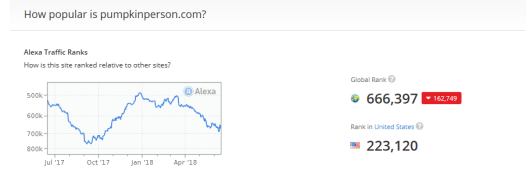
But not even 800 years of extreme natural selection could have prepared him for the genius gestating in his own comment section.  He was kind enough to promote my blog, but not even he could have imagined that not only would I match him in audience, but rank twice as high!

Today I rank as the 666,397th most popular web site on the planet.

pumpkin

While Lion ranks as the 1,356,401th most popular

lion

Not since Oprah overtook Donahue in the talk show ratings 32 years ago have we seen such a stunning upset.  In a desperate attempt to stay relevant in a ferociously competitive market, Lion has been reduced to sensational headlines like “I support child sex dolls”

Reminds me of when Donahue donned a dress and interviewed male strippers in a desperate attempt to compete with Oprah.

Nothing worked, because to quote Oprah “the difference between Donahue and me, is ME!”

The difference between Lion and me, is ME!


Share this:

  • Share on X (Opens in new window) X
  • Share on Facebook (Opens in new window) Facebook
Like Loading...

Affirmative inaction?

14 Thursday Jun 2018

Posted by pumpkinperson in Uncategorized

≈ 347 Comments

[please place all off-topic comments in the most recent open-thread.  They will not be published here]

Despite conservative claims that blacks benefit from affirmative action, a recent meta-analysis of 56,000 job applications found that whites are still getting 24%  more callbacks than Hispanics, and an incredible 36% more than blacks!

This despite the fact that the resumes were identical, except for race.

Northwestern professor Lincoln Quillian explained:

The vast majority of studies used names to do so – “Lakisha” and “Jamal” versus “Emily” or “Brandon” would be the kind of names that signal race and ethnicity. They found out that Emily and Brandon get significantly more callbacks for job interviews than Lakisha and Jamal do.
A few studies do put on an HBCU [historically black college or university] or some kind of mention of them in the Black Students Association or something like that as a kind of additional signal of race or ethnicity. Some studies used in-person applications by trained tester pairs of white and black applicants. In these studies, race or ethnicity was indicated by appearance.

My only quibble with the research is that names like Lakisha not only sound black, but also ghetto, so how do they know if this is race discrimination per se, or just class discrimination?

Perhaps the studies using in-person applicants are better.

But it’s hard to believe anti-black job discrimination could be so pervasive when other research shows that controlling for IQ, the black-white wage gap closes and blacks are more likely to land high IQ jobs.

bellcurve

Source: The Bell Curve by R. Herrnstein and C. Murray

bellcurve2

Source: The Bell Curve by R. Herrnstein and C. Murraya caption

On the other hand, if IQ tests are also unfairly discriminating against blacks to some degree,  then the paradox is resolved because blacks will typically be smarter than their test scores suggest, in which case controlling for IQ ≠ controlling for intelligence.

But one problem with this argument is Herrnstein and Murray argued that IQ tests are not biased against blacks because if they were, blacks would overperform their scores, which they apparently do not:

For job performance, the most thorough analysis is provided by the Hartigan Report, assessing the relationship between the General Aptitude Test Battery (GATB) and job performance measures. Out of seventy-two studies that were assembled for review, the white intercept was higher than the black intercept in sixty of them – that is, the GATB overpredicted black performance in sixty out of the seventy-two studies. Of the twenty studies in which the intercepts were statistically significantly different (at the .01 level), the white intercept was greater than the black intercept in all twenty cases.

Share this:

  • Share on X (Opens in new window) X
  • Share on Facebook (Opens in new window) Facebook
Like Loading...

Open thread week ending June 16, 2018

10 Sunday Jun 2018

Posted by pumpkinperson in Uncategorized

≈ 428 Comments

Please place all off-topic comments in this thread.  They will not be posted in the main article.

So we’re all very sad to hear about the tragic death of Anthony Bourdain

On a brighter note, this week Oprah officially became a historical figure with her own massive museum exhibit.

As the first multibillionaire descendent of black slaves, and someone who completely dominated U.S. culture for decades, the exhibit seems overdue.  Back in 1986, the idea of a black woman having the #1 talk show in America was groundbreaking, and it’s amazing to see how racism dropped dramatically during her reign from 1986-2011 (hat-tip to Afro for finding the chart):

racism

In other news, the trailer for the new Halloween movie is out.  Can’t wait to see this.  Love the fact that it actually looks like Fall in the Midwest (not like in the original which was filmed in Pasadena, California) and love the fact that Myers has been in a mental hospital in the 40 years since the original film ended.

I wonder if it would have been possible to administer him an IQ test (a non-verbal one since he doesn’t talk or read, but perhaps he could point to right answers or manipulate blocks-though his motor movements are slow as hell). The closet scene and the end of the trailer is freaky.

Finally, a fascinating discussion between Joe Rogan and Roseanne:


Share this:

  • Share on X (Opens in new window) X
  • Share on Facebook (Opens in new window) Facebook
Like Loading...

Monkey manhood

08 Friday Jun 2018

Posted by pumpkinperson in Uncategorized

≈ 107 Comments

It’s well known that chimps and bonobos have much larger overall genitalia size than humans, but most people think this is only because of their colossal testicular size (triple that of humans).


bonobo

Source


However it seems that chimps also have longer penises than non-African humans, and bonobos have much longer penises than all human races!

According to an article in Psychology Today, bonobos have an erect penis length of 6.8 inches, followed by chimps at 5.8 inches.


ape

Source unknown


By contrast, human racial data found by commenter Afrosapiens shows peoples of African ancestry averaging an erect penis size of 5.81 inches, followed by whites at 5.71 inches, and East Asians at 5.08 inches (though it’s worth noting that human penis size data is notoriously unreliable)

So even before adjusting for their much smaller heights, our closest ape relatives have far bigger male genitalia than most humans do, both in testicle size and in penis length. Though humans have thicker penises.

Sex is such a dominant part of human life that it’s fascinating to think that our closest ape relatives (with triple our testicle size) experience triple our sex drive.  Despite having an average IQ of only 14, they probably wouldn’t trade places with humans because it would mean giving up a sex life so intense and extreme, us humans can’t even imagine it.


Share this:

  • Share on X (Opens in new window) X
  • Share on Facebook (Opens in new window) Facebook
Like Loading...

Estimating IQ from genetic divergence

07 Thursday Jun 2018

Posted by pumpkinperson in Uncategorized

≈ 207 Comments

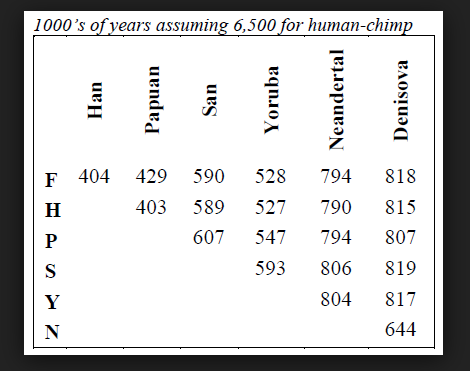
The following chart (created by some scientist(s) led by David Reich) shows the genetic divergence between hominin samples as a fraction of the human-chimp difference.  So for example, all the human groups have just over a 0.12 genetic divergence with Neanderthals, meaning that the genetic difference between humans and Neanderthals is only 12% as great as the genetic difference between humans and Chimps (source: supplement of Genetic history of an archaic hominin group from Denisova Cave in Siberia.)

distance4

The purpose of the chart is to estimate how long ago the different populations diverged from a common ancestor.  So since the fossil record tells us that Neanderthals and chimps diverged about 6.5 million years, then humans and Neanderthals should have diverged roughly 0.8 million years ago (12% of 6.5 million) assuming genetic divergence maps to chronological divergence in a linear way:

The above numbers make no sense to me (how could the Han and the French have separated 404 kya when the ancestors of both didn’t even leave Africa until 50 kya?).

Nonetheless, it seems to me that if you can estimate chronological divergence from genetic divergence, why not cognitive divergence?

Since I know that chimps and people of European ancestry differ by about 86 IQ points, then we can estimate how much each of these populations should differ in IQ from whites based on their genetic divergence as a percentage of the white-chimp divergence.

Using the French as the representatives for white people, we see from table S6.2 that the genetic gaps between whites and Han, Papuan, San, Yoruba, Neanderthals, and Denisovans  are 0.0622, 0.0660, 0.0907, 0.0812, 0.1218, and 0.1255 respectively.

Multiplying these fractions by the 86 point IQ gap between Chimps and European ancestry people, we get the following expected IQ gaps:

Han-white IQ gap: 5 points

Papuan-white IQ gap: 6 points

San-white IQ gap:  8 points

Yoruba-white IQ gap: 7 points

Neanderthal-white IQ gap: 10 points

Denisovan-white IQ gap: 11 points

These estimated IQ gaps are much smaller than the actual IQ gaps in most cases, suggesting that IQ tests are measuring a lot of non-genetic factors.

The second point is that the expected IQ gaps between white and non-white humans is not that much smaller than the expected IQ gap between whites and Neanderthals.  From a genetic perspective, Neanderthals could be just another human race, only slightly more divergent than the San, however from a morphological perspective, they’re clearly not human.

Since whites by definition have an average IQ of 100, and if we make the huge assumption that all non-white groups with the exception of Han have lower genetic IQs than whites, we get the following the figures:

Han average IQ 105
Whites average IQ 100
Papuans average IQ 94
Yoruba average IQ 93
San average IQ 92
Neanderthals average IQ 90
Denisovans average IQ 89

From these numbers we might conclude that it takes a genetic IQ of at least the mid 90s to independently invent agriculture (since everyone below that level failed to do so) and a genetic IQ of at least the high 90s to independently create civilization (since only Caucasoids and Mongoloids are credited with having done that).

Share this:

  • Share on X (Opens in new window) X
  • Share on Facebook (Opens in new window) Facebook
Like Loading...

IQ and taste in movies

30 Wednesday May 2018

Posted by pumpkinperson in Uncategorized

≈ 197 Comments

I’ve always wondered about the correlation between IQ and media preferences.  If you asked someone what their 10 favorite movies are and then scored them based on sophistication, the scores would probably be positively correlated with IQ, though I doubt the correlation would be more than +0.5 since some smart people like dumb entertainment (The Jerry Springer show was popular among Oxford students) and a lot of other factors like nostalgia play a role.

You can probably infer a lot of other things from the top 10 list beyond just IQ, such as personality and even psychiatric conditions like autism, depression and schizophrenia.

Here’s my own top ten list:

1.  Halloween (1978)

2. Friday the 13th (1980)

3. Carrie (1976)

4. The Sweet Hereafter (1997)

5. American Beauty (1999)

6. Silent Night Deadly Night (1984)

7. 2001: A Space Odyssey (1968)

8. Creepshow (1982)

9. Quest for Fire (1981)

10. The Breakfast Club (1985)

Share this:

  • Share on X (Opens in new window) X
  • Share on Facebook (Opens in new window) Facebook
Like Loading...

New paper claims to have solved the missing heritability problem

30 Wednesday May 2018

Posted by pumpkinperson in Uncategorized

≈ 179 Comments

[No off-topic comments please. Go to open thread]

This is going to send commenter RR into panic mode.

A new paper claims to have found molecular genetic evidence that IQ is every bit as heritable as twin studies show.

The paper’s quite complex and there are some people here who no matter how many times they read it, will never be able to understand it.  They simply don’t have the physiological genetic brain power to process such complex reading material.

And sadly one of those people is Mug of Pee.

Share this:

  • Share on X (Opens in new window) X
  • Share on Facebook (Opens in new window) Facebook
Like Loading...
← Older posts
Newer posts →

contact pumpkinperson at easiestquestion@hotmail.ca

Recent Comments

Anime's avatarAnime on The 2009 V reboot: One of the…
pumpkinperson's avatarpumpkinperson on The 2009 V reboot: One of the…
God's Word's avatarGod's Word on The 2009 V reboot: One of the…
Anime's avatarAnime on The 2009 V reboot: One of the…
pumpkinperson's avatarpumpkinperson on The 2009 V reboot: One of the…
Elmo Bunn's avatarElmo Bunn on The 2009 V reboot: One of the…
God's Word's avatarGod's Word on The 2009 V reboot: One of the…
pumpkinperson's avatarpumpkinperson on The 2009 V reboot: One of the…
God's Word's avatarGod's Word on The 2009 V reboot: One of the…
pumpkinperson's avatarpumpkinperson on The 2009 V reboot: One of the…
God's Word's avatarGod's Word on The 2009 V reboot: One of the…

Archives

  • January 2026
  • December 2025
  • November 2025
  • October 2025
  • September 2025
  • August 2025
  • July 2025
  • June 2025
  • May 2025
  • April 2025
  • March 2025
  • February 2025
  • January 2025
  • December 2024
  • November 2024
  • October 2024
  • September 2024
  • August 2024
  • July 2024
  • June 2024
  • May 2024
  • April 2024
  • March 2024
  • February 2024
  • January 2024
  • December 2023
  • November 2023
  • October 2023
  • September 2023
  • August 2023
  • July 2023
  • June 2023
  • May 2023
  • April 2023
  • March 2023
  • February 2023
  • January 2023
  • December 2022
  • November 2022
  • October 2022
  • September 2022
  • August 2022
  • July 2022
  • June 2022
  • May 2022
  • April 2022
  • March 2022
  • February 2022
  • January 2022
  • December 2021
  • November 2021
  • October 2021
  • September 2021
  • August 2021
  • July 2021
  • June 2021
  • May 2021
  • April 2021
  • March 2021
  • February 2021
  • January 2021
  • December 2020
  • November 2020
  • October 2020
  • September 2020
  • August 2020
  • July 2020
  • May 2020
  • April 2020
  • March 2020
  • February 2020
  • January 2020
  • December 2019
  • November 2019
  • October 2019
  • September 2019
  • August 2019
  • July 2019
  • June 2019
  • May 2019
  • April 2019
  • March 2019
  • February 2019
  • January 2019
  • December 2018
  • November 2018
  • October 2018
  • September 2018
  • August 2018
  • July 2018
  • June 2018
  • May 2018
  • April 2018
  • March 2018
  • February 2018
  • January 2018
  • December 2017
  • November 2017
  • October 2017
  • September 2017
  • August 2017
  • July 2017
  • June 2017
  • May 2017
  • April 2017
  • March 2017
  • February 2017
  • January 2017
  • December 2016
  • November 2016
  • October 2016
  • September 2016
  • August 2016
  • June 2016
  • February 2016
  • January 2016
  • November 2015
  • May 2015
  • January 2015
  • December 2014
  • November 2014
  • October 2014

Categories

  • ethnicity
  • heritability
  • income
  • Oprah
  • Uncategorized

Meta

  • Create account
  • Log in
  • Entries feed
  • Comments feed
  • WordPress.com

Recent Comments

Anime's avatarAnime on The 2009 V reboot: One of the…
pumpkinperson's avatarpumpkinperson on The 2009 V reboot: One of the…
God's Word's avatarGod's Word on The 2009 V reboot: One of the…
Anime's avatarAnime on The 2009 V reboot: One of the…
pumpkinperson's avatarpumpkinperson on The 2009 V reboot: One of the…
Elmo Bunn's avatarElmo Bunn on The 2009 V reboot: One of the…
God's Word's avatarGod's Word on The 2009 V reboot: One of the…
pumpkinperson's avatarpumpkinperson on The 2009 V reboot: One of the…
God's Word's avatarGod's Word on The 2009 V reboot: One of the…
pumpkinperson's avatarpumpkinperson on The 2009 V reboot: One of the…
God's Word's avatarGod's Word on The 2009 V reboot: One of the…

Archives

  • January 2026
  • December 2025
  • November 2025
  • October 2025
  • September 2025
  • August 2025
  • July 2025
  • June 2025
  • May 2025
  • April 2025
  • March 2025
  • February 2025
  • January 2025
  • December 2024
  • November 2024
  • October 2024
  • September 2024
  • August 2024
  • July 2024
  • June 2024
  • May 2024
  • April 2024
  • March 2024
  • February 2024
  • January 2024
  • December 2023
  • November 2023
  • October 2023
  • September 2023
  • August 2023
  • July 2023
  • June 2023
  • May 2023
  • April 2023
  • March 2023
  • February 2023
  • January 2023
  • December 2022
  • November 2022
  • October 2022
  • September 2022
  • August 2022
  • July 2022
  • June 2022
  • May 2022
  • April 2022
  • March 2022
  • February 2022
  • January 2022
  • December 2021
  • November 2021
  • October 2021
  • September 2021
  • August 2021
  • July 2021
  • June 2021
  • May 2021
  • April 2021
  • March 2021
  • February 2021
  • January 2021
  • December 2020
  • November 2020
  • October 2020
  • September 2020
  • August 2020
  • July 2020
  • May 2020
  • April 2020
  • March 2020
  • February 2020
  • January 2020
  • December 2019
  • November 2019
  • October 2019
  • September 2019
  • August 2019
  • July 2019
  • June 2019
  • May 2019
  • April 2019
  • March 2019
  • February 2019
  • January 2019
  • December 2018
  • November 2018
  • October 2018
  • September 2018
  • August 2018
  • July 2018
  • June 2018
  • May 2018
  • April 2018
  • March 2018
  • February 2018
  • January 2018
  • December 2017
  • November 2017
  • October 2017
  • September 2017
  • August 2017
  • July 2017
  • June 2017
  • May 2017
  • April 2017
  • March 2017
  • February 2017
  • January 2017
  • December 2016
  • November 2016
  • October 2016
  • September 2016
  • August 2016
  • June 2016
  • February 2016
  • January 2016
  • November 2015
  • May 2015
  • January 2015
  • December 2014
  • November 2014
  • October 2014

Categories

  • ethnicity
  • heritability
  • income
  • Oprah
  • Uncategorized

Meta

  • Create account
  • Log in
  • Entries feed
  • Comments feed
  • WordPress.com

Create a free website or blog at WordPress.com.

Privacy & Cookies: This site uses cookies. By continuing to use this website, you agree to their use.
To find out more, including how to control cookies, see here: Cookie Policy
  • Subscribe Subscribed
    • Pumpkin Person
    • Join 685 other subscribers
    • Already have a WordPress.com account? Log in now.
    • Pumpkin Person
    • Subscribe Subscribed
    • Sign up
    • Log in
    • Report this content
    • View site in Reader
    • Manage subscriptions
    • Collapse this bar
 

Loading Comments...
 

    %d