Open thread, Oct 26, 2016

For comments unrelated to my recent articles, The RISE and fall and RISE of brain SIZEThe genetic IQ and brain size of the 13 races, How smart was Homo Erectus?, and Estimating the IQ of Cro-Magnon Man from brain size and drawings, please post here.

Please feel free to post in this thread about any topic at all.

Estimating Cro-Magnon man’s IQ from brain size and drawings

Cro-Magnon man dominated Europe from about 45,000 years ago to 10,000 years ago.  Although they are sometimes considered the first Whites, the white gene pool is more complex given the spread of agriculture from the Middle east and actual white skin is thought not to have appeared until 7000 years ago, so Cro-Magnon’s probably looked liked this.

Brain Size suggests an IQ of 92 to 99

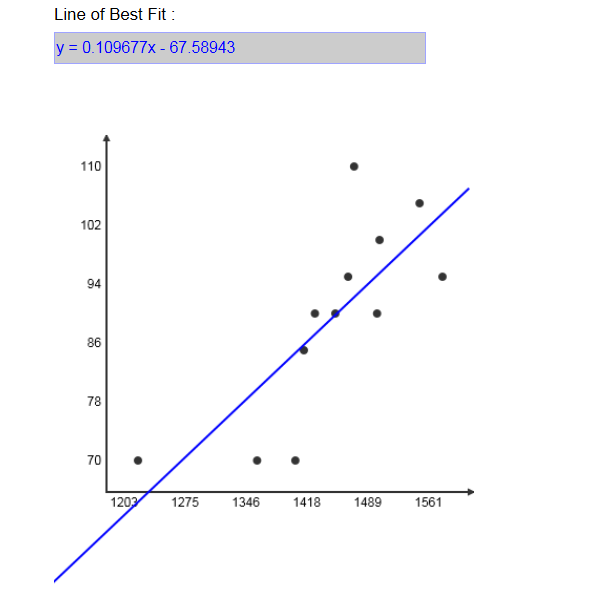
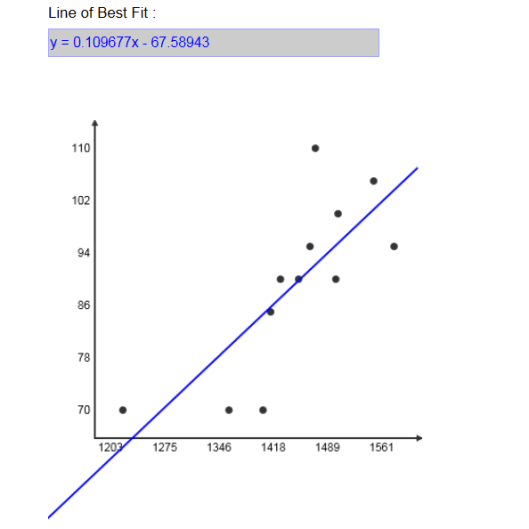
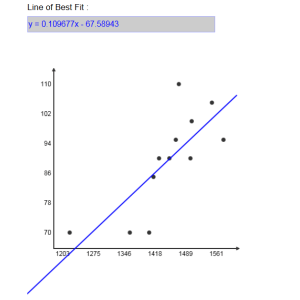
Commenter Milo wanted me to estimate their IQ from their brain size and using my line of best fit, which predicts mean genetic IQ (y) from mean genetic brain size (x) in 13 modern races, I can possibly do so.
popbrain

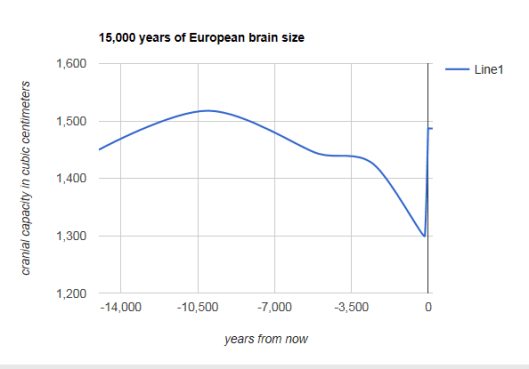
About 15,000 years ago their cranial capacity was 1450 cc, suggesting an IQ of 92, but by 10,000 years ago, the incredible cognitive demands of surviving ice age Europe had raised their brain sizes to 1518 cc, suggesting an IQ of 99.

Draw-A-Man IQ test suggests an IQ of 75

To validate these IQ estimates, I decided to look at their cave art, with an emphasis on drawings of people, so I could apply Dale Harris’s revision of the beloved Goodenough Draw-A-Man IQ test.  The first drawing of a man I found was discovered in South-western France and believed to be 17,000 years old.  It’s known as “The Wounded Man”.

woundedman

The Goodenough Harris Draw-A-Man test has a maximum raw score of 73, but because this drawing depicted the man with the head of a bird, not a human, 13 of the items dealing with features unique to the human head could not be scored, so it ended up with a score of 22/60 which I then prorated to 27/73.

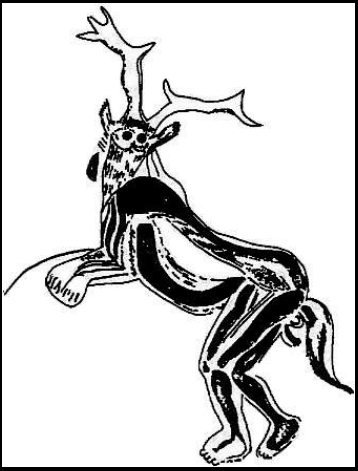
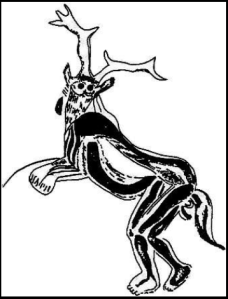
Another mysterious cave painting found in the cavern known as ‘The Sanctuary’ at Trois-Frères, Ariège, France, made around 15,000 years ago is known as “The Sorcerer”.
sorc

Unfortunately this too is a man-animal hybrid, and the animal features made some of the items inapplicable, in this case, the six items dealing with clothing (items #29,#55,#56,#57,#58 and #59), but out of the remaining 67 items, the picture scored 49, which I prorated into a score of 53/73.

Averaging the two drawings together, Cro-Magnon man scored 40/73 on the Goodenough-Harris Draw-A-Man test.  The smoothed mean and standard deviation for U.S. 15-year-olds (considered adult level for the purpose of this test) is 45.2 and 9.83  respectively, so this equates to an IQ of 92 (U.S. norms) or 90 (U.S. white norms).  But because these norms were published in 1963, and norms on this test became inflated at a rate of 3 IQ points per decade (Lynn, 2006) until at least 2006, we must reduce this IQ to 77 on modern white norms.

Correcting for culture bias, Draw-A-Man test suggests an IQ of 95

Because even the Draw-a-man test is culturally biased, we must do our best to adjust for the stone age environment Cro-Magnons lived in.  It’s well known that on typical IQ tests, dropping out of school causes IQ scores (though perhaps not real intelligence) to drop by 2 points per missed year, and research on adopted kids shows that each extra year of education in the rearing parent raises a child’s IQ score by 1.17 points.  Although such cultural biases fade by adulthood, as scholars Dickens and Flynn brilliantly noted, this is only true within generations.  Between generations these environmental effects are permanent.

So considering the average Cro-Magnon had about 13 years less schooling than today’s average white, this would artificially depress his IQ by 26 points.  Further, being raised by parents with 12 less years schooling than today’s average white would artificially depress his IQ by 14 points. So these two cultural biases together should artificially depress his IQ by 40 points on a typical IQ test, but because the Draw-A-Man test is only about half as culturally biased as a typical IQ test, we’ll say it’s depressed by only 20 points.

You might ask, why, if the Draw-A-Man test is only half as culturally biased as a typical IQ test, does it show the full 3 point a decade Flynn effect.  The answer is because the Flynn effect is not entirely cultural, it’s also biological (nutrition) and Performance IQ tests like Draw-a-man are sensitive to nutrition (which Cro-Mangnons had plenty of).

So adding 20 IQ points to their IQ of 77, to compensate for the test’s cultural bias, raises them to IQ 97.

I realize such corrections are very simplistic, but it seems to give believable results.

How smart was Homo Erectus?

homo_erectus_new


I’ve posted about the IQ of Homo Erectus before, but in this post, I will refine my analysis in light of better understanding.

Experiments suggest that it’s not until a child is seven that she has the mental capacity to create the kind of stone tools Homo erectus created. In other words, Homo erectus may have had the intelligence of a Western seven-year-old. On the WISC-R IQ test, an incipient adult (age 16.9) who performs like a seven-year-old on the spatial construction subtest scores lower than 99.5% of biologically normal members of his generation. In other words, an IQ of about 60.

But we should keep in mind that the research on seven-year-old tool making ability was published in 1979. Probably because of better nutrition/health,truly culture reduced spatial skill has been improved by about 0.2 points a year until 2006 (when U.S. nutrition gains seem to have ended). So Homo erectus probably had an IQ around 55 on the most recent culture reduced Western norms (U.S. white norms).

Brain size of Homo erectus

According to research cited by scholar Richard Lynn, Homo erectus emerged 1.7 million years ago with an average brain size of 885 cc and by 200,000 years ago, their brains had increased to 1,186 cc.

The below chart shows a line of best fit for the average genetic brain size and the average genetic IQ for 13 contemporary human races.

popbrain

If we extend the trend line to extinct Homo species like Erectus, and if we assume Erectus reached their genetic potential for brain size and IQ (early hunter/gatherers living their natural life style seemed to have far better nutrition than all but the most  recent First World agriculturalists and Erectus eventually learned to cook its food, digesting even more nutrients) then we can estimate from their brain size that they had an IQ of about 30, when they first appeared 1.7 million years ago, and about 62 when they were finally killed off by anatomically modern humans.  On the other hand, based on their lack of tool progress, they never progressed beyond a mean IQ of 55.


The RISE and fall and RISE of brain SIZE

In four million years of human evolution, brain size roughly tripled from 500 cm3 in Australopithecenes to 800 cm3 in Homo habilis to 1000 cm3 in Homo erectus to over 1300 cm3 in modern Homo sapiens and over 1500 cm3 in late ice age Europeans. However about 10,000 years ago, the human brain began to shrink quite precipitously only to rebound since the industrial revolution.   Here’s my best attempt to show the historical trend in sex-combined Europeans, though it may need some revising:

recoveredbrain

The simplest explanation for this is the development of agriculture, as scholar Richard Lynn explains:

The period of around 25-10,000 yr ago was the last ice-age and at this time the Caucasoid peoples of Europe and the Near East had brains of approximately the same size as today (Henneberg, Budnik, Pezacka & Puch, 1985). These peoples lived largely by hunting because plant foods were unavailable for much of the year and their meat diet evidently provided them with a high standard of nutrition and enabled them to develop their large heads and brains.

Following the recession of the ice age people evolved a new life style living in permanent village settlements with domestic animals and cereal agriculture. But although the new life style was more convenient the quality of nutrition fell and many skeletal remains show signs of rickets and other malformations caused by suboptimal nutrition (Festinger, 1983).

For the last 2000 yr data on heights of adult males in Britain have been collected by Kunitz (1987) and by Floud, Gregory and Wachter (1988). The broad trend is that height has been constant at a mean of approx. 172 cm up to the cohort born around 1930. From this date onwards height has increased. It seems reasonable to infer that brain size and intelligence were approximately stable for about 2000 yr up to around 1930 and it is only in the last half century that the increases have occurred. In the economically advanced nations the improvements in nutrition have enabled us to recover the brain size and intelligence levels of our ancestors of 25,000 yr ago.

Of course this analysis ignores long term secular changes which may have taken place in the genetic and cognitive stimulation determinants of intelligence, but is nevertheless offered as an approach to the intriguing question of long term historical trends in intelligence.

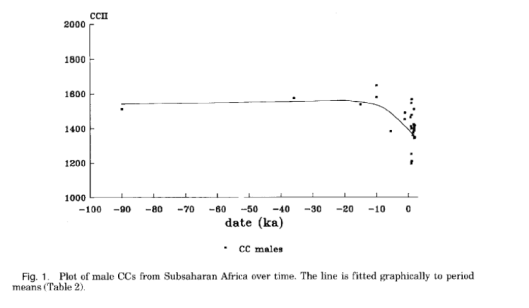
As usual, Lynn provides the most parsimonious explanation.  Of course not everyone agrees that agriculture was the cause of falling brain size, because brains shrunk even in sub-Saharan Africa and Australia where agriculture arrived late.  While it’s true Australian aboriginals had much bigger brains 10,000 years ago than they do today, there’s seemingly no evidence that their brains shrunk prior to European colonization and the resulting change in diet and life style.  Meanwhile the chart below shows little evidence that brain size in Africa shrunk prior to the arrival of agriculture there, several thousand years ago.

agriculture

Thus I think brains shrunk because of malnutrition and disease (agriculture) and not because of backwards evolution.  Of course with the end of the ice age, intelligence was not as crucial to survival (even in the tropics where it caused drought) so that may have relaxed selection for higher IQs, creating a dysgenic effect.  Also, a warming climate selects against brain size because a big head overheats like a 100 watt light bulb. However ice ages have ended before and brains did not shrink.  What was different the last time? Agriculture.


Open thread, Oct 11, 2016

For topics unrelated to my 4 latest articles, please post in this thread.  Please post about any topic at all.

However comments related to my 4 latest articles should be posted in their comment sections:

Trump wins second debate

More evidence that intelligence is the ability to adapt

The antiquity of the three main races

Prehistoric genocide


Trump wins second debate!

I have to give Trump credit.  Despite having virtually no political experience, he went face to face with one of the most experienced and intelligent politicians in America Sunday night, and beat her at her own game.

And he was quick on his feet.

Hillary said “It’s just a good thing that someone with the temperament of Donald Trump is not in charge of the law in our country,” to which Trump brilliantly replied:

“Because you’d be in jail.”

The crowd went wild.

That’ll go down in history as one of the greatest debate moments in U.S. history, along with “you’re no Jack Kennedy” and Reagan’s famous “there you go again.”

In an earlier post, I had somewhat facetiously estimated Trump’s IQ to be only 94 (white norms) because he failed to correctly multiply 17 by 6.  Perhaps his Arithmetic IQ is only 94, but having beat the 140 IQ Hillary in a debate (something not even Barack Obama accomplished), I assign him a verbal-improvisational IQ of 140.

Debating must be a fairly g loaded skill, so Trump’s debate performance, especially against a much more experienced opponent is empirical evidence of IQ.

Arithmetic and debating can be thought of two very different kinds of “verbal” subtests and Trump clocks in at IQ 117 when both are averaged .  On the WAIS-III IQ test, someone who averages the equivalent of IQ 117 on the various verbal subtest,  clocks in at IQ 121 on the composite verbal score (a good proxy for overall IQ).

Trump is probably smarter than your typical inheritance billionaire (IQ  114) because he built on his inheritance, but he’s probably not as smart as your typical self-made billionaire (IQ 132).  An IQ of 121 is entirely believable.

Nonetheless, winning a debate and winning an election are two very different things.  It’s unlikely Trump’s strong debate performance will heal his political wounds caused by a release of audio of him saying extremely lewd things.

More evidence that intelligence is the ability to adapt

I have long championed the view that intelligence is the mental ability to adapt: to take whatever situation you’re in, and turn it around to your advantage.  I fell in love with this definition because it unified the many parts of intelligence (verbal ability, spatial ability, Theory of Mind) into a single system, and because it placed intelligence at its rightful place at the pinnacle of evolution: for all animals have adaptations, but humans dominate, because our adaptation is the ability to adapt itself.

But the question becomes, why did humans become so uniquely intelligent?  The logical theory that I had always believed, and that Darwin himself believed, was that it was bipedalism. Once we started walking erect, we freed our hands up to make tools and this selected for intelligence, which allowed us to make more tools, which selected for even more intelligence.

Duh!

And yet the fossil record shows intelligence did not immediately follow bipedalism.  Indeed our ape ancestors may have been bipedal for nearly four million without showing much of any evidence for increased brain size or intelligence.

Then only in about the last few million years did brain size suddenly TRIPLE.  How do we explain this?

Scholar Rick Potts argues that during the last few million or so years there was rapid climate change in Africa.  Massive droughts followed by massive wet periods followed by massive droughts.  Lakes would come and go in the blink of a geological eye.  One day it dawned on Potts that it wasn’t the particular environment that was selecting for intelligence, it was the constant CHANGE in environment.

And who thrives in a constantly changing environment?  Those who can adapt.

Of course every organism adapts to its environment, that’s the point of evolution, however most organisms adapt by changing their genes over many generations.  We also adapted by changing our genes, but we took it a step further: We were selected for genes that allowed us to change our BEHAVIOR, which allowed rapid instantaneous change, far outpacing slow genetic change.

Intelligence is just whatever mental abilities are needed to change your behavior as successfully as possible.  Those who couldn’t learn quickly and think creatively during rapid change died out, leaving bigger brained primates as the survivors.

As an HBDer, I have long believed that adapting to newer colder climates caused whites and Northeast Asians to evolve especially high intelligence,  but I had no idea that climate change in Africa was so key to the evolution of human intelligence itself.

This theory is discussed starting at the 40 minute mark in the below video:


Prehistoric genocide

With Halloween only weeks away, I have to share one of the most terrifying images of my childhood.  When I was a little kid (I’m now in my 30s) I was already really interested in evolution, but in all the books on the subject I had leafed through, nothing scared me or captured my imagination as much as this image.

photo-1


I wish I could credit the artist, but it’s from a 1979 TIME-LIFE book called Early Man by F. Clark Howell and the editors of TIME-LIFE books.

It terrified me because it depicts the more evolved australopithecines killing off the primitive Australopithecus robustus but it captured my imagination because it shows Africa in all its glory.  There was such beauty in living in Africa millions of years ago, at the dawn of humanity while the setting sun subtly colors the rocks on the hills.  The open fields and endless landscape, on a lonely planet with only a few scattered Stone Age tribes on just a single continent.

In the picture, the more advanced tribe adapts the situation to their advantage by using lighter but sharper rocks, while the monkey tribe gets much less bang for their buck by draining their energy with heavy blunter weapons.

Intelligent behavior = low cost/benefit behavior.

The Friday the 13th movies show how IQ becomes more heritable with age

With Halloween only weeks away, the topics on this blog are getting darker.  I find it fascinating how art imitates life, even when the artists don’t understand the life they are imitating.  I doubt the writers of the original Friday the 13th movies (released in the 1980s) understood the concept of heritability, let alone the fact that heritability increases with age, and yet their main character, the iconic hockey mask wearing machete wielding killer, Jason, was a perfect example of exactly that.

In the late 20th century, it was discovered that genes explain about 45% of the IQ variation in childhood, 65% of the variation in adolescence, and about 80% in later maturity.  Family environment explains about 35% of the IQ variation in childhood, and near zero by later adulthood.  Meanwhile chance environment explains about 25% at all ages.

The character of Jason was born with extremely bad genes for IQ, a genetic condition called hydrocephalis, where there is too much cerebrospinal fluid in the brain, causing the head to swell and deform.  Yet despite his extremely bad genes, growing up he would have scored above 60 on IQ tests because his mother was constantly teaching him and getting him to participate in educational activities like summer camp.


tumblr_no4enpt1ye1sqftoto1_400

The late actress Betsy Palmer was brilliant as Jason’s all American mother; the ultimate summer camp mom

However the problem with trying to educated people beyond their genetic ability, is that as soon as they are placed in a novel situation, they can’t adapt, and their learning and training is useless.  For Jason, that novel situation was going swimming one evening at Camp Crystal Lake.

maxresdefault

Not intelligent enough to remember how to swim, he almost drowned and was washed to the other side of the lake.  When he came out of the water, in the unfamiliar wilderness, he could not adapt by finding his way back to the camp, let alone to his grieving mother.  So he simply lived in the woods like animal, for decades.

So he started with a great environment (being raised by an attentive all-American mother) which artificially propped his IQ up above 60, but because his genetic ability was so low, when faced with a truly novel problem (nearly drowning and washing up in an unfamiliar part of the woods), he turned the situation to his disadvantage, by getting stranded in the woods for decades and becoming a feral child, losing his capacity for speech.

0021

So what started as extremely bad genes being propped up by a good environment (attentive mother) became extremely bad genes in an extremely bad environment (living like an animal in the woods).  This is a classic example of the gene-environment correlation increasing with age: bad genes create bad environments, even when they start with good environments.

This shows that while a good cultural environment can raise IQ scores, it can’t do much to raise real intelligence.  Because if real intelligence was being raised, why do genetically dull people from good environments see their IQs drop with age?  It’s not that the effects of environment fade, it’s that environmentally enhanced IQs were never real to begin with, which is precisely why they can’t maintain their good environments.

By the time Jason was in his 30s (my age), not only had his low genetic IQ destroyed his cultural environment (living in the woods devoid of all culture) but he had finally destroyed his biological environment, as his violent behavior caused someone to sink a machete into his head, physically damaging his brain.


jason-4

Such damage from the physical environment, like the cultural deprivation of becoming a feral child, damaged his IQ score, but unlike cultural deprivation, the biological insults destroy real intelligence, and not mere test performance.

Jason was born with a genetic IQ of perhaps 40, but because of a loving mother (good environment) he had a phenotypic IQ of over 60 in childhood.  But because the phenotypic IQ was artificially propped up by an environment he could not adapt to his advantage, his environment precipitously declined, until his IQ was as low as his genetic IQ.