Estimating the genetic IQ & genetic brain size of many races

race iq real iq (rounded) genetic iq (rounded) brain size genetic brain size
ashkenazim 108 110  110 1457
east asians 105 105  105  1416  1534
whites 99 100  100 1369  1487
arctic people 91  95  95  1443  1561
southeast asians 87  90  95  1332  1450
native americans 86 90  90  1366  1484
pacific islanders 85 90  90 1317  1435
dark caucasoids 84 85  90  1293  1411
congoids 67  75  85  1280  1398
australoids 62 65  70  1225  1343
capoids 54 60  70 1270  1388
pygmies 54 60  70 1085  1203

The above chart has six columns.  In the first column I list 13 human races.  In the second column I list the IQs assigned to each of these 13 races by scholar Richard Lynn, on a scale where the British white mean is set at 100 (SD = 15).  In the third column I list the “real IQ” of each of these races.  That is, the IQ score each would get on a tuly culture reduced test, not the pseudo culture reduced tests they were often given like the Raven Progressive Matrices.  Real IQs were estimated by averaging the reported IQs in column 2, with the genetic IQ is column 4.

Genetic IQ

The genetic IQs in column 4 were estimated by noting that black Americans score about 85 on IQ tests as adults (even when reared by upper class whites) yet black Africans score 67, even though the two groups should have the same genetic IQ.  Yes black Americans have some white admixture which should have raised their genetic IQ above black Africans’, but they are also descended from perhaps the least intelligent class of black Africans (slaves) which should lower their genetic IQ below the average black Africans’, so on balance they should have the same genetic IQ.

And yet black African school kids score 18 points lower than African Americans, suggesting the poverty, illiterate parents,  malnutrition and disease of sub-Saharan Africa is  holding them back.  Averaging the 2001 human development index (HDI) of Cameroon and Cote D’Ivoire together (see table 7 of this paper), I estimated that sub-Sahara had a 2001 HDI of 0.448, compared to 0.937 for the United States and this roughly explained why they scored 18 points lower than U.S. blacks. From here I came up with the following formula:

Genetic IQ = Reported IQ + [(0.937 – population HDI)/0.02716]

For races that live in economically advanced countries such as Ashkenazim, East Asians, and Whites, IQs were assumed to equal genetic IQ, but for races like Southeast Asians and Pacific Islanders, I estimated the 2001 HDI of the Southeast Asia region to be 0.751 (based on the Philippines) and the above formula was applied.  Similarly, for Dark Caucasoids, I assumed the Middle East had an HDI of 0.709 (the average of Saudi Arabia and Egypt).

Although Arctic Peoples, Native Americans, and Austalian aboriginals technically live in developed countries, they are often segredated on reservations, and have HDIs below their fellow citizens.  Arctic Peoples were assigned an HDI of 0.851 based on the reported value for Canadian indigenous peoples (again see table 7 of this paper).  Native Americans were assigned an HDI of 0.864 based on averaging the HDI of Canadian and U.S. indigenous peoples.  Australian aboriginals reportedly had an HDI of 0.724.

Capoids and Pygmies were assumed to have the same HDI as mainstream black Africans (Congoids).  Although this is probably false, the Capoids and Pygmies used in actual IQ studies were those who lived side by side with their Congoid cousins under illiterate conditions.  Their actual IQ scores were probably a lot lower than the 54 Lynn reported for them, but because they scored about 13 points lower than illiterate Congoids, and Congoid school kids scored 67, it was assumed that Capoid and Pygmy school kids would score 67 – 13 = 54 if they too were in school.  Since the IQ was calculated under the scenario of similar environments, the genetic IQ was calculated assuming the same HDI.

Brain Size

Row 5 gives brain sizes reported by Lynn with the exception of pygmies which was reported by scolars C.L. Smith and K.L. Beals.  However since Lynn cited Smith and Beals as his brain size source, the figure should fit right in.

Row 6 gives estimated genetic brain size for each of the 13 races.  Because craniometry became taboo after WWII, I assume most of the brain size data was obtained before the 1930s, and perhaps well before the 20th century.  However Lynn notes that in the 1930s, people in the developed World began growing taller because of better health/nutrition and that height gains were perfectly paralleled by brain size gains.  Since height among U.S. whites has increased by 1.3 Standard Deviations over the 20th century before plateauing in 2006, I assumed that prior to the 1930s, Whites, and by extension every other race, were also 1.3 SD below their genetic brain size, and so genetic brain size was estimated by adding 118 cc to the Smith and Beals numbers.

To my knowledge Smith and Beals did not give data on Ashkenazim brain size, but very old studies suggest they were 30 cc below the white mean, so their genetic brain size is assumed to also be 30 cc below the genetic white mean.  These old studies give very different white brain sizes from Smith and Beals, showing how sensitive cranial capacity measures are to methodology.

I calculated the line of best fit to estimate the genetic IQ of a population from its genetic brain size, where X is genetic brain size (genetic cranial capacity) and Y is genetic IQ.  Pygmies were excluded because their small bodies make their brains abnormally small, even relative to IQ:

newfit

Is the upper paleolithic revolution just another example of cold winters causing high IQ?

The more I think about the upper paleolithic revolution, also known as the mind’s big bang, the great leap forward, or behavioral modernity, the more I think it fits perfectly with Richard Lynn’s theory that exposure to the ice age caused high IQ to evolve.

The upper paleolithic revolution (UPR) refers to a sudden explosion in culture that occurred in the archeological record around 50,000 years ago.  According to scholar Richard Klein, it was caused by a brain mutation that occurred in East Africa 50,000 years ago that allowed humans either the intelligence or language to leave  Africa and conquer the World.  The only problem with Klein’s theory is no such 50,000 year old mutation has yet been discovered, and most scientists seem to think humans left Africa 70,000 years ago, and most of the evidence for this great leap forward seems to come from Europe, not Africa.

For example here’s a fascinating list of the 10 oldest works of art ever discovered.  Notice how anything older than 50,000 years ago does not really qualify as art.  Only after 50,000 years ago do we get real art, and notice how all the oldest real art was found in Europe.

I think what probably happened is that anatomically modern humans evolved in Africa about 200,000 years ago, and probably had a mean IQ of 72 (genetically and phenotypically).  Then about 70,000 years they left Africa, and were exposed to the challenges of building watertight shelters with strong insulation and animal skin walls,  learning to make fire, creating warm clothes and mastering the complex art of sewing, and figuring how to hunt large animals since plants were not around.  The low IQ people, and low IQ tribes could not adapt to these challenges, leaving higher IQ people as the survivors.

So by about 39,000 years ago, the IQs of the proto-Caucasoids in Europe had finally reached the 80s, and they had discovered not only the art of drawing, but had the spatial ability to draw realistic forms despite having never been exposed to art, and by 38,000 years ago, were making impressive sculptures.

Alternative theory

Another theory, popularized by Greg Cochran and Henry Harpending in the book The 10,000 year explosion is that this cultural revolution was caused by gene flow from Neanderthals, which somehow dramatically improved the cognition of modern humans.

One problem with this theory is that Neanderthals went extinct partly because they LACKED these abilities, so it’s ironic to suggest they gave them to us.  Of course it’s always possible that the unique COMBINATION of human and Neanderthal brain genes produced an intellect far greater than either species on its own, but why entertain such a speculative idea when there’s a much simpler explanation that has repeatedly proved useful in the field of HBD: cold winters select for higher IQ.

I apologize to Homo erectus

A while back I had estimated that H. Erectus had an average IQ of 55 based on the fact that they had the tool making ability of a 1979 Western seven-year-old,  but more recently I had down graded them to an IQ of 40, based on my assumption that they had the symbolic IQ of 40.

My logic was that their tool making ability only represented their spatial IQ, but a symbolic IQ of 40 dragged down their COMPOSITE IQ to 40.

Brief comment on composite IQs

Statistically naïve readers might be wondering why a spatial IQ of 55 and a symbolic IQ of 40 equals a composite IQ of 40, and not a composite IQ of 48 (the average of 55 and 40).  The answer is that IQ is just a measure of where you rank compared to neurologically normal Northwest Europeans and ranks CAN NOT be averaged to give composite rank, unless the two sub-rankings correlate perfectly.  So if you rank super low in BOTH cognitive domains, then your rank order in the COMPOSITE of both domains will be LOWER than the average of the two, because impairment at BOTH domains is so rare that it pushes your composite way down in the pecking order.  The opposite is true for people who excel in BOTH domains; their composite IQs are HIGHER than the average of each subscale.

Why the apology?

So why am I apologizing to H. erectus?  Because I was wrong to assume their symbolic IQ was only 40.  That assumption was based on the fact that they couldn’t draw AT ALL, thus suggesting they had extremely impaired understanding of symbols or representations.  People who can’t draw ANYTHING obtain an IQ of only 19 on the Draw-a-man test (corrected for old norms), however correcting for culture bias (H. erectus lived in the wild), I raised it to about IQ 40.

How did I know they couldn’t draw?  Because as far as we know, they never drew a single thing in the nearly 1.9 million years they walked the Earth.  However a friend suggested that perhaps they could draw, they just never had the IDEA of drawing.  Inventing the idea of drawing is much more difficult than drawing,  so if they never had the idea in the first place, I can’t assume they were too dumb to execute the idea.

Thus there’s no evidence that H. erectus had a symbolic IQ as low as 40, and the only hard evidence of their IQ remains their tool making ability which equates to an IQ of 55.  Since this is the only data point, I have no choice but to tentatively accept it as their IQ.  And frankly it makes a lot more sense than IQ 40, which is getting into chimpanzee territory.

How much IQ is needed to have the IDEA of drawing?

So while it takes an IQ of only 40 TO draw, how much IQ is needed to come up with IDEA of drawing, if it never existed in your world before?  If you believe in the controversial field of HBD, then perhaps the lowest IQ people in the World are the Bushmen with a genetic IQ of perhaps 72.  Yet even they appear to have come up with the idea of drawing as evidenced by their ancient rock art, so unless a more advanced people taught them this skill, then a population with a mean IQ of 72 is capable of inventing drawing.

What about Neanderthals?

So what about Neanderthals who also never drew?  Earlier I wrongly suggested this implied they too had a symbolic IQ of only 40 (commenter Melo to his credit strongly disagreed) and yet I also speculated that they must have had a much higher spatial IQ to have survived in Northern Europe.  Overall I pegged their mean IQ to be 62.

I still roughly agree with this estimate, but my logic was wrong.  Better logic is as follows:  They were more technologically advanced, more evolved, and bigger brained than H. erectus, so they probably an overall IQ above 55 (H. erectus level); yet they apparently never had the IDEA of drawing, so they were probably lower than Bushmen (perhaps genetic IQ 72 if you take HBD seriously).  Thus, splitting the difference gives an IQ of 64.

Quest for Fire: The ultimate HBD movie

[update dec 26, 2016: an earlier version of this article estimated the monkey men and cavemen to have an average IQ of 40 & 62 respectively.  I have since changed these to 55 and 64 respectively]

In the past I’ve blogged about how my fascination with HBD started after I saw the movie Quest for Fire at age five (I’m now in my thirties) because it was the first time I had a sense of different levels of human evolution, some more advanced than others, co-existing and competing in a struggle for survival.  The film uses not a word of English, so I strongly recommend it to all my readers, especially my foreign readers.  A fictional language was created for the characters and as you watch the film, you slowly pick up words, and the number of words you can learn might serve as a measure of fluid verbal IQ (as opposed to the crystalized verbal IQ measured by standard vocabulary tests).

For a film over three decades old, it remains remarkably anthropologically accurate today, as it’s now widely accepted that 80,000 years ago, several species of human did indeed co-exist.

The film shows three major levels of human evolution struggling for survival: The primitive monkey men, the cavemen, and the advanced modern humans.  .

The monkey men IQ 55

If you believe IQ is a scientifically valid concept, then the monkey men probably have an average IQ of 55, both phenotypically and genetically.  Because they were living in the wild and the natural habitat their ancestors spent thousands of years adapting to, I believe most hominins living 80.000 years ago had more or less reached their genetic potential.  The monkey men were smart enough to understand the value of fire and attack their neighboring cavemen with clubs in an attempt to steal it, but not smart enough to speak, create spears or wear clothing.

The cavemen IQ 64

The cavemen in this film probably had an average IQ of 64.  High enough to wear very crude fur coats,  fight with spears, and to speak in a language of a few hundred words.  They live in terror of being attacked by the monkey men who they call “wogaboo”.  They are smart enough use fire to cook and scare away wolves, and they are smart enough to keep the fire alive for a long period of time, but they are not smart enough to make it.

The modern humans IQ 85

The modern humans probably have an average IQ 85.  They appear to be fully modern black African type people who speak in a complex language, use throwing spears, build sturdy huts, make beautiful ceramic containers, color themselves grey, wear masks, make fire, and are even smart enough to build their village behind a pond of quicksand that traps intruders from other tribes.  Unlike other tribes, they are evolved enough to have a sense of humor and are constantly laughing at the inferior cavemen.

I doubt any population living 80,000 years ago had the genetic potential to have an average IQ above 70, so the high intelligence of this tribe was perhaps the only unrealistic thing about this movie.  Or perhaps I’m overestimating their IQs.

The film’s impact on my life

After seeing this film as a child, I remembered wishing I had lived 80,000 years ago.  Life was so exciting when he had three different levels of human evolution coexisting in a Darwinian struggle for survival.  So imagine my excitement when scholar J.P. Rushton proposed his shocking theory that Orientals were more genetically advanced than whites who were more advanced than blacks.  While the rest of the World was disgusted that Rushton could promote such horrific “pseudoscience”, I was secretly fascinated, because It was almost as if I had willed my favorite movie into life, except instead of black Africans being the most evolved  humans, as they were 80,000 years ago, Rushton was arguing that they were now at the bottom of the new tri-level hierarchy.

A beautiful love story

Aside from the anthropological value of this film, it’s one of the most romantic movies I have ever seen.  At the heart of the film is a deeply moving love story about a caveman who falls in love with a modern human woman.

Even though they speak completely different languages and arguably belong to different species, they forge an intimate bond, as she slowly teaches him how to be human.   Through her tutoring he learns what humour is and laughs for the first time in his life, and while he and his tribe know only how to have doggie style sex, she teaches him how to make love.  This films takes you back 80,000 years in time, and allows you to see the World, through the innocent eyes of the first humans, and all the awe and mystery of the endlessly uncharted landscape.


Massive brain mutation 70,000 years ago

According to eminent scholar Richard Klein, there was a massive genetic mutation that occurred in Africa that SUDDENLY made humans MUCH smarter than they had ever been before.  This mutation did not make the brain any bigger, but it did rewire it, allowing for truly symbolic thought.

According to this article:

To witness the contrast between premodern and modern ways of life, Klein says, sift through the remains from caves along the southern coast of South Africa. Simple Stone Age hunter-gatherers began camping here around 120,000 years ago and stayed on until around 60,000 years ago, when a punishing drought made the region uninhabitable. They developed a useful tool kit featuring carefully chipped knives, choppers, axes and other stone implements. Animal bones from the caves show that they hunted large mammals like eland, a horse-sized antelope. They built fires and buried their dead. These people, along with the Neanderthals then haunting the caves of Europe, were the most technologically adept beings of their time.

However, Klein says, there were just as many things they couldn’t manage, despite their modern-looking bodies and big brains. They didn’t build durable shelters. They almost never hunted dangerous but meaty prey like buffalo, preferring the more docile eland. Fishing was beyond their ken. They rarely crafted tools of bone, and they lacked cultural diversity. Perhaps most important, they left no indisputable signs of art or other symbolic thought.

Later inhabitants of the same caves, who moved in around 20,000 years ago, displayed all these talents and more.

What happened in between?

The burst of modern behavior—like other momentous happenings in our evolution—arose not in South Africa, Klein says, but in East Africa, which was wetter during the drought. Around 45,000 years ago, he believes, a group of simple people in East Africa began to behave in new ways and rapidly expanded in population and range. With better weapons, they broadened their diet to include more challenging and nutritious prey. With their new sense of aesthetic, they made the first clearly identifiable art. And they freed themselves to wander beyond the local watering hole—setting the stage for long-distance trade—with contrivances like canteens and the delicately crafted eggshell beads, which may have functioned as “hostess gifts” to cement goodwill with other clans.

Dramatic evidence of a surge in ingenuity and adaptability comes from a wave of human migration around 40,000 to 35,000 years ago. Fully modern Africans made their way into Europe, Klein says, where they encountered the Neanderthals, cave dwellers who had lived in and around Europe for more than 200,000 years. The lanky Africans, usually called Cro-Magnons once they reached Europe, were more vulnerable to cold than the husky Neanderthals. Yet they came, saw and conquered in short order, and the Neanderthals vanished forever.

Compare that with an earlier migration around 100,000 years ago, in which the Neanderthals eventually prevailed. Physically—but not yet behaviorally—modern Africans took advantage of a long warm spell to expand northward into Neanderthal territory in the Middle East, only to scuttle south again when temperatures later plunged. The critical difference between the two migrations? The earlier settlers apparently lacked the modern ability to respond to change with new survival strategies, such as fitted garments, projectile weapons and well-heated huts.

I’ve done some research and I now believe Homo Erectus had a spatial IQ of 53 and a symbolic IQ of 40, giving it a composite IQ of 41.  Then about 200,000 years ago in East Africa, it mutated into anatomically modern humans and these had a spatial IQ of 75, but a symbolic IQ of still only 40, giving them a composite IQ of 53.

So when they tried to leave Africa, they were brutally killed off by Neanderthals, who in addition to being 2.5 times stronger, had a spatial IQ of 91 and a symbolic IQ of 40, giving them a composite IQ of 62

However sometime after 70,000 years ago, anatomically modern humans mutated again in East Africa into behaviorally modern humans: their spatial IQs stayed 75 but their symbolic IQs suddenly jumped to 75 too, bringing them their composite IQ to 70.

This allowed them to leave Africa without being bullied by the Neanderthals.  The Neanderthals were still 2.5 times stronger, but modern humans were taller, faster, and now 8 points smarter.

Then after evolving to the cold climate of ice age Europe, symbolic IQ improved to 88 and spatial IQ also improved to 88, raising their composite IQs to 87, allowing them to brutally murder all the Neanderthals in record time, despite the huge difference in strength.  The super strong Neanderthals were humiliated to be destroyed by a bunch of scrawny nerdy modern humans

After the Neanderthals were killed off,  the ice age ended, and the malnutrition and disease caused brain size to shrink and composite IQ of modern Europeans to drop to 77.  However with the booming population, new high IQ genes were lifting the composite IQ up to 90.

Then in the 20th century, advances in nutrition, sanitation and vaccines, allowed them to return to pre-agriculture health, and their brains returned to their original size, and with the mutations that occurred during agriculture (see the 10,000 year explosion by Cochran and Harpending), their composite IQ was now 100.


Facts of Life IQ episode returns to youtube

Apparently when I complained about the Facts of Life IQ episode going missing from Youtube on my blog yesterday, people in high places noticed because the show has been returned:

I got the most beautiful email this morning apologizing, saying they had no idea someone as important as me was watching, and they’re so honored to have me as a fan.  I’ve printed out the email and framed it.

I’m even being sent the complete series on DVD, a poster signed by all the stars of the show, and vintage Facts of Life T-shirts.  They don’t know what size I take, so get this.  They’re sending me one in:

EVERY

SINGLE

SIZE!

Not to brag, but I am Pumpkin Person.

Meanwhile here’s vintage opening theme song from the The Facts of Life.  What I love about the opening is Charlotte Rae (who played wise den mother Mrs Garrett) sings a line in the theme song itself in her loveable cackling voice, and that line is heard as her character is on screen smiling (excellent editing!)

When your books are what you’re there about

But looks are what you care about

The time is right

To learn the Facts of Life

See 0:47 in the video below:

I was so touched by the level of respect I’ve been shown that I spent the afternoon watching The Facts of Life reunion TV movie from 2001.  It was pretty cheesy in that warm fuzzy way we expect from TV chick flicks, but it was great seeing  the girls we grew up watching blossom into beautiful adult women.

Blair played by Lisa Whelchel is predictably married to some Ken doll rich guy.

Natalie, played by Mindy Cohn has grown up to be a successful journalist obsessively pursued by two good looking guys (You Go Girl!)

Tootie (aka Dorthy) played by Kim Fields has blossomed into a truly gorgeous black woman, and is working as a talk show host and aspiring actress.

tootie


Pumpkin Person’s hot chocolate recipe

Since much of North America is in the grip of a freezing weekend, I thought it’d be a good time to share my hot chocolate recipe.  I kind of copied this from a cooking show on OWN Canada (don’t know the name), but simplified it and changed it.

I love to spend winter weekends holded up at my remote lake cottage in the woods, where I put on the fire and snuggle on the couch beneath a sea of blankets, and watch a classy horror film like The Dark Hours, or an Atom Egoyan style dark drama,  or a series of a dark themed series like Six Feet Under, on a huge screen high definition TV.

And of course I need my hot chocolate on the coffee table in front of me, but not just any hot chocolate will do.  If you truly want to live like me and be part of the upper crust of the upper class, you must make your own.

You start with two chocolate bars (100 g each):  One MINTED milk chocolate, the other MINTED DARK chocolate.

photo-2

photo-8

You then break it into pieces and put the pieces in your hot chocolate maker.  If you can’t afford one of these, just use a pot on a stove.

photo-9

Then add a cup of milk and a cup of cream (or 2 cups of half and half if you’re clever).

photo-7

Then heat and mix

photo-5

Until it looks like this.

photo-4

Delicious.

photo-3

A wonderful desert on a cold winter night, like tonight.

Educable (mild) Retardation on The Facts of Life

Recently I posted an episode of the sitcom The Facts of Life that dealt with IQ, but sadly the video no longer works.

The POWER of this blog is such that almost every time I post a youtube, media owners seem to suddenly realize the enormous value of their old content and remove it from youtube.

Fortunately I found the only other episode of The Facts of Life that seemed to deal with intelligence (watch it quickly before they take it off youtube ).

In this episode, all the girls at the fictional Eastland New York private school are in love with a new boy who delivers the boarding house food, but what they don’t know is he has a tragic secret.

He’s retarded.

When this leads to an awkward confrontation, the school den mother Mrs Garrett makes it all better as usual with some words of wisdom.

One of the reasons the girls on campus don’t notice the boy is retarded is that he looks normal because he has familial retardation, meaning his retardation is just part of the normal spectrum of human intelligence, unlike organic retardation which is caused by a mutation of large effect, which impairs physical appearance and brain functions beyond intelligence.

Commenter “Mug of Pee” will happily concede that organic retardation is independently genetic because it has physical symptoms, but he downplays the independent effect of genes in biologically normal IQ differences.  It would be especially interesting to find cases where familial retardates have identical twins raised from birth in very different countries, because it’s hard to imagine such an immutable disability was not hard wired into the brain.

Another amusing thing about this episode of The Facts of Life is that we’re now in season 4, so the hilarious character “Jo” is by now a regular; the writers felt the show was missing a girl from a working class background.

“Jo” played by Nancy McKeon is like a young female John Travolta in both her appearance, attitude, and tough guy Brooklyn accent.

The Facts of Life: IQ episode

The Facts of Life was a popular U.S. sitcom that originally aired on NBC from August 24, 1979, to May 7, 1988, and then the reruns continued in syndication probably well into the late 1990s so for those of us in our thirties, it was an afterschool ritual, though younger readers may have never heard of it.  I was reminded of the show because Alan Thicke just died (RIP) and he wrote the shows memorable theme song.  The show launched the career of 80s teen star Molly Ringwald and even George Clooney.

The show was about a bunch of girls attending a New York boarding school under the protective care of loveable den mother Mrs Garrett (Charlotte Rae).  The show is a throwback to a more innocent period in American life, and a simpler time, when no problem was too big to be solved by a cup of hot chocolate and a few wise words from Mrs Garrett.

It’s been decades since I’ve seen an episode, but there was one episode I could never forget.  The one where the girls at the school discover their childhood IQ scores and all the harm it does to their relationships and self-esteem.  And as usual the wise den mother Mrs Garret to the rescue.

If you have half an hour to kill, I recommend you enjoy this funny, innocent, wholesome bit of 70s television.  You’ll be glad you did:


How well does the SAT correlate with official IQ tests?

I apologize to my readers for recycling so much old material, but certain crucial issues must be resolved before we can move forward knowledgeably.

In this post, I summarize all I have learned to date about how much high SAT performers regress to the mean when faced with official IQ tests and what this implies about the SAT’s correlation with said tests.  Some of the data may contradict previous posts, as new information has come to light, causing me to revise old numbers.

Study I: New SAT vs the Raven

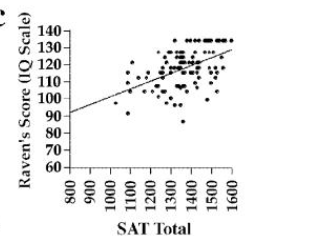
A study by Meredith C. Frey and Douglas K. Detterman found a 0.48 correlation between the re-centered SAT and the Raven Progressive Matrices in a sample of 104 university undergrads, but after correcting for range restriction, they estimate the correlation to be 0.72 in a less restricted sample of college students.  I don’t buy it, but I’m not interested in how well the re-centred SAT would correlate with the Raven among college students, but among ALL American young adults. (including the majority who never took the SAT).

Using the Frey and Detterman data, I decided to look at the Raven scores of those who scored 1400-1600 on the re-centred SAT, because 1500 on the new SAT (reading + math) corresponds to an IQ of 143 (U.S. white norms), which is 46 points above the U.S. mean of 97. Now if the new SAT correlated 0.72 or higher among ALL American adults, we’d expect their Raven scores to only regress to no less than 72% as far above the U.S. mean, so 0.72(46) + 97 = IQ 130.

I personally looked at the scatter plot carefully and did my best to write down the RAPM IQs of every single participant with an SAT score from 1400-1600. This was an admittedly subjective and imprecise exercise given how small the graph is, but I counted 38 top SAT performers and these were their approximate RAPM IQs: 95, 102, 105, 108, 108, 110, 110, 113, 113, 113, 113, 113, 117, 117, 117, 117, 117, 120, 120, 120, 122, 122, 128, 128, 128, 128, 134, 134, 134, 134, 134, 134, 134, 134, 134, 134, 134, 134

raven

The median IQ is 120, and it does not need to be converted to white norms because the Raven was normed in lily white Iowa circa 1993, but as commenter Tenn noted, I should have perhaps corrected for the Flynn effect since the norms were ten years old at the time of the study.  Correcting for the Flynn effect reduces the median to 118 (U.S. white norms) which is 21 points above the U.S. mean of 97.

For people who are 46 IQ points above the U.S. mean on the new SAT to regress to only 21 points above the U.S. mean, suggests the new SAT correlates 21/46 = 0.46 with the Raven in the general U.S. population.

Study II: New SAT vs the abbreviated WAIS-R

Harvard is the most prestigious university in the World with an average SAT score in the stratosphere, thus it’s interesting to ask how Harvard students perform on an official IQ test. The best data on the subject was obtained by Harvard scholar Shelley H Carson and her colleagues who had an abbreviated version of the WAIS-R given to 86 “Harvard undergraduates (33 men, 53 women), with a mean age of 20.7 years (SD 3.3)… All were recruited from sign-up sheets posted on campus. Participants were paid an hourly rate…The mean IQ of the sample was 128.1 points (SD 10.3), with a range of 97 to 148 points.”

It should be noted however that the WAIS-R was published in 1981, and that the norms were collected from 1976 to 1980. Carson’s study was published in 2003, so presumably the test norms were 25 years old.

James Flynn cites data showing that from WAIS-R norms (circa 1978) to WAIS-IV norms (circa 2006) the vocabulary and spatial construction subtest (used in the abbreviated WAIS-R) increased by 0.53 SD and 0.33 SD respectively. These gains would result in the composite score of the abbreviated WAIS-R becoming obsolete at a rate of 0.26 IQ points per year, meaning the Harvard students’ scores circa 2003 were 6.5 points too high. This reduces the mean IQ of the sample to 121.6 (U.S. norms) which is about 120 (U.S. white norms); 23 points above the U.S. mean of 97 (white norms).

However Harvard’s median re-centered SATs of 1490 equate to IQ 143 (U.S. white norms) which is 46 points above the U.S. mean of 97.  Assuming the sampled Harvard students were cognitively representative of Harvard and assuming Harvard is cognitively representative of all 1490 SAT Americans, the fact they regressed from being 46 IQ points above average on the SAT to 23 IQ points above average on the abbreviated WAIS-R, suggests the re-centered SAT correlates 23/46 = 0.5 with the abbreviated WAIS-R.

Study III:  Old SAT vs the full original WAIS

Perhaps the single best study was referred to me by a commenter named Andrew.  In this study, data was taken from the older more difficult SAT, and participants took the full-original WAIS.  In this study, six samples of  seniors from  the extremely prestigious Dartmouth (the 12th most selective university in America) averaged 1357 on the SAT just before 1974. Based on my latest research, an SAT score of 1357 circa 1974 would have equated to an IQ of 144 (U.S. norms); 143 (U.S. white norms).  Because this is much higher than previously thought; the degree of regression is quite devastating.

Assuming these students are typical of high SAT Americans, it is interesting to ask how much they regress to the mean on various subtests of the WAIS.

Averaging all six samples together, and then adjusting for the yearly Flynn effect from the 1950s through the 1970s (see page 240 of Are We Getting Smarter?) since the WAIS was normed circa 1953.5 but the students were tested circa 1971.5, then converting subtest scaled scores to IQ equivalents, in both U.S. norms and U.S. white norms (the 1953.5 norming of the WAIS included only whites), we get the following:

iq equivalent (u.s. norms) iq equivalent (u.s. white norms) estimated correlation with sat in the general u.s. population inferred from regression to the mean from SAT IQ 44 points above U.S. mean.
sat score 144 143 44/44 = 1.0
wais information 128.29 127.2 28.29/44 = 0.64
wais comprehension 122.22 120.9 22.22/44 = 0.51
wais arithmetic 120.37 119 20.37/44 = 0.46
wais similarities 119.16 117.75 19.16/44 = 0.44
wais digit span 117.37 115.9 17.37/44 = 0.39
wais vocabulary 125.93 124.75 25.93/44 = 0.59
wais picture completion 105.87 104 5.87/44 = 0.13
wais block design 121.82 120.5 21.82/44 = 0.50
wais picture arrangement 108.33 106.55 8.33/44 = 0.19
wais object assembly 113.65 112.05 13.65/44 = 0.31
wais verbal scale 126 125 26/44 = 0.59
wais performance scale 116 114 16/44 = 0.36
wais full-scale 123 122 23/44 = 0.52

Conclusion

In three different studies (New SAT vs Raven, New SAT vs abbreviated WAIS-R, Old SAT vs WAIS), people averaging exceptionally high SAT scores averaged only 46%, 50%, or 52%, respectively, as far above the U.S. mean on the official IQ tests as they did on the SAT, suggesting the SAT (old or new), only correlates about 0.5 with official IQ tests.  Correlations in the range of 0.5 are about all you’d expect most educational measures (school grades, years of school) to correlate with IQ, but it’s a surprisingly low correlation given that some consider the SAT to be more than a mere education measure, but an IQ test itself.  So either the SAT is NOT equivalent to an IQ test, or it’s only equivalent to an IQ test among people with similar educational backgrounds, or my method of inferring correlations from the degree of regression is giving misleading results (perhaps because Spearman’s Law of Diminishing Returns is flattening the regression slope at high levels or because of ceiling bumping on the tests involved).

The potentially low correlation between the SAT (and presumably other college admission tests like the GRE, LSAT, etc) with official IQ has some positive implications.  It means that to whatever extent IQ and success are correlated in America, the correlation is a natural consequence of smart  people adapting to their environment, and not the artificial self-fulfilling prophecy of a man-made testocracy.

It also suggests that there’s no substitute for a real IQ test given by a real psychologist with blocks, cartoon pictures, jig-saw puzzles, and open-ended questions.  I can see David Wechsler, chuckling from the grave, saying “I told you so.”