Loved ones keep begging to go out for a walk and get some fresh air. They say it’s not good for me to be hiding in the house all day and that I need exposure to the sun. I went for a half hour walk yesterday but spent most of my time on the road because I didn’t want to pass other humans on the sidewalk. But even when no one else is around, I’m still not sure if it’s safe to walk. What if this virus stays in the air just waiting for someone to walk through it?
This whole thing could have been minimized if we had just stopped international travel a few weeks earlier. Virtually every case in my city was brought here by someone traveling abroad.
I wonder if our failure to contain this thing is evidence of dysgenics?
It’s during times like this we see who are the truly intelligent. It’s the people who can adapt the situation to our advantage by making masks, test kits, ventilators, developing vaccines, and pushing common sense public policy.
The great writers, artists and philosophers may think they’re the most intelligent, but they’re not the ones who can save us.
An ad hoc assertion is essentially a hypothesis that has not been independently verified and is invoked to save a theory from falsification.
You’ve been doing that since I first started commenting here. To the point that the theory itself is just losing any real explanatory power it had. An example would be the statement that cold temperatures select for IQ but if the environment is too inhospitable, civilization will likely not emerge.
Actually it’s been independently verified over and over again and contradicted never. All six independent civilizations were created South of the Caspian sea by peoples who had spent tens of thousands of years outside the tropics. It’s one of the least ad hoc theories you’ve ever heard of because it has not a single exception.
So even though anatomically modern humans have been around for about 195,000 years, all six civilizations emerged 6000 to 3500 years ago. Coincidence? No. We didn’t evolve the cognitive ability to build civilization until we left the tropics and were exposed to the ice age, and even those who had evolved to the ice age could only build civilization if they ended up in bountiful land (i.e. South of the Caspian sea).
This perfectly explains both why civilization took so long, and why it was only created by certain peoples.
So because the IQ needed to build civilization evolved in high latitude (cold), but the lands amenable to civilization were low latitude (warm) it took our species 189,000 years before we had the right kind of humans on the right type of land during an interglacial period. These were humans who had migrated North but not too far North (i.e. Middle Easterners), or those who migrated as far North as the arctic circle, only to return to the tropics (i.e. the Mayans)
arctic peoples have large brains for a very NOT just so story reason; the exact same adaptation is found in arctic mammals and in ice age humans and it’s very simple, a big round head is more insulating than a small or long head, allen’s rule.
Arthur Jensen agrees writing:
climate also influenced the evolution of brain size apparently indirectly through its direct effect on head size, particularly the shape of the skull. Head size and shape are more related to climate than is the body as a whole. Because the human brain metabolizes 20 percent of the body’s total energy supply, it generates more heat in relation to its size than any other organ. The resting rate of energy output of the average European adult male’s brain is equal to about three-fourths that of a 100-watt light bulb. Because temperature changes in the brain of only four to five degrees Celsius are seriously adverse to the normal functioning of the brain, it must conserve heat (in a cold environment) or dissipate heat (in a hot environment). Simply in terms of solid geometry, a sphere contains a larger volume (or cubic capacity) for its total surface area than does any other shape. Conversely, a given volume can be contained in a sphere that has a smaller surface area than can be contained by a nonspherical shape, and less spherical shapes will lose more heat by radiation. Applying these geometric principles to head size and shape, one would predict that natural selection would favor a small head with a less spherical shape (brachycephalic) shape because of its better heat dissipation in hot climates, and would favor a more spherical (dollichocephalic) shape because of its better heat conservation in cold climates….
From The g Factor page 436
So even if cold climates didn’t require any extra intelligence to survive in, they did require more brain mass just to keep warm, and given the moderate causal correlation between IQ and brain size, they would have selected for intelligence indirectly as a byproduct of thermoregulation.
There is also likely a causal correlation between IQ and brain sphericity (independent of size) because a sphere is the shape that minimizes the distance between neurons and thus presumably maximizes brain efficiency.
So it seems that not only could cold winters have selected for high IQ directly because of the intelligence needed to survive the cold, but they also may have selected indirectly via thermoregulation of brain size and brain shape.
The question for HBDers is how do we test these three potential causes to determine how big a role (if any) each played in population differences in IQ?
Cold Winter Theory (CWT) is the theory that population differences in IQ are largely explained by the ancestral climates that the peoples evolved in, with colder climates selecting for higher IQs because of the difficulty figuring out how to build warm shelters, make warm clothes, create fire, get food etc. Modern CWT can be credited to Richard Lynn, though the idea is so intuitive that it was independently inferred by multiple historical thinkers throughout the centuries.
Now if you don’t believe population IQ differences are genetic in origin, then you don’t need an evolutionary theory like CWT to explain the correlation between a population’s ancestral climate and their mean IQ; in theory it might be explained by non-genetic factors like parasite load.
But if you do believe they’re genetic, CWT is the obvious cause: Hominoids have spent 25 million years adapting to the tropics so these may not require as much novel problem solving as the arctic, which we only encountered in the last 40,000 years. Among extant hunter-gatherers, the higher the latitude, the more diverse and complex their tool kit. There’s a reason people travel South for vacation and take vacation in the summer and why many camp grounds close for the winter. It seems cold weather is generally more challenging than warm weather.
Nonetheless I’ve been alerted to yet another attempt to debunk CWT, this time by W. Buckner on a blog called TRADITIONS OF CONFLICT (hat-tip to MeLo & RR). Buckner makes three main arguments against CWT.
Argument 1: Climate can’t explain the low IQ of Bushmen because the Kalahari is sometimes cold.
Counterargument
While it’s true that temperatures can sink as low as 0 °C in the Kalahari desert, this is nothing compared to the lows of -30°C in Ukraine, -52°C in Kazakhstan, and -68°C reached in Russia; three countries that makeup the Pontic-Caspian steppe, the homeland of the Indo-Europeans, far and away the most successful language group on the planet, giving rise to nearly half of the World’s population. With their wits perhaps sharpened by millennia of surviving extreme cold, they domesticated the horse and used them to brilliantly exploit the wheel, allowing their chariots to conquer almost everyone from Europe to India in record time.
Argument 2: Cold climates don’t require more intelligence to hunt because tropical people hunt too.
CWT claims that because plant foods are scarce in cold, high latitude places, people needed to be smart enough to cooperatively and strategically hunt large game, while tropical peoples could mindlessly pick berries all day. Buckner debunks this claim by noting that hunter-gatherers of all latitudes depend roughly equally on hunted animals for subsistence.
Counterargument
While Buckner might be correct that today, even tropical hunter-gathers depend as much on hunted animals as their Northern counterparts (at least land-animals, Northern hunter-gatherers do more fishing); it was likely untrue in the Paleolithic when population differences were evolving.
Living in Eurasia 300,000 to 30,000 years ago…in places like the Polar Urals and southern Siberia—not bountiful in the best of times, and certainly not during ice ages. In the heart of a tundra winter, with no fruits and veggies to be found, animal meat—made of fat and protein—was likely the only energy source.
Further evidence that cold climate Paleolithic peoples were more hunting dependent than their tropical counterparts is the fact that the former likely drove the mammoth to extinction, while the tropical dwelling elephant remains extant.
Argument 3: cold climates don’t require more intelligence to make clothes because tropical tribes can make clothes too.
Part of CWT is that the need for warm clothing as humans migrated North selected for high intelligence because those lacking the cognitive ability to make such clothes quickly froze to death (or their babies did) leaving those with high IQ DNA as the survivors.
To counter this point, Buckner mentions the elaborate costumes donned by the Bororo hunter-gatherers of Mato Grasso, Brazil during ceremonies, to prove that tropical people evolved just as much tailoring talent.
Anthropologist Vincent Petrullo is quoted:
The dancer was painted red with urucum and down pasted on his breast. His face was also smeared with urucum. Around his arms were fastened armlets made from strips of burity palm leaf, and his face was covered with a mask made of woman’s hair. The foreskin of the penis was tied with a narrow strip of burity palm leaf, for these men under their tattered European clothing still carry this string. A skirt of palm leaf strips was worn, and a jaguar robe was thrown over his shoulders. The skins of practically every speeies of snake to be found in the pantanal hung from his head down his back over the jaguar robe, which was worn with the fur on the ontside. The inner surface of the hide was painted with geometrie patterns, in red and black, but no one could explain the symbolism. A magnificent headdress consisting of many pieces, and containing feathers of many birds of the pantanal completed the costume with the addition of deerhoof rattles worn on the right ankle.
Firstly, although the Bororo currently live in the tropics, they are descended from cold adapted people who crossed the Beringia land bridge from Siberia to present-day Alaska during the Ice Age, and then spread southward throughout the Americas over the following generations. Their tailoring skills may have evolved during those ancestral cold journeys.
Secondly, just because some members of the Bororo have elaborate tailoring skills does not mean these people on average have the tailoring skills of high lattitidue hunter-gatherers. The existence of a few talented tropical tailors no more debunks the tailoring supremacy of high latitude people than the existence of a few really tall women debunks the male height advantage.
Lastly, although the Bororo costume is elaborate, it mostly just consists of wearing many skins on top of one another and attaching lots of things to one’s body. While this is impressive, it is nowhere near the proficiency of making body hugging clothes that cling to one snugly during the fierce winter. It reminds me a bit of cold nghts where I throw more and more blankets on myself to feel warm. This never works as well as putting on a pair of tightly knit jogging pants and a figure hugging sweater.
For all their pomp and circumstance, one dressed only in ceremonial Bororo costume could expect frostbite in less than 5 minutes during ice age winter Russia. Clearly this is nowhere near solving the problem of warm clothing, and that’s because it makes no use of one of the most revolutionary inventions of all time.
According to journalist Jacob Pagano “…researchers found that humans developed eyed sewing needles in what is now Siberia and China as early as 45,000 years ago.”
So crucial were eyed sewing needles that they are credited with allowing our species to out-survive the Neanderthals. A 2010 article in the guardian describes archaeologist Brian Fagan’s view:
While Neanderthals shivered in rags in winter, humans used vegetable fibres and needles – created by using stone awls – to make close-fitting, layered clothing and parkas: the survival of the snuggest, in short..
Of course no one is suggesting that cold climate was the only cause of population IQ gaps (it certainly doesn’t explain the high IQs of Ashkenazi Jews who largely descend from the warm Middle East). But it may help explain the more ancient differences between macro-level populations like North East Asians, West Eurasians and those from the tropics. I find it interesting to note that IQ tests involving spatial ability show larger gaps between humans from warm and cold regions than tests involving verbal skill. This is the opposite of what a culture bias explanation would predict, but is consistent with CWT since natural selection may have favored spatial ability in the cold for sewing, building shelters, making fires and hunting etc.
Horror video games have been scaring players for several decades now, and today that fear factor has moved inside people’s pockets! While that might not be the best place for you to see your fear residing at, but in times when mobile horror games are ruling the roost, everyone is coming on board and is having a gala time playing these games! Furthermore, there is no denying the fact that mobile gaming is on the rise like never before, with more and more people of all age groups becoming proud owners of high-end mobile phones today. Here in this short article, we will acquaint you with some of the top-rated horror themed games that you can easily enjoy on your mobile phone today.
Distraint
Available for both iOS and Android platforms, developed by Jesse Makkonen and priced around $ 4.99, Distraint utilises the concept of side scrolling adventure and fuels plenty of new visual elements into it. The dialogues are concise and the puzzles are kept light, but the story is guaranteed to make you go bonkers. What sets this game apart from others in the same genre is how it creatively uses sound. If played using headphones, you will hear abstract sounds and hissing TV screens, from one ear to the other, as the visuals change based on the aural features. You’ll see insects dancing, walls bleeding and lights flickering, delivering that scary feeling of desolation. The concept in particular is amongst the smartest ones around today.
The Five Nights at Freddy’s
Scott Cawthorn, the developer of this game has ensured that if creepy animatronic animals and jump scares are your piece of cake, this game will freak you out! Priced at a reasonable $ 2.99 and available for both iOS and Android platforms, the characters with their surreal looks make this game a standout in its genre. You get to control cameras like a night watch guard, thereby providing the interactivity element. The aesthetics are quite like that of Child’s Play and SAW, hence are good enough to keep you on your toes! In fact, Scott has claimed that no one has been able to figure out the game’s real story yet! The fear you witness in this game is more because of the suspense element than blood or violence.
Sinister Edge
Developed by Everbyte and offered free of cost, this mobile themed horror game for iOS and Android platforms is a part puzzler and part walking simulator which is clearly inspired from Resident Evil and other urban legends like Slenderman. The game does its trick by creating a very spooky atmosphere. You witness storms rolling around in the sky, over a well-created mansion which screams ‘Don’t Enter’. There is a spectral masked antagonist that will pop up every now and then at random places, ensuring that he scares the wits out of you, as you go about exploring its dark corridors, in search of the keys. It is also one of the best horror themed games that makes excellent use of motion control in the form of puzzles. Resultantly you feel heightening of the tension as you go about frantically twisting and turning your device.
Murray talks of an “orthodoxy” that denies the biology of gender, race, and class. This orthodoxy, Murray says, are social constructivists. Murray is here to set the record straight. I will discuss some of Murray’s other arguments in his book, but for now I will focus on the section on race.
Murray, it seems, has no philosophical grounding for his belief that the clusters identified in these genomic runs are races—and this is clear with his assumptions that groups that appear in these analyses are races. But this assumption is unfounded and Murray’s assumption that the clusters are races without any sound justification for his belief actually undermines his claim that races exist. That is one thing that really jumped out at me as I was reading this section of the book. Murray discusses what geneticists say, but he does not discuss what any philosophers of race say. And that is to his downfall.
Murray discusses the program STRUCTURE, in which geneticists input the number of clusters they want and, when DNA is analyzed (see also Hardimon, 2017: chapter 4). Rosenberg et al (2002) sampled 1056 individuals from 52 different populations using 377 microsatellites. They defined the populations by culture, geography, and language, not skin color or race. When K was set to 5, the clusters represented folk concepts of race, corresponding to the Americas, Europe, East Asia, Oceania, and Africa. (See Minimalist Races Exist and are Biologically Real.) Yes, the number of clusters that come out of STRUCTURE are predetermined by the researchers, but the clusters “are genetically structured … which is to say, meaningfully demarcated solely on the basis of genetic markers” (Hardimon, 2017: 88).
Races as clusters
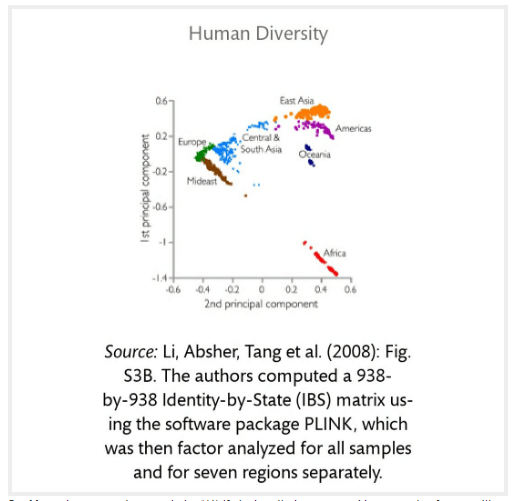
Murray then discusses Li et al, who set K to 7 and North Africa and the Middle East were new clusters. Murray then provides a graph from Li et al:
So, Murray’s argument seems to be “(1) If clusters that correspond to concepts of race setting K to 5-7 appear in STRUCTURE and cluster analyses, then (2) race exists. (1). Therefore (2).” Murray is missing a few things here, namely conditions (see below) that would place the clusters into the racial categories. His assumption that the clusters are races—although (partly) true—is not bound by any sound reasoning, as can be seen by his partitioning Middle Easterners and North Africans as separate races. Rosenberg et al (2002) showed the Kalash in K=6, are they a race too?
No, they are not. Just because STRUCTURE identifies a population as genetically distinct, it does not entail that the population in question is a race because they do not fit the criteria for racehood. The fact that the clusters correspond to major areas means that the clusters represent continental-level minimalist races so races, therefore, exist (Hardimon, 2017: 85-86). But to be counted as a continental-level minimalist race, the group must fit the following conditions (Hardimon, 2017: 31):
(C1) … a group is distinguished from other groups of human beings by patterns of visible physical features (C2) [the] members are linked by a common ancestry peculiar to members of that group, and (C3) [they] originate from a distinctive geographic location
[…]
…what it is for a group to be a race is not defined in terms of what it is for an individual to be a member of a race. What it means to be an individual member of a minimalist race is defined in terms of what it is for a group to be a race.
Murray (paraphrased): “Cluster analyses/STRUCTURE spit out these continental microsatellite divisions which correspond to commonsense notions of race.” What is Murray’s logic for assuming that clusters are races? It seems that there is no logic behind it—just “commonsense.” (See also Fish, below.) Due to not finding any arguments for accepting X number of clusters as the races Murray wants, I can only assume that Murray just chose which one agreed with his notions and use for his book. (If I am in error, then if there is an argument in the book then maybe someone can quote it.) What kind of justification is that?
Compared to Hardimon’s argument and definition. Homo sapiens is:
… a subdivision of Homo sapiens—a group of populations that exhibits a distinctive pattern of genetically transmitted phenotypic characters that corresponds to the group’s geographic ancestry and belongs to a biological line of descent initiated by a geographically separated and reproductively isolated founding population. (Hardimon, 2017: 99)
[…]
Step 1. Recognize that there are differences in patterns of visible physical features of human beings that correspond to their differences in geographic ancestry.
Step 2. Observe that these patterns are exhibited by groups (that is, real existing groups).
Step 3. Note that the groups that exhibit these patterns of visible physical features correspond to differences in geographical ancestry satisfy the conditions of the minimalist concept of race.
While Murray is right that the clusters that correspond to the folk races appear in K = 5, you can clearly see that Murray assumes that ALL clusters would then be races and this is where the philosophical emptiness of Murray’s account comes in. Murray has no criteria for his belief that the clusters are races, commonsense is not good enough.
Philosophical emptiness
Murray then lambasts the orthodoxy for claiming that race is a social construct.
Advocates of “race is a social construct” have raised a host of methodological and philosophical issues with the cluster analyses. None of the critical articles has published a cluster analysis that does not show the kind of results I’ve shown.
Murray does not, however, discuss a more critical article of Rosenberg et al (2002)—Mills (2017) – Are Clusters Races? A Discussion of the Rhetorical Appropriation of Rosenberg et al’s “Genetic Structure of Human Populations.” Mills (2017) discusses the views of Neven Sesardic (2010)—philosopher—and Nicholas Wade—science journalist and author of A Troublesome Inheritance (Wade, 2014). Both Wade and Seasardic are what Kaplan and Winther (2014) term “biological racial realists” whereas Rosenberg et al (2002), Spencer (2014), and Hardimon (2017) are bio-genomic/cluster realists. Mills (2017) discusses the “misappropriation” of the bio-genomic cluster concept due to the “structuring of figures [and] particular phrasings” found in Rosenberg et al (2002). Wade and Seasardic shifted from bio-genomic cluster realism to their own hereditarian stance (biological racial realism, Kaplan and Winther, 2014). While this is not a blow to the positions of Hardimon and Spencer, this is a blow to Murray et al’s conception of “race.”
Murray (2020: 144)—rightly—disavows the concept of folk races but wrongly accepting the claim that we dispense with the term “race”:
The orthodoxy is also right in wanting to discard the word race. It’s not just the politically correct who believe that. For example, I have found nothing in the genetics technical literature during the last few decades that uses race except within quotation marks. The reasons are legitimate, not political, and they are both historical and scientific.
Historically, it is incontestably true that the word race has been freighted with cultural baggage that has nothing to do with biological differences. The word carries with it the legacy of nineteenth-century scientific racism combined with Europe’s colonialism and America’s history of slavery and its aftermath.
[…]
The combination of historical and scientific reasons makes a compelling case that the word race has outlived its usefulness when discussing genetics. That’s why I adopt contemporary practice in the technical literature, which uses ancestral population or simply population instead of race or ethnicity …
[Murray also writes on pg 166]
The material here does not support the existence of the classically defined races.
(Nevermind the fact that Murray’s and Herrnstein’s The Bell Curvewas highly responsible for bringing “scientific racism” into the 21st century—despite protestations to the contrary that his work isn’t “scientifically racist.”)
In any case, we do not need to dispense with the term race. We only need to deflate the term (Hardimon, 2017; see also Spencer, 2014). Rejecting claims from those termed biological racial realists by Kaplan and Winther (2014), both Hardimon (2017) and Spencer (2014; 2019) deflate the concept of race—that is, their concepts only discuss what we can see, not what we can’t. Their concepts are deflationist in that they take the physical differences from the racialist concept (and reject the psychological assumptions). Murray, in fact, is giving into this “orthodoxy” when he says that we should stop using the term “race.” It’s funny, Murray cites Lewontin (an eliminativist about race) but advocates eliminativism of the word but still keeping the underlying “guts” of the concept, if you will.
We should only take the concept of “race” out of our vocabulary if, and only if, our concept does not refer. So for us to take “race” out of our vocabulary it would have to not refer to any thing. But “race” does refer—to proper names for a set of human population groups and to social groups, too. So why should we get rid of the term? There is absolutely no reason to do so. But we should be eliminativist about the racialist concept of race—which needs to exist if Murray’s concept of race holds.
There is, contra Murray, material that corresponds to the “classically defined races.” This can be seen with Murra’s admission that he read the “genetics technical literature”. He didn’t say that he read any philosophy of race on the matter, and it clearly shows.
Deflationary realism provides a worked-out alternative to racialism—it is a theory that represents race as a genetically grounded, relatively superficial biological reality that is not normatively important in itself. Deflationary realism makes it possible to rethink race. It offers the promise of freeing ourselves, if only imperfectly, from the racialist background conception of race.
Spencer (2014) states that the population clusters found by Rosenberg et al’s (2002) K = 5 run are referents of racial terms used by the US Census. “Race terms” to Spencer (2014: 1025) are “a rigidly designating proper name for a biologically real entity …” Spencer’s (2019b) position is now “radically pluralist.” Spencer (2019a) states that the set of races in OMB race talk (Office of Management and Budget) is one of many forms “race” can take when talking about race in the US; the set of races in OMB race talk is the set of continental human populations; and the continental set of human populations is biologically real. So “race” should be understood as proper names—we should only care if our terms refer or not.
Murray’s philosophy of race is philosophically empty—Murray just uses “commensense” to claim that the clusters found are races, which is clear with his claim that ME/NA people constitute two more races. This is almost better than Rushton’s three-race model but not by much. In fact, Murray’s defense of race seems to be almost just like Jensen’s (1998: 425) definition, which Fish (2002: 6) critiqued:
This is an example of the kind of ethnocentric operational definition described earlier. A fair translation is, “As an American, I know that blacks and whites are races, so even though I can’t find any way of making sense of the biological facts, I’ll assign people to my cultural categories, do my statistical tests, and explain the differences in biological terms.” In essence, the process involves a kind of reasoning by converse. Instead of arguing, “If races exist there are genetic differences between them,” the argument is “Genetic differences between groups exist, therefore the groups are races.”
So, even two decades later, hereditarians are STILL just assuming that race exists WITHOUT arguments and definitions/theories of race. Rushton (1997) did not define “race”, and also just assumed the existence of his three races—Caucasians, Mongoloids, and Negroids; Levin (1997), too, just assumes their existence (Fish, 2002: 5). Lynn (2006: 11) also uses a similar argument to Jensen (1998: 425). Since the concept of race is so important to the hereditarian research paradigm, why have they not operationalized a definition and rely on just assuming that race exists without argument? Murray can now join the list of his colleagues who also assume the existence of race sans definition/theory.
Murray (2020: 17) asks “Why me? I am neither a geneticist nor a neuroscientist. What business do I have writing this book?” If you are reading this book for a fair—philosophical—treatment for race, look to actual philosophers of race and don’t look to Murray et al who do not, as shown, have a definition of race and just assume its existence. Spencer’s Blumenbachian Partitions/Hardimon’s minimalist races are how we should understand race in American society, not philosophically empty accounts.
Murray is right—race exists. Murray is also wrong—his kinds of races do not exist. Murray is right, but he doesn’t give an argument for his belief. His “orthodoxy” is also right about race—since we should accept pluralism about race then there are many different ways of looking at race, what it is, and its influence on society and how society influences it. I would rather be wrong and have an argument for my belief then be right and appeal to “commonsense” without an argument.
Prestigious Black national merit finalist GondwanaMan writes in the comment section:
… I’ve heard Thomas speak multiple times over the past 10 years and he seems very intelligent but I’ve heard mixed things about his behavior/intellect. Maybe PP can do an IQ analysis I would be very interested…
Thomas came from nothing to become one of the most powerful men on the planent. He is clearly intelligent compared to the average American, but in my opinion he would score lower on an IQ test than most other members of the super-elite.
For one thing, Thomas is known for his chilling silence. Unlike other supreme court judges who ask questions and make comments, Thomas has been largely silent for decades, much like the dim-witted Jason from the Friday the 13th movies.
Conservatives tend to score lower on IQ tests than liberals and blacks tend to score lower than whites, but because blacks are almost never conservative, the rare combination of being both conservative and black doesn’t bode well.
Of course conservatism is a vaguely defined moving target so Thomas may have very intelligent reasons for his political views that are actually quite liberal in the true spirit of the term. For example Thomas opposes affirmative action, not because he’s anti-black, but because he saw first hand how being seen as a token devalued his Yale Law degree. While white law grads had elite law firms at their beck and call, Thomas had to apply to dozens of firms to even be considered. Of course this was the 1970s when there was a lot more racism.
In general he felt that affirmative action benefits light-skinned blacks from elite backgrounds while dark skinned blacks like himself had to work much harder. Of course if racial IQ differences are genomic, we’d expect darker skinned blacks like Thomas to have lower IQs (on average) than their lighter skinned peers like Obama and Corey Booker. From page 45 of the book Strange Justice written by Jane Mayer and Jill Abramson:
Not only was he short, and in his teen years slight, but he also had exceptionally African features years before the Black is Beautiful movement made them desirable. “He was darker than most kids, and in that generation, people were cruel,” recalled Sara Wright, a librarian for the Savannah Morning News who attended elementary and junior high school with Thomas. “He was teased a lot and they’d call him [N word redacted by PP, 2020-03-02] Naps” for his tightly curled hair. “A lot of the girls wouldn’t want to go out with him.”
Thomas himself remembered being called “ABC,” or “America’s Blackest Child.” Even friends recollect taunting him that “if he were any blacker, he’d be blue.” As Lester Johnson, who is now a lawyer in Savannah, recalled, “Clarence had big lips, nappy hair and he was almost literally black. Those folks were at the bottom of the pole. You just didn’t want to hang with those kids.
…The most prominent families in town since before the Civil War were for the most part what a local history of African-Americans called “high yellow,” or mulatto. At the same time, many of those with pure African bloodlines, like Thomas were made to feel inferior.”
…At Yale he talked bitterly about the “light-skinned elite” blacks who had it easier than the darker ones.
pg 45 of Strange Justice
Of course race is only one variable that correlates with IQ and we shouldn’t give it too much emphasis, as some very dark skinned blacks score far higher on IQ tests than 99% of whites and East Asians, however as the below photo with George H.W. Bush shows, Thomas has many physical traits that put him at risk for low IQ.
Thomas is much shorter and more muscular than his fellow elite George H.W. Bush. Height is positively correlated with IQ and weight/height ratio is negatively correlated with IQ. Also the cranial capacity of the elder Bush seems to dwarf Thomas’s. But to his credit, Thomas is wearing glasses and myopia is thought to be genomically linked to high IQ.
So what is his IQ?
It’s unclear if Thomas ever took an official IQ test but he almost certainly took proxy versions like the SAT and LSAT. However these scores are not known so we’re left only with his grades.
The book Strange Justice describes his academic behavior at Holy Cross college:
But much of his time was spent alone, usually studying. His classmates recalled that when they went to dances at nearby schools on Saturday nights, Thomas often preferred to stay in the basement of the college library. When the school threatened to shorten the Saturday night library hours, he petitioned the authorities to keep the facility open. And when others went away during holidays, he stayed in the otherwise empty school, explaining later that he viewed such breaks as a valuable opportunity to get ahead of the other students.
Academically, his efforts paid off. He wrote to a friend that he had managed to maintain a 3.7 grade point average, and he graduated in 1971 with honors, ranking ninth in his class
According to The New York Times, Thomas’s grades at Holy Cross were in the top 7% of his class.
Let’s assume grades are simply an average of IQ and hard work (averaging is appropriate because two variables are not correlated). If we assume Thomas was in the top 1% in hard work (skipping holidays, petitioning the library to stay open), which is 2.33 standard deviations above the class average, how high would his IQ have to be to end up in the top 7% (+1.6 SD). Simple algebra tells us that if he was +2.33 SD in hard work (relative to Holy Cross students), his IQ could be no higher than +0.87 SD for his grades to be +1.6 SD.
So now that we estimate Thomas’s IQ was +0.87 SD relative to Holy Cross students, we need to know what their IQ distribution was.
Circa 2014 Holy Cross had a median SAT score of 1280 out of 1600 which equates to a mean IQ of 128 (U.S. norms).
However we know Harvard students went from an SAT IQ of 143 to an IQ around 128 with an SD of 12 on a test not used to select them (one third regression to the mean) so the actual IQ distribution at Holy Cross (in 2014 and perhaps historically) was likely around 118 with a standard deviation around 12 (compared to the U.S. distribution of 100 with an SD of 15).
Thus Thomas’s estimated IQ is 118 + 0.87(12) = 128 (U.S. norms) or 127 (white norms). In other words, smarter than 96% of white America.
Is this estimate too high?
There is reason to think this estimate might err on the high side. For example on page 201 of the book Yale Law School and the Sixties: Revolt and Reverberations it states:
…Associate Dean Ralph Brown recalled that “we were admitting blacks very indulgently, and a lot of them could barely do the work.” When courses required in-class exams, minorities tended to end up “in the bottom,” Charles Reich said. “You couldn’t disguise that”. One could get around it, he added, by having students write papers that, after several drafts, might well deserve a high grade, as he did for Clarence Thomas. But first semester courses required exams.
Since first semester Yale Law courses require exams, perhaps the best estimate of Thomas’s IQ can be found in this paragraph from Strange Justice:
His academic records remain, with his consent, sealed. But professors and administrators from his era recall him as an average student, hard-working but not particularly brilliant. There is only one professor –Thomas I. Emerson– whose records have been made public. Thomas elected to take Emerson’s first-year course on politics and civil rights in 1972, and Emerson’s notes show that he finished the class near the bottom, with a 69 for the semester. One of only two students who scored lower was Thomas’s friend and later witness against Hill, John Doggett.
Interestingly Doggett is also a black conservative.
Assuming about 20 students per class room, being in the bottom three puts Thomas in the bottom 15%, or roughly 1.13 SD below the class mean.
Although students at the best law schools average around IQ 145 on the LSAT, they likely regress to 128 (with an SD of 12) on tests not used to select them. Thus if Thomas’s bottom 15% performance in Emerson’s law class implies an IQ of:
128 – 1.13(12) = 114 (U.S. norms) or 112 (U.S. white norms).
Higher than 79% of white America.
That sounds about right.
[this article was lightly edited on March 3, 2020]
So the other day I’m looking at the blogs internal statistics and I see a HUGE spike in traffic at the end of February.
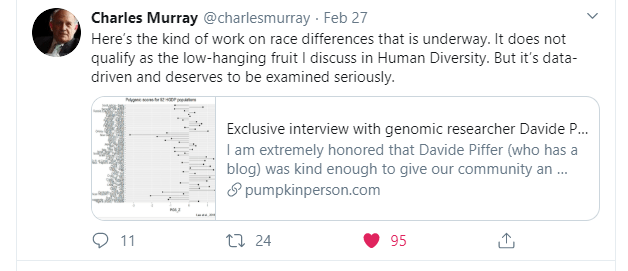
I look where the traffic is coming from and find this tweet from Charles Murray:
Murray is the most influential social scientist on the planet. His book Losing Ground is credited with welfare reform in the Clinton era and The Bell Curve (which he co-authored with Richard Herrnstein) mainstreamed the IQ debate.
After all I’ve done for RR, you would think he could at least pretend to be happy for me getting this iconic endorsement, but sadly the ungrateful charlatan allowed jealousy to get the better of him as he tweeted out the following:
No blogger works harder than RR (reading a book a week and creating articles with more references than a wikipedia page) so no wonder he’s bitter he can’t escape my shadow. His blog currently ranks 3,220,173rd in the world while mine ranks 1,178,817. RR (who looks like a hybrid between a poodle and the Jersey Shore) needs to surpass over TWO MILLION blogs in popularity to even come in striking distance with me.
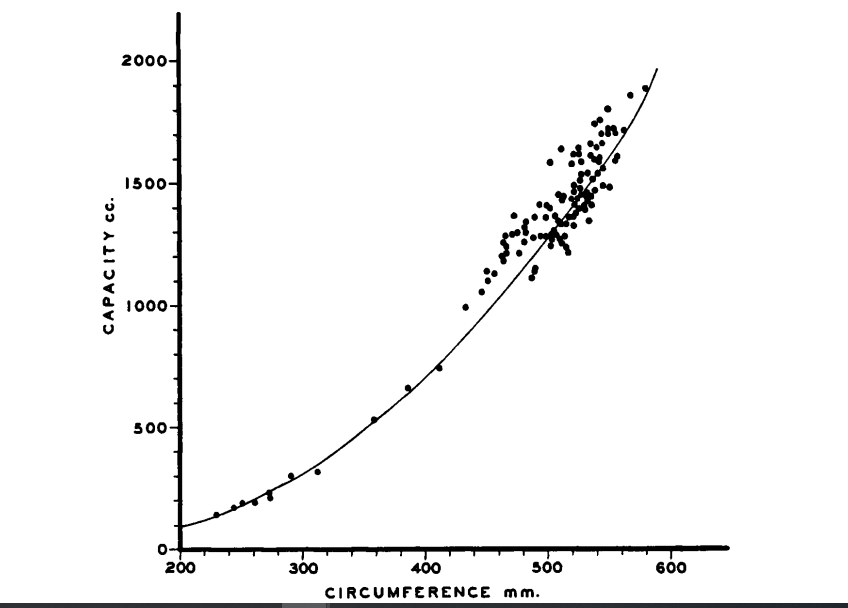
Source: Figue 3 in Jørgensen, J. B., & Quaade, F. (1956). External cranial volume as an estimate of cranial capacity. American Journal of Physical Anthropology, 14(4), 661–664.
The above chart shows the line of best fit predicting cranial capacity from head circumference in 121 skulls. The authors of the paper created the following formula to predict cranial capacity from head circumference:
However this formula predicts negative cranial capacity for the smallest circumferences in the scatter plot. Why? Because to make the relationship linear, the authors excluded the 11 smallest crania.
Although this paper is a major contribution to the field, the authors apparently lacked the skills to calculate non-linear relationships so Pumpkin Person decided to do it for them, creating a revised formula (using all 121 skulls):
So while the authors’ formula predicted a 200 mm head circumference would have a -260 cc capacity (physically impossible) my formula predicts 98 cc capacity (consistent with the line of best fit) because my formula can adapt to the curving shape of the relationship.
It’s important to note that the formulas above are both based on skulls so when applying them to living heads an adjustment needs to be made. For example, when J.P. Rushton estimated the cranial capacity of living army staff using Lee & Pearson’s regression equations using head length, head breadth and head height, he deducted 11 mm for fat and skin around the skull for each measurement since he was applying a formula derived from skulls on living heads.
However Lee & Pearson noted that there was no obvious way to adjust for fat and skin around the skull when using circumference to predict capacity.
However it occurred to Pumpkin Person that if head length and head width are deducted 11 mm, and these are more or less equivalent to head diameter, then perhaps one should convert circumference into diameter, subtract 11 mm, and then convert back to circumference before applying circumference formulas.
A lot of these progressive YouTube stars are kind of clueless, and Kulinski is no exception. If he really thinks Bush and Cheney were architects of the Iraq war, then the “Woke” generation is asleep. Though to his credit, at least Kulinski knows some of the relevant players (wolfowitz, kristol), and doesn’t blame it all on mysterious Bob Rubin types like certain morons in the comment section.