Revised formula for estimating IQ from bio-demographics

As I stated in a previous post:

Many years ago, I noticed that IQ was correlated with a great many physical and demographic traits such as head size, height, income, education, etc. This gave me the idea of trying to estimate peoples’ IQs based on bio-demographics. A member of Prometheus society brilliantly suggested that “multiple regression” would be the classic application for my idea, and he also suggested that I use religiosity as one of the demographic traits.

Well it turns outs psychologists have been using demographic traits like education and occupation to estimate premorbid IQ in people suspected of dementia for years, but they don’t include biological traits except for race. I thought it would be interesting to use a wide range of bio-demographic traits so using data from 144 Canadians (age 26 to 76) I created an equation to estimate your IQ. The sample was heavily skewed towards my demographic (Ontario men in their thirties) but the formula might still work on working age North Americans in general.

This formula has been substantially revised and adapted for use in Americans.

INSTRUCTIONS

Start by assuming your IQ is -1.251, and then add or subtract based on the following 25 instructions. Be honest or your estimate will not be accurate.

Education

1. If you graduated from elementary school, add 6.212 points

2. If you graduated from high school, add another 6.212 points

3. If you have a university degree, add another 6.212 points.

4. If you have a graduate degree or attended an elite college or high school, add another 6.212 points.

5. If you both attended an elite college AND have a graduate degree, add yet another 6.212 points.

Head Size

6. Multiply your cranial circumference (in inches) by 2.768 and add the resulting number of points.

Height

7. Multiply your height (in inches) by 0.418 and add the resulting number of points

Weight

8. Multiply your weight (in pounds) by 0.0927 and subtract the resulting number of points

Race

9. If you’re less than half-black, add 2.666 points

10. If you’re less than a quarter black and less than a quarter Native American, add another 2.666 points

11. If you’re more than 75% Northeast Asian, or more than 50% Ashkenazi Jewish, add another 2.666 points

12. If you’re more than 75% Ashkenazi Jewish, add yet another 2.666 points

Media preferences

13. Which of the following do you most prefer for entertainment: a) fun TV shows like sitcoms, reality TV, game shows, sports, and popular talk shows, b) intellectual TV shows about science, history or politics, c) fun books like romance novel or thrillers, or d) intellectual books like literary novels or academic texts.  If you chose “a” add 0 points,  if you chose “b” add 3.451 points, if you chose “c”, add 6.902 points, and if you chose “d”, add 10.353 points.

Sex

14. If you’re male, subtract 5.1 points

Income

15. Multiply the number of figures in your yearly pre-tax income by 1.869 and add the resulting number of points.  If you’re retired, use your peak earnings, adjusted for inflation. If much of your earnings go into your business or if you’re too rich to have a conventional income, simply divide your individual net worth by ten to approximate your income.

Religiosity 

16. If you believe in God, subtract 3.901 points.

17.  If you’re a creationist who does not believe in evolution, subtract another 3.901 points.

Political conservatism

18. Which of these U.S. political parties would you most like to see in power: The Green party, the Democrats, or the Republicans? If you picked the Green party, subtract 0 points, if you picked the Democrats, subtract 3.405 points, and if you picked the Republicans, subtract 6.81 points.

Alcoholism

19. If you’re an alcoholic, subtract 2.282 points

Smoking

20. If you’re a smoker, subtract 2.282 points

Age

21. Multiply the number of years you’ve been alive by 0.194 and add the resulting points

Birth Order

22. Multiply your birth order by 0.885 and subtract the resulting points. So if you’re your biological mother’s third born, multiply 3 by 0.885 and thus subtract 2.655 points.

And your IQ is…

23. Subtract 100 from all your points

24. Divide by 0.8

25. Add 100


The 3 types of American elites

To oversimplify, there are three types of people who rule America. The politically powerful, the intelligentsia, and the rich. They represent three types of power: the ability to win hearts, the ability to win minds, and the ability win wallets.

According to an article promoted by The New York Times, Ashkenazi Jews are genetically more intelligent than other American ethnic groups. Since intelligence can be defined as the cognitive ability to adapt your environment to your advantage, we should expect Ashkenazi Jews to rise to the top of American society, and we should expect lower IQs ethnic groups to be underrepresented among elites, so let’s see if this is the case.

The politically powerful: The politically powerful are probably the least intelligent of the American elites and thus can sometimes be manipulated by the rich and the intelligentsia. Indeed there have been several U.S. presidents who have seemed like puppets for more intelligent advisors behind the scenes.

I define the politically powerful as not just those who have been elected to public office, but rather as anyone who has a large constituency of loyal followers, since virtually any popular American has the ability to be a political force. A good measure of political power is Gallup’s most admired list. A quick perusal of the list reveals, that Ashkenazi Jews are not especially over-represented, but African Americans are. If measured by sheer popularity, African Americans are arguably the most politically powerful group, per capita, in society. I discussed possible reasons for this here.

Blacks have used their political power to achieve certain benefits like affirmative action and a black president. However raw political power is the only type of power African Americans have a lot of; as we will see, they are dramatically underrepresented in the two other types of power.

The intelligentsia: The intelligentsia are those who wield power not by winning the hearts of the masses, but by winning the minds of other elites. They are the columnists for The New York Times, the professor who writes a book that the President of the United States reads before bed, the members of Think Tanks who propose policy, and the intellectuals who provide the white house with expertise.

These elites are not rich or famous and most Americans have never heard of them, but they wield an enormous amount of power behind the scenes because billionaires and presidents turn to them for guidance and read their columns in The New York Times. They also wield power because they largely decide who gets to become rich and powerful in America and who gets to stay that way. If The New York Times decides a certain billionaire, celebrity, or politician is evil, all it takes is a few scathing editorials or exposés that the rest of the media mindlessly parrots, and the elite must resign in scandal. As the saying goes, never pick a fight with people who buy ink by the barrel.

Because Ashkenazi Jews have high IQs, they are dramatically over-represented among the intelligentsia. Despite beig 2% of America, Ashkenaz Jews are an astonishing 50% of America’s most influential pundits. By contrast, African Americans are 12% of America but only 2% of the 50 most influential pundits. This ethnic distribution suggests that the intelligentsia have very high IQs on average.

The rich: Billionaires wield enormous power in America because politicians are enormously dependent on money to fund their campaigns and fund their endless political advertising. The rich also have the power to buy major newspapers, television networks, internet search engines, and fund universities and thus dramatically dictate which intellectuals get hired as influential members of the intelligentsia. Because getting rich demonstrates intelligence (the ability to adapt your environment to your advantage), the high IQ Ashkenazi Jewish population is 36% of the 400 richest Americans, despite being only 2% of America. By contrast, blacks are only 0.25% of the 400 richest Americans, despite being 12% of America

Big Brained Oprah tried to stop the war with Iraq

My views on the probable nature of a person having a 400 IQ are as follows…a peace-maker at all levels, (human/human; human/animal; human/environment)…Why do I conceive of this being as so benign? The wisest sages through-out history have all emphasized the oneness and connectedness of all of creation. A truly aware person would see this…

__Member of Prometheus Society, imaging a creature with a 400 IQ

While no human in history has had a deviation IQ much beyond 200, Oprah’s 2,029 cc estimated brain size is arguably around what you would statistically expect from a 400 IQ being, and so was the wisdom she displayed in the run-up to the war in Iraq.  It’s hard to think of a more disastrous decision for America than the 2003 U.S.-lead invasion to remove Saddam Hussein, which cost America an incalculable amount of blood, treasure, security, and political capital, and continues to wreak havoc today, so those who had the intellect, courage, and integrity to oppose the war before it began deserve a large amount of credit, particularly if they did so publicly; and it’s hard to think of anyone who did so more publicly than Oprah, who did so repeatedly.

Of course Oprah was not publicly opposed to the Iraq war from the start.  After being bombarded with hate mail for doing a 2001 show asking whether war with Afghanistan was the only answer, she was not eager to appear anti-war when it came to Iraq too.  Indeed in October 2002 she did an Iraq show that was largely pro-war, and where Oprah was dismissive of an anti-war audience member.

But by November 2002, Oprah had suddenly jumped off the media’s pro-war bandwagon.  In his book Dude where’s my country? anti-war advocate Michael Moore praised her for being the only mainstream media at the time to show footage of Donald Rumsfeld shaking Saddam Hussein’s hand in the 1980s.

However the most significant anti-war show Oprah would do was a two-day special that aired the day after Colin Powell’s pivotal February 2003 U.N. speech making the case for war, which was credited with shifting public opinion in favor of regime change.  Winfrey recruited reporters from CNN to gather clips from people from countries as diverse as Britain, France, South Africa, Iraq, and Pakistan all trying to persuade America not to go to war, along with anti-war luminaries like Nelson Mandela and Pope John Paul II.  Here’s a brief clip from that show.

Buzzflash.com claimed there was a deliberate attempt to stop the show from airing in some markets:

Bush pre-empted Oprah for no reason other than to stop her broadcast regarding Iraq and insert his own propaganda!…In the middle of the show a “Special News Report” notice came up, then Peter Jennings announced Bush would be making a MAJOR announcement on Iraq. Then Bush and Powell came in and Bush summarized what Powell had said yesterday at the UN. He spent about 20 minutes in all…The Administration would have known the content and timing of today’s show because it is broadcast live and/or in the morning in many markets such as Oprah’s home base in Chicago. This was in such bad form I couldn’t believe it! I called Harpo Studios in Chicago to let them know and they said they had received a lot of phone calls. I said Oprah should tell her audience what happened and that I thought Bush was purposely interfering with her show. They commented they didn’t know what the reason was and in any case there was no way to prove anything

Academics for Justice made the same assertion:

Today, Oprah Winfrey started a two-part series focusing on the impending U.S. war on Iraq. About halfway through the show the broadcast was pre-empted by coverage of Pres. George Bush, with Colin Powell at his side, reading a prepared statement on Iraq. The coincidental timing of this pre-emptive press statement raised immediate questions about the motives of the White House war strategists. Students of the Civil Rights Movement will recall an incident in 1964 when activist Fannie Lou Hamer sat before a live television audience and gave a riveting account of the oppression she and other Blacks faced in the South. President Lyndon Johnson was so convinced of the power of her appeal to undermine his own political/racial agenda, that he hastily called a press conference to pull cameras away from Hamer’s impassioned revelations…The pre-emption of Winfrey’s show today should be seen in the same light. Oprah’s audience is a vast and powerful—but largely apolitical—force of middle-class white women. It is likely that most did not watch Colin Powell’s live testimony at the U.N. yesterday. In fact, it is likely that this huge audience was being oriented to the issues of the Iraq war for the first time…The first 30 minutes of the show was decidedly anti-war and highlighted not only worldwide unanimity in opposition to the war but presented many of the heretofore unheard voices of ordinary people speaking forcefully against Bush’s motives

Undeterred by the alleged attempt to stop part of her February 2003 anti-war shows from airing, Oprah made one last ditch attempt to stop the war in March 2003. Just 48 hours before the war the began, Oprah aired an anti-war show that included Michael Moore and the following shocking video:

Shortly after the show aired, Harvard Law grad Ben Shapiro condemned the show, calling Oprah a dangerously powerful political force, shaping the views of millions with her ignorant views and wacky reasoning. However Canada’s most respected media critic, John Doyle of the Globe and Mail, praised the show as “an act of extraordinary intelligence from Oprah”

photo (1)

Doyle wrote:

At a time when the consensus in American television is that everybody should pull together and support the men and women in the U.S. military, what Oprah Winfrey did was outright subversion. In the last week, Clear Channel, Worldwide Inc., America’s largest radio conglomerate (and a company looking for a break from the U.S. government), has been organizing pro-Bush and pro-war rallies and then reporting on them. A Nashville TV station has been charging local advertisers to take part in an on-air, support the military campaign and gloating about the profits. That’s just the tip of it…In normal circumstances, the perspectives [Oprah] presented would not be notable, but in the contemporary context, they were amazing.

The decision to invade or not invade Iraq was arguably the most important test of the courage, integrity, and yes, intelligence, that America’s leadership has faced in the last half century.  Thus it seems marvelously symbolic that Oprah, arguably the biggest brained member of America’s elite ultimately passed that test with such flying colours, and got on the right side of history.

Hypocrites who deny linear IQ income correlation

Evidence continues to debunk the popular idea that IQ is largely irrelevant to success above 120, and my less successful readers are going absolutely ballistic. The reason this idea is so popular (and its debunking so threatening) is that the internet is crawling with people who are either only moderately intelligent or only moderately successful; and they take comfort in believing they achieved their modest success by being way smarter than the homeless guy on the street, but hysteria ensues if you suggest that some gazillionaire pizza mogul is richer than they are because of brains. Thus, these self-serving elitist snobs want IQ and money to be correlated, but only up to either their level of money or their level of IQ (whichever comes first). This allows them to feel intellectually superior to the poor who they view as too dumb to meet basic needs, while also feeling morally superior to the rich who they view as greedy and ruthless.

This is reminiscent of the white supremacists of old who believed that IQ and brain size were only correlated at the low end, because tropical people had small brains, but irrelevant at the high end, since Mongoloid races had the biggest brains. Stephen Jay Gould mocked this as an unbeatable argument: “Deny it at one end where the conclusions are uncongenial; affirm it by the same criteria at the other.”

Unfortunately for the hypocrites, statistics seldom work that way.

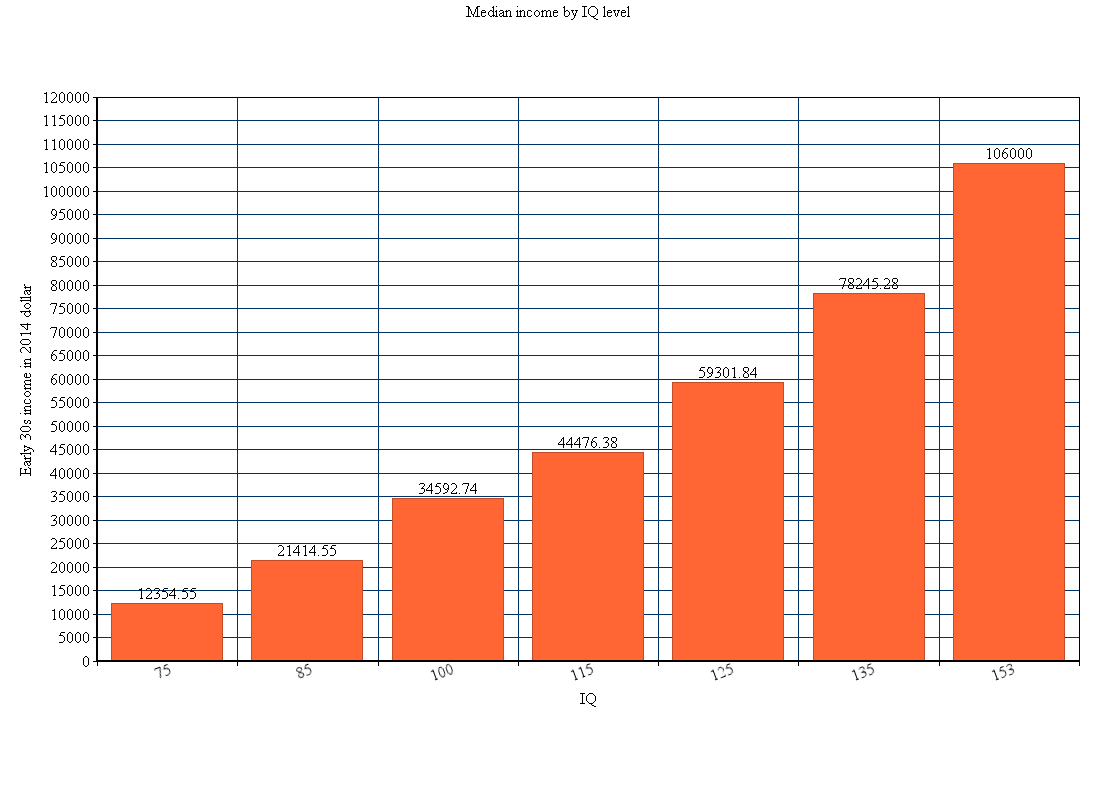
The median income (in 2014 dollars) of seven different IQ levels:

dollarbar

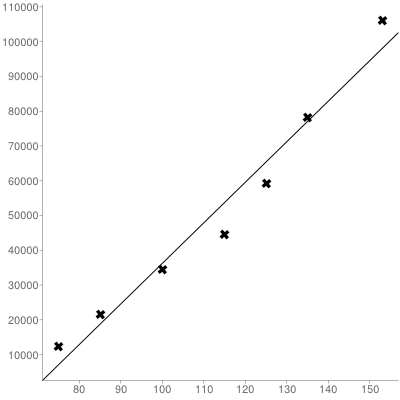
In the above chart, the income for IQ 153 people was documented here. The incomes for all the other IQ levels was documented here, but because those were in 1993 dollars, I converted them to 2014 dollars using this calculator. The below scatter plot shows how linear the relationship is, well above IQ 120:

dollarscat

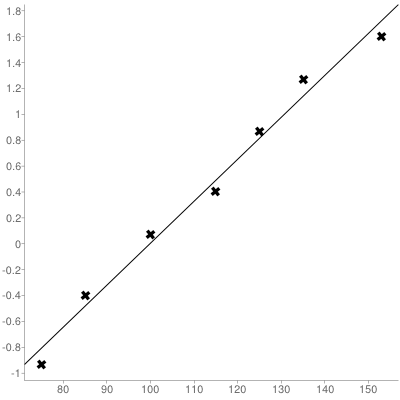
Because income can be quite skewed at the extremes, it also makes sense to convert raw dollars into normalized Z scores. This was accomplished in the below chart by converting the above dollar values into income percentiles for Americans in their early 30s using this calculator. The incomes are then assigned Z scores based on the Gaussian distribution. When this is done, the correlation between IQ and income continues to be beautifully linear well above IQ 120:

normscat

High IQ Bill Gates towers as the richest American, 21 years in a row!

Tags

, , ,

Forbes magazine just came out with their annual list of the 400 richest Americans and, for the 21st year in a row, Bill Gates tops the list, with over $80 billion. Just to qualify for the Forbes 400 this year, you need about $1.5 billion. It’s interesting to speculate on what Bill Gates’ IQ might be. In India, Gates was asked exactly that, though he didn’t give a number:

Way back in 1997, columnist Dan Seligman wrote the following:

It seems marvelously symbolic that William H. Gates III, the guy listed as number one on The Four Hundred, has an obviously breathtaking IQ. The figure 170 keeps getting into print, which would make him almost certainly the highest on this list or any other list you’re likely to be looking at soon. To be sure, one occasionally sees conjectures that Steven Ballmer, Microsoft’s executive vice president, worldwide sales and support, is in the same IQ league as Bill himself. Ballmer is number six among The Four Hundred. It also seems symbolic of the new order that their company has made IQ a public and explicit criterion for hires of senior personnel.


Anyhow, it seems reasonable to view The Four Hundred as a subset;an especially lucky subset;of the emerging cognitive elite.

One wonders where the 170 figure originated. I remember leafing through one of Gates’ biographies and seeing a quote from a teacher estimating his IQ to be about 160 or 170, but no actual test score was cited. So my guess is that’s where the 170 figure started. It’s also been widely reported that Gates scored a perfect 800 on the math section of the notoriously difficult old SAT (before the test was dumbed down circa 1995). Reports about his verbal score are a little inconsistent. For example, biographers Stephen Manes and Paul Andrews write:

Toward the end of the year, Lakeside senior classman Bill Gates took on a different marketing project: the selling of William Henry Gates. Potential customers? College admissions officers. Bill had scored 800 on his math SAT and five achievement tests (although only in the low 700s on the verbal SAT), and he put it, “I wanted to know which personality of mine would appeal to the world at large.

This would imply an overall SAT score in the low 1500s (which is spectacular for the old SAT) however in this Q&A, the interviewer states the Gates got an even more impressive 1590, and asks Gates if he ever wonders what question he got wrong. Gates replies:

The truth is, that was the verbal SAT. I got 790 the first time. I told my parents their vocabulary wasn’t large enough. I was criticizing them. So I did go back and take it and do better the next time.

Kind of clever how Gates managed to look like he was answering the question without actually confirming or denying the 1590 score. Assuming Gates did score 1590 on the old SAT, then according to the Prometheus MC Report (see section 8.3.3), that equates to a WAIS IQ of 169, or roughly 170. Even if he only scored around 1500, that would still equate to an IQ of 151 (99.97%ile). Either way, the man is likely smarter than the average Ivy League professor, the average Nobel prize winning scientist, and any American president of the last 100 years.

However even the old SAT might not have contained enough truly novel and complex problems to gives Gates an accurate test score. More informative are the opinions of his classmates at Harvard who actually got to observe him compete in an extremely high level academic environment. Despite writing a fairly negative book about Gates, Paul Allen admits his former friend was brilliant, stating:

I was decent in math, and Bill was brilliant, but by then I spoke from my experience at Washington State. One day I watched a professor cover the blackboard with a maze of partial differential equations, and they might as well have been hieroglyphics from the Second Dynasty. It was one of those moments when you realize, I just can’t see it. I felt a little sad, but I accepted my limitations. I was O.K. with being a generalist.


For Bill it was different. When I saw him again over Christmas break, he seemed subdued. I asked him about his first semester, and he said glumly, “I have a math professor who got his Ph.D. at 16.” The course was purely theoretical, and the homework load ranged up to 30 hours a week. Bill put everything into it and got a B. When it came to higher mathematics, he might have been one in a hundred thousand students or better. But there were people who were one in a million or one in 10 million, and some of them wound up at Harvard. Bill would never be the smartest guy in that room, and I think that hurt his motivation. He eventually switched his major to applied math.

Is Harvard math really so selective that even one in a 100,000 talent plus hard work only gets you a B? If so, it would imply Gates has an IQ of 164.

An anonymous commenter on Steve Sailer’s blog wrote:

Regarding Gates academic ability, I think the general consensus from people who knew him at Harvard was that he may not have the very best at mathematics, but that he was second to none in computer science. He was taking graduate courses as a freshman and apparently never taking notes and blowing the curve for the rest of the class. A doctoral student said that Gates would just sit with his arms behind his back and correct the algorithms being written on the board anytime the prof made a mistake. He also said everyone else in the class hated him, but that he would ask him questions on occasion, and that his answers were always penetrating and beyond anything this guy could have thought of on his own.


Gates apparently wrote an outstanding paper in theoretical computer science that solved a problem presented to him a math class that he co-authored with his professor who is now at UC-Berkeley.

Sounds like Gates has an IQ of at least 160 and possibly 170. Considering the average American has an IQ around 100 and the average self-made billionaire has an IQ around 130, is it any wonder Gates became the richest man in America? Compared to Gates the average self-made billionaire is mildly retarded, and the average American is so profoundly retarded they can not even feed themselves. Becoming the richest man in the country must have been like taking candy from a baby. At his peak, he was the first centibillionaire in world history, and probably would still be that rich had potentially jealous government officials, perhaps eager to take a nerd down a peg, decided not to go after him.

I really admire Gates because instead of being the typical high IQ nerd who just sits around playing computer games or working in academia, he decided to go out into the real world and compete with the alpha males at their own cutthroat game of Darwinian capitalism…and he beat the living shit out of them!

Correcting ethnic IQ differences for nutrition

Tags

, , , , ,

Readers of the New York Times have long known that there might be genetically based ethnic differences in IQ, but few people appreciate that nutrition also plays a huge role in IQ. For example, thanks to malnutrition, British whites in the 19th century had real IQ’s around 76 (on modern norms), though this was spuriously pushed down to IQ 66 by lack of schooling (see the Flynn effect). By comparison, in his book Race Differences in Intelligence, scholar Richard Lynn reports the following IQ’s for 10 major populations:

North East Asians: IQ 105
Europeans: IQ 99
Arctic peoples: IQ 91
Southeast Asians: IQ 87
Native Americans: IQ 86
Pacific Islanders: IQ 85
Non-white Caucasoids: IQ 84
Sub-Saharan agriculturalists: IQ 67
Australian aboriginals: IQ 62
Sub-Saharan hunter/gatherers: IQ 54

How much of these scores were affected schooling? Probably not much because virtually all the samples were school children. A major exception being sub-Saharan hunter’gathers, but Lynn estimated their IQ largely by comparing them to equally unschooled neighboring agriculturalist who score IQ 67 with schooling. Since the Bushmen scored about a dozen points lower, it was reasonable to assume that with schooling, Bushmen would score in the mid 50s. Although IQ tests are supposed to measure native ability, few tests are 100% culture fair so it’s necessary to control for schooling when comparing disparate cultures.

So if schooling did not affect these scores, what about nutrition? Although Lynn concedes that malnutrition adversely affects the IQ’s of third-world peoples, no attempt was made to correct the IQ’s for this effect. However on page 184, Lynn provides a table showing the prevalence of malnutrition for various geographic regions. The table lists several measures of malnutrition (i.e. percent underweight, percent wasted, percent stunted, percent anemic) and averaging across the different measures that are provided, implies that as of 1996, malnutrition afflicted 30% of Sub-Saharan Africa, 14% of the Middle East & North Africa, 45% of South Asia, 21% of East Asia & Pacific, and 16% of Latin America & Caribbean. Elsewhere in the book he claims that 25% of Australian aboriginals are malnourished.

I estimated that for each percentage of the population that is nutritionally deficient enough to be proclaimed malnourished, the average IQ of the population is lowered by 0.43 IQ points. This estimate is based on the fact that Lynn notes that African Americans with virtually no white admixture have IQ’s 13 points higher than their genetic counterparts in sub-Saharan Africa, 40% of whom are malnourished. Thus 40 multiplied by 0.43 lowers a population’s IQ 13 points below its potential. So correcting the IQ’s of all the ethnic groups for the level of malnutrition in the regions that they live, gives the following:

Northeast Asians: IQ 105 (no corrections, they live in first world countries)

Europeans: IQ 99 (no corrections, they live in first world countries)

Southeast Asians: IQ 96 (corrected for 21% malnutrition in East Asia & the Pacific Islands)

Pacific Islanders: IQ 94 (corrected for 21% malnutrition in East Asia & the Pacific Islands)

Arctic people: IQ 91 (no corrections, they live in first world countries)

Non-white Caucasoids: IQ 90 (corrected for 14% malnutrition, since they mostly live in the middle east/North Africa)

Native Americans: IQ 89 (many live in Latin America which has 16% malnutrition, others live in first-world North America, I split the difference & corrected for 8% malnutrition)

Sub-Saharan agriculturalists: IQ 80 (corrected for 30% malnutrition in Sub-Saharan Africa)

Australian aboriginals: IQ 73 (corrected for 25% malnutrition mentioned by Lynn)

Sub-Saharan hunter/gatherers: IQ 67 (corrected for 30% malnutrition in Sub-Saharan Africa)