Sexual Selection and Intelligence by meLo

[Note from Pumpkin Person, Dec 4, 2017: The following is a guest article and does NOT necessarily reflect the views of Pumpkin Person.  Out of respect for the author, please try to keep all comments on-topic.  I realize conversations naturally evolve, but at least start on-topic]

Introduction

Usually within the HBD community, discussions regarding the main mechanism(s) that drove the expressions of particular phenotypes is centered around natural selection or ecological(in the strictest, most traditional sense) factors. Sexual selection is unfairly sidelined, even though sex is the base of all multicellular evolution. The point of this article is to provide a logical argument for Sexual selections tremendous involvement, and to provide examples of how these pressures have shaped neolithic and modern Homo sapiens. I excluded Australoids but for good reason. Even though the population does have sexual selected traits, like blonde and curly hair, they are an incredibly diverse group and with the amount of pocket isolation I don’t think it’s fair without breaking this group into more categories. I kept this paper short, because it’s my first one and I wanted to use this as a “prototype” for future posts. Again all criticism is more than welcome because I myself am still learning about this topic.

First, it is important to note that traits which evolved from sexual selection are not the same thing as traits that serve reproductive purposes. Reproductive organs are usually the product of sexual selection, but sexual selection does not always act upon genitalia. Sexual selection favors any trait that allows an organism to attract the opposite mate more effectively, competitively or not.

The general trend
   

 Before I explain the respective pressures and phenotypes between subpopulations of the neolithic, it is essential to begin with a summary of the temporal trend that persisted before the aforementioned groups. This begins with a breakdown of definitions and the repair of misconceptions. Human development is extremely complicated, so this explanation will have oversimplifications for the sake of efficiency. Any questions or discussions on the matter are more than welcome. If you don’t know anything about heterochronies I suggest you read this

 Paedomorphosis=/= Neoteny. Neoteny is a heterochronic process, paedomorphism is a type of heterochrony. One of the largest or most noticeable differences between Homo sapiens and Chimpanzees is the increase in paedomorphic and peramorphic traits of the former. All heterochronic mechanisms affect the developmental outcome of homo sapiens this is mostly to do with developmental trade offs and creates a mosaic pattern of our evolution. Humans have accelerated brain growth which reaches full size before most of the other limbs and organs are finished, even though this is achieved through peramorphic heterochronies it coincides with the deceleration of the body which actually produces a more paedomorphic appearance in the population. This acceleration ends(progenesis) and is subsequently followed by a strong deceleration(neoteny) of the skulls growth (Penin, 2002). Neoteny and acceleration define growth rate, but the actual duration of the growth period is hypermorphic, meaning the duration of Human growth is delayed  or extended so that our legs and brains can continue to grow. Even though the brain is not paedomorphic it still enlarged to retain its childlike plasticity.These processes underlie the “direction” of our evolution, and while a lot of important traits are a result of peramorphic processes, it would be foolish to disregard the obviously paedomorphic traits we exhibit. It doesn’t take long to see how sexual selection can favor peramorphic or paedomorphic traits. Peramorphosis tends to create exaggerated features(think Irish Elk, Peacocks or the human brain) while paedomorphosis tends to appeal to sexual selection by producing “fragile” traits associated with infants of the species, in theory members of the opposite sex should associate these traits with “cuteness” and possibly even better parental skills.

Macro races

    Most don’t realize, but all races have undergone sexual selection. Each race has its own unique combination of peramorphic and paedomorphic traits as well as superficial ones that don’t relate to heterochrony. I will briefly go over each race and describe the varying degrees of pressures and the resulting phenotypes.

Caucasoids

  Caucasoids have the largest concentration of hypermorphic traits. They are the tallest race, and have the most color variation, this heavily implies sexual selection is involved. While height only has a small correlation with IQ, taller specimens will generally have larger brains, because they also have larger bodies. It also been documented that taller individuals tend to be seen as more attractive. Blue eyes are disproportionately present in the scientific community and they are a recessive trait, it’s speculative but very possible that blue eyes coincides with increased intelligence. Peter frost already did most of the work for me, you can read his piece on European sexual selection here. Mate competition becomes the obvious reason for these phenotypic expressions.

Negroids

Unfortunately there isn’t much data on penis size, as a result this description will be lackluster. Which is usually the go to trait that HBDers look for when defining the sexuality of Africans. Things like Breast and buttocks size are ill defined, and studies on them are rifled with misconceptions. What we do know though, is that blacks are around the same height as Europeans but the majority of groups tend to have smaller brain sizes. It is interesting to point out that Africans display more paedomorphic facial features(except for prognathism). This makes a lot of sense, Africans are more r selected than Caucasoids, so it is expected that they display more paedomorphic traits. Because of a lack of data, I can’t make a reasonable assessment on the pressures that could of caused these expressions, however I do not think it would be far fetched to assume that is also mate competiton

Capoids/Pygmies

Pygmies, are a result of what Shea 1984 calls “rate hypomorphosis” Essentially it is a truncation of allometric scaling. Pygmies should therefore be one of the least intelligent and most r selected races. Their body and brain size decreased from the ancestral one, and they are almost entirely paedomorphic. More than likely their body size has to do with their adaptation to fewer resources. Capoids can confuse a lot of people. At first I thought they must be intelligent because of their paedomorphosis, but their brains are only a measly 1270cc and according to the Shea and Penin studies(cited earlier) a lot of traits considered to be paedomorphic(flat nose, reduced prognathism) are actually just the result of functional innovations and are independent of developmental growth. Specimen like Homo sapien Idaltu then begin to make more sense. The pressure involved here is more than likely an increased need of childcare(or at least a decrease in aggression) but not necessarily and increased need of Intellectual faculties.

Mongoloids

   Along with pygmies they are the most Paedomorphic race, and one of the most r selected. East asians have proportionally short limbs, very baby like faces, and the largest brains of any race. More than likely this is due to shape retardation following neoteny(deceleration of growth). It is necessary to define why Capoids and Mongoloids share similar facial traits yet do not share the same body proportions or absolute brain size. In this situation it is reasonable to assume that both populations had similar pressures for childcare and decreased aggression the main difference is hypothesized to lie in the varying survival pressures each group faced, I believe the ecological factors in East asia were more cognitively demanding than in Southern Africa, not in the sense that Africa is an easier place to survive but that Eurasia had a higher demand for Neuroplasticity. This is for two main reasons 1) in a novel environment there is more that you are required to learn and 2) The founder effect makes recessive genes easier to be expressed.

In Summary

  Intelligence can arise from a multitude of factors and no factor is completely necessary. Caucasoids seem to have developed their intellect from mate competition and K selection. Negroids are similar but to a lesser degree. Mongoloids seem to have evolved their cranial capacity for primarily for docility and cooperation. All are forms of sexual selection, just for different preferences in attraction. Europeans and Africans tend to gravitate to more masculine features while capoids, and Mongoloids are more for feminine ones.
Did America’s smartest man read one of my articles?

Philosopher Chris Langan was dubbed America’s smartest man by the U.S. media after he correctly answered 47 out of 48 questions on the iconic Mega Test (it’s estimated that only one in 100 million U.S. adults were capable of scoring that high during the years that test was used).  Langan’s genius was also confirmed by professional testing arranged by ABC news:

It was further confirmed by him winning $250 K on a TV quiz show, and even by his stratospheric head size:

Recently, a reader kindly informed me of evidence that Langan may have been reading one of my blogs!  Back in July 2014 I reported (on my less active blog) that Harvard students scored 128 on an abbreviated version of the WAIS-R which I noted was much lower than their SAT IQ equivalents, and, in the same article, I also estimated that tenured professors average IQ 133.

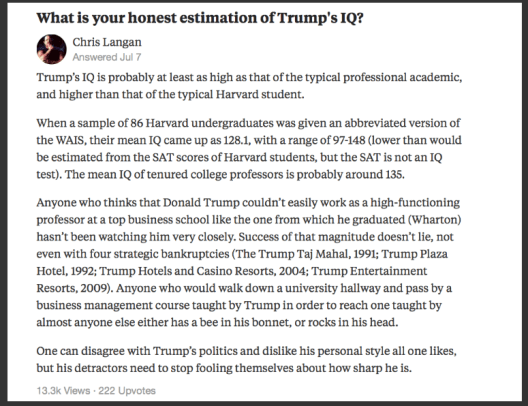
Thus, I was honored to learn that Langan mentioned in a Quora answer the same obscure Harvard study I publicized in my July 2014 article (along with the comparison to their SAT scores that I had made) along with virtually an identical IQ estimate for tenured professors I had made:

langan

This strongly suggests Langan had read my article, which makes sense since my article was extensively cited by Quora.

So I advise commenters not to say anything too dumb, because you never know when America’s smartest man might be reading!

Find the Genes: Testosterone Version by Race Realist


[Note from Pumpkin Person:  The following is a guest article and does NOT necessarily reflect the views of Pumpkin Person.  Out of respect for the author, please try to keep all comments on-topic.  I understand conversations naturally evolve, but please start on-topic]

Testosterone has a similar heritability to IQ (between .4 and .6; Harris, Vernon, and Boomsma, 1998Travison et al, 2014). To most, this would imply a significant effect of genes on the production of testosterone and therefore we should find a lot of SNPs that affect the production of testosterone. However, testosterone production is much more complicated than that. In this article, I will talk about testosterone production and discuss two studies which purport to show a few SNPs associated with testosterone. Now, this doesn’t mean that the SNPs cause high/low testosterone, just that they were associated. I will then speak briefly on the ‘IQ SNPs’ and compare it to ‘testosterone SNPs’.

Testosterone SNPs?

Complex traits are ‘controlled’ by many genes and environmental factors (Garland Jr., Zhao, and Saltzman, 2016). Testosterone is a complex trait, so along with the heritability of testosterone being .4 to .6, there must be many genes of small effect that influence testosterone, just like they supposedly do for IQ. This is obviously wrong for testosterone, which I will explain below.

Back in 2011 it was reported that genetic markers were discovered ‘for’ testosterone, estrogen, and SHGB production, while showing that genetic variants in the SHGB locus, located on the X chromosome, were associated with substantial testosterone variation and increased the risk of low testosterone (important to keep in mind) (Ohlsson et al, 2011). The study was done since low testosterone is linked to numerous maladies. Low testosterone is related to cardiovascular risk (Maggio and Basaria, 2009), insulin sensitivity (Pitteloud et al, 2005Grossman et al, 2008), metabolic syndrome (Salam, Kshetrimayum, and Keisam, 2012Tsuijimora et al, 2013), heart attack (Daka et al, 2015), elevated risk of dementia in older men (Carcaillon et al, 2014), muscle loss (Yuki et al, 2013), and stroke and ischemic attack (Yeap et al, 2009). So this is a very important study to understand the genetic determinants of low serum testosterone.

Ohlsson et al (2011) conducted a meta-analysis of GWASs, using a sample of 14,429 ‘Caucasian’ men. To be brief, they discovered two SNPs associated with testosterone by performing a GWAS of serum testosterone concentrations on 2 million SNPs on over 8,000 ‘Caucasians’. The strongest associated SNP discovered was rs12150660 was associated with low testosterone in this analysis, as well as in a study of Han Chinese, but it is rare along with rs5934505 being associated with an increased risk of low testosterone(Chen et al, 2016). Chen et al (2016) also caution that their results need replication (but I will show that it is meaningless due to how testosterone is produced in the body).

Ohlsson et al (2011) also found the same associations with the same two SNPs, along with rs6258 which affect how testosterone binds to SHGB. Ohlsson et al (2011) also validated their results: “To validate the independence of these two SNPs, conditional meta-analysis of the discovery cohorts including both rs12150660 and rs6258 in an additive genetic linear model adjusted for covariates was calculated.” Both SNPs were independently associated with low serum testosterone in men (less than 300ng/dl which is in the lower range of the new testosterone guidelines that just went into effect back in July). Men who had 3 or more of these SNPs were 6.5 times more likely to have lower testosterone.

Ohlsson et al (2011) conclude that they discovered genetic variants in the SHGB locus and X chromosome that significantly affect serum testosterone production in males (noting that it’s only on ‘Caucasians’ so this cannot be extrapolated to other races). It’s worth noting that, as can be seen, these SNPs are not really associated with variation in the normal range, but near the lower end of the normal range in which people would then need to seek medical help for a possible condition they may have.

In infant males, no SNPs were significantly associated with salivary testosterone levels, and the same was seen for infant females. Individual variation in salivary testosterone levels during mini-puberty (Kurtoglu and Bastug, 2014) were explained by environmental factors, not SNPs (Xia et al, 2014). They also replicated Carmaschi et al (2010) who also showed that environmental factors influence testosterone more than genetic factors in infancy. There is a direct correlation between salivary testosterone levels and free serum testosterone (Wang et al, 1981; Johnson, Joplin, and Burin, 1987), so free serum testosterone was indirectly tested.

This is interesting because, as I’ve noted here numerous times, testosterone is indirectly controlled by DNA, and it can be raised or lowered due to numerous environmental variables (Mazur and Booth, 1998; Mazur, 2016), such as  marriage (Gray et al, 2002Burnham et al, 2003Gray, 2011Pollet, Cobey, and van der Meij, 2013Farrelly et al, 2015;  Holmboe et al, 2017), having children (Gray et al, 2002Gray et al, 2006Gettler et al, 2011); to obesity (Palmer et al, 2012Mazur et al, 2013Fui, Dupuis, and Grossman, 2014Jayaraman, Lent-Schochet, and Pike, 2014Saxbe et al, 2017) smoking is not clearly related to testosterone (Zhao et al, 2016), and high-carb diets decrease testosterone (Silva, 2014). Though, most testosterone decline can be ameliorated with environmental interventions (Shi et al, 2013), it’s not a foregone conclusion that testosterone will sharply decrease around age 25-30.

Studies on ‘testosterone genes’ only show associations, not causes, genes don’t directly cause testosterone production, it is indirectly controlled by DNA, as I will explain below. These studies on the numerous environmental variables that decrease testosterone is proof enough of the huge effects of environment on testosterone production and synthesis.

How testosterone is produced in the body

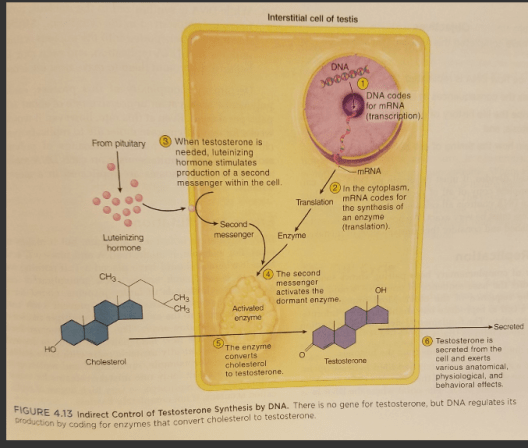
There are five simple steps to testosterone production: 1) DNA codes for mRNA; 2) mRNA codes for the synthesis of an enzyme in the cytoplasm; 3) luteinizing hormone stimulates the production of another messenger in the cell when testosterone is needed; 4) this second messenger activates the enzyme; 5) the enzyme then converts cholesterol to testosterone (Leydig cells produce testosterone in the presence of luteinizing hormone) (Saladin, 2010: 137). Testosterone is a steroid and so there are no ‘genes for’ testosterone.

Cells in the testes enzymatically convert cholesterol into the steroid hormone testosterone. Quoting Saladin (2010: 137):

But to make it [testosterone], a cell of the testis takes in cholesterol and enzymatically converts it to testosterone. This can occur only if the genes for the enzymes are active. Yet a further implication of this is that genes may greatly affect such complex outcomes as behavior, since testosterone strongly influences such behaviors as aggression and sex drive. [RR: Most may know that I strongly disagree with the fact that testosterone *causes* aggression, see Archer, Graham-Kevan and Davies, 2005.] In short, DNA codes only for RNA and protein synthesis, yet it indirectly controls the synthesis of a much wider range of substances concerned with all aspects of anatomy, physiology, and behavior.

test

(Figure from Saladin (2010: 137; Anatomy and Physiology: The Unity of Form and Function)

Genes only code for RNA and protein synthesis, and thusly, genes do not *cause* testosterone production. This is a misconception most people have; if it’s a human trait, then it must be controlled by genes, ultimately, not proximately as can be seen, and is already known in biology. Genes, on their own, are not causes but passive templates (Noble, 2008; Noble, 2011Krimsky, 2013; Noble, 2013; Also read Exploring Genetic Causation in Biology). This is something that people need to understand; genes on their own do nothing until they are activated by the system. 

What does this have to do with ‘IQ genes’?

My logic here is very simple: 1) Testosterone has the same heritability range as IQ. 2) One would assume—like is done with IQ—that since testosterone is a complex trait that it must be controlled by ‘many genes of small effect’. 3) Therefore, since I showed that there are no ‘genes for’ testosterone and only ‘associations’ (which could most probably be mediated by environmental interventions) with low testosterone, may the same hold true for ‘IQ genes/SNPS’? These testosterone SNPs I talked about from Ohlsson et al (2011) were associated with low testosterone. These ‘IQ SNP’ studies (Davies et al, 2017; Hill et al, 2017; Savage et al, 2017) are the same—except we have an actual idea of how testosterone is produced in the body, we know that DNA is indirectly controlling its production, and, most importantly, there is/are no ‘gene[s] for’ testosterone.

Conclusion

Testosterone has the same heritability range as IQ, is a complex trait like IQ, but, unlike how IQ is purported to be, it [testosterone] is not controlled by genes; only indirectly. My reasoning for using this example is simple: something has a moderate to high heritability, and so most would assume that ‘numerous genes of small effect’ would have an influence on testosterone production. This, as I have shown, is false. It’s also important to note that Ohlsson et al (2011) showed associated SNPs in regards to low testosterone—not testosterone levels in the normal range. Of course, only when physiological values are outside of the normal  range will we notice any difference between men, and only then will we find—however small—genetic differences between men with normal and low levels of testosterone (I wouldn’t be surprised if lifestyle factors explained the lower testosterone, but we’ll never know that in regards to this study).

Testosterone production is a real, measurable physiologic process, as is the hormone itself; which is not unlike the so-called physiologic process that ‘g’ is supposed to be, which does not mimic any known physiologic process in the body, which is covered with unscientific metaphors like ‘power’ and ‘energy’ and so on. This example, in my opinion, is important for this debate. Sure, Ohlsson et al (2011) found a few SNPs associated with low testosterone. That’s besides the point. They are only associated with low testosterone; they do not cause low testosterone. So, I assert, these so-called associated SNPs do not cause differences in IQ test scores; just because they’re ‘associated’ doesn’t mean they ’cause’ the differences in the trait in question. (See Noble, 2008; Noble, 2011Krimsky, 2013; Noble, 2013.) The testosterone analogy that I made here buttresses my point due to the similarities (it is a complex trait with high heritability) with IQ.

Open thread Nov 21, 2017

A few random thoughts:

Too bad about Charlie Rose not being the upstanding gentleman the World thought he was.  This is the third time in the past few years a talented interviewer (seemingly) lost his show because of a sex scandal, the first two being CBC radio’s Jian Ghomeshi and Fox News’s Bill O’reilly.

I suspect part of what happened in Rose’s case is that a lot of women were star struck by his power and celebrity, and Rose misinterpreted this as sexual interest since as a former college basketball player and media elite, he was used to women being attracted to him.  But sadly the ageing process catches up with even the most alpha of males, and the ladies are no longer liked him that way.

It will be interesting to see who replaces him on CBS this morning.  He and Gayle King Bumpus had such great chemistry and it’s sad to see it potentially end.

Meanwhile, I found this really interesting talk about cross-cultural schizophrenia:

Always cool when the elite psychology professor looks like a psycho himself, and the fact that elite professors are able to look like that, yet still command respect is a testament to their status.

This professor was raised an Orthodox Jew but his IQ was apparently so high he realized there was no God at just 13, though could never tell his father about his atheism.

He clearly has an extremely high verbal IQ, and an extremely high full-scale IQ, but I suspect only average or slightly below average Performance IQ .  One thing I love about the WAIS-R is you can be a moron in several ways, yet still end up with an extremely high overall IQ, because intelligence is not a unitary variable, but as Wechsler said, a composite global entity.

Excellent talk on epigenetic inheritance

I really enjoyed this talk by Karen B. Michels on epigenetic inheritance (see video below):

Michels is a Radcliffe fellow (one of the top 50 artists/scholars as chosen by Harvard each year) and she begins the talk by explaining how when she first got the email informing her of her acceptance, she started screaming on a bus in rural Vietnam, and the other passengers may have thought “these foreigners are soooooooo weird”

I thought it was a funny story; her audience didn’t, but she was adaptable enough to quickly switch gears and dive right into epigenetic inheritance.

Epigenetics literally means “on top of genetics”, and the epigenome refers to the chemical tags placed on the DNA sequence to either silence or activate certain genes.  Unlike our genome, which remains stable throughout our life unless we get rare mutations, the epigenome is much more sensitive to environmental effects like smoking and diet etc.

The question is, does this environmental damage to your epigenome get passed on to your kids?  Many studies claim it can, including a very famous study in which the children of mice taught to fear a certain smell, also feared that smell.

However Michels explains that if you have kids, these epigenetic tags are removed not once, but twice, during fertalization, which should protect your kids from the environmental damage you did to your epigenome.

So how does Michels explain what looks like cases of environmental damage to the epigenome being passed on?  A common example is a grandmother smoking during pregnancy causing obesity in grandkids.  While this is commonly interpreted as a case of epigenetic inheritance (since smoking damages your epigenome), Michels explains that the grandkid didn’t nessecarily inherit her damaged epigenome from grandma, but rather smoking damaged the unborn female fetus (including its reproductive cells, thus damaging the future grandchild to boot).

Study after study proclaims “epigenetic inheritance” even though they don’t even come close to proving it (which would require four generations on the female line and three on the male line).  Michels got so frustrated by the misleading use of the term “epigenetic inheritance” that she complained to Nature Genetics and their response was NOT INTERESTED.

The audience gasped.

Michels explained that the way you get published, tenure, and grants is to use epigenetics in your titles.

Michels does not deny epigenetic inheritance, she just feels there’s no evidence for it in humans (and presumably other complex animals) with the exception of genomic imprinting.

Overall I loved the talk, but what I really wanted to know was how an epigenetic inheritance skeptic like Michels explains how mice can be born to fear smells their parents were taught to fear.


Lamarckism vs Darwinism

Lamarckism is the theory that organisms evolve not through survival of the fittest as Darwin argued, but by passing on acquired traits to their descendants.  For example,  you might naturally have a very scrawny body build, but if you spend all your time lifting weights, not only will you become more muscular, but you will biologically pass those muscles on to your son, and if he too lifts weights, he’ll pass on even more muscle to his sons, and in many generations, we’ll evolve into a race of incredible hulks.

Lamarckists believed that giraffes evolved long necks, not because only the longest necked giraffes survived (as Darwinists believe) but because by stretching their neck to reach food, they made them longer, and that extra length was somehow biologically inherited by the next generation, who would in turn stretch their necks even further, etc.

Lamarckism was famously discredited when a scientist chopped off the tails of mice for multiple generations and the mice were still born with tails.  This convinced scientists that you could not biologically pass acquired traits down to your children.  Lifting weights everyday might turn a scrawny nerd into a hulking  power lifter, however his son will still be born with the same scrawny build dad had before he started lifting weights, and the only way we would evolve into a race of hulks would be for the most naturally muscular people to have the most kids each generation, as Darwinists argue.

However with the rise of epigenetics, many people, including our very own Race Realist, have been arguing that Lamarck was somewhat right after all.  To oversimplify, epigenetics refers to chemical tags that are placed on the letters of our DNA sequence, that turn certain genes on or off, and some believe that not only can these tags be influenced by our life experience, but they can be passed on for many generations.

However when Race Realist tried to push this view at the West Hunter blog, scientist Greg Cochran would have none of it.  This is not surprising because Cochran’s skepticism towards such theories is well documented (see the 15 min mark in the below video):

Also expressing skepticism is scientist Richard Dawkins (see 2:40 mark in below video), though Race Realist feels this is largely because epigenetics undermines his “selfish gene” theory.

A major 2014 article by  Edith Heard and Robert Martienssen, published in the journal Cell, was every bit as skeptical as Cochran and Dawkins.  According to a summary of the Cell article by science writer Alex B. Berezow:

…characteristics many researchers assume to be the result of epigenetic inheritance are actually caused by something else. The authors list four possibilities: Undetected mutations in the letters of the DNA sequence, behavioral changes (which themselves can trigger epigenetic tags), alterations in the microbiome, or transmission of metabolites from one generation to the next. The authors claim that most epigenetic research, particularly when it involves human health, fails to eliminate these possibilities.

It is true that environmental factors can influence epigenetic tags in children and developing fetuses in utero. What is far less clear, however, is whether or not these modifications truly are passed on to multiple generations. Even if we assume that epigenetic tags can be transmitted to children or even grandchildren, it is very unlikely that they are passed on to great-grandchildren and subsequent generations. The mammalian epigenetic “reprogramming” mechanisms are simply too robust.

Therefore, be very skeptical of studies which claim to have detected health effects due to epigenetic inheritance. The hype may soon fade, and the concept of Lamarckian evolution may once again return to the grave.


IQ & the Bell Curve

Commenter Race Realist claimed in the comment section that IQ and many other physiological traits do not form bell curves.

A bell curve is just a distribution of scores where most people score around average, and as scores move further from the average in either direction, the number of people very gradually decreases (forming the shape of a bell).

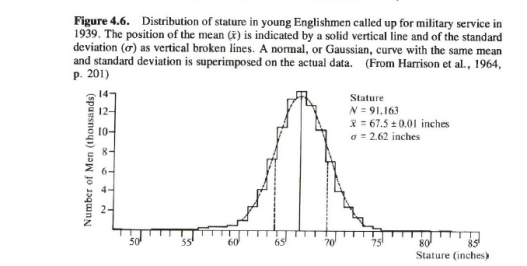
As Arthur Jensen noted in his book, Bias in Mental Testing, many physical traits roughly form a bell curve, for example, height:

bellcurve4

Birth weight:

bellcurve6

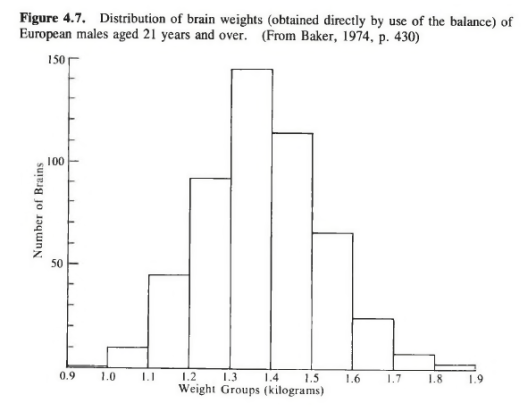
Brain weight:

bellcurve5

The reason for this, as Jensen brilliantly understood even back in the early 1970s, is these are complex polygenetic traits caused by a great many uncorrelated genetic and micro-environmental effects, and thus their distribution should resemble the flipping of thousands of coins, giving you either bad or good genetic (and environmental) luck:

bellcurve10

While it’s true that modern IQ test results are forced to fit a bell curve, this is not necessarily because cognition doesn’t naturally form a bell curve, but rather it’s because in order for test results to naturally form a bell curve, you need what’s called an interval scale: A scale where items increase in difficulty at equal intervals.

But because it can be tricky and tedious to judge whether a certain IQ test item is 10% more difficult than another one, or 30% more difficult,  IQ tests often contain abrupt jumps in difficulty, making them ordinal scales, not interval scales, which prevent the distribution of scores from being smooth and continuous.  As a result scores wont always naturally fit a bell curve, they must be forced to.

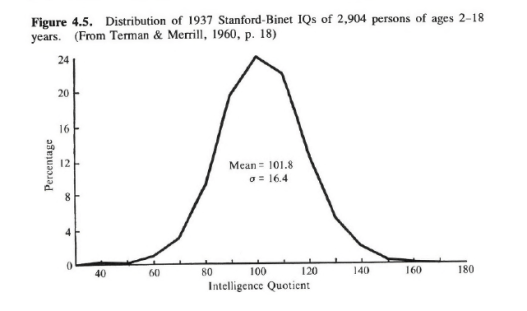
However as Arthur Jensen noted in  Bias in Mental Testing, some psychometric tests are based on interval scales.  For example the original Binet scale used the concept of age.  Since the difference between a six-year-old and a five-year-old is theoretically the same as the difference between a ten-year-old and a nine-year-old (one year), this is an interval scale, and so IQs calculated from the ratio of a child’s mental age to his chronological age closely approximated a bell curve for the middle 99% of the population:

bellcurve3

As Jensen explained, the departure from normality at the lower extreme is caused by major disorders that override normal polygenetic variation such as mutations of large effect, chromosomal abnormalities, birth trauma and the like.  The surplus of scores at the high extreme is less pronounced and harder to explain.

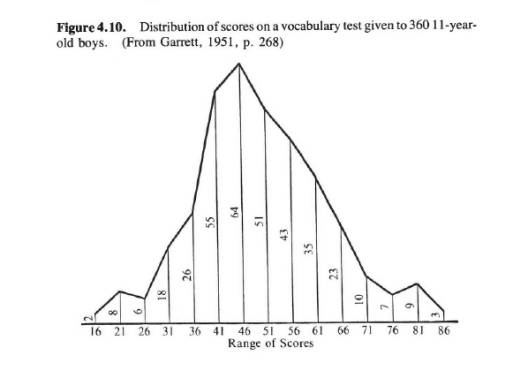
One of the best measures of IQ is Vocabulary.  Most vocabulary tests are not true interval scales because psychologists arbitrarily pick words for people to define, and these may increase in difficulty in a non-linear way,  however as Jensen noted, some Vocabulary tests are based on selecting words from the dictionary at random, and when this is done, the total number of random words kids can correctly define, approximates a bell curve:

bellcurve8

Another example of an interval scale is Digit Span, because Digit spans gradually increase in difficulty one digit at a time, with multiple trials at each difficulty level.  When this was scored such that each digit correctly recalled in the right order scored a point, the scores of 5,539 Navy recruits approximated a bell curve:

bellcurve7

Of course I’m not suggesting that all cognitive abilities form a bell curve.  Indeed a member of Prometheus once claimed that because the human mind works in parallel, complex problem solving speed actually doubles every 5 IQ points, which is about as far from a normal distribution as you can get.

An interesting question is why do some forms of cognition (including some very g loaded abilities like Vocabulary) form a bell curve, while spatial and math talent may form an exponential curve, and does this imply math and spatial geniuses are vastly more intelligent than verbal geniuses, since the latter are at most only about 100% verbally smarter than average, while the former are many orders of magnitude spatially or mathematically smarter?


IQ, biology and culture bias

An ideal study of IQ and environment might be as follows:

Find 300 Bushmen babies being raised as hunter-gatherers and randomly assign them to three groups of 100 Bushmen each:

Group 1:  Gets sent to the United States where they are raised by billionaire Ivy League PhDs and the full-blooded children of these adopted Bushmen are also raised by billionaire Ivy League PhDs.

Group 2:  Remains in their hunter-gatherer environment, but gets weekly visits from doctors and nutritionists  to make sure they, and their babies have the exact same First World medical care, health and nutrition as Group 1, but these health professionals are not allowed to speak to them in English or explicitly educate them in anyway; their only role to make sure the Bushmen reach their biological potential which means doing regular health checkups and supplementing any nutritional deficiencies, especially in pregnant women.  If the health professionals do their job, we’d expect the second generation of group 2 to have the same birth weight, infant head circumference, adult height, and perhaps adult MRI brain size as group 1’s second generation.

Group 3:  Remains in their hunter-gather environment with no intervention at all.

Several decades later, the children of all three groups would be administered the Wechsler intelligence scales (in English for group 1, translated into a Khoe language for groups 2 and 3, though for the Vocabulary subtest they would still have to define English words, none of which they would have heard before, but they would define them in their native Khoe)

If this were done, I would expect the subtests of the Wechsler could be divided into the following categories:

Type 1:  subtests where the group 1 > group 2 gap far exceeds the group 2 > group 3 gap.  These would likely be subtests like Information and Vocabulary which requires exposure to Western culture which groups 2 and 3 lacked.

Type 2:  subtests where the group 2 > group 3 gap far exceeds the group 1 > group 2 gap.  These would be subtests where exposure to Western culture and education matters much less than the physical development of the brain.  These would likely include some of the hard-core Wechsler performance subtests where you have to use your hands to quickly fit objects together in a spatially competent way.

Type 3:  subtests where all three groups would score relatively equal.  These are subtests where neither the cultural nor biological environment matters much unless it’s pathological.  Skeptics would deny type 3 tests are even possible, but perhaps some of the Wechsler auditory short-term memory subtests might be type 3.

We don’t have to give the three subtest types names, but it’s tempting to use adjectives like crystallized, achievement, and culturally loaded to describe type 1 subtests, and fluid, aptitude and culture reduced to describe types 2 and 3.  The difference between 2 and 3 being that the former show more phenotypic plasticity, but for biological, not cultural reasons.

The Raven Progressive Matrices is a test which showed enormous phenotypic plasticity over the 20th century (the Flynn effect) even though it was intended to be culture reduced.  This can be partly explained by the fact that Flynn effect is partly biological (Richard Lynn noted that improved nutrition has increased brain size since WWI) and by the fact that the Raven is partly cultural, as James Flynn has argued.

If even the Raven is culturally biased, is a truly culture fair psychometric test even possible?  If we define culture fair as tests where group 1 and group 2, but not necessarily group 3, score equally, these might be possible, but I think the reason the Raven failed was a) it’s boring nature made it too sensitive to test motivation which is a culturally sensitive variable, and b) as James Flynn implied, it relied too much on hypothetical thinking:  people in less modern cultures only apply their intelligence to clearly defined practical looking problems with tangible solutions.

Some of the Wechsler auditory short-term memory subtests or hands-on spatial subtests might come a lot closer to culture fair than the Raven did.

They’re all gona laugh at you!

A popular theory among U.S. elites:  Trump ran for President because he was so humiliated by Barack Obama at the 2011 White House Correspondents’ Dinner that it was the only way to save face.  Explaining the theory Dan McLaughlin writes:

Despite being born to wealth, he’s lived his whole life as the nouveau riche kid from Queens whose fame, fortune, Ivy League degree, fashion-model wives, TV shows, casinos, beauty pageants, football team, political largesse . . . none of it could get his old-money Manhattan society neighbors, the smart kids, the political movers and shakers to treat him as a peer, an equal, a man of consequence.

Partly because of this,  The New York Time‘s Charles M. Blow argues Trump is jealous of Obama:

Trump wants to be Obama — held in high esteem. But, alas, Trump is Trump, and that is now and has always been trashy. Trump accrued financial wealth, but he never accrued cultural capital, at least not among the people from whom he most wanted it.

Therefore, Trump is constantly whining about not being sufficiently applauded, commended, thanked, liked. His emotional injury is measured in his mind against Obama. How could Obama have been so celebrated while he is so reviled?

The whole world seemed to love Obama — and by extension, held America in high regard — but the world loathes Trump.

Obama was a phenomenon. He was elegant and cerebral. He was devoid of personal scandal and drenched in personal erudition. He was a walking, talking rebuttal to white supremacy and the myths of black pathology and inferiority. He was the personification of the possible — a possible future in which legacy power and advantages are redistributed more broadly to all with the gift of talent and the discipline to excel.

Given this backdrop, when Obama lured Trump to the 2011 White House Correspondents’ Dinner to be laughed at to his face by a room full of  U.S. elites and on international TV, he snapped, according to The New Yorker‘s Adam Gopnik:

On that night, Trump’s own sense of public humiliation became so overwhelming that he decided, perhaps at first unconsciously, that he would, somehow, get his own back — perhaps even pursue the Presidency after all, no matter how nihilistically or absurdly, and redeem himself

Explaining further, McKay Coppins writes:

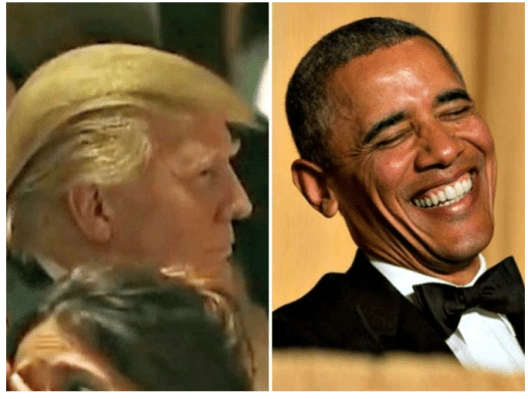
On the night of the dinner, Trump took his seat at the center of the ballroom, perfectly situated so that all 2,500 lawmakers, movie stars, journalists, and politicos in attendance could see him….But as soon as the plates were cleared and the program began, it became agonizingly clear that Trump was not royalty in this room: He was the court jester. The president used his speech to pummel Trump with one punchline after another…When host Seth Meyers took the mic, he piled on with his own rat-a-tat of jokes, many of which seemed designed deliberately to inflame Trump’s outer-borough insecurities: “His whole life is models and gold leaf and marble columns, but he still sounds like a know-it-all down at the OTB.” The longer the night went on, the more conspicuous Trump’s glower became. He didn’t offer a self-deprecating chuckle, or wave warmly at the cameras, or smile with the practiced good humor of the aristocrats and A-listers who know they must never allow themselves to appear threatened by a joke at their expense.

whitehouse

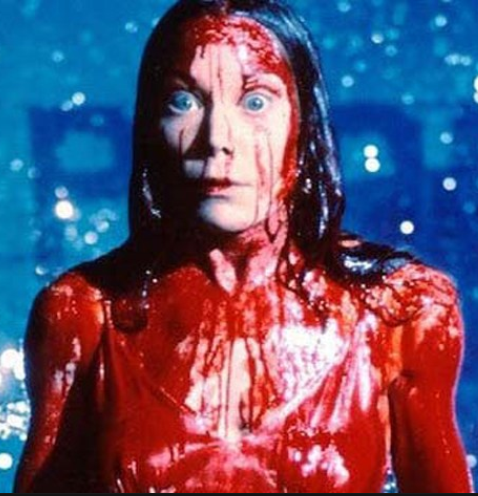
Instead, Trump just sat there, stone-faced, stunned, simmering — Carrie at the prom covered in pig’s blood.

carriewh

It’s ironic that Coppins seems to hint at Trump’s lack of social intelligence in this situation since commenters on this blog often praise Trump as one of the greatest social geniuses of our time, a reasonable opinion given Trump beat the top politicians in America at the their own game, despite no political experience.  Perhaps Trump was just too angry to display his social skills on that night, or perhaps his type of social savvy can’t adapt to upper class environments.

More interesting, given it’s Halloweek, was Coppins’s reference to Stephen King’s first novel.  In Carrie, after being lured to the prom by the elite kids only to be publicly laughed at, a high school senior takes her revenge by becoming the most powerful girl in the World (destroying the school with her telekinetic powers).

Similarly, after being lured to the White House Correspondents’ Dinner by U.S. elites to be publicly laughed at, Trump got his revenge by becoming the World’s most powerful man, displacing the President who mocked him.

He who laughs last, laughs best.

Did modern humans evolve from killer apes?

Homo Erectus

In honor of Halloweek, I thought I’d share a terrifying little tidbit I learned from a great lecture by professor Henry Gilbert.  At the 1 hr 14 min mark in the below video he mentions a theory that the really thick crania observed in Homo Erectus may have been an adaptation to the fact that they were bashing each other’s heads in.  This is wildly speculative but this might also help explain extreme selection for brain size we see in Erectus, since 1) winning fights requires brain functions like intelligence and physical coordination, 2) head butting people requires a large cranium, 3) some research claims big brains can absorb more insults though this is disputed, and 4) selection for brain size was paralleled by selection for height, which is also useful in combat, especially head butting.

Another point Gilbert makes is that the huge brow ridges of Homo Erectus might be explained by their  robust cranium combined with small frontal lobes (compared to modern humans).

In my last article I discussed the opening scene in 2001: A Space Odyssey, which really emphasized Raymond Dart’s killer ape theory that was popular in the 1960s but has since fallen out of favour, which is a bit surprising given the facts that 1) violence is an obvious selection pressure for intelligence 2) humans are incredibly violent creatures and so are our ape relatives the chimpanzees, and 3) genetic evidence confirms that anatomically modern humans rapidly replaced all other “human” species with only minimal admixture.  On the other hand, there isn’t much evidence the replacement was violent, other than a controversial claim that we ate Neanderthals and the fact that caves occupied by Neanderthals were often taken over by modern humans quite rapidly.

One problem with the killer ape theory is that a recent paper claimed that contrary to Gilbert, cranial thickness was not exceptionally extreme in Erectus.