Homeless (2016)

Pumpkin Person rating: 8 out of 10

Homeless (2016) Directed by Clay Riley Hassler

I watched this movie last night on tubi and was utterly blown away. It was so brilliantly simple, realistic and depressing in its portrayal of the dark side of teenaged life that I would compare it to the 2020 masterpiece Never, Rarely, Sometimes, Always.

The film is about a homeless teenaged white boy named Josh (spelled Gosh). The film starts with the haunting image of Gosh just looking at a lantern in the blowing wind of a cold urban street. For this is the life of the homeless; you having nothing to do all night but fixate on random objects and appreciate their beauty until you fall asleep or you mind turns to mush; whichever happens first.

Gosh looks like the kind of guy who have might been one of the cool kids if he were in high school, but having sunk to a level of poverty so extreme, he is now the lowest of the low. Despite being a young white man in America, he is looked upon like a crippled old black skinned untouchable in India.

He enters a store and asks the clerk if she got his job application.

“we’re not hiring right now,” she tells him nervously and then looks at her coworker with horrified relief as he finally leaves.

He smells like shit, we overhear them whisper behind his back.

But then as Christmas approaches, the kindness of a single lady in a mall food court leads to Gosh getting a job, a place to stay and maybe even a cute girlfriend.

Can he finally turn his life around?

Available on tubi:

The life span of body builders

A study reports:

Bodybuilders have a mortality rate 34% higher than that of the age-matched U.S. male population, according to a study presented at the American Urological Association’s 2016 annual meeting.

Daniel Gwartney, MD, and colleagues at Baylor College of Medicine in Houston identified 1,578 professional male bodybuilders who compete from 1948 to 2014. They were able to obtain complete mortality data for 597. The mean age of the cohort was 47.5 years (range 25–81.7 years). The mean age during competitive years was 24.6 years (range 18–47 years). Of the 597 men, 58 (9.7%) were reported dead. Only 40 deaths were expected in this population based on age-matched data, for a standardized mortality rate of 1.34…

Although the cause is unclear, the increased mortality supports the possibility that use of performance enhancing drugs and unique competitive training, such as extreme weight changes, may contribute to deaths among younger professional bodybuilders.

Another possibility is that body building increases body mass index (bmi) and bmi causes death, regardless of whether the weight is muscle or fat. One reason might be that it burdens the heart to pump blood through such a robust body.

Another reason is that weight/height ratio is negatively correlated with IQ so high BMI people might make bad health and safety decisions.

Another reason weight/height ratio may lower life span is that it requires that you eat a lot and a growing body of research suggesting fasting is the key to long life span.

Having tall gracile African physiques may have give our species a competitive advantage over the short robust cold adapted Neanderthals because although height and strength both confer benefits, the caloric cost of the latter is much greater making it an inferior strategy.

Late Night (2019)

Pumpkin Person rating 7 out of 10

I finally watched this movie!

I don’t know why it took me so long because I love Emma Thompson, I love Mindy Kaling, and I love TV talk show hosts, and this movie combines all three.

The film is about a brilliant British late night talk show host named Katherine (Emma Thompson) who is being fired from her job because declining ratings. Adding insult to injury, she is being replaced by a lower class low IQ male comic who relishes in vulgar bathroom fraternity boy humour, much like our very own Mug of Pee. Desperate to save her show from being taken over by such trash, she orders her assistant to hire a woman to provide a fresh perspective, and in comes Molly (Mindy Kaling). The white male writing team is appalled that Indian American Molly went from working at a chemical factory to writing for a major late night talk show.

“I wish I was a woman of color so I could get any job with no qualifications!” one of them bitterly says behind her back. But little do they know Molly is the perfect person for the job!

The film is kind of predictable and the characters are a little underdeveloped, but the dialogue is sharp and funny and Thompson and Kaling shine in their respective parts,. Now available on Netflix:

Never have I ever (Netflix dromedy) 2020-

Pumpkin Person rating: 8.5/10

Never have I ever is a teen dromedy on Netflix created by Indian American actress/writer/producer Mindy Kaling. The show has been a huge success, drawing 40 million households worldwide in its first four weeks and now renewed for its 4th season.

I watched the first three seasons and was very impressed. The main character is Brahman brainiac Devi Vishwakumar who feels that losing her virginity to Paxton (the coolest kid in school) will maker her popular (the actor who plays Paxton is 31 causing hilarious mocking from an Nigerian viewer who watches the show on youtube).

Devi’s nemesis is the Ashkenazi Ben Gross who is the only student to rival her academically.

Devi is best friends with Elanor (an East Asian American aspiring actress) and Fabiola (a light skinned Afro-multi-racial robotic expert) who reminds me of a female Obama (like the real Obama in youth, she socializes more with Asians than African Americans ) . The three smartest characters on the show (in no particular order) are Devi, Ben and Fabiola and all show correlates of high IQ. Ethnic background in the case of Devi and Ben and tall skinny light skinned physique in the case of Fabiola. Given that this is a pretty typical California public school, I estimate the three smartest grads a year have an average IQ of 140 (U.S. norms).

Meanwhile at home, Devi lives with her mother (a stereotypical Indian doctor) and her cousin (a Cal Tech student) who Devi is ashamed of because she thinks she’s “too Indian”. But Devi’s shame turns to indignant jealousy when she sees the way guys slobber over her cousin’s light skinned beauty.

When will aliens attack the Earth? Revised numbers

Analogy is an important part of human thought, so to estimate when aliens will invade Earth, I extrapolate from 2 relevant analogies:

When were Neanderthals invaded by Homo Sapiens?

When were Native Americans invaded by Europeans?

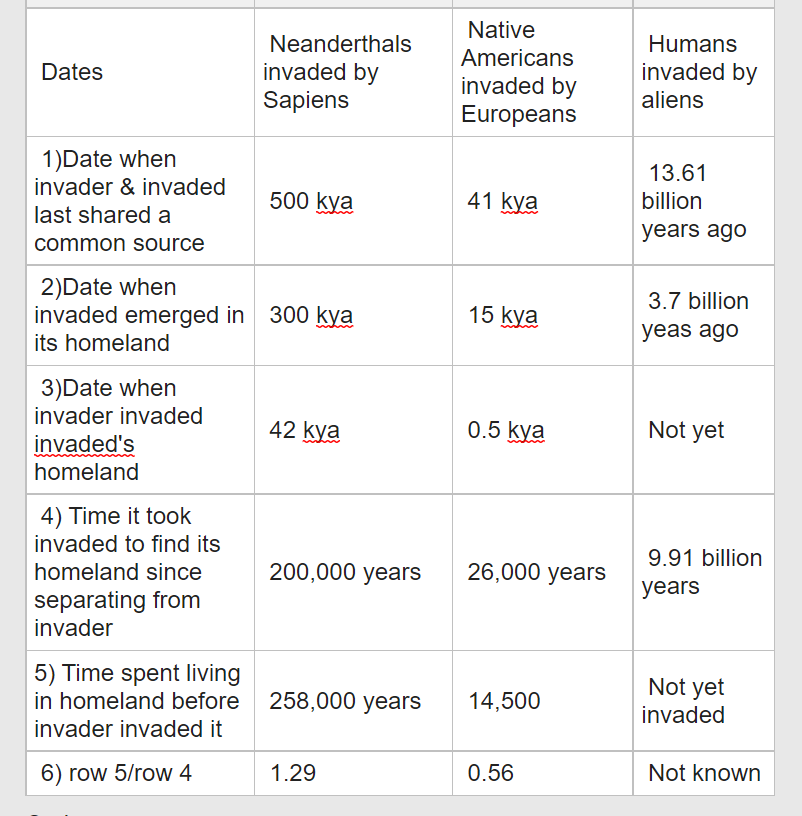
It’s estimated that Neanderthals and Sapiens shared a common ancestor about 500 kya and that Neanderthals colonized Europe 300 kya and then were invaded (in large lasting numbers) by our species, Sapiens, about 42 kya.

Thus it took 200,000 years for future Neanderthals to find Europe since splitting from future Sapiens and then got to live there in peace for 258,000 years before being invaded by their distant relatives. So in this case, they had 1.29 times as much time to enjoy their homeland as they did to emerge in it in the first place.

Meanwhile, it’s estimated Native Americans and Europeans shared a common ancestor 41 kya and that Native Americans colonized the Americas 15 kya and then were invaded by Europeans about 0.5 kya.

Thus it took 26,000 years for future Native Americans to find the Americas since splitting from future Europeans, and they had 14.5 kya to enjoy it before being invaded. Thus 0.56 as much time.

Applying the same logic to humans and aliens is tricky since we don’t share a common ancestor, but we do share a common origin; and assuming there are no intelligent aliens in our solar system, that common origin is the emergence of our galaxy itself about 13.61 billion years ago and 9.91 billion years later, we began living on Earth.

So how long will it take our alien “relatives” to hunt us down and attack us? Using the invasions of Neanderthals and Native Americans as analogies, it should tale between 1.29 and 0.56 of 9.91 billion years so between 12.8 billion and 5.5 billion years.

So given that we’ve been on Earth for 3.7 billion years, that gives us another 9.1 billion to 1.4 billion years to live in peace, with the best estimate being 5.25 billion years.

Thus it makes perfect sense that we haven’t been invaded yet and have more to fear from a nuclear holocaust, a meteor and climate change than we do from alien invasion.

Who needs the Drake equation when we got the Pumpkin equation?

When to expect life from other planets?

For over 14,000 years Native Americans must have looked out at the ocean and asked “are we alone on the planet? Is there intelligent life on other continents? We must be alone; we’ve been looking at the ocean for 14,000 years and no intelligent life has ever come our way. We are alone on the planet”

Then one day in 1492, they were invaded by another intelligent life form known as the white man.

What does this tell us about life on other planets?

If it took 14,000 years to be visited by intelligent life that Native Americans shared a common ancestor with only 41,000 years ago, then this suggests it takes 34% of the time since two populations diverged for one of the populations to find the other.

Thus if our galaxy is 13.6 billion years old, any other intelligent life will share a common cosmic non-living source with us about 13.6 billion years ago. Thus it should take them 0.34(13.6 billion) = 4.6 billion years to find us. Life has only been on Earth for 3.7 billion years, so I expect aliens to discover us in about 900 million years.

The history of Homo Sapiens brain size part 3: pre-war Holocene

In the third edition of this series, I use the DeSilva (2021) data-set explore human brain size from 11,700 years ago to about the first World War. The data-set has 704 crania in this period and these range from 907 cc (Morton specimen from the early 20th century) to 1,859 cc (Bristol 2 specimen from about 750 years ago).

The total sample in this era has a mean of 1324 cc with an SD of 156. This is a major reduction from the 1459 cc mean found in the Upper Paleolithic so I must side with those scientists who say the brain has shrunk since the ice age (at least phenotypically).

Why did the brain suddenly start shrinking after 4 million years of growth?

The most obvious reason is malnutrition. The transition from hunters to farmers damaged our height, health and life span, so why not our brain size (and intelligence) too? But the good news is these declines reflect our phenotypic plasticity. The fact that we still have the genetic potential to be tall, smart and big brained is proven by the speed with which these traits have come roaring back with the advent of 20th century nutrition. Indeed my analysis of 21st century military records suggests that at least in America, brain size has reached 1418 cc. This is almost as big as our Paleolithic ancestors and what little shortfall exists, can probably be explained by us being more genetically gracile than our muscle bound stone age forerunners who needed those extra 40 cc to coordinate their ample bulk. It’s well known that brain size better predicts intelligence when body size is adjusted for.

The history of Homo Sapiens brain size part 2: Upper Paleolithic

In part 1 of this series I examined the average brain size of Sapiens in the Middle Paleolithic (300 kya to 50 kya). In this article, I look at the Upper Paleolithic (50 kya to 12 kya) and once again I turn to DeSilva (2021) data-set ( considered the largest known data-set of directly measured ancient human crania)

The 115 specimens in this time period ranged from 1117 cc (Coobool creek, 14 kya) to 1775 cc (Grothes des infants 4, about 28 kya). The mean is 1459 (SD 143), vs 1452 (SD 129) in the Lower Paleolithic. Although it’s likely that brains got bigger as Sapiens left the tropics and headed North in the Upper Paleolithic, the observed difference here is not statistically significant.

The history of Homo Sapiens brain size part 1: Middle Paleolithic

Commenter Melo (meLon Musk) recently linked to a paper arguing that the brain size of H Sapiens has been stable for hundreds of thousands of years. Already aware of the paper, I had emailed the lead author and he replied “You might download the DeSilava data set from their paper – it is open source. As far as I know, it has the most complete cranial volume data set (directly measured volume).”

Of course analyzing such an enormous data set is overwhelming so I decided to start with Middle Paleolithic brains (300 kya to 50 kya). There were 17 Sapiens skulls in the data set from this time period and these ranged from 1100 cc (Manot Cave specimen) to 1590 (skhul 9 specimen) with a mean of 1441 (SD 127). When I remove the two oldest specimens from the sample (the Jebel Irhoud pair which some argue are proto-Sapiens not fully Sapiens) the mean and SD increase slightly (1452, 129 respectively).

Overall, these brains look pretty damn big, especially since Sapiens hadn’t even lastingly left the tropics yet, but I’ll reserve judgement until analyzing other time periods.