• About

Pumpkin Person

~ The psychology of horror

Pumpkin Person

Tag Archives: David Reich

Genetic distance between humans, neanderthals & other primates

25 Saturday May 2019

Posted by pumpkinperson in Uncategorized

≈ 92 Comments

Tags

anatomically modern humans, David Reich, Denisovans, genetic distance, genus, Neanderthals, race, species, taxonomy

About a year ago I wrote:

The following chart (created by some scientist(s) led by David Reich) shows the genetic divergence between hominin samples as a fraction of the human-chimp difference.  So for example, all the human groups have just over a 0.12 genetic divergence with Neanderthals, meaning that the genetic difference between humans and Neanderthals is only 12% as great as the genetic difference between humans and Chimps (source: supplement of Genetic history of an archaic hominin group from Denisova Cave in Siberia.)

distance4

The purpose of the chart is to estimate how long ago the different populations diverged from a common ancestor.  So since the fossil record tells us that Neanderthals and chimps diverged about 6.5 million years, then humans and Neanderthals should have diverged roughly 0.8 million years ago (12% of 6.5 million) assuming genetic divergence maps to chronological divergence in a linear way.

I transformed the genetic distance matrix into a dendrogram, which looks at all the distances and creates the most parsimonious family tree:
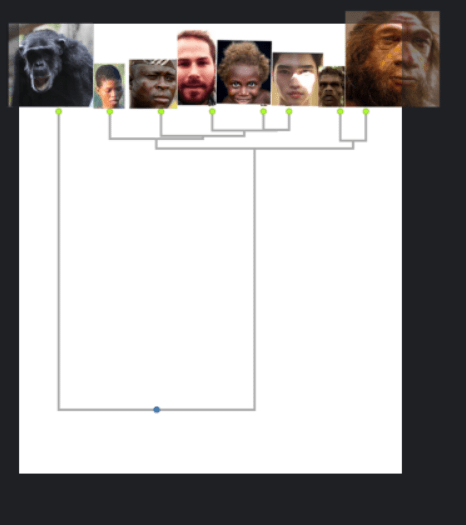
Dendogram showing genetic relationship between 8 groups. From left to right: chimps, san, Yoruba, French, Papuan, East Asian, Denisovan, Neanderthals

What’s cool about dendrograms is they let you determine the number of categories and subcategories in a very objective way.

Of course dendrograms are only as good as the data you put into them, and I don’t endorse basing taxonomy simply on genetic relatedness, but if I did, here’s how I’d interpret the above tree:

The first major split is between chimps & everyone else. This is consistent with two well recognized genera of hominins : Pan (i.e. chimps) and Homo (humans and near-humans).

Now within the Homo genus, we see another major split in the tree. Anatomically Modern Humans (AMH) vs Archaic Humans. Thus we can divide the homo genus into at least two major species.

Within the Archaic Humans we can further subdivide into major races: Denisovans and Neanderthals.

Now within our own species, AMH, the dendrogram shows three major races: Capoids, Congoids and Non-Africans.

I’m not saying I agree with this taxonomy since it was only based on genetic distance (much of which is junk DNA) but what’s great about using dendrograms is almost everyone looking at them will assign groups to the same categories and subcategories, even if they don’t use the same words (race, species, genus) to describe them. It’s wholly objective.

But what is needed is a dendrogram based on polygenic scores of actual phenotypes. That way people who have the same phenotypes caused by the same genomic architecture could be grouped together.

Unlike the above dendrogram, which groups based on how recently we share a common ancestor, we need to group based on how much of the common ancestor we share.

[update may 26, 2019: an earlier version of this article misspelled dendrogram]

[2nd update may 26, 2019: an earlier version of this article contained bragging that has since been removed]

Share this:

  • Click to share on X (Opens in new window) X
  • Click to share on Facebook (Opens in new window) Facebook
Like Loading...

The evolution of behavioral modernity

10 Friday May 2019

Posted by pumpkinperson in Uncategorized

≈ 292 Comments

Tags

David Reich, Richard Klein

Commenter Nehemiah writes:

It is implausible that the Bushmen populations (which once occupied a much larger range than today) lived in total isolation from non-Bushmen populations. Presumably the mutation or mutations that facilitated the emergence of grammar appeared or came together in one population first. This development was so valuable that the relevant genes had a high chance of being preserved and spreading to fixation if even a small amount of interbreeding occurred with a neighboring population. Thus, even if Bushmen (and Pygmies, BTW) split off between 200kya and 300kya, that would not have prevented the spread of an especially valuable mutation from any one human population to all the rest. I argue that a limited vocabulary already existed in all sapiens populations (and probably some non-Sapiens populations as well), but the appearance of the “grammar gene(s)” made vocabulary immensely more useful so that it was now worthwhile to coin many more words, and the more intelligent band members could master the use and comprehension of this expanding vocabulary much better than the less intelligent. The grammar mutation should have spread relatively rapidly from any human population to all the rest. If we backcrossed with Neanderthals and Denisovans, I cannot imagine that there was not also gene flow to (and from) Bushmen (and Pygmies) as well. Further, I know of no reason to presume that grammar did not first emerge in Bushmen and spread to non-Bushmen rather than vice versa. We simply do not know.

Neanderthals possessed our FOXP2 gene and a hyoid bone that facilitate speech, but the larynx was still in a more anterior position, as in an infant of our species, which restricted the number of vowel sounds that could be formed, and therefore the number of words that could be created. I argue that if Neanderthal has possessed grammatical language at an earlier date, there would have been evolutionary selection for a larynx positioned so that a larger number of words could be formed. Thus, I also argue that grammar evolved sometime after Neanderthals split from the lineage that led to sapiens, and our sudden and rapid colonization of the world in the last 70ky suggests that the grammatically structured use of vocabular evolved shortly before we exploded suddenly over the world’s surface, since the appearance of grammatical language is the most likely advantage that allowed us to expand rapidly and to quickly displace our rivals who were longer established and better adapted to the local environment.

The notion that a small number of genetic mutation(s) gave rise to behavioral modernity and the upper Paleothic revolution is associated with paleontologist Richard Klein:

But geneticist David Reich is having none of it:

Expanding our analysis to the whole genome, we could not find any location–apart from mitochondrial DNA and the Y chromosome, where all people living today share a common ancestor less than 320,000 years ago. This is a far longer time scale than the one required by Klein’s hypothesis. If Klein was right, it would be expected that there would be places in the genome, beyond mitochondrial DNA and the Y chromosome, where almost everyone shares a common ancestor within the last hundred thousand years. But these do not in fact seem to exist.

Our results do not completely rule out the hypothesis of a single critical genetic change. There is a small fraction of the genome that contains complicated sequences that are difficult to study and that was not included in our survey. But the key change, if it exists, is running out of places to hide….

From Who are we and how we got here by David Reich, pg 18

But while Reich largely rejects the idea of a single (or small number) of genetic mutations giving rise to behavior modernity, he seems open to the possibility that “…coordinated natural selection on combinations of many mutations simultaneously–did enable new cognitive capacities…”

See also: The importance of brain shape

Share this:

  • Click to share on X (Opens in new window) X
  • Click to share on Facebook (Opens in new window) Facebook
Like Loading...

contact pumpkinperson at easiestquestion@hotmail.ca

Recent Comments

pumpkinperson's avatarpumpkinperson on Which better predicts populati…
God's Word's avatarGod's Word on Which better predicts populati…
RaceRealist's avatarRaceRealist on Which better predicts populati…
austin slater's avataraustin slater on Which better predicts populati…
RaceRealist's avatarRaceRealist on Which better predicts populati…
God's Word's avatarGod's Word on Which better predicts populati…
pumpkinperson's avatarpumpkinperson on Which better predicts populati…
RaceRealist's avatarRaceRealist on Which better predicts populati…
Anime's avatarAnime on Which better predicts populati…

Archives

  • December 2025
  • November 2025
  • October 2025
  • September 2025
  • August 2025
  • July 2025
  • June 2025
  • May 2025
  • April 2025
  • March 2025
  • February 2025
  • January 2025
  • December 2024
  • November 2024
  • October 2024
  • September 2024
  • August 2024
  • July 2024
  • June 2024
  • May 2024
  • April 2024
  • March 2024
  • February 2024
  • January 2024
  • December 2023
  • November 2023
  • October 2023
  • September 2023
  • August 2023
  • July 2023
  • June 2023
  • May 2023
  • April 2023
  • March 2023
  • February 2023
  • January 2023
  • December 2022
  • November 2022
  • October 2022
  • September 2022
  • August 2022
  • July 2022
  • June 2022
  • May 2022
  • April 2022
  • March 2022
  • February 2022
  • January 2022
  • December 2021
  • November 2021
  • October 2021
  • September 2021
  • August 2021
  • July 2021
  • June 2021
  • May 2021
  • April 2021
  • March 2021
  • February 2021
  • January 2021
  • December 2020
  • November 2020
  • October 2020
  • September 2020
  • August 2020
  • July 2020
  • May 2020
  • April 2020
  • March 2020
  • February 2020
  • January 2020
  • December 2019
  • November 2019
  • October 2019
  • September 2019
  • August 2019
  • July 2019
  • June 2019
  • May 2019
  • April 2019
  • March 2019
  • February 2019
  • January 2019
  • December 2018
  • November 2018
  • October 2018
  • September 2018
  • August 2018
  • July 2018
  • June 2018
  • May 2018
  • April 2018
  • March 2018
  • February 2018
  • January 2018
  • December 2017
  • November 2017
  • October 2017
  • September 2017
  • August 2017
  • July 2017
  • June 2017
  • May 2017
  • April 2017
  • March 2017
  • February 2017
  • January 2017
  • December 2016
  • November 2016
  • October 2016
  • September 2016
  • August 2016
  • June 2016
  • February 2016
  • January 2016
  • November 2015
  • May 2015
  • January 2015
  • December 2014
  • November 2014
  • October 2014

Categories

  • ethnicity
  • heritability
  • income
  • Oprah
  • Uncategorized

Meta

  • Create account
  • Log in
  • Entries feed
  • Comments feed
  • WordPress.com

Recent Comments

pumpkinperson's avatarpumpkinperson on Which better predicts populati…
God's Word's avatarGod's Word on Which better predicts populati…
RaceRealist's avatarRaceRealist on Which better predicts populati…
austin slater's avataraustin slater on Which better predicts populati…
RaceRealist's avatarRaceRealist on Which better predicts populati…
God's Word's avatarGod's Word on Which better predicts populati…
pumpkinperson's avatarpumpkinperson on Which better predicts populati…
RaceRealist's avatarRaceRealist on Which better predicts populati…
Anime's avatarAnime on Which better predicts populati…

Archives

  • December 2025
  • November 2025
  • October 2025
  • September 2025
  • August 2025
  • July 2025
  • June 2025
  • May 2025
  • April 2025
  • March 2025
  • February 2025
  • January 2025
  • December 2024
  • November 2024
  • October 2024
  • September 2024
  • August 2024
  • July 2024
  • June 2024
  • May 2024
  • April 2024
  • March 2024
  • February 2024
  • January 2024
  • December 2023
  • November 2023
  • October 2023
  • September 2023
  • August 2023
  • July 2023
  • June 2023
  • May 2023
  • April 2023
  • March 2023
  • February 2023
  • January 2023
  • December 2022
  • November 2022
  • October 2022
  • September 2022
  • August 2022
  • July 2022
  • June 2022
  • May 2022
  • April 2022
  • March 2022
  • February 2022
  • January 2022
  • December 2021
  • November 2021
  • October 2021
  • September 2021
  • August 2021
  • July 2021
  • June 2021
  • May 2021
  • April 2021
  • March 2021
  • February 2021
  • January 2021
  • December 2020
  • November 2020
  • October 2020
  • September 2020
  • August 2020
  • July 2020
  • May 2020
  • April 2020
  • March 2020
  • February 2020
  • January 2020
  • December 2019
  • November 2019
  • October 2019
  • September 2019
  • August 2019
  • July 2019
  • June 2019
  • May 2019
  • April 2019
  • March 2019
  • February 2019
  • January 2019
  • December 2018
  • November 2018
  • October 2018
  • September 2018
  • August 2018
  • July 2018
  • June 2018
  • May 2018
  • April 2018
  • March 2018
  • February 2018
  • January 2018
  • December 2017
  • November 2017
  • October 2017
  • September 2017
  • August 2017
  • July 2017
  • June 2017
  • May 2017
  • April 2017
  • March 2017
  • February 2017
  • January 2017
  • December 2016
  • November 2016
  • October 2016
  • September 2016
  • August 2016
  • June 2016
  • February 2016
  • January 2016
  • November 2015
  • May 2015
  • January 2015
  • December 2014
  • November 2014
  • October 2014

Categories

  • ethnicity
  • heritability
  • income
  • Oprah
  • Uncategorized

Meta

  • Create account
  • Log in
  • Entries feed
  • Comments feed
  • WordPress.com

Create a free website or blog at WordPress.com.

Privacy & Cookies: This site uses cookies. By continuing to use this website, you agree to their use.
To find out more, including how to control cookies, see here: Cookie Policy
  • Subscribe Subscribed
    • Pumpkin Person
    • Join 686 other subscribers
    • Already have a WordPress.com account? Log in now.
    • Pumpkin Person
    • Subscribe Subscribed
    • Sign up
    • Log in
    • Report this content
    • View site in Reader
    • Manage subscriptions
    • Collapse this bar
 

Loading Comments...
 

    %d