Noam Chomsky thinks language is only about 100,000 years old

[PLEASE PLACE ALL OFF-TOPIC COMMENTS HERE.  THEY WILL NOT BE POSTED IN THIS THREAD]

We’ve talked a lot on this blog about Noam Chomsky, and also about Richard Klein, a scientist who argued that a single brain mutation about 50 kya sparked behavioral modernity (the rise of art, symbolism, and complex tools).

But what we haven’t talked about, is that Noam Chomsky essentially endorses Klein’s theory, only Chomsky is much more specific: he believes the genetic mutation was the capacity for language.

While a lot of comments in the comment section blather on about Chomsky’s political theories, these same comments are mum when it comes to Chomsky’s linguistic theories.  Why?  Because the latter theory is much more abstract and people lack the cognitive ability to discuss it.

Chomsky believes in part that before about 100,000 years ago, humans could only understand linear language, but because of a mutation after 100,000 years ago, we suddenly acquired an ability to arrange words in stacked triangles, and thus think hierarchically, so adverbs could modify verbs that were linearly far away in a sentence.  So as Chomsky’s co-author Robert C. Berwick likes to say:

“Instinctively, birds that swim, can fly”

Instinctively refers to the ability to fly, not the ability to swim, even though linearly, the former verb is closer.  So if Chomsky and Berwick are right, if we cloned someone from 100,000 years ago and raised them in the best modern schools today, they would still not be able to understand this sentence because their brains were only wired to process linear, non-hierarchical language.

Chomsky cites the complete lack of symbolism in the archeological record prior to 100,000 years ago as evidence that there was no language.

In Chomsky’s view, language mutated in the brain of a single African about 100 kya, but because he or she was the first to possess language, she had no one to talk to and just talked to herself.

But perhaps once she had kids who shared her capacity for language, the entire family could speak among themselves and plan strategies that allowed her to exploit the environment in ways their pre-language contemporaries could not, causing the language mutation to spread rapidly.

Many years ago some scientists decided to make a monkey out of Chomsky, literally.  They raised a chimp as though it were human, and named the Chimp “Nim Chimpsky” and tried to teach it human language.

“The experiment was a total failure” gloated Chomsky.  Apparently, the chimp could only string words together linearly, but lacked the hierarchical processing for true language.

A more recent challenge to Chomsky’s language theory is the claim that Neanderthals had language.  Chomsky finds it completely unconvincing and wonders, if Neanderthals had language, why didn’t they use it?  Chomsky’s analogy: It would be like a wild species bird not knowing it could fly until a bunch of biologists tossed them in the air and said “hey you guys can fly!”


For a more in depth discussion about Chomsky’s views, see this lecture by his co-author Robert Berwick:

The beautiful average theory by Zeitgeisterfahrer

[NOTE FROM PUMPKIN PERSON: The following is a guest article by Zeitgeisterfahrer and does not necessarily reflect the views of Pumpkin Person.   PLEASE PLACE ALL OFF-TOPIC COMMENTS HERE.  THEY WILL NOT BE POSTED IN THIS THREAD]

I discovered this image that shows the average faces of of many countries.

beautiful

The average face of each country looks much better than a random person
from that country. If I had to rate the attractivity of 100 people in 100 rounds against the country’s average face, the the latter would likely win in most cases.

Averageness equals attractivity.
Attractive people are average.
Attractive people represent the average of a country or race.
Their behavior and IQ are more average and their standard deviation is smaller.

What is the reason why we prefer beautiful people?
Natural selection!

We prefer beautiful people because we are the descendents of people who prefered attractive (who we now consider attractive) people and mated with them or were beautiful themselves.
They had more offspring and their offspring prefered people with similar faces.
Those who didn’t prefer them had less offspring.

Unattractive people don’t resemble our ancestors that much.
Their package wasn’t very successful and people who considered them okay or attractive were sorted out.
That’s why we have a preference for some faces and and an aversion to other faces.

On the bell curve, average people are the most numerous.
If average people represent the average of a race and averageness equals attractivity, attrative people represent their race in IQ, body, face and behaviour.

Attractive people are the best representation of our ancestors. Their body and mind shows us, how the abilities or our ancestors were and
how and if we diverge from them.

The most attractive people are the mean of the bell curve of our ancestors.

They are less likely to be very dumb or very smart.

They show us how our generation compares to them.

Especially interesting is the comparison of a whole country vs a selection of attractive people.

According to Satoshi Kanazawa, the average IQ of attractive people (american) is 104,23.
The IQ for men is 105 and for women it’s 103,64.
I don’t know if it’s based on a mean of 100 or 98 (american IQ).

According to my theory, americans are 4-6 points less intelligent than their ancestors.

Selection of course has an effect on the perception of attractivity. That means attractive people are a bit less smart than our ancestors,
because the people who are less average and who have more offspring become more average over time.

To get the most representive IQ our our ancestors, you have to first choose a bunch of attractive people.
But we won’t measure their IQ. They will now choose among a new list of attractive people.
The average IQ of the latter group is the best represenation of the intelligence of our ancestors.

If beautiful people in a society have an above average IQ, that means the society is dysgenic and selects for less intelligent people.

If beautiful people in a society have a below average IQ, that means the society is eugenic and selects for more intelligent people.

It’s highly likely that attractive people are smarter in all western countries, which means that we have become more stupid.

Culture reduced tests LIVE

[NOTE FROM PUMPKIN PERSON: PLEASE PLACE ALL OFF-TOPIC COMMENTS HERE.  THEY WILL NOT BE POSTED IN THIS THREAD]

When I was tested at age 12, I remembered thinking “how are they going to test my intelligence?  Every question you can ask me reflects not just my intelligence, but the knowledge I have acquired.  How do you create a test of innate intelligence separate from acquired knowledge?”

One of the reasons I fell in love with the Wechsler scales is that when I finally sat down to be tested, I was blown away by one of the subtests.  It was the purest, most culture reduced intelligence test I could imagine.  It required nothing but coloured blocks being manipulated to create abstract designs.

It struck me as such a culture free test, that not only could you travel back 2000 years in times and give this test to Jesus, but you could go back 40,000 years and give it to wild Neanderthals.

Another fairly culture reduced test on the Wechsler involved repeating digits from memory, however this would need to be translated into the language of Jesus and Neanderthals to get good results.

Many people don’t think culture reduced tests are possible.  I remember asking my cognitive science professor in university what she thought of the idea, and she said the very idea of testing is a cultural act, so no test could be culture fair.

While academics find the idea of comparing different human races on “culture reduced tests” to be anathema, they have no problem comparing the intelligence of humans and non-humans on such tests.  For example, a respected study in 2007 by the prestigious Max Planck institute compared “chimps, orangutans and 2.5 year-old children” on a battery of tests and “found all to be about equal in the physical cognitive skills of space, quantities and causality. In the social skills of communication, social learning and theory-of-mind skills, the children were correct in about 74 percent of the trials, while the two ape species were correct only about 33 percent of the time.”

How can intelligence tests be culture reduced enough to compare wildly different species, yet too culturally biased to compare different human cultures?

I think part of the answer is that most of the culture reduced tests used for cross cultural comparison have been paper-pencil tests like the Raven Progressive Matrices, and paper-pencil tests are inherently cultural because they require looking at a page in a culture specific way, and school acquired habits like sitting down and concentrating.

To be truly culture reduced, tests need to have some kind of practical relevance that all cultures can relate to, such as getting food for example, as this test of crow intelligence illustrates:

As Arthur Jensen noted on page 248 of Bias in Mental Testing, more support for culture reduced tests comes from this quote from a psychologist who gave a lot of Performance type IQ tests to Kalahari Bushmen.  There was clearly a positive correlation between how well the Bushmen did on these culture reduced tests and how smart the Bushmen considered each other, suggesting the tests were indeed valid for Bushmen.  The Bushmen

accepted as a matter of fact that the “clever ones” would do well on them.  The kind of individual the Bushmen recommended to us, e.g., as a guide when we needed one or as one whose opinion in important matters must be obtained, tended to have above average scores on our tests.  The Bushmen’s concept of “practical intelligence” does not appear to differ essentially from ours (Reuning, 1972, p. 179)


Brain size & IQ in Homo erectus

[NOTE FROM PUMPKIN PERSON: PLEASE PLACE ALL OFF-TOPIC COMMENTS HERE.  THEY WILL NOT BE POSTED IN THIS THREAD]

homo_erectus_new

I’ve posted about the IQ of Homo Erectus before, but in this post, I will refine my analysis based on new information.

Brain size of Erectus

According to research cited by scholar Richard Lynn, Homo erectus emerged 1.7 million years ago with an average cranial capacity of 885 cc and by 200,000 years ago, their cranial capacity had increased to 1,186 cc.

How does this compare to modern white cranial capacity?  Anthropologists still cite data from before WWII which is useless because people were short and malnourished back then.  The most up to date direct data I could get on white brain size was a 1980 study of autopsied brains at the Case-Western Reserve University’s Medical School in Cleveland, Ohio.  At age 25 white male brains averaged 1570 g and white females averaged 1339 g,  which I converted to in vivo volumes of 1492 cc and 1273 cc respectively, for a sex-combined white mean 1383 cc.

People use the terms brain size and cranial capacity interchangeably, but the reality is that much of your intracranial volume is cerebrospinal fluid cushioning your brain from blows to the head.  Indeed when I looked at the brain volume/intracranial volume ratio for control subjects in table II of this study,   I found it to be 0.906, which means the sex-combined white brain volume of 1383 cc I cited above, needs to be divided by 0.906 to get the sex-combined cranial capacity, which is 1526 cc.  And the within race, within sex, standard deviation for cranial capacity appears to be about 91 cc ( see table 1 of Rushton’s data), which means that when Erectus first appeared with their 885 cc heads, they were 7.04 SD smaller brained than today’s whites, but by the end of their run when they were 1,186 cc, they were 3.74 SD smaller brained than today’s whites.

The 0.45 correlation between IQ and brain size suggests that for every 1 standard deviation increase in brain size, IQ is expected to increase (on average) by 0.45 standard deviations,  so when Erectus was 7.04 SD smaller brained than today’s whites, their expected IQ was 7.04 SD(0.45) = 3.17 SD lower than modern whites.  Since whites by definition have a mean IQ of 100 with an SD of 15, this gives early Erectus an expected IQ of 52.

However towards the end of its run, Erectus was only 3.74 SD smaller brained than today’s whites, implying an IQ that was only 3.74 SD(0.45) = 1.68 SD lower.  In other words an IQ of 75.

How well does brain size predict the fossil evidence for cognitive ability?

The IQ of Homo erectus 

Experiments suggest that it’s not until a child is seven that she has the mental capacity to create the kind of stone tools Homo erectus created. In other words, Homo erectus may have had the intelligence of a Western seven-year-old. On the WISC-R IQ test, an incipient adult (age 16.9) who performs like a seven-year-old on the spatial construction subtest scores lower than 99.5% of biologically normal members of his generation. In other words, an IQ of about 60.

But we should keep in mind that the research on seven-year-old tool making ability was published in 1979. Probably because of better nutrition/health, truly culture reduced spatial skill has been improved by about 0.2 points a year until 2006 (when U.S. nutrition gains seem to have ended). So Homo erectus probably had an IQ around 55 on the most recent culture reduced Western norms (U.S. white norms).  This is about the IQ predicted from the brain size of early erectus, however it’s well below the IQ 75 predicted for bigger brained later erectus.

Either erectus had other brain deficiencies that prevented their IQs from rising above the 50s despite increasing size, or they made more sophisticated tools later in their existence that I’m not aware of.


The IQ of Chimpanzees

[NOTE FROM PUMPKIN PERSON: PLEASE PLACE ALL OFF-TOPIC COMMENTS HERE.  THEY WILL NOT BE POSTED IN THIS THREAD]

Before investigating the IQ of chimps, it’s interesting to ask what the expected IQ chimps should have given their brain size.

Chimp brain size predicts an IQ of 20

The average chimp has a cranial capacity of about 400 cubic centimeters.  The average cranial capacity of white adults in modern Western countries is not known because most of the cited figures come from people who lived before WWII and we know brain size like height has increased since then.  Perhaps the best estimate for modern white cranial capacity is 1474 cubic centimeters, since this is the cranial capacity of Eurasians before the malnutrition and disease of agriculture shrunk our brains and bodies, and with modern nutrition, we’ve hopefully recovered this lost brain size in the generations since WWII!

Given that the within sex standard deviation for cranial capacity among whites is about 91 cc, this implies the chimps are 11.8 standard deviations smaller in brain size than modern whites.  Given about a 0.45 within sex correlation between brain size and IQ in Western samples, this predicts their IQs would be 11.8 SD(0.45) = 5.31 SD below the white mean.  Given that the (white) American mean and SD for IQ are defined as 100 and 15 respectively, this equates to an IQ of 100 – 5.31(15) = 20 (white norms)

How do chimps score on “IQ tests”?

In 2007 there was a fascinating study that compared human 2.5 year-olds to chimps and other apes on a battery of intelligence tests.  With the exception of social intelligence, where the human toddlers were way ahead, the apes and toddlers had the same intelligence.

In other words, chimps have the same intelligence as a 2.5 year old (white) human.

What adult IQ does a mental age of 2.5 equate to?  The question is a lot trickier than it seems.  One could define adult mental age as 16+ and then use the age ratio method to conclude that since 2.5 is 16% of 16, a mental age of 2.5 equates to an adult IQ of 16.  The problem with this method is it assumes intelligence develops as a function of age in a linear way, which is an oversimplification.

What is needed is an actual intelligence test that’s been given to both adults and to toddlers and one where scores increase on an interval scale.

One such test is digit span.  Since the earliest days of intelligence testing (digit span has virtually no Flynn effect) it’s been known that by the age of three, a white child can repeat two digits, which probably means a 2.5 year old can repeat one digit.

By contrast U.S. adults average a forward digit span of 6.645 with a standard deviation of 1.35 and since races in the U.S. differ very little on forward digit span, this should be taken as the white adult distribution.  This means that an adult who performs like a 2.5 year-old (digit span of 1) is  4.18 standard deviations below the white adult average.

If we assume that most cognitive abilities are like digit span,  then chimps (who score like 2.5 years olds on most tested cognitive functions) perhaps average 4.18 standard deviations below white adults on the average test.

Does this mean their IQs average 4.18 SD below the average white adult?  No, because if you score 4.18 SD below white adults on the average test, your composite score on a battery of tests is actually much lower.  Why?  Because it’s much more rare to average an extremely low score across a battery of tests than it is  to score that low on any one test.  Indeed based on the intercorrelation of WAIS-IV subtests, someone who is 4.18 SD below average on the average subtest, would be 5.73 standard deviations (86 IQ points) below average on the composite score, thus my best guess for the average IQ of chimps is 14 (white norms).

This is remarkably close to the predicted IQ of 20 based on chimp brain size.  The fact that the IQ of a species separated from us by over 6 million years of evolution, can have their IQs so closely predicted by the same regression line predicting Western human IQ from Western human brain size, suggests that it’s possible to create culture reduced IQ tests that transcend not only culture, time and space, but species too.

IQ is measuring something very real and biological.

Converting Israel’s Psychometric Entrance Test to IQ

[NOTE FROM PUMPKIN PERSON: PLEASE PLACE ALL OFF-TOPIC COMMENTS HERE.  THEY WILL NOT BE POSTED IN THIS THREAD]

An Israeli reader asked me to convert Israel’s Psychometric Entrance Test to IQ.  According to Wikipedia:

The Psychometric Entrance Test (PET, colloquially known in Hebrew as “the Psychometric“—ha-Psikhometri, הפסיכומטרי) is a standardized test in Israel, generally taken as a higher education entrance exam. The PET covers three areas: mathematics, verbal reasoning and the English language. It is administered by the Israeli National Institute for Testing and Evaluation (NITE) and is heavily weighed for university admissions.

The test may be taken in Hebrew, Arabic, Russian, French, Spanish, or combined Hebrew/English. There are generally five dates the test may be taken each year, between February, April, July, October, and December. Hebrew may be taken at any date; Arabic at four dates; Russian and combined Hebrew/English at two dates; and French and Spanish at one date. Taking the test on two consecutive dates is not allowed; this results in the test being disqualified. The results are valid for university admission for seven years.

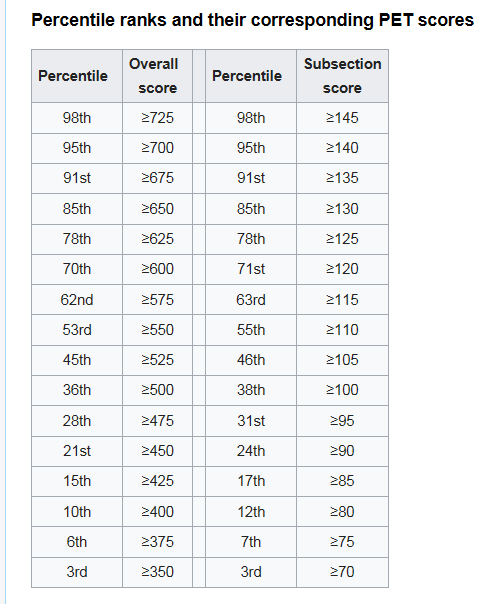
Wikipedia provides the following percentiles for the PET

pet

Of course the above percentiles apply only to the subset that takes the PET and not the general Israeli young adult population.  In order to know how select this group is, we need to first know how many Israelis become university age each year (even if they never attend university).

Based on stats from this article, I was able to infer that about 179,000 babies were born in Israel in 2015.  Assuming this is typical of how many are born there each year for the past few decades, then 179,000 become old enough to take the PET each year.  Of these, how many make it through high school and then go on to take the PET?  According to my Israeli reader, only 70,000 take the PET each year which means that the top 2% of test takers (those scoring 725+ overall and 145+ on the subsection) reflect 1400 people.

If we assume that 100% of the most academically skilled Israeli youth take the PET and whatever shortfall there might be is balanced by top foreign talent, then those top 1400 scores reflect not just the highest among the 70,000 test takers, but the highest among all 179,000 Israelis that age.  In other words, the top 0.78% of the general Israeli population.

What IQ does this equate to?  On a scale where the white mean and SD are defined as 100 and 15 respectively, the general U.S. mean and SD are 97 and 15.5.  Israeli’s mean IQ is reportedly 94 (103 for Israeli Ashkenazi, 91 for Israeli Sephardics and 86 for Israeli Arabs) and given it has an ethnically diverse population like the U.S., it’s SD is likely also as high as 15.5.  The normal curve predicts that in a country with a mean IQ of 94 and an SD of 15.5,  the top 0.78% have IQs of 131 (white norms).

Thus:

PET overall score of 725 = IQ 131 (U.S. white norms); 133 (U.S. norms)

PET subsection score 145 = IQ 131 (U.S. white norms); 133 (U.S. norms)

The next question is what is the average IQ of people who write the PET.  About 39% of Israelis of a given birth cohort write the PET each year (70,000 out of 179,000) so PET takers reflect the top 39% of Israeli educational status, which means the median PET taker reflects the top 19.5% of education status.  Normalizing the education distribution, the median PET taker is +0.93 SD in education status.  I don’t know the correlation between IQ and education in Israel, but in the U.S. it used to be 0.7, but has sunk to 0.55 in recent decades.  Let’s split the difference and assume it’s 0.63 in Israel.  This implies PET takers who are +0.93 SD in education would be +0.93 SD(0.63) = 0.59 SD in IQ.  And assuming an Israeli IQ mean and SD of 94 and 15.5 respectively, this equals 0.59(15.5) + 94 = 103.

Thus:

median overall PET score 538 = IQ 103 (U.S. white norms); 106 (U.S. norms)

median subsection PET score 108 = IQ 103 (U.S. white norms); 106 (U.S. norms)

Now that we’ve estimated the IQ equivalents for both the median and the high extreme of the PET distribution, we can tentatively deduce the following linear equations (assuming the relationship is roughly linear):

IQ (white norms) = 0.1497(overall PET score) + 22.44

IQ (U.S. norms) = 0.1444(overall PET score) + 28.32

IQ (white norms) = 0.7568(subsection PET) + 21.27 

IQ (U.S. norms) = 0.7297(subsection PET) + 27.19

Because of ceiling bumping, I suspect these formulas greatly underestimate IQ equivalents as you approach the test ceiling.

According to my Israeli reader “most universities, at least the famous ones in Israel require 740 to enter medicine, 700 computer science.”

Saul Kripke’s estimated IQ: A historiometric analysis

[NOTE FROM PUMPKIN PERSON: PLEASE PLACE ALL OFF-TOPIC COMMENTS HERE.  THEY WILL NOT BE POSTED IN THIS THREAD]

kripke

Commenter gregorwayne wrote:

If I may make a request, I would love to see you estimate the IQ of Saul Kripke.

Saul Kripke is often considered one of the smartest people on Earth and the greatest living philosopher.   To estimate Kripke’s IQ, I decided to take a historiometric approach, analyzing his biography for evidence of verbal IQ, followed by math IQ.  These two estimates were then combined into a composite IQ estimate.

Historiometric estimate of Kripke’s verbal IQ

Kripke’s bio shows  much evidence of extreme verbal IQ.  According to his Wikipedia article:

Kripke was labelled a prodigy, having taught himself Ancient Hebrew by the age of six, read the complete works of Shakespeare by nine, and mastered the works of Descartes…before finishing elementary school

Some of these achievements are so specialized that it’s hard to compare his abilities to the common man, so I decided to focus on his mastery of Shakespeare, since that’s a common benchmark. A yougov poll in the UK found that about 94% of adults had experienced Shakespeare in some form (i.e. reading a play, seeing a film, being taught it in school) and of these, 58% claimed to understand it.  This implies 55% of the UK adult population understands Shakespeare.

Perhaps a higher percentage could have understood him if given exposure.  On the other hand, perhaps some claiming to understand him are not being honest.  Both sources of error likely cancel out, thus the ability to understand Shakespeare implies an adult verbal IQ in the top 55% of the British distribution, implying an IQ of 98+ (British norms).  It’s worth noting that Britain was 87% white as of 2011, so British norms are more or less synonymous with U.S. white norms.

Having read the complete works of Shakespeare by age nine, Kripke at age nine was as capable as an adult with a verbal IQ of 98.  Since adult mental age is defined as 16, an adult with a verbal IQ of 98 has a mental age 98% as high as 16, so 15.68.  A nine-year-old with a verbal mental age of 15.68 has a verbal ratio IQ of 174, which translates into a deviation IQ of 155 (sigma 15).

This number should be increased by 4 points because verbal IQ, as measured by the WISC Vocabulary test, has been increasing by 4 IQ points over the last half century, so any measure of Kripke’s verbal functioning at age nine that relies on modern data (the recent yougov poll) will be 4 points too low.  Thus Kripke’s verbal IQ is 159.

Historiometric estimate of Kripke’s math IQ

According to Wikipedia, Kripke:

 mastered…complex mathematical problems before finishing elementary school.[7][8] He wrote his first completeness theorem in modal logic at the age of 17, and had it published a year later. After graduating from high school in 1958, Kripke attended Harvard University and graduated summa cum laude obtaining a bachelor’s degree in mathematics. During his sophomore year at Harvard, Kripke taught a graduate-level logic course at nearby MIT.

According to The New York Times

Mr. Kripke, a rabbi’s son, grew up in Omaha, and by all accounts was a true prodigy, so brilliant and precocious that the so-called prodigies of today are by comparison mere shadows flickering on the wall of our collective cave. In the fourth grade he discovered algebra, which he later said he could have invented on his own, and by the end of grammar school he had mastered geometry and calculus… While still a teenager he wrote a series of papers that eventually transformed the study of modal logic. One of them, or so the legend goes, earned a letter from the math department at Harvard, which hoped he would apply for a job until he wrote back and declined, explaining, “My mother said that I should finish high school and go to college first.”

A lot of these achievements depend on more than just raw math IQ, but interest and motivation as well.  Thus, I decided to focus just on when Kripke “discovered algebra” because this is probably the closest datum we have to a developmental milestone. You either grasp the concept or you don’t.

In 2012, The New York Times reported:

To our nation’s shame, one in four ninth graders fail to finish high school… Most of the educators I’ve talked with cite algebra as the major academic reason.   Shirley Bagwell, a longtime Tennessee teacher, warns that “to expect all students to master algebra will cause more students to drop out.” For those who stay in school, there are often “exit exams,” almost all of which contain an algebra component. In Oklahoma, 33 percent failed to pass last year, as did 35 percent in West Virginia

So it sounds like as of 2012, only 75% of American young adults completed high school, and of those who did, only 2/3rds grasped algebra.  This roughly implies only 50% of all American young adults can do algebra, which means grasping algebra requires an adult math IQ of 100 (U.S. norms), or 97 (U.S. white norms).  Since adult mental age is defined as 16, then adult IQ 97 implies a mental age that is 97% of 16 or 15.52.  Since Kripke had discovered algebra in fourth grade (when he was presumably nine), a math ratio IQ of 172 (15.52/9=1.72) is implied.  This equates to a math deviation IQ of 154 (sigma 15).

We should probably add about 10 points because Kripke’s precocity was achieved before 1950, and the Flynn effect has raised math related abilities by 2 (Arithmetic) to 16 (Block Design) IQ points from 1947 to 2001. Thus Kripke’s deviation math IQ might be 164.

Composite IQ

Given an estimated verbal IQ of 159 and an estimated math IQ of 164, and given a 0.67 correlation between verbal and math talent in the general population, Kripke’s estimated composite IQ is 168 (white norms).   Only one in 344,000 white Americans have an IQ this high or higher.

Lead, Race, and Crime by Race Realist

[Note from Pumpkin Person, feb 22, 2018: The following is a guest article by Race Realist and does not necessarily reflect the views of Pumpkin Person.  Out of respect for the author, please try to keep all comments on-topic.  I understand conversations naturally evolve but at least start on topic] 

Lead has many known neurological effects on the brain (regarding the development of the brain and nervous system) that lead to many deleterious health outcomes and negative outcomes in general. Including (but not limited to) lower IQ, higher rates of crime, higher blood pressure and higher rates of kidney damage, which have permanent, persistent effects (Stewart et al, 2007). Chronic lead exposure, too, can “also lead to decreased fertility, cataracts, nerve disorders, muscle and joint pain, and memory or concentration problems” (Sanders et al, 2009). Lead exposure in vitro, infancy, and childhood can also lead to “neuronal death” (Lidsky and Schneider, 2003). While epigenetic inheritance also playing a part (Sen et al, 2015). How do blacks and whites differ in exposure to lead? How much is the difference between the two races in America, and how much would it contribute to crime? On the other hand, China has high rates of lead exposure, but lower rates of crime, so how does this relationship play out with the lead-crime relationship overall? Are the Chinese an outlier or is there something else going on?

The effects of lead on the brain are well known, and numerous amounts of effort have been put into lowering levels of lead in America (Gould, 2009). Higher exposure to lead is also found in poorer, lower class communities (Hood, 2005). So since higher levels of lead exposure are found more often in lower-class communities, then blacks should have blood-lead levels than whites. This is what we find.

Blacks had a 27 percent higher concentration of lead in their tibia, while having significantly higher levels of blood lead, “likely because of sustained higher ongoing lead exposure over the decades” (Theppeang et al, 2008). Other data—coming out of Detroit—shows the same relationships (Haar et al, 1979Talbot, Murphy, and Kuller, 1982Lead poisoning in children under 6 jumped 28% in Detroit in 2016; also see Maqsood, Stanbury, and Miller, 2017) while lead levels in the water contribute to high levels of blood-lead in Flint, Michigan (Hanna-Attisha et al, 2016Laidlaw et al, 2016). Cassidy-Bushrow et al (2017) also show that “The disproportionate burden of lead exposure is vertically transmitted (i.e., mother-to-child) to African-American children before they are born and persists into early childhood.

Children exposed to lead have lower brain volumes as children, specifically in the ventrolateral prefrontal cortex, which is the same region of the brain that is impaired in antisocial and psychotic persons (Cecil et al, 2008). The community that was tested was well within the ‘safe’ range set by the CDC (Raine, 2014: 224), though the CDC says that there is no safe level of lead exposure. There is a large body of studies which show that there is no safe level of lead exposure (Needleman and Landrigan, 2004; Canfield, Jusko, and Kordas, 2005Barret, 2008; Rossi, 2008; Abelsohn and Sanborn, 2010; Betts, 2012; Flora, Gupta, and Tiwari, 2012; Gidlow, 2015; Lanphear, 2015; Wani, Ara, and Usmani, 2015; Council on Environmental Health, 2016Hanna-Attisha et al, 2016Vorvolakos, Aresniou, and Samakouri, 2016; Lanphear, 2017). So the data is clear that there is absolutely no safe level of lead exposure, and even small effects can lead to deleterious outcomes.

Further, one brain study of 532 men who worked in a lead plant showed that those who had higher levels of lead in their bones had smaller brains, even after controlling for confounds like age and education (Stewart et al, 2008). Raine (2014: 224) writes:

The fact that the frontal cortex was particularly reduced is very interesting, given that this brain region is involved in violence. This lead effect was equivalent to five years of premature aging of the brain.

So we have good data that the parts of the brain that relate to violent tendencies are reduced in people exposed to more lead had the same smaller parts of the brain, indicating a relationship. But what about antisocial disorders? Are people with higher levels of lead in their blood more likely to be antisocial?

Needleman et al (1996) show that boys who had higher levels of lead in their blood had higher teacher ratings of aggressive and delinquent behavior, along with higher self-reported ratings of aggressive behavior. Even high blood-lead levels later in life is related to crime. One study in Yugoslavia showed that blood lead levels at age three had a stronger relationship with destructive behavior than did prenatal blood lead levels (Wasserman et al, 2008); with this same relationship being seen in America with high blood lead levels correlating with antisocial and aggressive behavior at age 7 and not age 2 (Chen et al 2007).

Nevin (2007) showed a strong relationship between preschool lead exposure and subsequent increases in criminal cases in America, Canada, Britain, France, Australia, Finland, West Germany, and New Zealand. Reyes (2007) also shows that crime increased quicker in states that saw a subsequent large decrease in lead levels, while variations in lead levels within cities correlating with variations in crime rates (Mielke and Zahran, 2012). Nevin (2000) showed a strong relationship between environmental lead levels from 1941 to 1986 and corresponding changes to violent crime twenty-three years later in the United States. Raine (2014: 226) writes (emphasis mine):

So, young children who are most vulnerable to lead absorption go on twenty-three years later to perpetrate adult violence. As lead levels rose throughout the 1950s, 1960s, and 1970s, so too did violence correspondingly rise in the 1970s, 1980s and 1990s. When lead levels fell in the late 1970s and early 1980s, so too did violence fall in the 1990s and the first decade of the twenty-first century. Changes in lead levels explained a full 91 percent of the variance in violent offending—an extremely strong relationship.

[…]

From international to national to state to city levels, the lead levels and violence curves match up almost exactly.

But does lead have a causal effect on crime? Due to the deleterious effects it has on the developing brain and nervous system, we should expect to find a relationship, and thus relationship should become stronger with higher doses of lead. Fortunately, I am aware of one analysis, a sample that’s 90 percent black, which shows that with every 5 microgram increase in prenatal blood-lead levels, that there was a 40 percent higher risk of arrest (Wright et al, 2008). This makes sense with the deleterious developmental effects of lead; we are aware of how and why people with high levels of lead in their blood show similar brain scans/brain volume in certain parts of the brain in comparison to antisocial/violent people. So this is yet more suggestive evidence for a causal relationship.

Jennifer Doleac discusses three studies that show that blood-lead levels in America need to be addressed, since they are related strongly to negative health outcomes.Aizer and Curry (2017) show that “A one-unit increase in lead increased the probability of suspension from school by 6.4-9.3 percent and the probability of detention by 27-74 percent, though the latter applies only to boys.” They also show that children who live nearer to roads have higher blood-lead levels, since the soil near highways was contaminated decades ago with leaded gasoline. Fiegenbaum and Muller (2016) show that cities’ use of lead pipes increased murder rates between the years o921 and 1936. Finally, Billings and Schnepnel (2017: 4) show that their “results suggest that the effects of high levels of [lead] exposure on antisocial behavior can largely be reversed by intervention—children who test twice over the alert threshold exhibit similar outcomes as children with lower levels of [lead] exposure (BLL<5μg/dL).

A relationship with lead exposure in vitro and arrests at adulthood. The sample was 90 percent black, with numerous controls. They found that prenatal and post-natal blood-lead exposure was associated with higher arrest rates, along with higher arrest rates for violent acts (Wright et al, 2008). To be specific, for every 5 microgram increase in prenatal blood-lead levels, there was a 40 percent greater risk for arrest. This is direct causal evidence for the lead-causes-crime hypothesis.

One study showed that in post-Katrina New Orleans, decreasing lead levels in the soil caused a subsequent decrease in blood lead levels in children (Mielke, Gonzales, and Powell, 2017). Sean Last argues that, while he believes that lead does contribute to crime, that the racial gaps have closed in the recent decades, therefore blood-lead levels cannot be a source of some of the variance in crime between blacks and whites, and even cites the CDC ‘lowering its “safe” values’ for lead, even though there is no such thing as a safe level of lead exposure (references cited above). White, Bonilha, and Ellis Jr., (2015) also show that minorities—blacks in particular—have higher rates of lead in their blood. Either way, Last seems to downplay large differences in lead exposure between whites and blacks at young ages, even though that’s when critical development of the mind/brain and other important functioning occurs. There is no safe level of lead exposure—pre- or post-natal—nor are there safe levels at adulthood. Even a small difference in blood lead levels would have some pretty large effects on criminal behavior.

Sean Last also writes that “Black children had a mean BLL which was 1 ug/dl higher than White children and that this BLL gap shrank to 0.9 ug/dl in samples taken between 2003 and 2006, and to 0.5 ug/dl in samples taken between 2007 and 2010.” Though, still, there are problems here too: “After adjustment, a 1 microgram per deciliter increase in average childhood blood lead level significantly predicts 0.06 (95% confidence interval [CI] = 0.01, 0.12) and 0.09 (95% CI = 0.03, 0.16) SD increases and a 0.37 (95% CI = 0.11, 0.64) point increase in adolescent impulsivity, anxiety or depression, and body mass index, respectively, following ordinary least squares regression. Results following matching and instrumental variable strategies are very similar” (Winter and Sampson, 2017).

 Naysayers may point to China and how they have higher levels of blood-lead levels than America (two times higher), but lower rates of crime, some of the lowest in the world. The Hunan province in China has considerably lowered blood-lead levels in recent years, but they are still higher than developed countries (Qiu et al, 2015). One study even shows ridiculously high levels of lead in Chinese children “Results showed that mean blood lead level was 88.3 micro g/L for 3 – 5-year-old children living in the cities in China and mean blood lead level of boys (91.1 micro g/L) was higher than that of girls (87.3 micro g/L). Twenty-nine point nine one percent of the children’s blood lead level exceeded 100 micro g/L” (Qi et al, 2002), while Li et al (2014) found similar levels. Shanghai also has higher levels of blood lead than the rest of the developed world (Cao et al, 2014). Blood lead levels are also higher in Taizhou, China compared to other parts of the country—and the world (Gao et al, 2017). But blood lead levels are decreasing with time, but still higher than other developed countries (He, Wang, and Zhang, 2009).

Furthermore, Chinese women, compared to American women, had two times higher BLL (Wang et al, 2015). With transgenerational epigenetic inheritance playing a part in the inheritance of methylation DNA passed from mother to daughter then to grandchildren (Sen et al, 2015), this is a public health threat to Chinese women and their children. So just by going off of this data, the claim that China is a safe country should be called into question.

Reality seems to tell a different story. It seems that the true crime rate in China is covered up, especially the murder rate:

In Guangzhou, Dr Bakken’s research team found that 97.5 per cent of crime was not reported in the official statistics.

Of 2.5 million cases of crime, in 2015 the police commissioner reported 59,985 — exactly 15 less than his ‘target’ of 60,000, down from 90,000 at the start of his tenure in 2012.

The murder rate in China is around 10,000 per year according to official statistics, 25 per cent less than the rate in Australia per capita.
“I have the internal numbers from the beginning of the millennium, and in 2002 there were 52,500 murders in China,” he said.

Instead of 25 per cent less murder than Australia, Dr Bakken said the real figure was closer to 400 per cent more.”

Guangzhou, for instance, doesn’t keep data for crime committed by migrants, who commit 80 percent of the crime in this province. Out of 2.5 million crimes committed in Guangzhou, only 5,985 crimes were reported in their official statistics, which was 15 crimes away from their target of 6000. Weird… Either way, China doesn’t have a similar murder rate to Switzerland:

The murder rate in China does not equal that of Switzerland, as the Global Times claimed in 2015. It’s higher than anywhere in Europe and similar to that of the US.

China also ranks highly on the corruption index, higher than the US, which is more evidence indicative of a covered up crime rate. So this is good evidence that, contrary to the claims of people who would attempt to downplay the lead-crime relationship, that these effects are real and that they do matter in regard to crime and murder.

So it’s clear that we can’t trust the official Chinese crime stats since there much of their crime is not reported. Why should we trust crime stats from a corrupt government? The evidence is clear that China has a higher crime—and murder rate—than is seen on the Chinese books.

Lastly, effects of epigenetics can and do have a lasting effect on even the grandchildren of mothers exposed to lead while pregnant (Senut et al, 2012Sen et al, 2015). Sen et al (2015) showed lead exposure during pregnancy affected the DNA methylation status of the fetal germ cells, which then lead to altered DNA methylation on dried blood spots in the grandchildren of the mother exposed to lead while pregnant.—though it’s indirect evidence. If this is true and holds in larger samples, then this could be big for criminological theory and could be a cause for higher rates of black crime (note: I am not claiming that lead exposure could account for all, or even most of the racial crime disparity. It does account for some, as can be seen by the data compiled here).

In conclusion, the relationship between lead exposure and crime is robust and replicated across many countries and cultures. No safe level of blood lead exists, even so-called trace amounts can have horrible developmental and life outcomes, which include higher rates of criminal activity. There is a clear relationship between lead increases/decreases in populations—even within cities—that then predict crime rates. Some may point to the Chinese as evidence against a strong relationship, though there is strong evidence that the Chinese do not report anywhere near all of their crime data. Epigenetic inheritance, too, can play a role here mostly regarding blacks since they’re more likely to be exposed to high levels of lead in the womb, their infancy, and childhood. This could also exacerbate crime rates, too. The evidence is clear that lead exposure leads to increased criminal activity, and that there is a strong relationship between blood lead levels and crime.