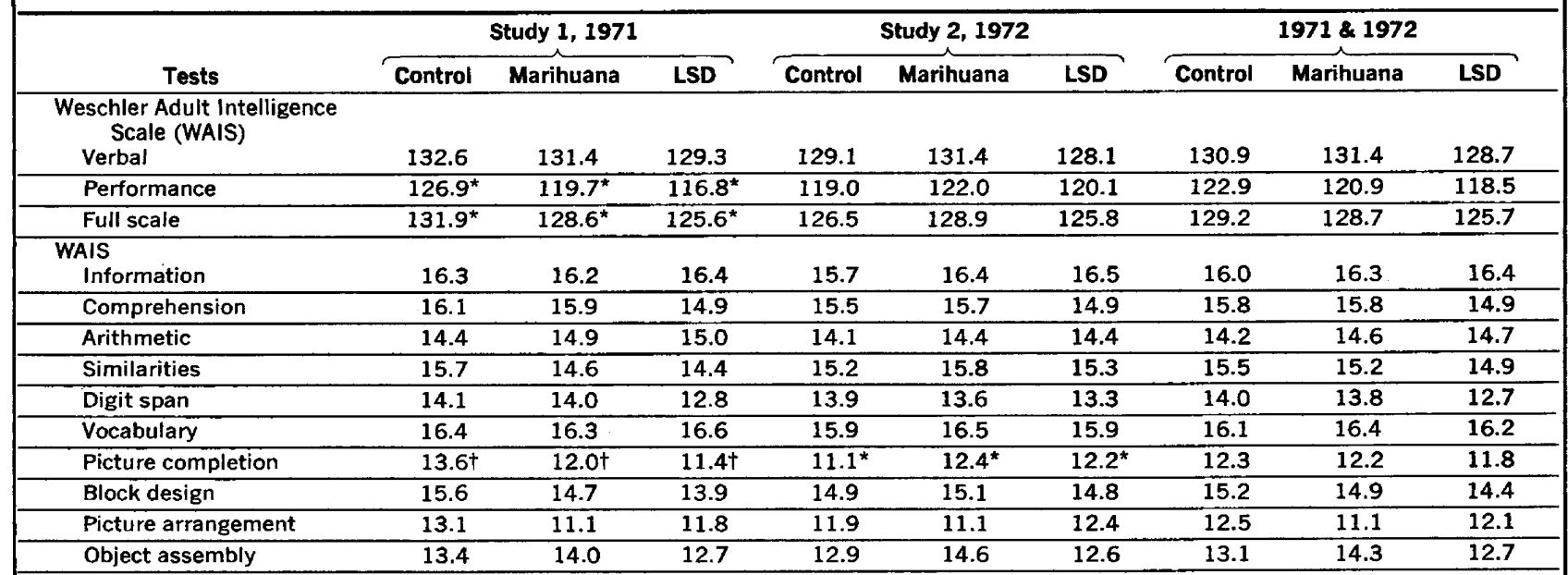
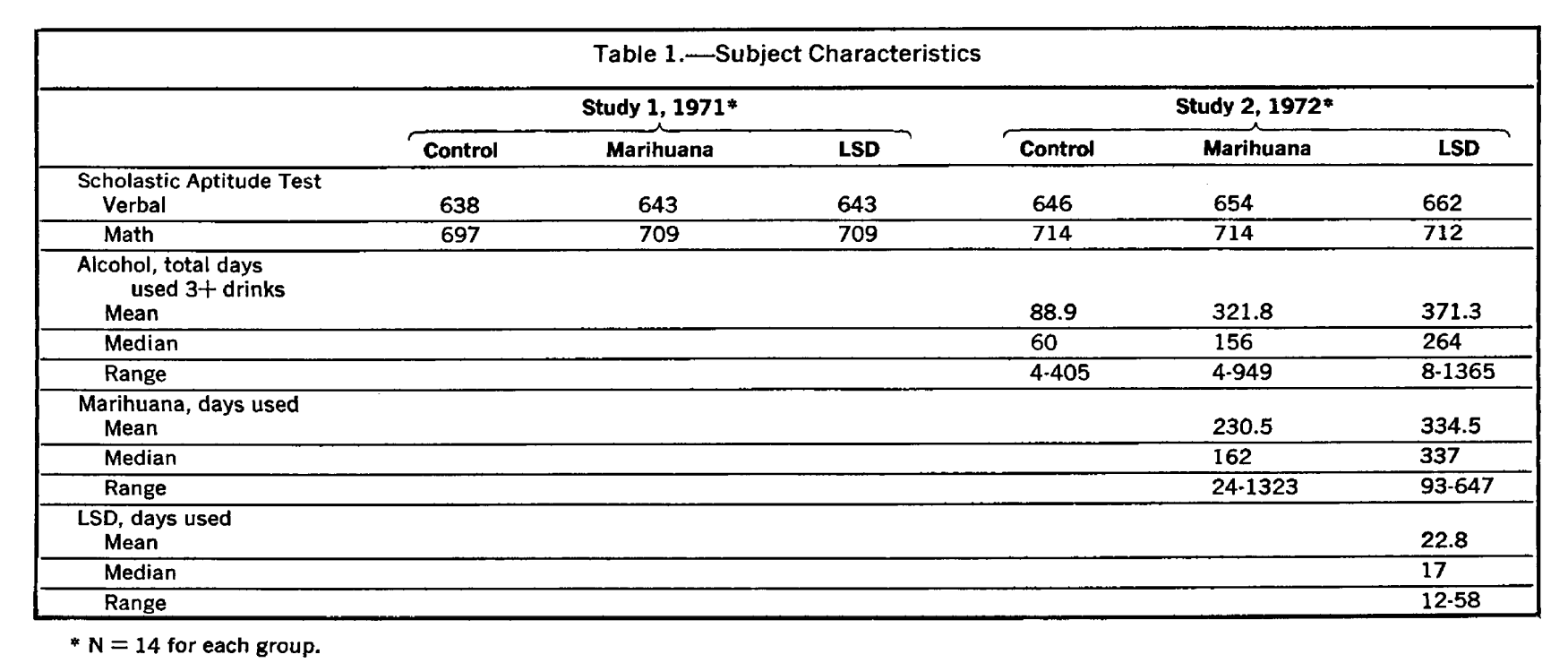
Long ago a person in the comment section told me about an excellent study in which several groups of Dartmouth seniors were administered the WAIS (Culver & King, 1974).
What made the study especially useful is their SAT scores (probably taken when they were around 17) were provided:
I decided to focus on the control groups because their IQs were least likely to be impaired by the substance abuse effects the study investigated. The 1971 Dartmouth control group averaged a combined SAT of 1335 and the 1972 control group averaged a combined SAT of 1360. Averaging these together gives 1348. Since the students were 20 to 25 when they took the WAIS in 1970 to 1972, they probably took the SAT from 1965 to 1969. Based on national norm studies I estimate that if virtually all American 17-year-olds took the SAT in 1960 and 1974, the mean and standard deviation (SD) would have been 784/210 and 770/204 respectively.
Since the WAIS was normed so that a representative sample of U.S. adults in each age group would have a mean IQ and SD of 100 and 15 respectively (see WAIS manual, chapter 2), I equated the national means and SDs of the SAT to 100 and 15 also. By this measure a 1360 on the SAT equated to an IQ of 141 or 143 depending on whether I used the 1960 or 1974 norms. Let’s split the difference and say 142. Meanwhile the full-scale WAIS IQ of the Dartmouth control group students was 129.
Now because they were tested circa 1971 and the WAIS was normed circa 1953.5, their scores are inflated by a 17.5 year Flynn effect. According to the brilliant and influential James Flynn (RIP), the Wechsler Flynn effect was 3 points per decade but according to my own independent research, it was more like 1 point a decade. Flynn (who was always kind enough to respond to emails) told me my research was not accurate because I was using a pre-war Wechsler scale and IQ tests did not become accurate until after WWII. I countered that his own research may be compromised by test order effects. (Davis 1977, Kaufman 2010)
Using Flynn’s estimate, their IQs need to be reduced to 124 but using mine they need to be reduced to 127. Either way, they scored substantially lower on the WAIS than they did on the SAT. This is to be expected because Dartmouth students were largely selected by SAT scores and given the imperfect correlation between standardized tests, people who are selected using one test should regress to the mean on another and assuming a bivariate normal distribution, the slope of the standardized regression is a function of the correlation between the tests.
So given an SAT that was 42 points above the U.S. mean defined as 100, the expected correlation (r) between the WAIS and the SAT is:
r = (number of IQ points above 100 on the WAIS/number of IQ points above 100 on the SAT)
r = (24 or 27/42)
r = 0.57 or 0.64
Let’s split the difference and say 0.61.
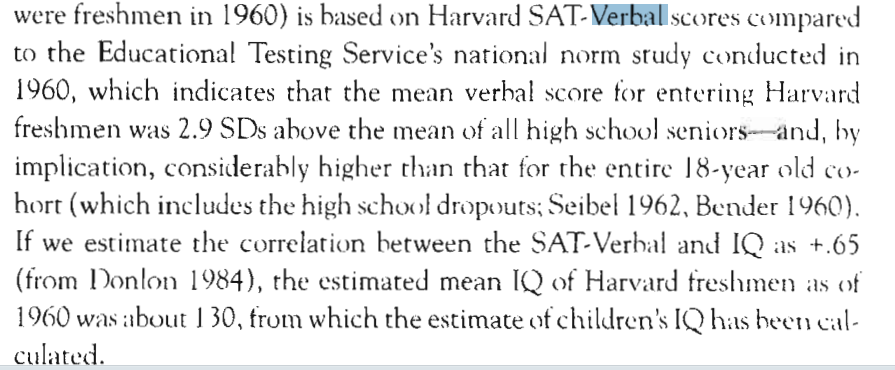
Because Herrnstein & Murray (1994) popularized the myth that Ivy League students have IQs in the stratosphere (and Jordan Peterson believed it, even though studies he co-wrote show otherwise) I was surprised to learn that at least one of The Bell Curve’s authors knew the truth, though this was relegated to the footnotes (see page 688):
[Update July 28, 2024: an earlier version of this article suggested the correlation between the SAT and the WAIS be adjusted for the time difference between the two administrations however it’s unclear if such a an adjustment is valid]
A while back I was delighted to learn that my estimate for Elon Musk’s IQ had proven spot-on and now I discovered I was also spot-on for Jeff Bezos. I discovered a Washington Post article from Sept 2, 2000 in which Bezos states he scored 1450 on the SAT. Given that Bezos was born in 1964, he would have likely took the SAT in 1981. I’ve estimated that if all American 17-year-olds (including high school dropouts) had taken the SAT in the 1980s, the mean would have been 787 and the SD would have been 220. Thus Bezos score was +3.01 SD or IQ 145 (U.S. norms) (144 U.S. white norms).
But nearly seven years before I knew his SAT score, I estimated his IQ based on an anecdote.
There’s a beautiful paper about converting the ACT to the Generation Y SAT (taken April 1995 to March 2016). Apparently there was a massive sample of people who took book the ACT and Generation Y SAT making it possible to equate scores of equal percentile rank within this group that took both tests. The results are as follows:
Once you know the SAT equivalent of your ACT, you can convert the SAT score into an IQ equivalent using this little formula I made:
IQ equivalent = 23.835 + 0.081(SAT) (U.S. norms)
What’s strange is that ACT.org has a chart converting ACT to SATs in 2018
If you use this chart, you can convert SAT to IQ using the formula I created for Generation Z SAT scores (taken after March 2016):
IQ = 26 + 0.07(Combined SAT)
So let’s say you’re a genius who scored a perfect 36 on the ACT. If you convert to Generation Y SAT scores you get 1600 which converts to IQ 153 using the Generation Y formula.
But if you convert to Generation Z SAT scores, you get 1590 which equates to IQ 137! That’s a difference of 16 points for the same ACT score.
My guess is that by eliminating all the hardest questions from the SAT so that generation Z could have a safe space and so political correctness could be maintained, the equipercentile equating with ACT scores went awry at the high end. Until further research can clarify this issue, I strongly recommend using the Generation Y conversions, even if you’re in Generation Z.
Trump’s test scores have been in the news a lot lately. It started over a year ago when Trump’s former lawyer Michael Cohen told congress that he threatened Trump’s university Fordham not to release his SAT scores (which is illegal anyway). An official from Fordham confirmed this.
More recently, Trump’s niece Mary Trump has said that when Trump transferred to the University of Pennsylvania he hired a boy named Joe Shapiro to take his SATs for him. The White House denies this.
More recently still, Trump has been bragging about acing the Montreal Cognitive Assment (MOCA) during a screening for dementia.
Trump may sound like an idiot to most liberals but remember that IQ is scored on an age based curve and many people in their 70s can barely string together a sentence, so the mere fact that he can argue with the press in a fast and entertaining way should put him comfortably above IQ 100 (the population mean). But how much much above 100?
Trump claims to have scored 30 out of 30 on the MOCA but given Trump’s history of exaggerating personal accomplishments (net worth, TV ratings, etc) that’s highly suspect. His doctor confirmed that, but when it comes to presidential politics, even medical reports can’t be trusted.
But assuming he’s being truthful, I emailed Dr. Ziad Nasreddine (the test’s creator) to ask what percentage of non-demented elderly people score perfect on this test. He replied “10% of normals score 30/30”.
Of course the MOCA does not call itself an IQ test, but aside from the brief administration time, incredibly low ceiling and bias towards memory items, it’s content is virtually indistinguishable from one. It includes general knowledge “What’s today’s date?”, picture vocabulary “identify pictures of common animals”, spatial reasoning “draw a cube”, arithmetic “count backwards from a 100 in multiples of 7”, short-term memory “repeat words”, and verbal abstract reasoning “state how common objects are alike”.
Still, I wouldn’t recommend using this as an IQ test in above average populations. A Nobel Prize winning theoretical physicist could have a verbal and mathematical IQ in the stratosphere, but because they lack the spatial IQ to draw a clock at a given time, they’d end up with a score lower than Trump’s.
On the WAIS-IV, if an elderly person scores in the top 10% of the “healthy population”, they’re assigned an IQ of 119, however by excluding the demented from the norms, I’ve long felt the WAIS-IV underestimates elderly IQs. IQ is supposed to reflect your cognitive rank within the range of cognitively normal variation so it makes sense to exclude people with gross chromosomal abnormalities (i.e. Downs syndrome) from the norms, but dementia is arguably just the low end of normal elderly cognitive variation.
Research suggests 13.9% of Americans aged 71+ have dementia, so about 86.1% do not. So if Trump scored in the top 10% of the non-demented, that puts him in the top 8.6% of the general population which equates to an IQ of 120 but obviously since that’s the test’s ceiling, he could be much higher.
When will you do another study on the post 2016 SAT? There was a 60 points inflation. It would be great if you looked into this recent change.
For years I’ve complained that the SAT is normed on college bound students, but in order to convert it to IQ equivalents, we need to know how the general U.S. population would score. Well perhaps someone from the college board was reading because their website has now started publishing two types of norms:
Nationally Representative Sample Percentiles are derived from a research study of U.S. students in grades 11 and 12 and are weighted to represent all U.S. students in those grades, regardless of whether they typically take the SAT.
SAT User Percentiles are based on the actual scores of students in the past three graduating classes who took the current SAT during high school. These user percentiles are reported on tests completed in August 2019 through June 2020.
So for example, a combined score (verbal + math) of 1055, which makes you dead average (50th percentile) among the college bound elite who takes the SAT, would make you slightly above average (59th percentile) among the nationally representative sample.
One problem is even the nationally representative sample is a bit elite because many of the dullest Americans don’t make it to grade 11, let alone grade 12. so how do we adjust for this?
It turns out we don’t have to because only 6% of U.S. high school students now dropout, and even assuming none of this 6% would score high, the percentiles would only change by a fraction of a percent. For example, if you score in the top 1 out of 100 high school seniors, including the high school dropouts would only move you to 1 out of 106. A trivial difference (at least at the high end)
Verbal SAT (Evidence-based reading & writing)
On this section the median high school senior scores 510 so let this = verbal IQ 100. The 98th percentile is 720 so let this = verbal IQ 130. Thus:
Verbal IQ = 27 + 0.14(verbal SAT)
Math SAT
On this section the median high school senior scores 505 and the top 2% score 740, so let these scores equate to math IQs of 100 and 130 respectively. Thus:
Math IQ = 36 + 0.13(math SAT)
Combined SAT (verbal + math)
Overall the median high school senior scores 1055 and the top 2% score 1480, so let these scores equate to composite IQs of 100 and 130 respectively. Thus:
IQ = 26 + 0.07(Combined SAT)
Is the SAT an IQ test?
I have never found a study correlating the SAT with Wechsler IQ in the general U.S. population but I did find such a study correlating the WIAT (which also measures reading and math knowledge) with IQ in a very representative sample of U.S. 16-19 year-olds (n = 142). Reading comprehension and math reasoning correlated 0.71 and 0.82 with Wechsler full-scale IQ respectively (WAIS-III WMS-III Technical Manual page 85-86).
However there are several reasons for thinking the SAT may correlate somewhat less: 1) the enormous importance of the test for some creates huge differences in motivation, test-prep and cheating, and 2) people diagnosed with learning disabilities can take the test without time limits, 3) my research on the Wechsler IQs of Ivy Leagues students suggest they regress at least a third of the way to the mean from their SAT scores, suggesting a correlation no higher than 0.66.
One way psychologists estimate IQ heritability (the percentage of variation in IQ linked to variation in DNA) is by correlating the IQs of monozygotic (MZ) twins raised apart. The higher the correlation, the more genetic IQ is thought to be.
However skeptics argue that because MZ twins raised apart still shared the same womb, and still grow up in the same country and sometimes the same town, the high correlation doesn’t prove the genetic effects are independent of environment (maybe the same genotype that increases IQ in the U.S. would decrease it Japan, but we’ll never know if virtually all the twins raised “apart” are still raised in the same country).
As commenter “Mugabe” suggested, the ideal study would have genetic clones separated at conception and gestated and raised by random women all over the developed World, but such a study would be unethical. And even if such a study were possible, and even if it showed strong independent genetic effects, the nature of these effects would remain mysterious. Does DNA directly cause IQ (i.e. coding for bigger and more efficient brains), or does it do so indirectly (i.e. causing us to stay in school longer, where we learn how to think). The problem with even the best designed study of MZ twins separated into random environments is that only the starting environment is random. As we grow old, we select environments that fit our DNA, and although the effects of such environments are counted as genetic effects (since our genes made us choose those environments) they are actually gene-environment feedback loops.
But what if it were possible to clone just our brains, and these cloned brains were reared in environments completely alien to anything we have experienced. You grew up in a nice middle class family, and your cloned brain grows up in a petri dish, where its environment was 100% controlled with no gene-environment feedback loop.
Then we could be sure that any cognitive correlation between us and our cloned brains was not only an independent genetic effect, but a direct one to boot.
It sounds like science fiction, but something similar is actually happening in the lab of Alysson Muotri, a biologist at the University of California, San Diego. Muotri takes skin cells from volunteers, turns them into stem cells, and then makes them grow into tiny pinhead sized balls of brain tissue called organoids.
Of course these organoids are way too tiny to be considered cloned brains, but they are complex enough to make brain waves. And Muotri has already found that cognitively impaired populations have cells that produce underdeveloped brain organoids in the petri dish. For example brain organoids derived from autistic people had about a 50% reduction in synaptogenesis.
Muotri also decided to study Neanderthal brain organoids. Since it’s not possible to get cells from Neanderthals, he edited modern human DNA. Of the 20,000 protein coding genes, only 61 differ between us and them, and of these, only four are highly expressed in the brain so by editing just these four genes, he was able to produce Neanderthalized organoids, or Neanderoids as he calls them. Modern humans had far more spherical skulls than Neanderthals so it’s interesting that our brain organoids are spherical, while theirs look like popcorn.
Muotri notes that like the autistic brain organoids, the Neanderoids have a 50% reduction in synaptogenesis. Neanderoids also show 65% to 75% reductions in firing rate and activity level per neuron per minute. Muotri thinks this may help explain why it took them several hundred thousand years to progress from simple stone tools to, well, simple stone tools. By contrast, in just the last 50,000 years we jumped from simple stone tools to the internet, genetic engineering and traveling to the moon.
image from Muotri’s talk comparing our rate of cultural progress to Neanderthals’
So clearly brain organoids are very good at identifying cognitively impaired populations, but can they measure normal variation in human intelligence?
Muotri could greatly advance our understanding of behavioral genetics if he made brain organoids of a representative sample of Americans of known IQ scores, and then correlated the synaptogenesis, neuron activity level and firing rate of the organoids with the tested IQs of the people from whom they were derived. Perhaps a carefully weighted composite score of all three measures would give the best prediction of IQ, and perhaps such a formula could allow us to estimate how Neanderthal’s would score on IQ tests (if they were reared in our society).
If it’s too difficult to get a representative sample of Americans and test their IQs, he could simply have students at his university donate their cells, and then correlate their brain organoid scores with their SAT scores. Would there be statistically significant differences in the brain organoids of people who score a perfect 1600 on the SAT compared to those who score 1400 compared to those who score 1200 compared to those who score 1000?
Muotri is also trying to teach the brain organoids how to control a robotic body. The speed with which they learn might be considered a low level IQ test. So imagine taking a conventional intelligence test like the Wechsler Adult Intelligence Scale (WAIS) or the SAT, while your mini-brain, raised in a petri dish is taking its own IQ test (learning to control its robotic body). This could be the 21st century version of studies where identical twins raised apart have their IQs correlated. If your score on a conventional intelligence test predicts the speed with which your brain organoid learns to control its robotic body, then that proves IQ tests are measuring a genetic property of the brain that is completely independent from social class and culture because environment is perfectly controlled in the petri dish.
Perhaps in the future instead of universities testing candidates on the SAT, they’ll just test the student’s brain organoids instead to eliminate the cultural bias some think confounds the SAT. For there’s no culture in the petri dish (aside from bacteria culture :-)).
When a prosecutor suspects a murderer is faking his low score on the WAIS to avoid execution (because it’s illegal to execute people with IQs below 70 in some states) he could insist on testing the murderer’s brain organoid instead (since they can’t fake low scores-as far as we know).
On the other hand brain organoids might prove that normal variation in IQ is nowhere near as genetic or biological as its proponents think. I find it fascinating that just four brain genes separating modern humans from Neanderthals produced such dramatic differences in brain organoids. That implies each gene must have huge effects. That’s not at all consistent with research on normal IQ variation among modern humans, which estimates that some 10,000 genomic variants are involved, each one affecting IQ by only a fraction of a point. It’s also possible that brain organoids showcase too early a stage of brain development to correlate with the higher abstract abilities measured by IQ tests (for example infant development scales have weak correlations with adult IQ).
In the below video Muotri discusses his brain organoid research:



 Pumpkin Person