Weight/height ratio is negatively correlated with IQ, meaning the more you weigh for your height, the lower your IQ tends to be. Almost everyone in the HBD-o-sphere assumes this correlation just means fat people tend to be dumb, which I don’t deny, but I’ve always thought it would be more interesting if low IQ muscular people were also driving the correlation.
A few weeks ago I discovered an interesting passage on page 321 of Wechsler’s Measurement and Appraisal of Adult Intelligence Fifth Edition:
…most studies report a small, but significant correlation (r of about 0.25) between IQ and Sheldon’s body type, with individuals of “tall and narrow build” (ectomorphs) earning on the average higher S-B or WAIS IQ’s than persons who are either chubby (endomorphs) or more muscular and athletically built (mesomorphs)…
This is interesting because:
a) as we evolved from ape to man, we lost muscle but gained height.
Indeed in the film Quest for Fire, set 80,000 years ago, the most advanced tribe had the least muscle, and would point and laugh at the more primitive muscular cavemen they captured.
b) When we imagine advanced life visiting from other planets, they are devoid of muscle.
.
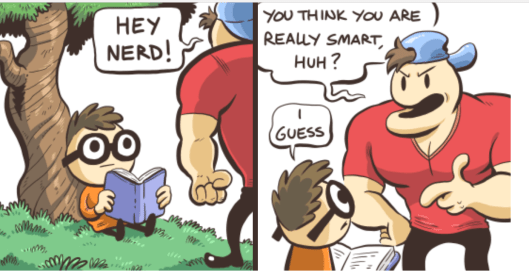
c) the stereotypical smart guy is a scrawny nerd while the stereotypical dumb guy is a roided up wrestler or football player.
I recently got the following email from commenter “Aint tellin”:
Hello,
I don’t want to bother you with such a mundane question, but this past week I’ve been seeing more and more of one particular comment in regards to comedian Norm Macdonald. I figured you would be the best person to validate this claim. He is frequently cited by many comedians as being a genius and having an incredibly high IQ. These same high-profile comedians are quick to label him the greatest living comic alive.
While I don’t know if these comments are correct, I do have to concede that from my listening of him out-of-character that he appears to be well read (particularly in Russian literature) very witty and articulate.
I know that you’ve previously estimated the IQ of the average comedian to be in the realms of +1.5SD above the norm. How high above the norm (no pun intended) would a comedian have to be to produce work worthy of the title: ‘funniest man alive’? Would you consider the claims of Norm Macdonald’s genius accurate or hyperbole?
I don’t know if there’s any consensus on who the funniest man alive is, but certainly Norm Macdonald is up there as one of the greats. Comedians are fascinating because most are obviously very smart, but often act dumb for comic effect, and unlike other high IQ occupations, they seldom have elite or advanced degrees, or even any degrees at all.
One sign that they have very high IQs is the extreme overrepresentation of the high IQ Ashkenazi population. Depending on how you define them, Jews are 2 or 3% of America, and yet a third of Comedy Central’s “100 Greatest Standups of All Time” are Jewish. Interestingly blacks are also overrepresented: they are 18% of the list despite being 13% of America.
Expected IQ of “funniest man alive”
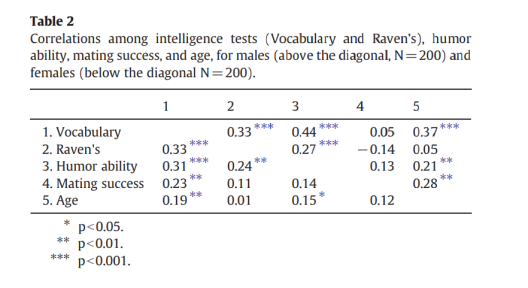
We first need to know the correlation between IQ and comedy. A 2011 study found a 0.27 correlation between Raven IQ and humor ability (as measured by the rated funniness of captions you can think up for cartoons).
But there are two reasons to think the correlation is an underestimate. It was calculated on college students who vary less in IQ than the general population. Correcting for range restriction would likely increase the correlation by about 0.1 or so. Also, a very abbreviated version of the Raven was used and the lower reliability likely further depressed the correlation by perhaps an additional 0.1. Correcting for both factors, the correlation is likely 0.44.
However the Raven likely has a g loading around 0.72 (the g loading of the Matrix reasoning subtest on the WAIS-IV). Some might say the Matrix reasoning subtest is less g loaded since it’s shorter than the Raven, but this is perhaps counterbalanced by the fact that it’s individually administered which ensures everyone understands the task. Dividing 0.44 by 0.72 gives 0.61, which is the likely correlation between humor ability and general intelligence (g).
However great achievement requires more than just raw talent. It also helps to have 10,000 hours of practice, among other things. Raw talent seems to explain 66% to 70% of the variance in various cognitive performance, suggesting talent correlates 0.82 with performance.
So multiplying the 0.61 correlation between g ad humor ability by the 0.82 correlation between ability and performance gives a 0.5 correlation between g and comic performance.
Now when people say “funniest man alive” they probably really mean “funniest American of either sex” (Macdonald had to move to the U.S. though may not be a U.S. citizen). Assuming there are 215 million Americans over age 25, a perfect correction between IQ and comedy would give the funniest person in America an IQ of 186 (U.S. norms). In other words, 86 points above the U.S. mean. But since the correlation is perhaps 0.5, we’d expect him to be 86(0.5) = 43 points above the U.S. mean, or IQ 143 (U.S. norms), with a 95% chance of being from 118 to 168.
How close did the estimate come?
Given the huge margin of error associated with this estimate, it’s always nice to have some empirical confirmation. Usually no such confirmation exists, but I was extremely lucky to discover that back in 2000, Macdonald had appeared on the hit TV show Who wants to be a millionaire? Since general knowledge is among the most g loaded measures of intelligence, I decided this could serve as a rough proxy for his IQ, though he was asked only 15 questions (the WAIS information subtest has nearly twice that), and they were multiple choice which makes it easier to get lucky.
Although Macdonald relied on help from the audience and friends for some questions , and was talked out of giving a final answer to the last question, in my judgement he knew or would have correctly guessed the answer to all the questions except for the one about the guitar auction, giving him a score of 14 out of 15.
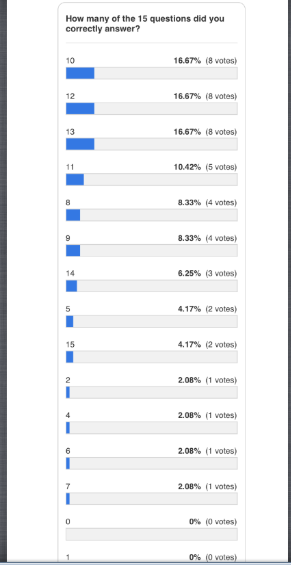
To see how this maps to IQ, I asked the questions to my readers, who self-reported the following scores (out of 15):
Distribution of the 48 self-reported scores as of sept 24, 4:24 pm Eastern:
The mean is 10.5 with a standard deviation (SD) of 2.8, so Macdonald’s IQ (as crudely measured by this quiz) is 1.25 SD above the average reader of pumpkinperson.com.
Since previous research suggests my readers average a borderline genius IQ of 127 (U.S. norms) with an SD of 15, that would put his IQ at:
1.25(15) + 127 = 146
Of course, modern IQ scales normalize the distribution, but that makes little difference for Macdonald’s score. Either way he scored in the mid 140s, exactly as we’d statistically expect from his comic talent.
Despite his great performance on the game show, some might dismiss Macdonald as a mere clown and doubt he could be so brilliant. And admittedly, general knowledge is only a rough proxy for IQ, and the game show was only a rough and perhaps rigged proxy for general knowledge (it’s not in the show’s interest to make us celebs looks dumb) and my equating to IQ relied on self-reported data from people on the internet.
However I saw an interview where Macdonald made a comment implying he’s smarter than he seems: He said that unlike Bill Maher and other cerebral comics who want to show how smart they are, David Letterman is smarter than all those guys but smart enough to know that everyone hates a smart guy. Perhaps Macdonald was projecting onto Letterman his own dumbing down strategy.
The following questions are taken from an episode of the hit quiz show Who wants to be a millionaire? Try to answer each one and then scroll down to see the answers, and then vote in the anonymous poll so I know how my very bright readers perform on general knowledge.
Question 1
Question 2
Question 3
Question 4
Question 5
Question 6 (these question were asked in the year 2000)
I’ve been looking through the book Rising Star: The making of Barack Obama by Pulitzer Prize winning author David J. Garrow. The book is huge. The main text is 1,084 pages, followed by a few hundred pages of chapter notes, and then about another hundred pages for the bibliography and index. Garrow reportedly interviewed over a thousand of Obama’s friends and colleagues and even interviewed Obama himself for eight hours. All this for a book that only covers Obama’s pre-presidential life!
Obama fans might be disappointed to learn how calculating and deceptive Obama has been about his own life story. On the other hand, Obama haters will be disappointed to learn that Obama was an excellent law student who earned his high grades at Harvard.
Indeed I’m impressed by how the book is both so negative yet so positive. Unlike many biographers who try to vilify or deify their subject, Garrow only seems interested in gathering as much information as he can and letting the chips fall where they may. It’s great when truly objective historians take the time to interview this many people and collect this much original research before memories fade, people die, and things get covered up.
Long before Ellen, Will & Grace or Modern Family, it was Oprah (and before her Donahue) and the genre of TV she popularized, that played the critical role bringing gays into the mainstream. Here she is way back in 1989 (before most of my readers were even born) discussing gay marriage.
Oprah really is the most influential woman in the World because virtually no single living person has done more to change the culture of America, and by extension, the World. It sounds bad to say now, but back in the 1980s people weren’t used to seeing a black looking black woman on TV. What few black celebs there were, were often mixed race or skin bleached, so to see an authentic dark skinned black woman with African features on TV was transformative. One Oprah fan told me that she didn’t watch for years because she thought “she is black, what kind of show can she have?” A TV station told the legendary King brothers (Oprah’s syndicators) that they could get a better rating with a potato than by putting a black woman on TV.
But if being overweight and hardcore black wasn’t taboo enough, Oprah shocked the world by discussing topics as forbidden as gay marriage, infidelity, food addiction, and above all, sexual abuse, leading millions of victims to recovery.
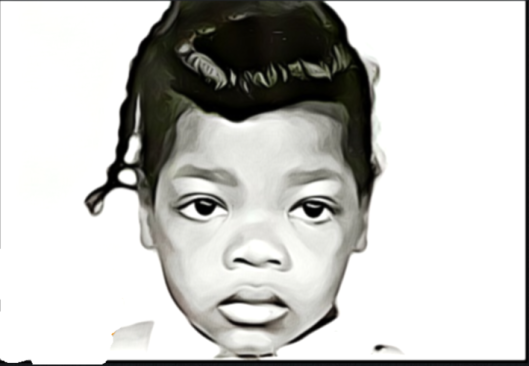
Even though at age three, Oprah was a preacher prodigy, raised to believe gays would go to hell, she slowly abandoned this dogma for a more inclusive spirituality that millions of her fans embraced.
A preacher at the age of 3
She was smart enough to know that as an overweight dark skinned black woman, she faced discrimination in the same way gays did, and with 20th century nutrition increasing the World’s brain size and IQ, an awakened public would soon embrace moral progress, causing gay suicide rates to plummet.
As Martin Luther King once observed, the arch of the moral universe is long, but bends towards justice.
Like all revolutionary leaders, Oprah got on the right side of history, way ahead of her time, just as she had with the Iraq war:
Obama has realized that if he wants to maintain his enormous popularity among liberals, he can no longer just sit on the sidelines as Trump tramples all over his legacy. At the same time, the last thing he wants to do is ruin his retirement and risk his pristine reputation by getting into a mud fight, since no one benefits more from those than Trump. Thus he seems to have found a middle ground of mild criticism.
Trump reacted with a zinger about falling asleep.
When Obama fans heard about this, they went absolutely ballistic.
It’s not surprising they would become so angry. They consider Obama to be the greatest public speaker of all time, so to have a man they consider unworthy of shining Obama’s shoes, not only destroy Obama’s legacy, but mock even his greatest talent, just adds insult to injury.
Why are they so psychologically invested in Obama? Because white liberals pride themselves in supporting the underdogs and thus being very pro-black, but for years they’ve struggled to find a black they can get excited about. Rap stars and athletes are too uneducated for their elitist tastes. Even Oprah struck some of them as tacky for celebrating diets and materialism, and being loved by Midwestern housewives.
In Obama they found a black who looked, acted, and had the credentials of the white liberal elite, and thus he became their messiah. By contrast, Trump is everything they hate (tacky materialism, uneducated speaking style, white working class fans) and is also a “racist” white conservative, making him the ultimate villain.
[Please place all off-topic comments here. They will not be posted in the main articles]
When most people talk about “elites”, they’re talking about who has the most power. But power is only as good as what you do with it, so to me, the real elites are those with influence. Those who have changed history and actually made a difference, especially the difference they wanted to make. Roughly speaking, the more different the world is, then it would have been, had you never lived, the more influential you are.
Of course we can’t go back in a time machine and prevent people from being born, to see how big a difference their lives have made. But if we asked a dozen different historians to name the most influential people in history, they’d all name many of the same people (Jesus, the prophet Mohammad, Newton etc) proving there’s some objectivity to this.
When analyzing 2018’s list of the 100 most influential living people of all time, I found that although blacks are 15% of the World’s population, they are only 3% of the most influential (Oprah, Diana Ross, and “Kool Herc”). The number increases to 6% if you include Afro-multiracials such as Obama, Colin Powell, and Condi Rice. All are Americans.
Powell, primarily used his influence to advance the interests of others, so I would not consider him an elite. Rice was influential more by what she failed to prevent, then by what she actually intended, so I would not consider her an elite either. But the other blacks all used their influence to advance their own agendas and thus qualify as elites.
Even though Ashkenazi Jews are only 0.14% of the World’s population, they’re roughly half the World’s 100 most influential people. Sadly one of these (Bernard Lewis) recently passed away, opening up a slot for a newcomer on 2019’s list.
Although they are listed for their impact on history, one listee (Bob Woodward) is having a huge impact right now, for his new book about Trump, which claims his aids are secretly against him. Just as Woodward helped drive one president to paranoia back in the 1970s, he may be doing the same today.
There’s an interesting 2013 meta-analysis by Branigan et al about the heritability of education attainment as measured by twin studies:
Source: Branigan et al, 2013
If you average all the studies in the US and UK, the mean heritability is 0.31.
A recent study of 1.1 million people (largely from the U.K. and U.S.) found polygenic scores predicted 0.12 of the variation in education, or roughly 39% of twin studies’ heritability.
Why so much lower than twin studies? One reason might be that genetic samples suffer from range restriction, since relatively educated people (like our very own G-man!) seem more likely to get genotyped.
A personal measure of socioeconomic status is educational attainment. We compared the distributions of educational attainment in UK Biobank to the data from the 2011 Census for England and Wales (available at the following URL: https://www.nomisweb.co.uk/census/2011; England and Wales makes up the vast majority—around 89%—of the population of the United Kingdom). In the census, for those ages 50+ years, 25.5% of males and 20.5% of females reported having a ‘level 4 qualification’, the category including college/university degrees (we might expect this figure to be slightly higher were it restricted to the 44-77 age group, but that precise age subset was not available from the census data). In the subsample of UK Biobank used here, 48.0% of males and 42.2% of females reported having a college degree. Thus, the sample was not representative in terms of educational attainment: a higher proportion of individuals in general had a degree.
Adjusting for range restriction would perhaps increase the amount of education variance explained by DNA from 0.12 to 0.2 (though that’s just a guess).
0.2 is 65% of the heritability found in twin studies.
Meanwhile twin studies find about a 0.75 heritability for IQ.
That means we might expect polygenic scores to eventually explain 65% of 0.75 of the variance in IQ, or 0.49 at least among whites living in the West.
Of course that might be a huge overestimate of heritability, if much of the genetic variance is not causal (i.e. population stratification, gene environment interaction).
On the other hand it might be a huge underestimate of heritability, if much of the genetic variance in IQ is not capture by the additive effects of common SNPs.
Both possibilities likely cancel each other out to some degree.
Last week I was busy searching the internet when I got a text message urging me to immediately turn on CBC radio because there was an excellent show. CBC radio puts out a lot of really good shows and this one was no exception. You can hear the whole episode here.
Here’s the description:
Universities are supposed to be dedicated to the exchange of ideas. But according to social psychologist Jonathan Haidt, campuses now skew so far to the left that they’ve become what he calls “political monocultures” in which voices that stray too far from liberal orthodoxy are shouted down. Paul Kennedy speaks with Professor Haidt – and with other scholars who have been thinking about the complex question of diversity on campus.
The great Italian geneticists Cavalli-Sforza has passed away. I can’t even count how many times I’ve posted his genetic trees on this blog. He will be missed.





















 Pumpkin Person