• About

Pumpkin Person

~ The psychology of horror

Pumpkin Person

Author Archives: pumpkinperson

How genetic is IQ?

13 Friday Jul 2018

Posted by pumpkinperson in Uncategorized

≈ 17 Comments

A recent study used genomic predictors of cognitive ability, education, and reaction time respectively, derived from a UK sample, to predict test scores in Scottish samples.

vnr3

As we can see, genomic predictors of VNR scores in a UK sample explained 3.59% of the variance in age 70 Morray House IQ scores in a Scottish sample , implying a correlation of 0.19.  However if we assume that the VNR has a g loading of only 0.45, and further assume that the correlation between two scores is a product of their factor loading (Jensen, 1998), then dividing 0.19 by 0.45 tells us that a polygenic score based on a perfect measure of g would correlate 0.42 with Morray house scores at age 70, and if the Morray itself were a perfect measure of g, the correlation would rise  above 0.5, explaining 25% of the variance, since variance explained equals correlation squared.

And keep in mind we are only looking at common additive genetic variance.  Gail Davies et al writes

SNP-based estimates of heritability for general cognitive function are about 20–30%13. However, these estimates might increase to about 50% when family-based designs are used to retain the contributions made by rarer SNPs14. To date, little of this substantial heritability has been explained, i.e., only a few relevant genetic loci have been discovered

Heritability of 50% (meaning genomic predictions of 0.71) might be an overestimate because a lot of the variants might not be causal.  On the other hand it could be an underestimate because we’re still only talking about additive variants; we haven’t even begun to look for gene-gene interactions.

I think it’s neither an overestimate nor an underestimate, but roughly correct, because even the most extreme critics of twin studies pegged heritability at 45%.

Share this:

  • Share on X (Opens in new window) X
  • Share on Facebook (Opens in new window) Facebook
Like Loading...

The g loading of the UK Biobank’s Verbal Numerical Reasoning test

13 Friday Jul 2018

Posted by pumpkinperson in Uncategorized

≈ 2 Comments

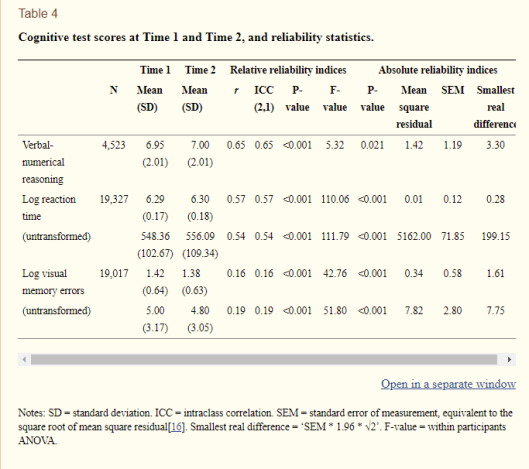
The Verbal Numerical Reasoning test (VNR) is a thirteen item test given to people in the UK Biobank.  It’s kind of like the SAT, except instead of taking 2 hours, it takes 2 minutes.

Given such brevity, I’m not surprised at its low genetic loading in most studies.  Short tests seldom load high on the general factor (g) of IQ tests, and g is the most genetic component of IQ tests.

So how g loaded is the VNR?  One way to try to answer this is to look at its correlation with brain size (corrected for age and ethnicity)

vnr

When highly g loaded IQ tests are used, the correlation between brain size and IQ is 0.4 (maybe a bit higher (0.45) when sex is controlled and a bit lower (0.35) when sex is not controlled as in this study).  And yet the VNR only correlates 0.177 with brain size,  roughly half the 0.35 you’d expect from a highly g loaded (0.9+) IQ test, suggesting the VNR has a g loading of only half as high as the most g loaded tests (0.45 instead of 0.9).

With a g loading of only 0.45, it’s not surprising so few “genes” for IQ have been found.

It’s also worth noting that the VNR has a test-retest correlation of 0.65.   Not bad for a 2 minute test, but nowhere near the 0.9+ stability coefficients that SATs or professional IQ tests show over a four year span.

vnr2


Share this:

  • Share on X (Opens in new window) X
  • Share on Facebook (Opens in new window) Facebook
Like Loading...

Could the mediocre correlation between the SAT & Raven be the Raven’s fault?

13 Friday Jul 2018

Posted by pumpkinperson in Uncategorized

≈ 58 Comments

Back in 2016 I wrote:

A study by Meredith C. Frey and Douglas K. Detterman found a 0.48 correlation between the re-centered SAT and the Raven Progressive Matrices in a sample of 104 university undergrads, but after correcting for range restriction, they estimate the correlation to be 0.72 in a less restricted sample of college students.  I don’t buy it, but I’m not interested in how well the re-centred SAT would correlate with the Raven among college students, but among ALL American young adults. (including the majority who never took the SAT).

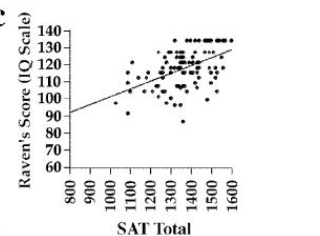
Using the Frey and Detterman data, I decided to look at the Raven scores of those who scored 1400-1600 on the re-centred SAT, because 1500 on the new SAT (reading + math) corresponds to an IQ of 143 (U.S. white norms), which is 46 points above the U.S. mean of 97. Now if the new SAT correlated 0.72 or higher among ALL American adults, we’d expect their Raven scores to only regress to no less than 72% as far above the U.S. mean, so 0.72(46) + 97 = IQ 130.

I personally looked at the scatter plot carefully and did my best to write down the RAPM IQs of every single participant with an SAT score from 1400-1600. This was an admittedly subjective and imprecise exercise given how small the graph is, but I counted 38 top SAT performers and these were their approximate RAPM IQs: 95, 102, 105, 108, 108, 110, 110, 113, 113, 113, 113, 113, 117, 117, 117, 117, 117, 120, 120, 120, 122, 122, 128, 128, 128, 128, 134, 134, 134, 134, 134, 134, 134, 134, 134, 134, 134, 134

raven

The median IQ is 120, and it does not need to be converted to white norms because the Raven was normed in lily white Iowa circa 1993, but as commenter Tenn noted, I should have perhaps corrected for the Flynn effect since the norms were ten years old at the time of the study.  Correcting for the Flynn effect reduces the median to 118 (U.S. white norms) which is 21 points above the U.S. mean of 97.

For people who are 46 IQ points above the U.S. mean on the new SAT to regress to only 21 points above the U.S. mean, suggests the new SAT correlates 21/46 = 0.46 with the Raven in the general U.S. population.

I maintain that the SAT only correlates 0.46 with the Raven in the general U.S. population, however it now seems that this mediocre correlation may be more the fault of the Raven than the SAT.

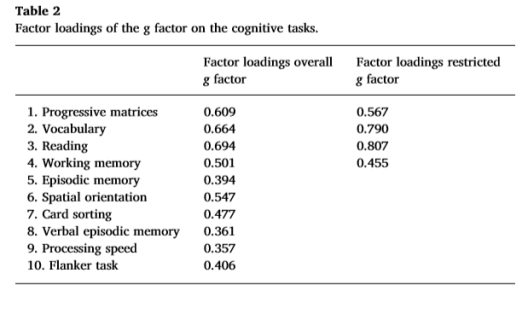
In a 2017 study by Dimitri van der Lindena, Curtis S. Dunkelb, Guy Madison, the Raven was found to have a g loading of 0.609 in 900 American healthy young adults.

raveng

As Arthur Jensen has noted, the correlation between two tests is a product of their factor loading, so assuming the SAT and Raven have only the g factor in common, the estimated 0.46 correlation between the SAT and Raven, (if all American young adults took the SAT), implies the SAT has a g loading of 0.46 divided by the Raven’s 0.609 g loading.

Thus the SAT may have a high g loading of 0.76!

Share this:

  • Share on X (Opens in new window) X
  • Share on Facebook (Opens in new window) Facebook
Like Loading...

Data on sex differences in IQ and brain size

13 Friday Jul 2018

Posted by pumpkinperson in Uncategorized

≈ 2 Comments

A while back I promised to blog about sex differences in IQ but never did because I couldn’t find good data (many IQ tests assume the sexes are equal a priori, thus eliminating subtests or items that show big sex differences).

Anyway, here’ s some interesting data comparing the sexes in brain size and g (general intelligence) (hat-tip to James Thompson for blogging about this).

sexdifferences

The first thing I notice is how HUGE younger American adults (age 22 to 37 circa 2011 to 2013) are in brain size.  Scientists have been claiming for years that brains are shrinking, but as Richard Lynn noted back in the 1990s, they only shrunk because of the malnutrition/disease that was agriculture,  but they rebounded over the 20th century.  Indeed if you average the intracranial volume of these “young” American men and women, you get 1,586,683 cubic mm, which is virtually identical to Cro-Magnon’s 1600 cc crania though methods of estimating cranial capacity likely differ and participants in the study were pre-screened for health issues.

As for sex differences in IQ (or g), they’re expressed as Z scores but if we convert them to the IQ scale where all Americans average 100 with a standard deviation (SD) of 15, we find that men average 102 (SD = 13.4), while women average 98 (SD = 13.2).

Share this:

  • Share on X (Opens in new window) X
  • Share on Facebook (Opens in new window) Facebook
Like Loading...

Open thread week ending July 14, 2018

10 Tuesday Jul 2018

Posted by pumpkinperson in Uncategorized

≈ 289 Comments

Please post all off-topic comments for the week in this thread.  They will not be posted in the main articles.

I’m so excited.  This Friday is Friday the 13th!

pam2

Share this:

  • Share on X (Opens in new window) X
  • Share on Facebook (Opens in new window) Facebook
Like Loading...

Forbes ranks the World’s 75 most powerful people

08 Sunday Jul 2018

Posted by pumpkinperson in Uncategorized

≈ 35 Comments

Back in May, Forbes released their 2018 list of the World’s Most Powerful People, not to be confused with Pumpkin Person’s 2018  list of the 100 most influential living people of all time.  Power is what you can do.  Influence is about what you have done.  Here’s the top five in power according to Forbes:

worldsmostpowerful

From the perspective of HBD, it seems symbolic than an East Asian is #1.  Don’t agree with Putin being #2.  If any other foreign leader is more power that Trump it should be Bibi, given that Trump recently ripped up the Iran nuclear deal.

Forbes explains how the list was created:

To compile the ranking of The World’s Most Powerful People, we considered hundreds of candidates from various walks of life all around the globe, and measured their power along four dimensions. First, we asked whether the candidate has power over lots of people. Pope Francis, ranked #6, is the spiritual leader of more than a billion Catholics. Doug McMillon (#23), is the CEO of the world’s largest private employer, Wal-Mart Stores, with more than 2.3 million workers around the globe.

Next we assessed the financial resources controlled by each person. Are they relatively large compared to their peers? For heads of state we used GDP, while for CEOs, we looked at measures like their company’s assets and revenues. When candidates have a high personal net worth, like the world’s richest man, Jeff Bezos (#5), we also took that into consideration. In certain instances we considered other valuable resources at the candidate’s disposal, like access to oil reserves.

Then we determined if the candidate is powerful in multiple spheres. There are only 75 slots on our list –one for approximately every 100 million people on the planet– so being powerful in just one area is often not enough. Our picks project their influence in myriad ways: Elon Musk (#25) has power in the auto business through Tesla Motors, in the aerospace industry through SpaceX, because he’s a billionaire, and because he’s a highly respected tech visionary.

Lastly, we made sure that the candidates actively used their power. North Korean dictator Kim Jong-un (#36) has near absolute control over the lives of the 25 million people who live in his country, and is known to punish dissent with death.

To calculate the final rankings, a panel of Forbes editors ranked all of our candidates in each of these four dimensions of power, and those individual rankings were averaged into a composite score. This year’s list comes at a time of rapid and profound change, and represents our best guess about who will matter in the year to come.

In my previous discussion of the World’s richest people, I noted that blacks were dramatically underrepresented in wealth, but given the cultural capital of black celebs, one might have expected more blacks among the World’s most powerful.

And yet blacks are only about 1% of the list, despite being 15% of the World’s population, and despite all the super famous U.S. blacks, not a single African American made the list this year.  It seems blacks get a lot of fame, visibility and status, but are still locked out of power.

To quote J.R. Ewing, “nobody gives you power.  Real power, is something that you take.”

Share this:

  • Share on X (Opens in new window) X
  • Share on Facebook (Opens in new window) Facebook
Like Loading...

World billionaires by race

08 Sunday Jul 2018

Posted by pumpkinperson in Uncategorized

≈ 39 Comments

Blogger n/a analyzed the ethnic background of Forbes 2013 listing’ of “The World’s Billionaires“:

No. %
Northwestern European 415 29.10
Asian or Pacific Islander 313 21.95
Jewish 249 17.46
Middle Eastern or Central Asian 120 8.42
Eastern European 95 6.66
Southern European 84 5.89
(New World) Hispanic or Brazilian 75 5.26
South Asian 69 4.84
Black 6 0.42
total 1426 100


So even though blacks are 15% of the World’s population, they are only 0.42% of the World’s richest.  Thus their representation among the super rich is only 2.8% of their population share.

White (Gentiles) are 16% of the World’s population, but 41.65% of the World’s billionaires, thus their representation among the super rich is 260% of their population share.

Jews are only 0.2% of the World’s population, but 17.46% of the World’s richest.  Thus their representation is 8,730% of their population share.


Share this:

  • Share on X (Opens in new window) X
  • Share on Facebook (Opens in new window) Facebook
Like Loading...

World population by race

08 Sunday Jul 2018

Posted by pumpkinperson in Uncategorized

≈ 7 Comments

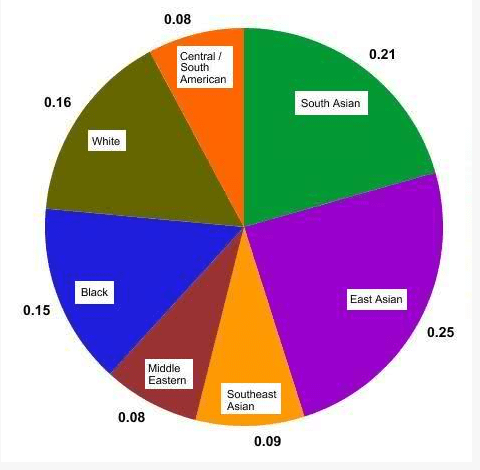
I found the following chart at the sciencechatforum.com.  Not sure how accurate it is.  One major group that is missing are Jews, but being only 0.2% of the world population, their population is too low to show anyway.

racepie


Share this:

  • Share on X (Opens in new window) X
  • Share on Facebook (Opens in new window) Facebook
Like Loading...

r vs K

06 Friday Jul 2018

Posted by pumpkinperson in Uncategorized

≈ 166 Comments

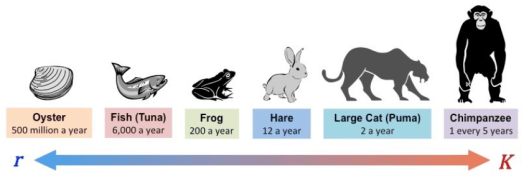
A while back there was a guest article about r vs K.  Wikipedia defines r vs K:

In ecology, r/K selection theory relates to the selection of combinations of traits in an organism that trade off between quantity and quality of offspring.

This theory has a certain common sense appeal, because there clearly is an evolutionary trade off between quantity and quality, and that fascinates me because quality is a value judgement and scientists aren’t supposed to think in terms of some life forms being genetically superior to others.  An r strategist is like fast-food cook (she makes tons of food fast and cheap) while a K strategist is like a fine dining chef (makes a few expensive masterpieces with exquisite care and craft)
rk

I think where the theory went wrong is claiming that selection pressures that depended on population density led to K selection because when this hypothesis was actually tested, it wasn’t always true causing many to reject the whole concept prematurely.

In the 1980s J. Phillipe Rushton became perhaps the first person to ever apply the r vs K to humans, arguing more recently evolved and colder adapted races like Northeast Asians were more K than older tropical peoples.  He viewed large genitalia and other developed sexual traits (including less obvious ones like breasts, buttocks, voice deepness, muscle salience) as a sign of r selection since they presumably lead to more and better sex, and thus reproduction.  By contrast large brains were viewed as a sign of K selection because they are slow to develop and thus require more parental care.

kim

Genetically superior?  Trump brilliantly defeated every politician in America, yet still got played by Kim Jong Un

Critics claimed Rushton was wrong and that arctic environments are actually more r selecting because they are less stable, and that tropical diseases are actually K selecting because they are infectious and less density dependent.

The critics were not completely wrong.  In his book Lone Survivor, Christopher Stringer argued that one reason modern humans evolved in Africa instead of Northern Eurasia is that in the latter, sudden burst of extreme cold would kill entire populations before any progress could gain traction.

But to me, critics were making the whole debate more complicated than it needs to be.  To me it’s very simple:  if individual survival is luck-dependent, it’s better to have high quantity offspring (r selection) than high quality offspring (K selection) because luck favors large numbers.  The more lottery tickets you buy, the more likely one will win.

How do you know if individual survival is luck dependent?  It’s not as simple as asking whether you live in the tropics or the arctic, because an environment that is luck dependent at a primitive stage of technology, might be skill dependent at a more advanced stage.

Instead I suggest you look at how heritable life span is in a particular environment.  The lower the heritability, the more luck-dependent your environment is, because luck is really just unexplained variance, and if there’s nothing about the genetic variance (which is the variance that matters in evolution) that can explain who lives or dies, then survival depends on luck.

Of course even if life span had a high heritability at first, natural selection would likely drive it down by removing unfit genetic variance, so it’s not as simple as just comparing heritabilities in the tropics to the arctic.  Instead what we need to do is take a group of people who have not had time to genetically adapt to either the tropics or the arctic (middle easterners perhaps) and get one group of them to live as hunter-gatherers in the arctic, and another to live as hunter-gatherers in the tropics.  Whichever group showed a higher life span heritability would be in the more K selecting environment.


Share this:

  • Share on X (Opens in new window) X
  • Share on Facebook (Opens in new window) Facebook
Like Loading...

Is it harder to become a black billionaire in America or Nigeria?

05 Thursday Jul 2018

Posted by pumpkinperson in Uncategorized

≈ 29 Comments

[Note from Pumpkin Person, July 5, 2018: A previous version of this article greatly underestimated the number of 55 to 69-year-old Nigerians]

According to Forbes 2018 listing of the World’s billionaires, there are only three black billionaires in America (Oprah, Michael Jordan, Robert Smith) and only three black billionaires in Nigeria (Aliko Dangote, Mike Adengua, and Folorunsho Alakija).

Now at first glance, you might think it’s easier to become a black billionaire in America because the U.S. has a much smaller black population than Nigeria has, yet still produced the same number of black billionaires.  But this ignores the different age structure of the two countries.  If we limit ourselves just to people in the age group of the above mentioned six individuals (55 to 69), then we find America has about 5 million blacks in this age group, and Nigeria has about 10.2 million.

So the odds of a black person in the billionaire age group actually being a billionaire are about one in 1.7 million in America vs one in 3.4 million in Nigeria.  So the same black person should find it harder to become a billionaire if they were born in Nigeria as they would if born in America.

Of course the problem with this analysis is that if you were born in Nigeria, you would not be the same person.  Third World malnutrition and disease stunt the development of the brain and body.  A Nigerian born Michael Jordan would have been 6’4″ instead of 6’6″,  making his basketball empire that much less likely, especially since his brain would have been smaller too, shrinking his physical coordination and business sense.

So part of what makes it so hard to get rich in the Third World is that you don’t reach your physiological potential, physically or mentally, however if you do, I’d say it’s probably much harder to get rich in the United States because you’re competing against other people who have also reached their physiological potential (and cultural potential too).  So a young black adult raised with no cultural links to either  the U.S. or Nigeria would be much better off moving to Nigeria if his only goal was to become a billionaire.


Share this:

  • Share on X (Opens in new window) X
  • Share on Facebook (Opens in new window) Facebook
Like Loading...
← Older posts
Newer posts →

contact pumpkinperson at easiestquestion@hotmail.ca

Recent Comments

Anime's avatarAnime on The 2009 V reboot: One of the…
pumpkinperson's avatarpumpkinperson on The 2009 V reboot: One of the…
God's Word's avatarGod's Word on The 2009 V reboot: One of the…
Anime's avatarAnime on The 2009 V reboot: One of the…
pumpkinperson's avatarpumpkinperson on The 2009 V reboot: One of the…
Elmo Bunn's avatarElmo Bunn on The 2009 V reboot: One of the…
God's Word's avatarGod's Word on The 2009 V reboot: One of the…
pumpkinperson's avatarpumpkinperson on The 2009 V reboot: One of the…
God's Word's avatarGod's Word on The 2009 V reboot: One of the…
pumpkinperson's avatarpumpkinperson on The 2009 V reboot: One of the…
God's Word's avatarGod's Word on The 2009 V reboot: One of the…

Archives

  • January 2026
  • December 2025
  • November 2025
  • October 2025
  • September 2025
  • August 2025
  • July 2025
  • June 2025
  • May 2025
  • April 2025
  • March 2025
  • February 2025
  • January 2025
  • December 2024
  • November 2024
  • October 2024
  • September 2024
  • August 2024
  • July 2024
  • June 2024
  • May 2024
  • April 2024
  • March 2024
  • February 2024
  • January 2024
  • December 2023
  • November 2023
  • October 2023
  • September 2023
  • August 2023
  • July 2023
  • June 2023
  • May 2023
  • April 2023
  • March 2023
  • February 2023
  • January 2023
  • December 2022
  • November 2022
  • October 2022
  • September 2022
  • August 2022
  • July 2022
  • June 2022
  • May 2022
  • April 2022
  • March 2022
  • February 2022
  • January 2022
  • December 2021
  • November 2021
  • October 2021
  • September 2021
  • August 2021
  • July 2021
  • June 2021
  • May 2021
  • April 2021
  • March 2021
  • February 2021
  • January 2021
  • December 2020
  • November 2020
  • October 2020
  • September 2020
  • August 2020
  • July 2020
  • May 2020
  • April 2020
  • March 2020
  • February 2020
  • January 2020
  • December 2019
  • November 2019
  • October 2019
  • September 2019
  • August 2019
  • July 2019
  • June 2019
  • May 2019
  • April 2019
  • March 2019
  • February 2019
  • January 2019
  • December 2018
  • November 2018
  • October 2018
  • September 2018
  • August 2018
  • July 2018
  • June 2018
  • May 2018
  • April 2018
  • March 2018
  • February 2018
  • January 2018
  • December 2017
  • November 2017
  • October 2017
  • September 2017
  • August 2017
  • July 2017
  • June 2017
  • May 2017
  • April 2017
  • March 2017
  • February 2017
  • January 2017
  • December 2016
  • November 2016
  • October 2016
  • September 2016
  • August 2016
  • June 2016
  • February 2016
  • January 2016
  • November 2015
  • May 2015
  • January 2015
  • December 2014
  • November 2014
  • October 2014

Categories

  • ethnicity
  • heritability
  • income
  • Oprah
  • Uncategorized

Meta

  • Create account
  • Log in
  • Entries feed
  • Comments feed
  • WordPress.com

Recent Comments

Anime's avatarAnime on The 2009 V reboot: One of the…
pumpkinperson's avatarpumpkinperson on The 2009 V reboot: One of the…
God's Word's avatarGod's Word on The 2009 V reboot: One of the…
Anime's avatarAnime on The 2009 V reboot: One of the…
pumpkinperson's avatarpumpkinperson on The 2009 V reboot: One of the…
Elmo Bunn's avatarElmo Bunn on The 2009 V reboot: One of the…
God's Word's avatarGod's Word on The 2009 V reboot: One of the…
pumpkinperson's avatarpumpkinperson on The 2009 V reboot: One of the…
God's Word's avatarGod's Word on The 2009 V reboot: One of the…
pumpkinperson's avatarpumpkinperson on The 2009 V reboot: One of the…
God's Word's avatarGod's Word on The 2009 V reboot: One of the…

Archives

  • January 2026
  • December 2025
  • November 2025
  • October 2025
  • September 2025
  • August 2025
  • July 2025
  • June 2025
  • May 2025
  • April 2025
  • March 2025
  • February 2025
  • January 2025
  • December 2024
  • November 2024
  • October 2024
  • September 2024
  • August 2024
  • July 2024
  • June 2024
  • May 2024
  • April 2024
  • March 2024
  • February 2024
  • January 2024
  • December 2023
  • November 2023
  • October 2023
  • September 2023
  • August 2023
  • July 2023
  • June 2023
  • May 2023
  • April 2023
  • March 2023
  • February 2023
  • January 2023
  • December 2022
  • November 2022
  • October 2022
  • September 2022
  • August 2022
  • July 2022
  • June 2022
  • May 2022
  • April 2022
  • March 2022
  • February 2022
  • January 2022
  • December 2021
  • November 2021
  • October 2021
  • September 2021
  • August 2021
  • July 2021
  • June 2021
  • May 2021
  • April 2021
  • March 2021
  • February 2021
  • January 2021
  • December 2020
  • November 2020
  • October 2020
  • September 2020
  • August 2020
  • July 2020
  • May 2020
  • April 2020
  • March 2020
  • February 2020
  • January 2020
  • December 2019
  • November 2019
  • October 2019
  • September 2019
  • August 2019
  • July 2019
  • June 2019
  • May 2019
  • April 2019
  • March 2019
  • February 2019
  • January 2019
  • December 2018
  • November 2018
  • October 2018
  • September 2018
  • August 2018
  • July 2018
  • June 2018
  • May 2018
  • April 2018
  • March 2018
  • February 2018
  • January 2018
  • December 2017
  • November 2017
  • October 2017
  • September 2017
  • August 2017
  • July 2017
  • June 2017
  • May 2017
  • April 2017
  • March 2017
  • February 2017
  • January 2017
  • December 2016
  • November 2016
  • October 2016
  • September 2016
  • August 2016
  • June 2016
  • February 2016
  • January 2016
  • November 2015
  • May 2015
  • January 2015
  • December 2014
  • November 2014
  • October 2014

Categories

  • ethnicity
  • heritability
  • income
  • Oprah
  • Uncategorized

Meta

  • Create account
  • Log in
  • Entries feed
  • Comments feed
  • WordPress.com

Blog at WordPress.com.

Privacy & Cookies: This site uses cookies. By continuing to use this website, you agree to their use.
To find out more, including how to control cookies, see here: Cookie Policy
  • Subscribe Subscribed
    • Pumpkin Person
    • Join 685 other subscribers
    • Already have a WordPress.com account? Log in now.
    • Pumpkin Person
    • Subscribe Subscribed
    • Sign up
    • Log in
    • Report this content
    • View site in Reader
    • Manage subscriptions
    • Collapse this bar
 

Loading Comments...
 

    %d