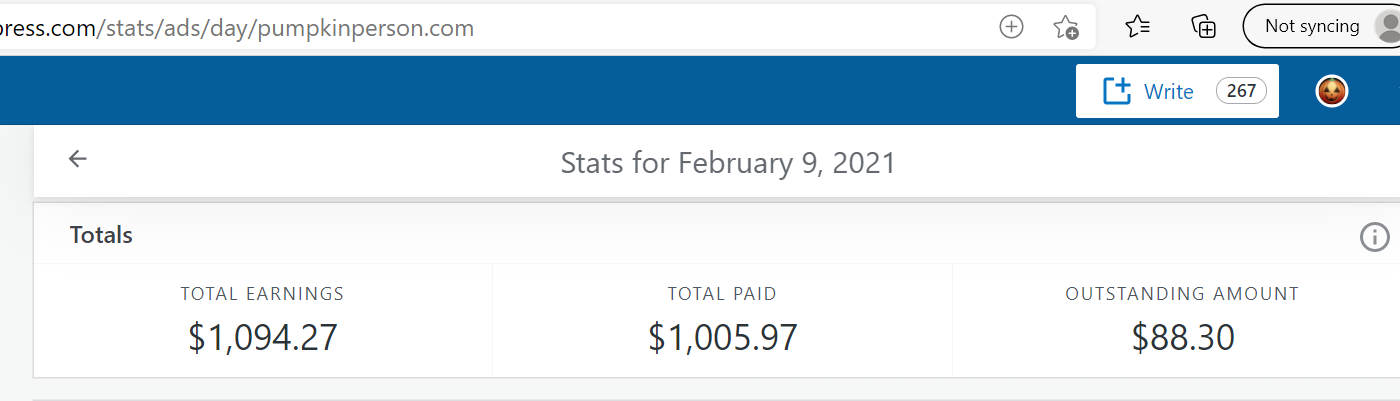
While other HBD bloggers have likely made thousands of dollars off donations, I’m proud of the fact that I earned every penny of my measly 1 thousand through advertising.
But now I want to become HBD’s first self-made multi-thousandaire so let the bidding wars begin.
Who ever is willing to pay me the most money on Paypal gets to decide the topic of one of my articles next week (as long as it’s related to psycometrics/HBD). If you would like to bid, simply place your bid in the comment section. I will then ask you to provide an email which I will not publish but will use to email you an invoice if you become the highest bidder. To become the highest bidder, we must go 24 hours without anyone bidding higher.
If you don’t have a paypal account I strongly advise you to get one because it allows you to buy and sell stuff while maintaining anonymity (if you desire that). Even if you have no desire to ever pay me a penny, you can use the account to start your own online business!
[This article is sponsored by proscootersmart.com. Check out the unbiased reviews of skateboards, scooters, and much more.]
Few sports embody what Howard Gardener called bodily-kinesthetic intelligence quite like skateboarding, where champions seem to defy the laws of gravity. But how smart are the best skateboarders in the conventional sense? How would they score on an actual IQ test?
Skateboarders have never been accused of being the smartest people in the room. They are creative, artistic, and resourceful, but most are high school or home school drop-outs incapable of basic reading comprehension.
Average IQ of the 10 best skaters
While your average skater may have only average intelligence, those who dominate the sport might be quite a bit smarter. The following video ranks the ten best skaters:
Even though skateboarding is a physical skill, it requires far more coordination than most sports, which means the brain is highly involved.
Since the best skaters must be young enough to be physically active, but old enough to have decades of practice, the majority of the most skilled are from Generation X (the 84 million Americans born from the early 1960s to the early 1980s). About 1.7% of U.S. youth are core skaters (defined as people who’ve skated 52+ times per year). Assuming this was the case when generation X was young, roughly 1.4 million Gen Xers were core skaters.
Thus, ranking among the ten best skaters in America is roughly a one in 140,000 level achievement, and the median top ten skater would be at the one in 280,000 level (or roughly 4.5 standard deviations above the mean). And because performance correlates about 0.82 with talent, the top ten skaters likely average 0.82(4.5) = 3.69 standard deviations above average in raw physical coordination. And since physical coordination correlates 0.35 with IQ, they likely average 0.35(3.69) = 1.29 standard deviations above average in IQ.
In other words the 10 best skaters in America likely average an IQ of about 120 (smarter than 90% of Americans their age), however the Gaussian curve predicts that in a group of 10 people, the dullest is roughly 20 points below the group’s average and the brightest is roughly 20 points above, and so America’s 10 best skaters likely range from around a normal IQ of 100 to a genius IQ of 140.
As a child, he used Erector sets to build a complete control center for his room, which used pulleys and strings to allow him to turn on the lights and open the door from the upper bunk of his bed.
High IQ may run in his family: His mother “graduated high school at age 14 and then earned a degree in physics, while also being an accomplished pianist.”
It’s interesting to note that the #1 skater on this list (Tony Hawk) actually took a professionally administered IQ test and scored an incredible 144! Described by the psychologist as a twelve-year-old’s mind in an eight-year-old’s body, Hawk would grow up to build a $140 million empire.
It’s sometimes claimed that high IQ people only get rich because IQ predicts education and it’s the latter that’s rewarded by the market, but Hawk has little formal education and started getting rich while still in high school. He’s an example of a high functioning braining causing money directly, first by having the neurological ability to master a lucrative sport, and secondly, having the mental ability to parlay that talent into a huge brand.
Starting an online business
Of course we can’t all be the next Tony Hawk no matter how high your IQ might be, but that doesn’t mean we can’t make some money off skateboards, or whatever your passion may be. Who would have guessed that a small web site likeproscootersmart.com made a few thousand dollars last year and expects to double that this year.
“I was shopping for a scooter for my son and noticed that a lot of the sites were affiliate sites so I wanted to get in the game,” the owner explained.
“I’ve actually tried many of the products myself because I want to give unbiased reviews of them. Hover boards are the hardest product to ride because everyone wants to ride one but don’t automatically get the concept of how it works.”
For those who want to learn from his business model and start their own affiliate site, his advice is to just jump in because you’ll “never learn unless you try it.” He also notes that education can be overrated since the internet can teach you anything. He advises not giving up because your luck can change, just when you think something’s a lost cause.
As the super high IQ Marilyn Vos Savant once said, failure tends to be a temporary condition. Giving up is what makes it permanent.

 Pumpkin Person