
[The following is a guest article written by RR. It does not necessarily reflect the views of Pumpkin Person]
Charles Murray published his Human Diversity: The Biology of Gender, Race, and Class on 1/28/2020. I have an ongoing thread on Twitter discussing it.
Murray talks of an “orthodoxy” that denies the biology of gender, race, and class. This orthodoxy, Murray says, are social constructivists. Murray is here to set the record straight. I will discuss some of Murray’s other arguments in his book, but for now I will focus on the section on race.
Murray, it seems, has no philosophical grounding for his belief that the clusters identified in these genomic runs are races—and this is clear with his assumptions that groups that appear in these analyses are races. But this assumption is unfounded and Murray’s assumption that the clusters are races without any sound justification for his belief actually undermines his claim that races exist. That is one thing that really jumped out at me as I was reading this section of the book. Murray discusses what geneticists say, but he does not discuss what any philosophers of race say. And that is to his downfall.
Murray discusses the program STRUCTURE, in which geneticists input the number of clusters they want and, when DNA is analyzed (see also Hardimon, 2017: chapter 4). Rosenberg et al (2002) sampled 1056 individuals from 52 different populations using 377 microsatellites. They defined the populations by culture, geography, and language, not skin color or race. When K was set to 5, the clusters represented folk concepts of race, corresponding to the Americas, Europe, East Asia, Oceania, and Africa. (See Minimalist Races Exist and are Biologically Real.) Yes, the number of clusters that come out of STRUCTURE are predetermined by the researchers, but the clusters “are genetically structured … which is to say, meaningfully demarcated solely on the basis of genetic markers” (Hardimon, 2017: 88).
Races as clusters
Murray then discusses Li et al, who set K to 7 and North Africa and the Middle East were new clusters. Murray then provides a graph from Li et al:
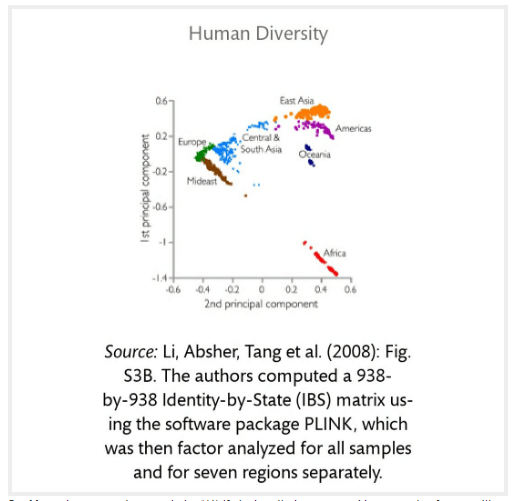
So, Murray’s argument seems to be “(1) If clusters that correspond to concepts of race setting K to 5-7 appear in STRUCTURE and cluster analyses, then (2) race exists. (1). Therefore (2).” Murray is missing a few things here, namely conditions (see below) that would place the clusters into the racial categories. His assumption that the clusters are races—although (partly) true—is not bound by any sound reasoning, as can be seen by his partitioning Middle Easterners and North Africans as separate races. Rosenberg et al (2002) showed the Kalash in K=6, are they a race too?
No, they are not. Just because STRUCTURE identifies a population as genetically distinct, it does not entail that the population in question is a race because they do not fit the criteria for racehood. The fact that the clusters correspond to major areas means that the clusters represent continental-level minimalist races so races, therefore, exist (Hardimon, 2017: 85-86). But to be counted as a continental-level minimalist race, the group must fit the following conditions (Hardimon, 2017: 31):
(C1) … a group is distinguished from other groups of human beings by patterns of visible physical features
(C2) [the] members are linked by a common ancestry peculiar to members of that group, and
(C3) [they] originate from a distinctive geographic location[…]
…what it is for a group to be a race is not defined in terms of what it is for an individual to be a member of a race. What it means to be an individual member of a minimalist race is defined in terms of what it is for a group to be a race.
Murray (paraphrased): “Cluster analyses/STRUCTURE spit out these continental microsatellite divisions which correspond to commonsense notions of race.” What is Murray’s logic for assuming that clusters are races? It seems that there is no logic behind it—just “commonsense.” (See also Fish, below.) Due to not finding any arguments for accepting X number of clusters as the races Murray wants, I can only assume that Murray just chose which one agreed with his notions and use for his book. (If I am in error, then if there is an argument in the book then maybe someone can quote it.) What kind of justification is that?
Compared to Hardimon’s argument and definition. Homo sapiens is:
… a subdivision of Homo sapiens—a group of populations that exhibits a distinctive pattern of genetically transmitted phenotypic characters that corresponds to the group’s geographic ancestry and belongs to a biological line of descent initiated by a geographically separated and reproductively isolated founding population. (Hardimon, 2017: 99)
[…]
Step 1. Recognize that there are differences in patterns of visible physical features of human beings that correspond to their differences in geographic ancestry.
Step 2. Observe that these patterns are exhibited by groups (that is, real existing groups).
Step 3. Note that the groups that exhibit these patterns of visible physical features correspond to differences in geographical ancestry satisfy the conditions of the minimalist concept of race.
Step 4. Infer that minimalist race exists. (Hardimon, 2017: 69)
While Murray is right that the clusters that correspond to the folk races appear in K = 5, you can clearly see that Murray assumes that ALL clusters would then be races and this is where the philosophical emptiness of Murray’s account comes in. Murray has no criteria for his belief that the clusters are races, commonsense is not good enough.
Philosophical emptiness
Murray then lambasts the orthodoxy for claiming that race is a social construct.
Advocates of “race is a social construct” have raised a host of methodological and philosophical issues with the cluster analyses. None of the critical articles has published a cluster analysis that does not show the kind of results I’ve shown.
Murray does not, however, discuss a more critical article of Rosenberg et al (2002)—Mills (2017) – Are Clusters Races? A Discussion of the Rhetorical Appropriation of Rosenberg et al’s “Genetic Structure of Human Populations.” Mills (2017) discusses the views of Neven Sesardic (2010)—philosopher—and Nicholas Wade—science journalist and author of A Troublesome Inheritance (Wade, 2014). Both Wade and Seasardic are what Kaplan and Winther (2014) term “biological racial realists” whereas Rosenberg et al (2002), Spencer (2014), and Hardimon (2017) are bio-genomic/cluster realists. Mills (2017) discusses the “misappropriation” of the bio-genomic cluster concept due to the “structuring of figures [and] particular phrasings” found in Rosenberg et al (2002). Wade and Seasardic shifted from bio-genomic cluster realism to their own hereditarian stance (biological racial realism, Kaplan and Winther, 2014). While this is not a blow to the positions of Hardimon and Spencer, this is a blow to Murray et al’s conception of “race.”
Murray (2020: 144)—rightly—disavows the concept of folk races but wrongly accepting the claim that we dispense with the term “race”:
The orthodoxy is also right in wanting to discard the word race. It’s not just the politically correct who believe that. For example, I have found nothing in the genetics technical literature during the last few decades that uses race except within quotation marks. The reasons are legitimate, not political, and they are both historical and scientific.
Historically, it is incontestably true that the word race has been freighted with cultural baggage that has nothing to do with biological differences. The word carries with it the legacy of nineteenth-century scientific racism combined with Europe’s colonialism and America’s history of slavery and its aftermath.
[…]
The combination of historical and scientific reasons makes a compelling case that the word race has outlived its usefulness when discussing genetics. That’s why I adopt contemporary practice in the technical literature, which uses ancestral population or simply population instead of race or ethnicity …
[Murray also writes on pg 166]
The material here does not support the existence of the classically defined races.
(Nevermind the fact that Murray’s and Herrnstein’s The Bell Curve was highly responsible for bringing “scientific racism” into the 21st century—despite protestations to the contrary that his work isn’t “scientifically racist.”)
In any case, we do not need to dispense with the term race. We only need to deflate the term (Hardimon, 2017; see also Spencer, 2014). Rejecting claims from those termed biological racial realists by Kaplan and Winther (2014), both Hardimon (2017) and Spencer (2014; 2019) deflate the concept of race—that is, their concepts only discuss what we can see, not what we can’t. Their concepts are deflationist in that they take the physical differences from the racialist concept (and reject the psychological assumptions). Murray, in fact, is giving into this “orthodoxy” when he says that we should stop using the term “race.” It’s funny, Murray cites Lewontin (an eliminativist about race) but advocates eliminativism of the word but still keeping the underlying “guts” of the concept, if you will.
We should only take the concept of “race” out of our vocabulary if, and only if, our concept does not refer. So for us to take “race” out of our vocabulary it would have to not refer to any thing. But “race” does refer—to proper names for a set of human population groups and to social groups, too. So why should we get rid of the term? There is absolutely no reason to do so. But we should be eliminativist about the racialist concept of race—which needs to exist if Murray’s concept of race holds.
There is, contra Murray, material that corresponds to the “classically defined races.” This can be seen with Murra’s admission that he read the “genetics technical literature”. He didn’t say that he read any philosophy of race on the matter, and it clearly shows.
To quote Hardimon (2017: 97):
Deflationary realism provides a worked-out alternative to racialism—it is a theory that represents race as a genetically grounded, relatively superficial biological reality that is not normatively important in itself. Deflationary realism makes it possible to rethink race. It offers the promise of freeing ourselves, if only imperfectly, from the racialist background conception of race.
Spencer (2014) states that the population clusters found by Rosenberg et al’s (2002) K = 5 run are referents of racial terms used by the US Census. “Race terms” to Spencer (2014: 1025) are “a rigidly designating proper name for a biologically real entity …” Spencer’s (2019b) position is now “radically pluralist.” Spencer (2019a) states that the set of races in OMB race talk (Office of Management and Budget) is one of many forms “race” can take when talking about race in the US; the set of races in OMB race talk is the set of continental human populations; and the continental set of human populations is biologically real. So “race” should be understood as proper names—we should only care if our terms refer or not.
Murray’s philosophy of race is philosophically empty—Murray just uses “commensense” to claim that the clusters found are races, which is clear with his claim that ME/NA people constitute two more races. This is almost better than Rushton’s three-race model but not by much. In fact, Murray’s defense of race seems to be almost just like Jensen’s (1998: 425) definition, which Fish (2002: 6) critiqued:
This is an example of the kind of ethnocentric operational definition described earlier. A fair translation is, “As an American, I know that blacks and whites are races, so even though I can’t find any way of making sense of the biological facts, I’ll assign people to my cultural categories, do my statistical tests, and explain the differences in biological terms.” In essence, the process involves a kind of reasoning by converse. Instead of arguing, “If races exist there are genetic differences between them,” the argument is “Genetic differences between groups exist, therefore the groups are races.”
So, even two decades later, hereditarians are STILL just assuming that race exists WITHOUT arguments and definitions/theories of race. Rushton (1997) did not define “race”, and also just assumed the existence of his three races—Caucasians, Mongoloids, and Negroids; Levin (1997), too, just assumes their existence (Fish, 2002: 5). Lynn (2006: 11) also uses a similar argument to Jensen (1998: 425). Since the concept of race is so important to the hereditarian research paradigm, why have they not operationalized a definition and rely on just assuming that race exists without argument? Murray can now join the list of his colleagues who also assume the existence of race sans definition/theory.
Conclusion
Hardimon’s and Spencer’s concepts get around Fish’s (2002: 6) objection—but Murray’s doesn’t. Murray simply claims that the clusters are races without really thinking about it and providing justification for his claim. On the other hand, philosophers of race (Hardimon, 2017; Spencer, 2014; 2019a, b) have provided sound justification for the belief in race. Murray is not fair to the social constructivist position (great accounts can be found in Zack (2002), Hardimon (2017), Haslanger (2000)). Murray seems to be one of those “Social constructivists say race doesn’t exist!” people, but this is false: Social constructs are real and the social can does have potent biological effects. Social constructivists are realists about race (Spencer, 2012; Kaplan and Winther, 2014; Hardimon, 2017), contra Helmuth Nyborg.
Murray (2020: 17) asks “Why me? I am neither a geneticist nor a neuroscientist. What business do I have writing this book?” If you are reading this book for a fair—philosophical—treatment for race, look to actual philosophers of race and don’t look to Murray et al who do not, as shown, have a definition of race and just assume its existence. Spencer’s Blumenbachian Partitions/Hardimon’s minimalist races are how we should understand race in American society, not philosophically empty accounts.
Murray is right—race exists. Murray is also wrong—his kinds of races do not exist. Murray is right, but he doesn’t give an argument for his belief. His “orthodoxy” is also right about race—since we should accept pluralism about race then there are many different ways of looking at race, what it is, and its influence on society and how society influences it. I would rather be wrong and have an argument for my belief then be right and appeal to “commonsense” without an argument.
 Pumpkin Person