
In the Minnesota Transracial Adoption study, white babies, black babies, and mixed babies (biological father black; biological mother white) were adopted into white upper middle-class homes when they were 19 months, 32 months, and nine months respectively. The purpose of the study was to determine how much of the 15 point black-white IQ gap in the United States is genetic.
In 1975, the children and adoptive parents were IQ tested on at least an abbreviated versions of the Stanford Binet/WISC/WAIS (depending on age), and then retested in 1986 on the WISC-R/WAIS-R depending on age. Here are the results:
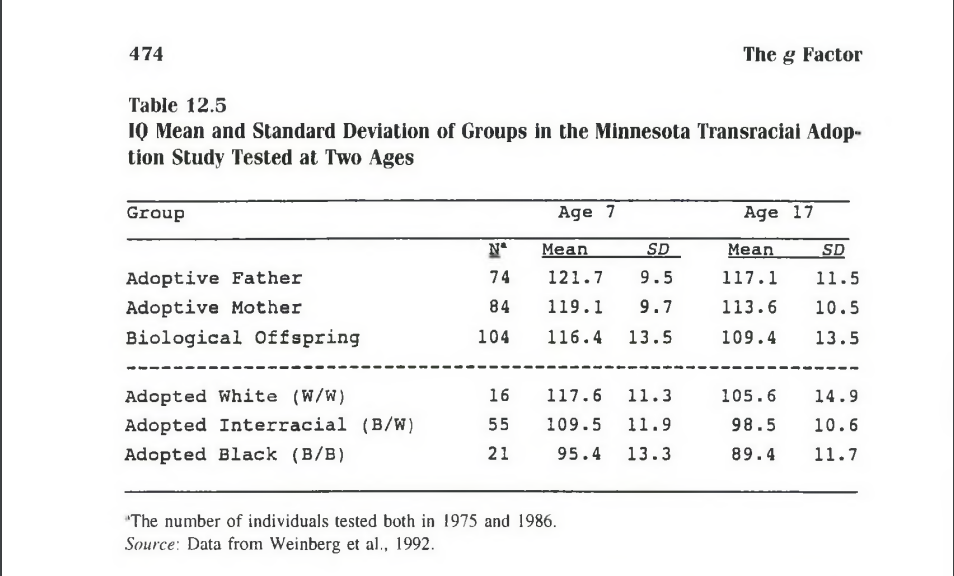
Because the norms on all the tests were out-dated at the time of testing (especially in 1975), John Loehlin attempted to correct all scores for the Flynn effect.

But many people ignore the IQs themselves, and instead just focus on the IQ differences. They see that at age 17, adopted whites scored 7.1 points higher than adopted mixeds in the unadjusted data, and 16.2 points higher than the adopted blacks, and conclude that the 15 point black-white IQ gap in the United States is roughly 100% genetic.
One problem with this is that black babies were adopted later than the non-black babies. Another problem is they were born to black mothers, while the non-black babies were all born to white mothers, so the prenatal and perinatal environments may have been quite unequal.
Thus I have always been more intrigued by the 7.1 IQ gap between the adopted whites and adopted mixeds. Since the adopted mixeds presumably had only half as much black ancestry as the typical U.S. black, it’s interesting that there’s roughly half the infamous 15 point black-white IQ gap, despite being gestated in white wombs and raised in white homes. Does this point to the importance of genetics?
Physicist Drew Thomas argues that the comparison between the adopted whites and adopted blacks is misleading because in the tables posted above, at both ages we only see data for the adopted kids who remained in the study for the follow-up testing in 1986. He argues that several low IQ adopted white kids dropped out of the study, and had they remained, the IQ gap between the adopted whites and adopted mixeds would have perhaps been only 3.5 points at age 17.
However this argument is starting to feel a little post-hoc. When you do a study, your data is what it is. You can’t adjust it for what it would have been had people you wished remained in the study. Almost any study can be debunked if we imagine how it would have turned out in a parallel universe where different people took part.
That’s not to deny that adjusting for attrition can be important in some cases, but in this study, Thomas argues attrition only increased the IQs of adopted whites and not the adopted non-whites. An effect that only affected one demographic sounds to me like random error, not a systematic bias that needs to be adjusted for. And if the error was random, one could just as easily argue the IQs of adopted whites were too low before the attrition rather than too high after the attrition.
Indeed if the adopted white sample is so easily skewed by a few kids dropping out of the study, then maybe that sample is too small to begin with, and instead we should compare the much larger sample of adopted mixeds not to the adopted whites, but to the general U.S. white population.
At an average age of 17, the adopted mixeds took the WISC-R and WAIS-R depending on age, and averaged 98.5 (93.5 after adjustments for the Flynn effect, since WISC-R and WAIS-R norms were 14 and 8 years old respectively at the time of testing).
However some top-secret research I’ve been slowly doing over the past decade suggests the Flynn effect has been wildly exaggerated, so while I don’t think their average IQ was as high as 98.5, I also doubt it was as low as the Flynn corrections say. Let’s split the difference and say 96 (U.S. norms).
By contrast, the whites in the WISC-R and WAIS-R standardization samples averaged 102.2 (standard deviation (SD) = 14.08) and 101.4 (SD = 14.65) respectively. Let’s split the difference and say 101.8 (SD = 14.4).
Thus converting to the more traditional scale where the U.S. white mean and SD are set at 100 and 15 respectively, the adopted mixed mean of 96 becomes ((96 – 101.8)/14.4)(15) + 100 = 94.
In other words, despite being gestated in white wombs and raised in upper-middle class white homes, having just one U.S. black biological parent appears to have reduced IQ by 6 points, suggesting that having two U.S black biological parents would reduce IQ by 12 points, suggesting that 80% of the 15 point black-white IQ gap in the U.S. is genetic. 80% squared is 0.64 which is similar to the 0.69 heritability of the WAIS full-scale IQ found in Thomas Bouchard’s study of identical twins reared apart, consistent with Jensen’s default hypothesis which claimed that IQ gaps between U.S. races are caused by the same nature-nurture mix that occurs within them.
To paraphrase President Obama, there is no black America or white America; from a nature-nurture perspective, there’s just America.
While this analysis seems to have controlled for the prenatal and family environment, it’ does not control for peer groups. Maybe as mixed kids raised in white homes, they were unmotivated on IQ tests because of the racist stereotype that being smart = acting white. On the other hand, they did better on scholastic tests than they did on formal IQ tests, suggesting motivation was not a problem.
If the genetic part of the U.S. black-white IQ gap is indeed 12 points and black Americans are only about 74% black on average it implies that 100% West African ancestry would reduce IQ by 16 points below the U.S. white mean (at least if we assume U.S. black ancestry is representative of West African ancestry).
And at least if we assume the Phenotype = Genotype + Environment model
Some readers invoke a reaction norm model where genotype A is higher IQ than genotype B in environment A, but lower than genotype B in environment B. Assuming such norm crossing occurs with IQ, my sense is that it would be limited to individual cases and cancel out in group level comparisons like the black-white IQ gap.
Some might argue that it’s inappropriate to compare adopted mixeds to the general U.S. white population because adopted mixeds might not be genetically representative of their parent populations. In The g Factor, Jensen states that the parents of the mixeds averaged 12.5 years of schooling (page 473) while just the mothers averaged 12.4 (page 478). From here we can deduce that the fathers averaged 12.6.
In 1975 America, white women and non-white men age 25+ had a median of 12.3 and 11.3 years of schooling respectively (see table 4 of this document). Comparable figures in 1986 were 12.6 and 12.5. So using education as a proxy, there’s no reason to think the mixed kids were selected to have lower IQs than the mean of their parent races. If anything, their biological fathers averaged more education than age 25+ non-white men throughout the full duration of the study and their biological mothers averaged about the same education as age 25+ white women.
Of course it would help to know the exact ages of the parents, rather than just lumping them in with everyone over 25. I can’t find the age of the biological parents of the mixeds specifically, but the bio moms and dads of all the kids who took part in at least part of the study (see table 3 of this paper) averaged 21.6 and 26.3 at the time the kids were born, and thus were about 29 and 33 in 1975 and about 39 and 43 in 1986, thus they were likely near the median age of the 25+ cohort by the end of the study.
Although this study shows the black-white IQ gap is highly genetic, several similar studies beg to differ. Tizard (1974) compared black, white and mixed-race kids raised in English residential nurseries and found that the only significant IQ difference favored the non-white kids. A problem with this study is that the children were extremely young (below age 5) and ethnic differences in maturation rates favor black kids. A bigger problem with this study is that the parents of the black kids appeared to be immigrants (African or West Indian) and immigrants are often hyper-selected for IQ (see Indian Americans).
A second study by Eyferth (1961) found that the biological illegitimate children of white German women had a mean IQ of 97.2 if the biological father was was a white soldier and 96.5 if the biological father was a black soldier (a trivial difference). Both the white and mixed kids were raised by their biological white mothers. One problem with this study is that the biological fathers of both races would have been screened to have similar IQ’s because at the time, only the highest scoring 97% of whites and highest scoring 70% of blacks passed the Army General Classification Test and were allowed to be U.S. soldiers. In addition, 20% to 25% of the “black fathers” were not African-American or even black Africans, but rather French North Africans (non-white caucasoids or “dark whites” as they are sometimes called). In addition, there was no follow-up to measure the adult IQ of the children.
A third study by Moore (1986) included a section where he looked at sub-samples of children adopted by white parents. He found that nine adopted kids with two black biological parents averaged 2 IQ points higher than 14 adopted kids with only one biological black parent but the sample size was quite small, I don’t know anything about the bio-parents and again, no followup when the kids were older.
 Pumpkin Person