This is a great film to watch on Halloween, and it’s available on shudder. I saw at it as a kid after Roger Ebert gave it no stars. The 1980s was the golden age of horror. You can’t make movies like this anymore because people will think it’s a self-parody or you’ll have clueless people like commenter Pill saying “your films are so weird, are you an alien with no social intelligence?”. But in the 1980s normal people produced and consumed these gritty films with no sense of irony.
Beloved (1998) is one of the most underrated movies of all time and a great ghost story for the Halloween season. No other film captures the beauty of 19th century America as vividly as this film does. Whenever I think about the Flynn effect, I think about Beloved. How people started scoring about 1 or 2 IQ points higher on the Wechsler every decade because of better nutrition and nothing else. The film captures the wide eyed child-like innocence of reconstruction era Americans and unlike other films which show the violence of slavery, this film, set years after slavery, is about how the memory of slavery haunts the former slaves as they try to start a new life.
After reading the entire novel in one sitting, Oprah purchased the movie rights in the 1980s, telling her lawyers to give Nobel Prize winning Toni Morrison whatever she wanted. Oprah, who had built her $2.7 billion dollar empire on shrewd business deals insisted that when it came to this priceless work of art, there’d be no negotiations.
But Oprah soon learned that buying the rights was the easy part. It took ten years for Oprah to find a director. Some felt Beloved (which has been deemed too difficult for university undergrads) was too literary a book to be made into a movie. One director felt it could be a movie, but wanted to decide whether Oprah was right for the lead role.
Finally Oprah struck gold when academy award winning director Jonathan Demme agreed to direct. Sadly, the film got mixed reviews and flopped at the box office and is generally regarded as one of the rare failures of Oprah’s career. Many viewers found it too long and confusing.
Below is an excellent defense of the film by Adam Zanzie which describes the 10 year struggle to get it made.
So it was pouring rain last night and I just had to get out of my apartment, so even though I had to be on my computer before sunrise the next morning for work, I decided to drive to the 10:35 showing of Halloween Kills. After showing proof of vaccination and buying some popcorn, I took my reclining seat at the very back and middle of the movie theatre. Two young women sat one row ahead and to the right of me, and then there was a demented young man sitting by himself in the very middle of the theatre (saw him after the movie ended, just aimlessly walking in the rain after midnight). So just the four of us, in this huge theatre built for hundreds of people.
I should make clear that Halloween Kills is a sequel to John Carpenter’s original 1978 Halloween where Michael Myers is from a middle class home:
Not to be confused with the white trash kid from Rob Zombie’s 2007 remake that they want so desperately for us to forget.
In the original 1978 classic, 6-year-old Myers stabs his baby-sitting older sister to death on Halloween night. 15 years later he escapes from a mental hospital, returns to the same town to relive his crime by killing the local baby-sitters.
The original Halloween became for years the most successful independent film of all time, launching the stalker sub-genre and turning Jamie Lee Curtis into the Scream Queen. Curtis played Laurie Strode, everyone’s favorite girl next door. The high IQ bookworm virgin who uses her quick wit to outsmart the killer who slaughtered her promiscuous best friends.
Halloween Kills, like its immediate predecessor Halloween 2018, takes place exactly 40 years after the 1978 classic (ignoring all the other sequels). Laurie is now a grandmother but still traumatised by Myers who has once again escaped from the mental hospital to terrorize his hometown. Laurie had trapped him in her basement and then set her own house on fire to kill him, but sadly, the firemen unintentionally come to his rescue.
The film will be a bit confusing to those who haven’t mastered the original or the 2018 sequel but I enjoyed it. There’s a scene where a police officer recalls being sent by a sympathetic mother to play with Myers as a young child, but all Myers would do was stare out his sister’s bedroom window. Finally confirmation that Myers was weird even before he killed his sister.
In a sign of the times, the franchise gets its first openly gay characters: a couple who moves into Myers’s childhood home where he killed his older sister. At first I was annoyed by the film’s transparent virtue signaling but then I realized, moving into a “haunted” house is exactly the kind of campy thing a couple gay guys would do.
In another scene Myers is described as a 6-year-old with the body of a man and the the mind of an animal. His socialization certainly stopped at age 6 because he spent the next 55 years never speaking, just sitting motionless in a mental hospital, except for the two Halloween nights he escaped. Having the mind of an animal may explain why he never speaks because if you believe Noam Chomsky, no animal has anything even remotely resembling language and even we didn’t have it until 50,000 years ago.
In the original film, Myers’s psychiatrist is told of Myers “there’s nothing left. No reason, no understanding, not even the most rudimentary sense of life or death, good or evil, right or wrong”. The demented way Myers tilts his head after killing someone in the original film suggests he doesn’t grasp life or death.
What was Myers’s IQ? Verbal tests are out of the question because he doesn’t speak and can’t read. Performance tests also wouldn’t work because he moves extremely slowly. The only test I could picture him taking is the Raven Matrices because all you need to do is point to the right answer without time limit, though you’d have to adjust for his lack of schooling since the test is surprising sensitive to education.
Another white suburban guy who is angry that Rob Zombie turned their beloved Michael Myers into white trash in his 2007 remake of John Carpenter’s horror masterpiece Halloween (see video below). I say “get over it”. It’s not as though the franchise was not already tainted by many of the crappy sequels. I do not consider Rob Zombie (or his wife Sherri Moon Zombie) to be white trash because his white trashiness is more of an artistic choice. They are sometimes unwelcome in the rich neighborhoods they can now afford because those people probably don’t get him.
Class expert Paul Fussell (who LOTB blogged a lot about) would probably realize Zombie was not a true prole, but rather someone who transcends class. From wikipedia:
In the final chapter, The X Way Out, Fussell identifies “category X” people who exist outside of the US class structure. Fussell argues that it is essentially impossible to change one’s social class —up or down— but it is possible to extricate oneself from the class system by existing outside the system as a X person. (In the US, Middles and proles are conditioned to believe in meritocracy, despite class mobility being among the lowest in industrialized economies.)[5] He states that X people do self-directed work without a boss or supervisor; they are writers, artists, musicians and others “creative” types. X people dress comfortably, wearing L. L. Bean, Lands’ End, and thrift store purchases. They drink good wine without commenting on it, speak multiple languages, and generally disregard social norms because they have no interest in class status and disdain the Middles who are so concerned with it. Fussell names the Mark Twain character Huckleberry Finn as an archetypal Category X person.
Many people hated Rob Zombie’s 2007 Halloween remake (and its underrated sequel), especially us older fans of John Carpenter’s original 1978 masterpiece. The thing they most complain about is that unlike the suburban kid from the original film, Rob Zombie’s Myers is white trash. Although the original Halloween was one of the best movies ever made, I find Zombie’s remake (and its sequel) to be a fascinating alternative.
Many found it scarier when Myers came from the perfect family because it meant evil could strike anywhere. But I find it scarier to see this dysfuntional family that is so chaotic and unstable that they don’t even notice the evil that is gestating upstairs in their very own home.
Witness the breakfast scene:
William Forsythe is utterly hilarious as Ronnie White (Myers’s mother’s boyfriend): “BITCH I WILL SKULL FUCK THE SHIT OUT OF YOU!!”
LMAO! Zombie is a master of trashy white wit.
What the hell does “skull fuck” mean anyway? I just picture him penetrating her with his cranium.
I also like the chemistry between White and Myers’s slutty sister. Even though she sees him as a dirty old man, the two smile at each other when mocking Myers for stroking his rat or his mother for having abortions.
In a scene that never would have made the final cut today, White says of young Myers “he’s probably queer” and predicts he’ll “cut off his dick and change his name to Michelle”.
Like a lot of ageing white trash men with long hair, White seems a little schizo, which some think is the opposite of autism in some ways. Thus it makes sense that White would have the social intelligence to be the first to see how deviant young Myers really was. He was wrong about the details, and sadly quite bigoted against the LGBTQ2+, but in his own redneck way he was trying to warn people “this kids a monstrous freak who will grow up to do gruesome things”
Perhaps bullying evolved as a way of driving bad genes from the tribe. Many fans hate that young Myers was bullied in Zombie’s remake because it gave him a motive which undermines their preferred theme that Myers was pure evil. But I see the bullying as more a product than a cause of Myers’s freakiness.
So I was flipping through the Forbes list of the 400 richest Americans and most of the top 10 are centibillionaires:
Jeff Bezos $201 billion
Elon Musk $190.5 billion
Mark Zuckerberg $134.5 billion
Bill Gates $134 billion
Larry Page $123 billion
Sergey Brin $118.5 billion
Larry Ellison $117.3 billion
Warren Buffet $102 billion
Steve Balmer $96.5 billion
Michael Bloomberg $70 billion
Despite being 2 to 3% of America, Jews are an astonishing 60% of the top 10! Given that Jews have likely the highest IQ of any U.S. ethnic group, this dramatic overrepresentation suggests centibillionaires have very high IQs.
And indeed two members of the top 10 (Gates and Balmer) scored a perfect 800 on the pre-recentered math SATs which equates to a math IQ of roughly 154+ (U.S. norms). Elon Musk never took the SAT but if he had, he too would have likely scored 800 also considering he got the highest score they had ever seen on IBM’s computer aptitude test (at least if the tweets of his doting mother can be believed). Mark Zuckerberg is widely believed to have scored 800 on both sections of the SAT but the only source for this is the biopic The Social Network, and even if true, he took the easier recentered SAT, though still extremely impressive!
So let’s say about 30% of the 10 richest Americans (according to Forbes) have math IQ’s of 154+. In the general population, the top 30% are about 8 IQ points smarter than the average American, so assuming something similar in the centibillionaire population, the average math IQ should be 146.
Now usually when dealing with group data, it matters little whether you’re looking at math IQ, verbal IQ, spatial IQ, or just IQ. All these measures are so intercorrelated that they’re essentially interchangeable at the group level, however given that all these high math IQ centibillionaires earned their fortune in high tech, math IQ might give a biased measure. But given about a 0.9 correlation between math SAT and composite SAT, we can conservatively assume they have an average IQ of (0.9) 46 + 100 = 141 (U.S. norms; 140 U.S. white norms) though this feels like an over-correction.
To put this in perspective, the average U.S. homeless person has an IQ of about 80 (U.S. white norms).
If there were a perfect correlation between IQ and money, we’d expect a 129 point IQ gap between the 10 richest Americans and the poorest 0.17% (the homeless) but instead we get just under half of that, consistent with a correlation of 0.48 between IQ and permanent income, at least in men (the correlation in women is distorted by the fact that many enjoy money through marriage instead of direct earnings)
To quote Daniel Seligman, “people who are at the top in American life, are probably there because they’re more intelligent than the rest of us”
As I’ve said many times, intelligence is arguably the ability to adapt; to take whatever situation you’re in and turn it around to your advantage.
As for the conspiracy theorists who think there are secret billionaires even richer than Jeff Bezos, any errors on the Forbes list would likely have the effect of underestimating the correlation between IQ and money (unless this supposed hidden wealth is inherited or illegal).
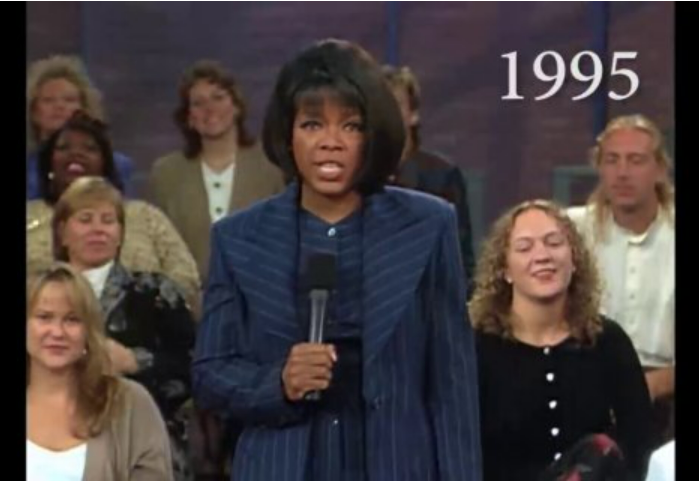
In 1995, Oprah’s net worth ballooned to $340 million, allowing her to qualify for Forbes annual ranking of the 400 richest Americans. She had already been the richest woman in entertainment for several years, but the Forbes list put her in a new category, along side the big boys like Bill Gates, Steve Jobs and Stephen Spielberg. Even though she was dead last on the list, it didn’t matter; she was on the Forbes 400. One of the 400 richest people in the richest country in the history of the World. The only black and only performer to make the list that year.
You could tell she had a new confidence, and she even started dressing more business like and got a new hair style:
At one point she jokingly refered to herself as “Miss Forbes list” and at another point she clapped her hands together and said “y’all know I got a lot of money”.
Even a highly intelligent relative who had nothing but disdain for daytime talk shows and rolled his eyes whenever I mentioned Oprah, suddenly had a new found respect for her, simply because she made that list. At the time it was unimaginable that a mere daytime talk show host, let alone a black female one, could make that list. Even better, with Oprah’s hot new contract, Forbes predicted she’s become a billionaire (unheard of for blacks in those days).
Every year when the leaves changed colours I would bike to the local corner story to get the annual Forbes 400. “Is Oprah a billionaire yet?” I asked the clerk in 1996, “no $415 million”
“Is Oprah a billionaire yet?” I asked in 1997. “no $550 million”
“Is Oprah a billionaire yet?” I asked in 2002. “no $975 million”
At this point Forbes was just being stingy. Round up to a billion already, you’re killing me.
Finally in 2003, Forbes made it official. Oprah was the rarest of creatures: A black billionaire and for three straight years she was the ONLY black billionaire (especially in the United States).
However in the years since black billionaires have become more an more common. No longer the unicons they were in 2007, there are now roughly half a dozen black billionaires in America alone.
Sadly, instead of making our elite more integrated, the rise of black billionaires has meant billionaires are less elite.
In 1982 only $90 million made you one of the 400 richest Americans and roughly $2 billion made you #1, but today you need over $2.9 billion just to make the Forbes 400 and over $200 billion just to be number one.
A new generation of blacks had finally reached the promise land, only to find that the promise land has moved and they’ve been priced out.
And for the first time ever, even Oprah, whose $2.6 billion fortune has stagnated since ending her hugely successful talk show ten years ago, failed to make the cut. Luckily, this rare failure has been eclipsed by the news that Donald Trump has also has been priced out of the Forbes 400 this year. It’s the first time in a quarter century either of these two iconic names (which had become synonymous with wealth itself) have failed to make the rich list.
This month was the 20th anniversary of the 9/11 attacks, so it is interesting to ask what Usama bin Laden’s IQ was. In all those years he was hiding in the caves of Afghanistan, anyone could have snuck across the border, stumbled upon his cave, and handed him a copy of the Standard Progressive Matrices.
Average IQ of the Arab World: 84 (UK norms)
The first question that needs to be answered is how do Saudi Arabians perform on the SPM? In 2010, 15-year-old Saudis averaged 36 out of 60 on the SPM.
This put them at the 14th percentile of UK 1979 norms which equates to IQ 84 (UK norms). Although these norms were 29 years old, no adjustment for the Flynn effect is needed because the UK’s Raven Flynn effect in teens appears to have plateaued in 1979:
From Lynn, R. (2009). Fluid intelligence but not vocabulary has increased in Britain, 1979–2008. Intelligence, 37(3), 249–255.
Expected IQ of World’s most influential Arab: 117
Now regardless if one considers Usama to have been an evil geopolitical Genius or just a useful idiot for the neocons, there’s no denying that September 11th was arguably the most consequential event of our lifetimes, so by the end of his life, Usama was not just the most evil Arab on the planet, but arguably the most influential. Indeed objectively he should have been Time magazine’s Person of the Year in 2001 but fearing this would be misinterpreted as praise, Rudy Giuliani got the title instead after Oprah crowned him “America’s mayor”. Analogously, Einstein had been named Person of the Century because giving that tile to Hitler was anathema. Many years later, when it was safe, Time would name Usama (and Hitler) among of the 100 most influential people of all time.
If there were a perfect correlation between IQ and influence, the most influential Arab out of 423 million would have an IQ 88 points higher than the average Arab. But given the correlation is only about 0.37, the most influential Arab has an expected IQ 88(0.37) = 33 points higher than the average Arab, or IQ 117. The standard error of this estimate would be 13.9. 95% Confidence Interval: IQ 90 to IQ 144.
Expected IQ of a 6’5″ Arab: 97
As a kid, Usama was praised for his light skin and height. The FBI listed him as 6’4″ to 6’6″. Let’s say he was 6’5″. This is about 3.5 standard deviations taller than the average Arab man (5’8″).
If there were a perfect correlation between IQ and height, Usama would have been 53 IQ points smarter than the average Arab, but since the correlation is only 0.24, his expected IQ was 53(0.24) = 13 points above the Arab mean. In other words IQ 97. Standard error: 14.55. 95% Confidence Interval: IQ 68 to IQ 126.
Expected IQ when World’s most influential Arab wasalso 6’5″: 125
A random Arab has an expected IQ of 84 but being the World’s most influential Arab adds 33 IQ points and being 9 inches taller than average adds 13 IQ points. Since Usama met both of these criteria, it’s tempting to add these expectations together and conclude he was 33 + 13 = 46 points smarter than the average Arab.
However these expectations can not be added because they’re not fully independent. Part of the reason Usama was influential is he was tall enough to command respect. And part of the reason he was so tall, is he comes from an influential well-fed family. For example the correlation between height and income (a proxy for influence) is 0.13.
When we remove this redundancy, and look only at the independent predictive power of influence and height, his influence adds 30 IQ points and his height adds 11, so Usama’s expected IQ is 30 + 11 = 41 points above the Arab mean of 84. In other words, his expected IQ was 125. Standard error: 13.6. 95% confidence interval: IQ 98 to IQ 152
Whoever was the mastermind behind the September 11th attacks likely had an IQ above 120. Planes are transportation, not missiles, so to adapt them to such an evil purpose required thinking outside the box ( lateral thought) which is probably quite g loaded. However a member of a super high IQ society famously said after September 11th (I paraphrase from a 20-year-old memory):
Surprising that anyone smart enough to pull off such an attack would be sufficiently unwise as to actually do it.
Bill Gates’s comment about Epstein implies equally to Usama: “Well, he’s dead, so in general you always have to be careful,”
Let’s assume Reagan had the lowest elderly IQ of any U.S. President (he got dementia) and Nixon had the highest teenaged IQ (he aced the Ottis). What does this tell us about the average IQ of U.S. Presidents?
Reagan
About one in six (British?) people over age 80 have dementia. Thus one can consider a dementia diagnosis (over age 80) as more or less equivalent with scoring at or below the 16th percentile (IQ 85) on an IQ test. On the other hand, only the best and brightest tend to live over 80. If everyone in the UK lived over 80, probably 25% would get dementia and the 25th percentile equates to IQ 90.
Nixon
Daniel Seligman wrote:
Nixon biographer Roger Morris says RMN tested at 143 when he was in Fullerton High School in California. Kennedy biographer Thomas C. Reeves tells us JFK tested at 119 just before entering Choate Academy. That last figure looks low. Might there have been some kind of testing error? The ”standard error” for the Otis test — the one taken by both future Presidents — was six IQ points.
I had since learned that the Otis had a standard deviation of about 10 in those days so Nixon’s IQ of 143 would actually equate to about 165 on the standard 15 sigma scale, making him almost certainly the smartest U.S. President ever. Of course the Otis items were not selected at random, so there’s no reason to assume the curve was Gaussian, and thus equivalent to a modern IQ of 165. On the other hand there’s no strong reason to assume it was less than that either.
Conclusion
Assuming Reagan had an IQ around 90 (probably higher when he was younger) and Nixon had an IQ of 165 (probably lower when he was older), let’s split the difference and assume the average U.S. President has an IQ around 130 (two standard deviations above the U.S. mean).
Just as the most physically dominant men in America (heavy weight boxing champions) are 2 standard deviations taller than the average U.S. man (on average), the most socially dominant men in America (U.S. Presidents) are about 2 standard deviations smarter.
On page 242 of his book Are We Getting Smarter?, James Flynn claims the original Wechsler Intelligence Scale (WISC) normed circa 1947.5 yields full-scale IQs 7.63 points higher than those of its revision (WISC-R) normed in 1972. Stats like that are known as the Flynn effect; the notion that IQ is going up at rate of 3 points per decade. Of course by definition the average U.S./U.K. IQ is always around 100, but tests must be constantly re-normed to keep it that way.
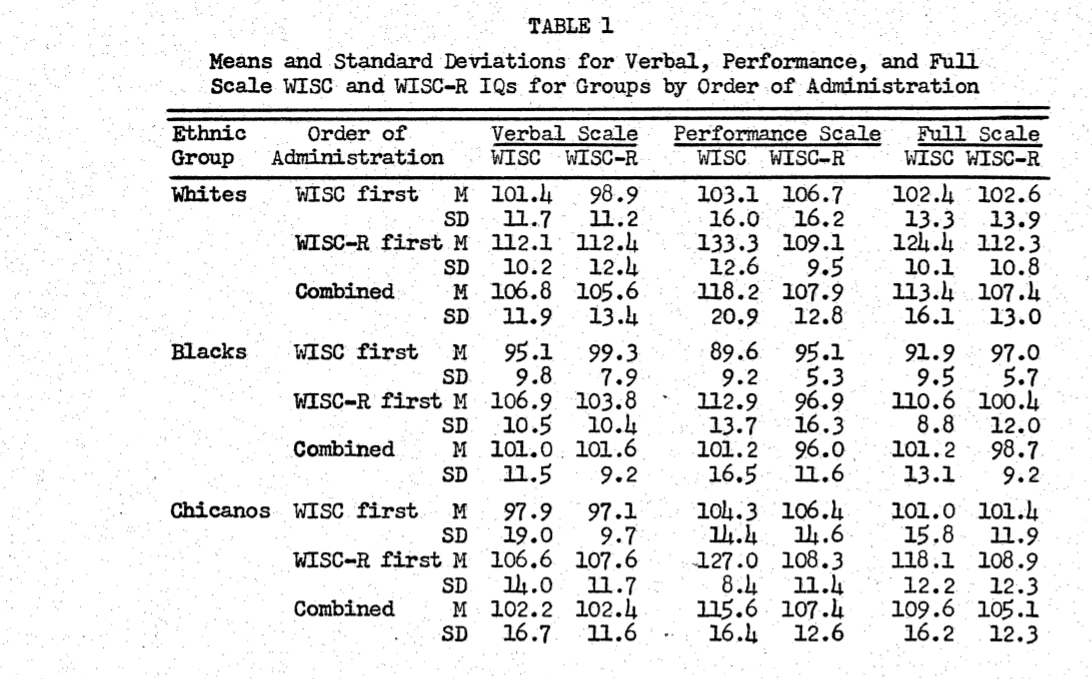
However I have long suspected (and largely proven) that the Flynn effect is exaggerated by a statistical artifact. For example, when comparing old and new versions of the Wechsler, half of the test subjects will take the old version first and the other half will take the new version first, so whatever practice effect from being tested twice affects both tests equally. However I had a hunch (as had A.S. Kaufman) that you get more of a practice effect from taking the WISC-R first than from taking the WISC first, thus WISC scores will be spuriously high when people take both tests.
Finally I found some obscure old paper that proves this right. White kids who took the WISC-R first scored 12 points higher on the WISC than WISC-R, but white kids who took the WISC first scored virtually the same on both tests! When you combine the two groups together, the WISC appears 6 points easier than the WISC-R, but that difference is entirely driven by the subset of the sample that took the WISC-R first
A similar (though less extreme pattern) is found for non-whites.




 Pumpkin Person