I compared data from an old and new study of brain size. The old data was analyzed by FW and EM Appel who wrote in 1942:
The material came from the St. Elizabeth’s Hospital of Washington, D. C. Dr. Walter Freeman, who was formerly pathologist at this hospital, brought certain biometrie data from the autopsy records of the Hospital to the Department of Biology of the Johns Hopkins School of Hygiene and Public Health for statistical analysis. Beginning with
the first autopsy after the founding of the Hospital, the records date from 1884. The records available for the present work run consecutively through 1924, and then skip to a few for 1933. The cases for the interval between 1924 and 1933 were used by Freeman in his studies on the endocrine organs (Freeman, 1931, 1934; Pearl, Gooch, and Freeman, 1935 )• For the remaining body of material, totaling nearly 4500 data sheets, 2752 records have been segregated. These include all of the male, white cases for which the weight of the brain is given. This array of cases is much more extensive than any series for one sex and one race which has been available heretofore from a single source.
From “INTRACRANIAL VARIATION IN THE WEIGHT OF THE HUMAN BRAIN” Author(s): F. W. APPEL and E. M. APPEL Source: Human Biology, Vol. 14, No. 1 (FEBRUARY, 1942), pp. 48-68
This was then compared with more recent U.S. data from a 1980 study from Ho et al.
From “The g Factor”, 1998, by Arthur Jensen, page 439
The mean age for both the whites and blacks in Ho’s study was about 60 so it’s possible to compare the average of Ho’s circa 1980 white males with the 55 to 64 year-old white males from 1884 to 1933. And because Ho et al, used regression to estimate brain size at age 25, we can also compare circa 1980 white men age 25 to the 25-29 year-old while men from 1884 to 1933.
Here are the comparisons:
Of course it’s possible the brains were not weighed using the same procedure causing such a large increase to be spurious. However Richard Lynn has been arguing for decades that thanks to 20th century nutrition and health, a major brain size increase has occurred, and is consistent with major intelligence increase. This makes sense because the last few hundred years have been a quantum leap forward in human achievement. It took 70,000 years for our population to increase to 1 billion people, yet technology has allowed us to reach 7 billion in just the last few centuries, not to mention space travel, the internet, and genetic engineering.
Commenter pumpkinhead is the second person to doubt my claim that brain weight increases by 9% after death so I thought it would be useful to devote a whole article to this. The skepticism is understandable since there’s no obvious mechanism by which this should happen. If I were a theist I might say that when we die we join the spirit world and become omniscient like God and it requires extra brain weight to have all this knowledge.
I first learned about the post-mortem increase by reading J.P. Rushton who cited pg 299 of a 1983 article by Jorgen Voigt and Henning Pakkenberg who write:
Appel and Appel [1942a, b] seem to be the first to point out that the brain weight increases post-mortem, mostly during the first 12 h after death, then more slowly,
totalling an average of about 9%. However, experiments with rats [Boyd and Knight,
1963] later showed that the brain weight in these animals does not change very much post-mortem, and the tendency here is to a loss of weight which, in a single experimental group reached a total of 12%. If the results of Appel and Appel [1942a, b] are accepted our brain-weight results should be approximately 9% above the weight in vivo, as the autopsies are always carried out considerably later than 12 h after death
In the original 1942 article by FW and EM Appel they discuss their equation for predicting brain weight as a function of time since death:
Brain weight (in grams) = 1242.44 + .33 H + 39.72 log H
Here H is the number of hours post mortem.
The curve is certainly suggestive. It suggests that the weight of the brain increases almost continuously after death, at a rate that gradually diminishes. The increase must be limited, but its limit must be beyond the reach of our data. The weight certainly increases for many hours, and possibly it does so for more than 6 days. In the first 12 hours after death the mean weight increases about 47 grams, or nearly 4 percent.
By the end of the second 12-hour period the increase amounts to 63 grams, or more than 5 percent ; by 36 hours it amounts to 74 grams, or nearly 6 percent. If this increase continued for 170 hours after death it would amount to 145 grams, or the amount of the mean loss in weight between ages 25 and 96.
Conjectures as to the implications of this increase are not in order until it has been demonstrated beyond any doubt that the increase is a real phenomenon. Other workers have demonstrated that the weight of the brain varies with the skull dimensions and with the age at death, so there has been no reason to doubt our findings on these points. But no evidence of a post-mortem increase has ever before been presented. It is conceivable that the apparent increase might be due to a chance drift in the age at death, or in the dimensions of the skull, though it is difficult to see why the apparent increase should be essentially continuous and at a gradually diminishing rate if any accident of sampling or distribution is responsible for it. Still, the possibility needs to be investigated
Here’s their data for the brain weight increase, so judge for yourselves how convincing it is.
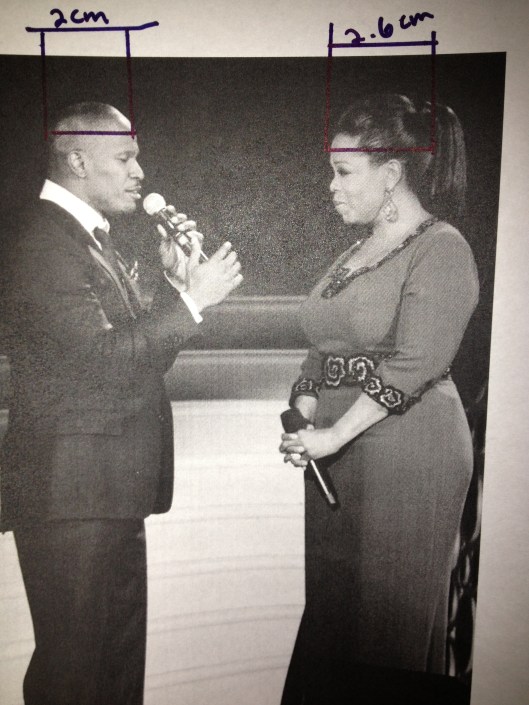
Commenter pumpkinhead doubts Oprah’s head is as big as I say it it, writing:
Given this information of 1358 cc cranial capacity(for white females mind you) and 91 SD, Oprah would be 7.45 SD above average making her 1 in the tens of trillions.
I don’t want to argue about Oprah’s head size here since we’re already having that argument in the previous thread, but rather I want to make a more general point.
The problem with pumpkinhead’s argument is it assumes cranial capacity fits the Gaussian curve which is a reasonable assumption for non-pathological heads, but there’s just one problem with it. If head circumference is normally distributed, and head circumference has a cubic relationship with cranial capacity, then extreme cranial capacity can not be normally distributed.
For example, the late J.P. Rushton suggested that at least in very young children, cranial capacity ( cm3 ) = circumfence3/118.4. This is the formula for a volume of a hemisphere, which as Rushton acknowledged, is an oversimplification, because the cranium is not a perfect hemisphere and there is massive individual variation in head shape.
But let’s imagine a world where all crania were perfect hemispheres. I randomly generated 60 crania and these had a mean of 54.7 cm (SD 1.28 cm which because of my small sample size, is slightly smaller than the actual U.S. female SD). In this sample, the one in several billion level (+6.3 SD) would be reached at 62.76 cm.
Now what happens when all the circumferences are converted into cranial capacity using the hemisphere formula. The mean becomes 1387 cm3 and the SD becomes 97. What this means is that a head that is +6.3 SD in circumference (62.38 cm), becomes +7.2 SD in cranial capacity (2088 cm3 ). So the cubic effect of going from circumference to volume make extreme humans seem superhuman.
Of course our crania are not perfect hemispheres, but the cubic effect still applies.
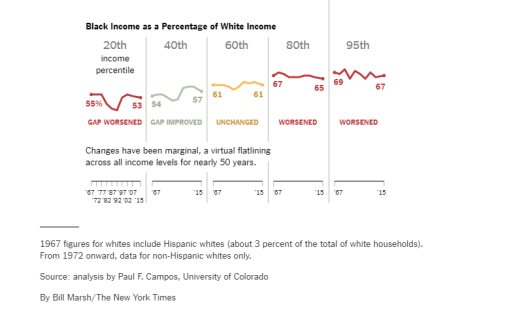
You would think that after the civil rights movement and half a century of affirmative action, that the racial income gap would be closing, but nothing could be further from the truth.
People look at billionaire media queen Oprah and President Obama and think blacks have made real progress. FALSE! Oprah has made real progress because she was born with a freakishly large brain and she used that brain power to not only make herself a success, but to put the Obamas in the White House.
However without this rare genetic mutation that caused one person to jump from poverty to Queen of the World in record time, there’s been little progress.
And yes I realize a genetic mutation is a “just-so story” but if other people get to tell them, why not me? At least I have physical evidence.
They year was 1968. Aretha Franklin (aka Queen of Soul) was getting into her limo in Milwaukee.
A young black runaway approached her sobbing. asking for money. The generous star handed the girl $100 U.S. (that’s $724 in today’s dollar).
Little did she know that young girl would grow up to be the World’s ONLY black billionaire and the most influential woman on the planet.
In Aretha’s day, the idea that a black woman could be become such an influential billionaire was unimaginable, but thanks to the trail Aretha helped blaze, they are finally getting their R-E-S-P-E-C-T.
When I was a child, I didn’t understand that adults were more intelligent than children. I thought adults just seemed smarter because they had more experience, but I didn’t realize there were biological changes in the brain that made them smarter.
Similarly there are some anthropologists like Sally McBrearty and Alison Brooks who argue that late stone age humans were just as smart as modern people, they just didn’t have as much time to accumulate culture, since our species was very young then.
This begs the question, since cultural evolution happens so much faster than biological evolution, how do we know when cultural progress reflects biological progress?
Most kids don’t study calculus until their later teens. Is this because they’re not biologically ready until the brain approaches adulthood, or they simply haven’t had time to acquire the prerequisite knowledge?
Similarly representational art does not appear before the upper paleolithic? Was this because our species wasn’t biologically ready, or not culturally ready?
Perhaps one way to tell is to look at the growth curve. If knowledge or culture is progressing gradually in a person or our species, there’s no reason to suspect it’s anything more than cultural progress, but if the growth suddenly starts accelerating, then maybe cultural has had some help from biology.
For example, after 150,000 long years of being confined to Africa, and being just one of several homo species on Earth, anatomically modern humans suddenly colonized six other continents, created representational art, and replaced all other Homo species, in just 40,000 years. This was such a massive change in our trajectory that scientists like Richard Klein think it must have been a biological leap in evolution, stating:
What happened 40,000 or 50,000 years ago was the last major change in the genotype. At least the last major biological change. Evolution continues, but the evolution that’s involved in making us capable of wielding this vast variety of cultures–that probably stopped around 40,000 or 50,000 years ago and there’s been no essential change since.
Forget about the construction of the first cities or the introduction of the internal combustion engine. The revolution that made the biggest difference occurred on the savanna of East Africa roughly 45,000 years ago, Klein and others maintain.
There has been no biological change in humans in 40,000 or 50,000 years. Everything we call culture and civilization we’ve built with the same body and brain
However is the Upper Paleolithic Revolution really that much more dramatic than other revolutions that have since followed it? Since cultural change is hard to judge, perhaps the most objective measure of humanity’s progress is population size.
It took us 200,000 years to reach a population size of 1 billion people, and yet in just the last few centuries we’ve hit 7 billion! That seems like a much bigger revolution than the Upper Paleolithic. The Upper Paleolithic may have been when modern humans left Africa, but the industrial revolution is when humans left the Earth!
So why do people like Richard Klein invoke a massive brain mutation to explain the Upper Paleolithic, but feel no genetic explanation is needed for the industrial revolution? Is this just political correctness or was the Upper Paleolithic genuinely in a class of its own?
I’m skeptical that a genetic mutation caused either, but just as biological evolution happens in sudden growth spurts (punctuated equilibrium model), perhaps cultural evolution does the same.
For many human traits, it’s perfectly obvious what it means to have twice as much. A six-foot tall man is twice as tall as a three foot tall man. Someone who can lift 300 lbs is twice as strong as someone who can lift 150 lbs. Someone who can run 100 meters in 10 seconds is twice as fast as someone who can run it in 20 seconds.
It becomes more difficult to apply the same logic to IQ. Although we can say a 2000 cubic centimeter brain is twice as big as a 1000 cubic centimeter brain, we can’t necessarily say it’s twice as smart (on average) because we don’t know if the relationship between intelligence and brain size is linear.
I do think the relationship between brain size and IQ is linear (excluding pathological cases) but that’s because brain size is normally distributed and IQ is largely forced to fit a normal curve, however that doesn’t mean intelligence itself is normally distributed.
On the contrary, a member of Prometheus society once claimed that because the human mind works in parallel, complex learning and problem solving speed doubles every 10 IQ points (he later revised to every 5).
To test this fascinating this hypothesis, I imagined people taking the WAIS-R IQ test. Because several subtests (Arithmetic, Block Design and Object Assembly) awarded bonus points for super fast performance, it was possible to imagine a person perfectly solving all the items within the time limit, but using 100% of the allotted time.
Such a person would have an Arithmetic IQ of 105, a Block Design IQ of 100, and an Object Assembly IQ of 90.
Then I asked what would happen if the same person had only used 50% of the allotted time: Arithmetic IQ 105, Block Design IQ of 105, and Object Assembly IQ of 90.
25% of the allotted time: Arithmetic IQ 110, Block Design IQ 120, Object Assembly IQ 100.
12.5% of the allotted time: Arithmetic IQ 135, Block Design IQ 145, Object Assembly IQ 125.
6.25% of the allotted time: This speed takes you beyond the ceiling of all subtests except Object Assembly for which you would score an Object Assembly IQ of 140
It’s hard to draw strong conclusions because David Wechsler arbitrarily decided how much speed was needed for a bonus point, but on balance it looks like a doubling of speed on a particular subtest, equates to a jump of 10 or 15 IQ points (on that subtest)
But how do we reconcile such an explosive distribution with the popular notion of a bell shaped IQ curve, which Jensen assumed IQ likely had given the fact that linear regression predicts IQs of one’s relatives and biological correlates of IQ like brain size enjoy a bell curve.
And indeed some psychometric tasks really do enjoy a true curve (without test takers having to force one). The number of digits you can repeat from memory, or the number of abstract symbols you can copy in 90 seconds or even in the number of words in your vocabulary (when randomly selected from a dictionary) all increase in a linear way with IQ, which means all must form the same bell curve.
So my guess is that the building blocks of intelligence (brain size, memory, raw neural speed) are all normally distributed yet actual complex problem solving and real world adaptive behavior show huge inequality, perhaps because a few extra units of data can double the number of interrelations between them, so the amount of information we can process is normally distributed, but the output of that data is explosively distributed.
So what does it mean to be twice as smart? Well, if you define intelligence as the cognitive capacity for problem solving or goal directed adaptive behavior, then being twice as smart means either the ability to solve twice as many problems or the ability to solve the same amount of problems twice as well.
If we assume most problems in the universe are complex problems, then I’d say an extra 13 math IQ points makes you twice as smart mathematically, an extra 13 spatial IQ points makes you twice as smart spatially etc.
But since different cognitive abilities are imperfectly correlated, I’d say it takes 19 overall IQ points to be twice as smart overall (all domains averaged together).
So assuming mature apes have an IQ of 14, we can very tentatively conclude the following (for young adults):
IQ 14: 1 times smarter than an ape
IQ 33: 2 times smarter than ape
IQ 52: 4 times smarter than an ape
IQ 71: 8 times smarter than an ape
IQ 90: 16 times smarter than an ape
IQ 109: 32 times smarter than an ape
IQ 128: 64 times smarter than an ape
IQ 147: 128 times smarter than an ape
IQ 166: 256 times smarter than an ape
IQ 185: 512 times smarter than an ape
IQ 204: 1,024 times smarter than an ape
So instead of asking people their IQ, you can ask them their MiQ pronounced My Cue (monkey intelligence quotient). A MiQ of 16 to 32 (16 to 32 times smarter than an anthropoid monkey) implies average intelligence for young adults in developed countries. A MiQ below 8 implies impairment in a young adult but would mean gifted in a toddler.
So even though the average human brain is roughly 4 times bigger than the average ape’s, the human mind is roughly 20 times bigger.
[Please post off-topic comments here and not in the main thread]
There’s a fascinating article in The Ringer about how Tom Cruise jumping on Oprah’s couch was one of the most important pop-culture events of the 21st century, and transformed the nature of media and celebrity in America. It goes down in history as the moment celebrities lost control of the narrative and the internet took over.
As I recall, Cruise was there to promote the movie War of the Wolds but the interview got side tracked because Cruise was so “in love” with Katie Holmes that he could hardly concentrate on Oprah’s questions and instead just jumped on her couch like a lovesick schoolboy.
I found the show entertaining, but when I checked the internet after, a storm was brewing. Many gay men were swarming gossip sites to say “TOM YOU ARE GAY!” and were furious that he went on Oprah acting fanatically hetero.
Many gay men are attracted to Tom Cruise and thus want to believe he is gay, and don’t like it when their most iconic “gays” deny their “gayness”.
We see a similar phenomenon in the black community. When Tiger Woods told Oprah he was “Cablinasian” (Caucasian + Black + Indian + Asian) many blacks stormed the media screaming “TIGER YOU ARE BLACK!!!”
The interview describes a study where a genomic formula predicted 11-13% of the variance in educational attainment (highest degree or diploma obtained).
Taking the square root, it implies that known common genetic variants correlate 0.35 with education, however Lee cautions that population stratification can inflate these numbers. He cites the cliché that chopstick use would seem highly genetic if the sample were a mix of Chinese and non-Chinese people, but the heritability would be misleading because it’s not that many genomic variants are causing chopstick use, but rather they’re signaling Chinese ancestry, which in-turn causes chopstick use.
To avoid the problem of population stratification in the study Lee co-authored, they looked at within family data (I guess because siblings all belong to the same sub-population) but found that the effect size of their predictors were 40% smaller. I guess that means instead of common SNPs correlating 0.35 with education, they correlated 0.21, now explaining only 4% of the variance?
I wonder if these numbers are distorted by range restriction because families have less variance than the general population and that’s known to depress correlations.
The following chart shows height and IQ as a function of race and gender (note: these are average differences and genius IQs and giant heights exist in all races and genders):
Table I
IQ stats were estimated here. Height stats for men and women were taken from tables 12 and 10 of this document respectively (Americans aged 20-39 in 2011-2014). Although height standard deviations were not reported, they can be calculated by multiplying the standard errors by the sample size.
In the below chart I estimate the average IQ of each race, sex, height combination.
Average IQ by height for 6 U.S. demographics (excluding pathological conditions causing extreme height)
height
iq of young white men
iq of young white women
iq of young black men
iq of young black women
iq of young asian men
iq of young asian women
6’7″
113
122
99
99
124
124
6’6″
112
120
97
98
122
123
6’5″
110
119
96
97
120
121
6’4″
109
117
94
96
119
120
6’3″
108
115
92
94
117
119
6’2″
106
114
91
93
115
117
6’1″
105
112
89
92
113
116
6’0″
104
111
88
91
112
115
5’11”
102
109
86
90
110
113
5’10”
101
107
84
89
108
112
5’9″
100
106
83
87
106
111
5’8″
98
104
81
86
105
109
5’7″
97
102
79
85
103
108
5’6″
96
101
78
84
101
107
5’5″
95
99
76
83
99
106
5’4″
93
97
74
82
98
104
5’3″
92
96
73
80
96
103
5’2″
91
94
71
79
94
102
5’1″
89
92
69
78
92
100
5’0″
88
91
68
77
91
99
4’11”
87
89
66
76
89
98
4’10”
85
88
65
75
87
96
4’9″
84
86
63
73
85
95
4’8″
82
84
61
72
84
94
4’7″
81
83
60
71
82
92
4’6″
80
81
58
70
80
91
The chart assumed a 0.244 correlation between IQ and height within sex and race, based on a massive study of of 76,111 young Danish men. IQs for each height were estimated by assuming that for every 1 standard deviation increase in height (within each race-sex demographic), IQ would increase by 0.244 SDs on average (each demographic’s SD were estimated in table I).
The chart suggests that on average a black man needs to be nearly two feet taller than an Asian woman in order to have a higher IQ, and that when black men and Asian women are the same height, the IQ gap approaches two standard deviations.
Sadly, this suggests black men will have an incredibly difficult time dating taller Asian women because the Asian woman will not only feel smarter and if she’s a racist, more evolved, but she’ll be disgusted that in the one area where the black man is supposed to be better (physicality), she surpasses him too, so her level of disrespect will be off the charts. If the shorter black man is well built, this might help him compensate, or it will make the problem worse given the extra IQ penalty of big muscles and because women may expect even more height from muscular men.