• About

Pumpkin Person

~ The psychology of horror

Pumpkin Person

Monthly Archives: July 2024

The correlation between the Old SAT & WAIS IQ

27 Saturday Jul 2024

Posted by pumpkinperson in Uncategorized

≈ 300 Comments

Tags

college, college-admissions, education, SAT, testing

Long ago a person in the comment section told me about an excellent study in which several groups of Dartmouth seniors were administered the WAIS (Culver & King, 1974).
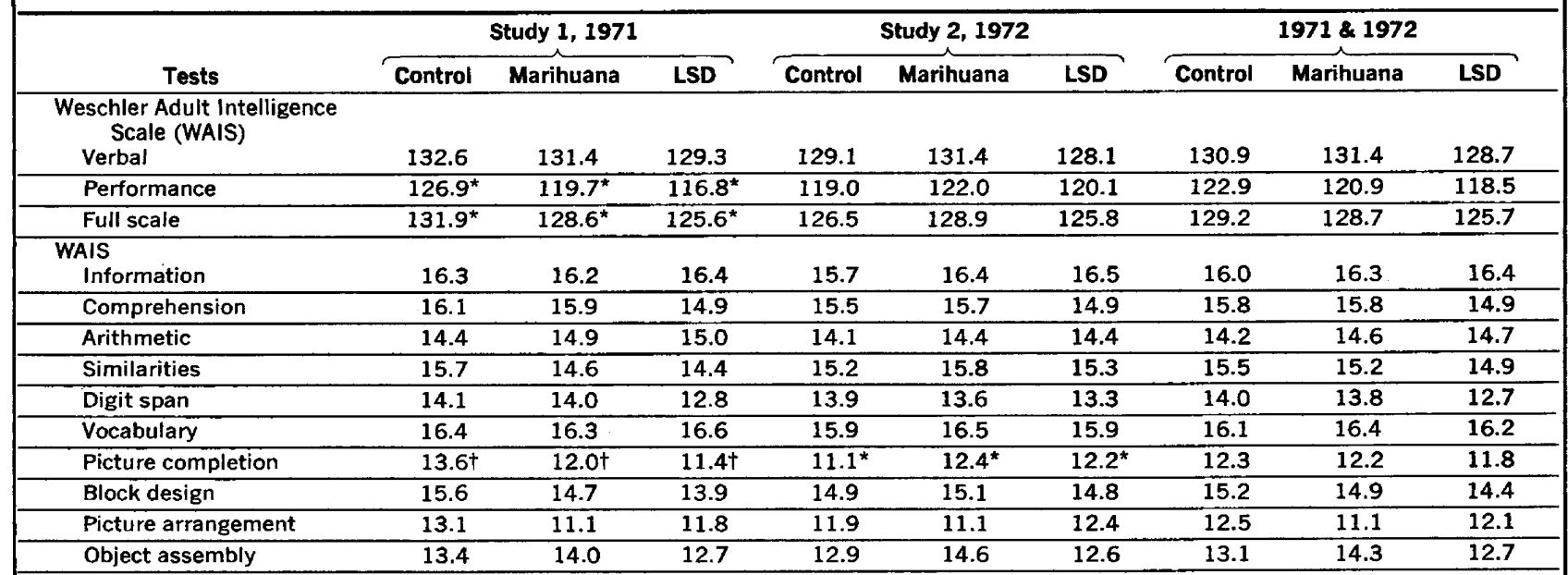
What made the study especially useful is their SAT scores (probably taken when they were around 17) were provided:
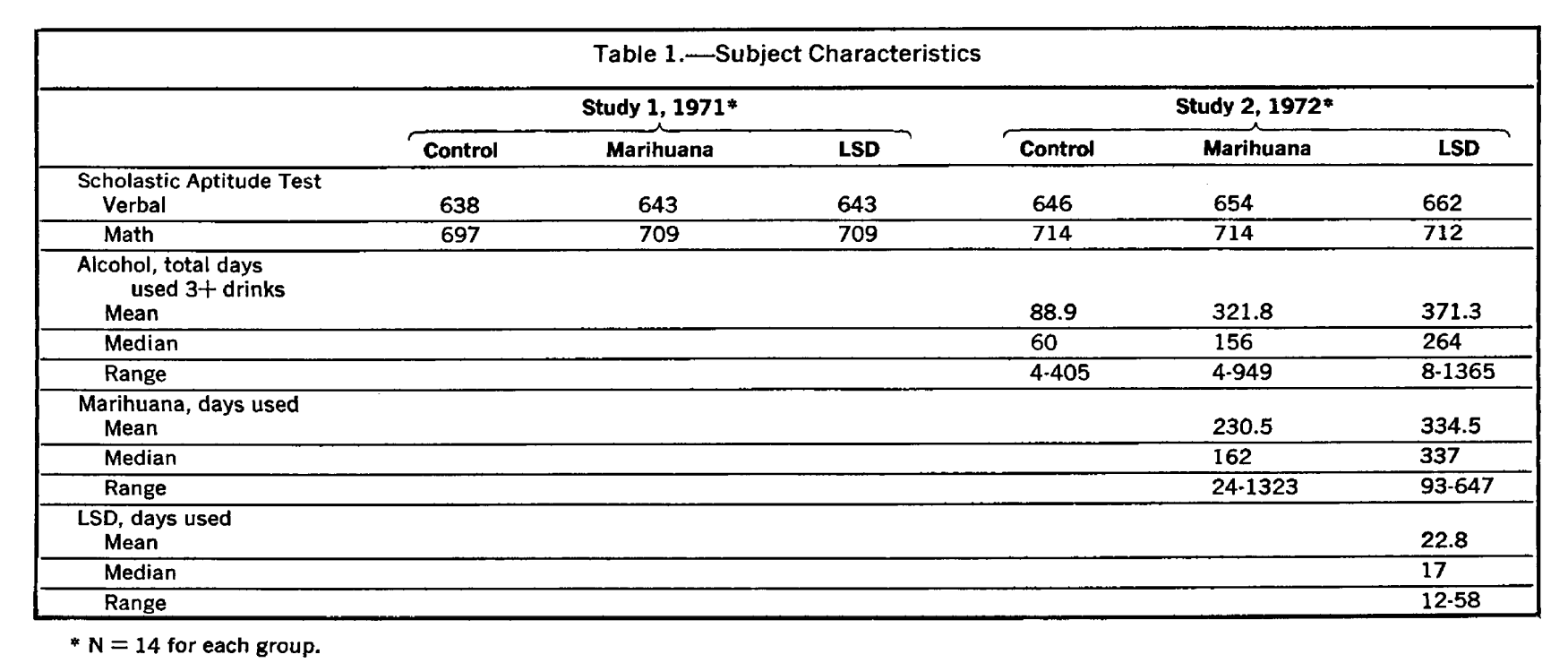
I decided to focus on the control groups because their IQs were least likely to be impaired by the substance abuse effects the study investigated. The 1971 Dartmouth control group averaged a combined SAT of 1335 and the 1972 control group averaged a combined SAT of 1360. Averaging these together gives 1348. Since the students were 20 to 25 when they took the WAIS in 1970 to 1972, they probably took the SAT from 1965 to 1969. Based on national norm studies I estimate that if virtually all American 17-year-olds took the SAT in 1960 and 1974, the mean and standard deviation (SD) would have been 784/210 and 770/204 respectively.

Since the WAIS was normed so that a representative sample of U.S. adults in each age group would have a mean IQ and SD of 100 and 15 respectively (see WAIS manual, chapter 2), I equated the national means and SDs of the SAT to 100 and 15 also. By this measure a 1360 on the SAT equated to an IQ of 141 or 143 depending on whether I used the 1960 or 1974 norms. Let’s split the difference and say 142. Meanwhile the full-scale WAIS IQ of the Dartmouth control group students was 129.

Now because they were tested circa 1971 and the WAIS was normed circa 1953.5, their scores are inflated by a 17.5 year Flynn effect. According to the brilliant and influential James Flynn (RIP), the Wechsler Flynn effect was 3 points per decade but according to my own independent research, it was more like 1 point a decade. Flynn (who was always kind enough to respond to emails) told me my research was not accurate because I was using a pre-war Wechsler scale and IQ tests did not become accurate until after WWII. I countered that his own research may be compromised by test order effects. (Davis 1977, Kaufman 2010)

Using Flynn’s estimate, their IQs need to be reduced to 124 but using mine they need to be reduced to 127. Either way, they scored substantially lower on the WAIS than they did on the SAT. This is to be expected because Dartmouth students were largely selected by SAT scores and given the imperfect correlation between standardized tests, people who are selected using one test should regress to the mean on another and assuming a bivariate normal distribution, the slope of the standardized regression is a function of the correlation between the tests.

So given an SAT that was 42 points above the U.S. mean defined as 100, the expected correlation (r) between the WAIS and the SAT is:

r = (number of IQ points above 100 on the WAIS/number of IQ points above 100 on the SAT)

r = (24 or 27/42)

r = 0.57 or 0.64

Let’s split the difference and say 0.61.

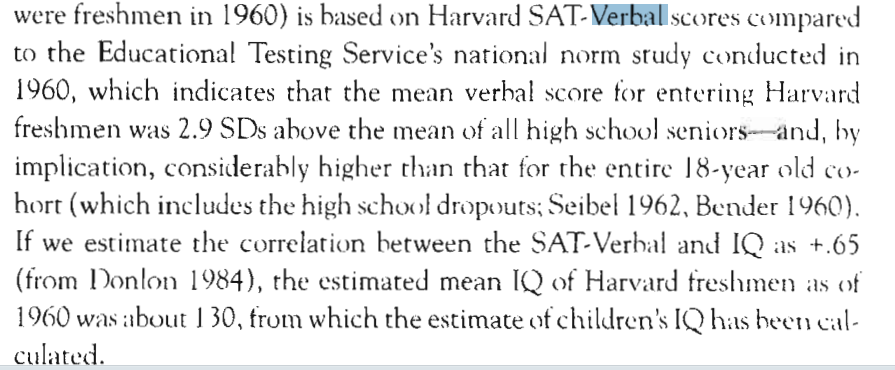
Because Herrnstein & Murray (1994) popularized the myth that Ivy League students have IQs in the stratosphere (and Jordan Peterson believed it, even though studies he co-wrote show otherwise) I was surprised to learn that at least one of The Bell Curve’s authors knew the truth, though this was relegated to the footnotes (see page 688):
[Update July 28, 2024: an earlier version of this article suggested the correlation between the SAT and the WAIS be adjusted for the time difference between the two administrations however it’s unclear if such a an adjustment is valid]
Share this:

  • Click to share on X (Opens in new window) X
  • Click to share on Facebook (Opens in new window) Facebook
Like Loading...

IQ of people who took the GRE in the 1980s

25 Thursday Jul 2024

Posted by pumpkinperson in Uncategorized

≈ 155 Comments

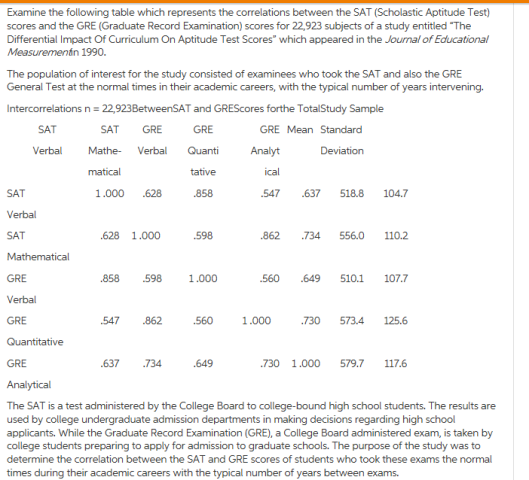
Based on thousands of people who took both the SAT and GRE in the 1980s, we can say that a verbal GRE of 510.1 (SD 107.7) equaled an SAT verbal of 518.8 (SD 104.7)

gredata

By the end of the 1980s, the average GRE taker 484 SD 125 (source)

From the above data points, we can say GRE takers had the equivalent of a verbal SAT of 493 (SD 122).

Now national norms studies suggest that if all American young adults had taken the SAT in the 1980s (not just the college-bound elite), the verbal mean and SD respectively would be 376 and 102 (Herrnstein & Murray 1994). If the U.S. mean is defined as 100 and 15 respectively, this puts the 1980s GRE population at 117 and 18.

[UPDATE July 25, 2024: A commenter suggested that the strangely high standard deviation of the GRE takers was inflated by the uneven verbal scores of foreign test takers. I thus re-did the analysis using the math SAT and this time I got a slightly lower mean IQ (116) but oddly an even bigger SD (19). ]

Share this:

  • Click to share on X (Opens in new window) X
  • Click to share on Facebook (Opens in new window) Facebook
Like Loading...

Old school SAT data

15 Monday Jul 2024

Posted by pumpkinperson in Uncategorized

≈ 334 Comments

In the mid 20th century, the college board became curious about what the distribution of SAT scores would be if ALL American 17-year-olds took the SAT, not just the college bound elite. One reason for this curiosity was the average score of people who actually took the SAT started falling in the 1960s, especially the verbal scores, so people wanted to know whether this was simply because less elite kids were applying to college, or if teens in general were being dumbed down (see chart from Herrnstein & Murray, 1994; page 425):

This is discussed in the book The Bell Curve:

What they found was that the decline was just an artifact of the SAT population becoming more inclusive. When you look at nationally representative samples, not only was there no decline, but there was actually a very small Flynn effect.

I was especially interested in seeing these national norms because the SAT has long been considered a good proxy for IQ, but unlike IQ tests which are normed to have a mean and standard deviation of 100 and 15 in the general U.S. population, the verbal and math subscales of the pre-1995 SAT were both normed to have a mean and SD of 500 and 100 respectively and with respect to the 1940s SAT taking population (not the general U.S. population). The chart above tells us how the average U.S. 17-year-old (IQ 100) would have scored on the SAT from 1950s to the 1980s, but to fill in the rest of the IQ distribution, we need to know the standard deviations.

Thanks to Charles Murray, I was able to find the SDs for the 1980s and I had already found the SDs for the 1970s.

What about the 1960s? I recently discovered this data from the 1960 norming study:

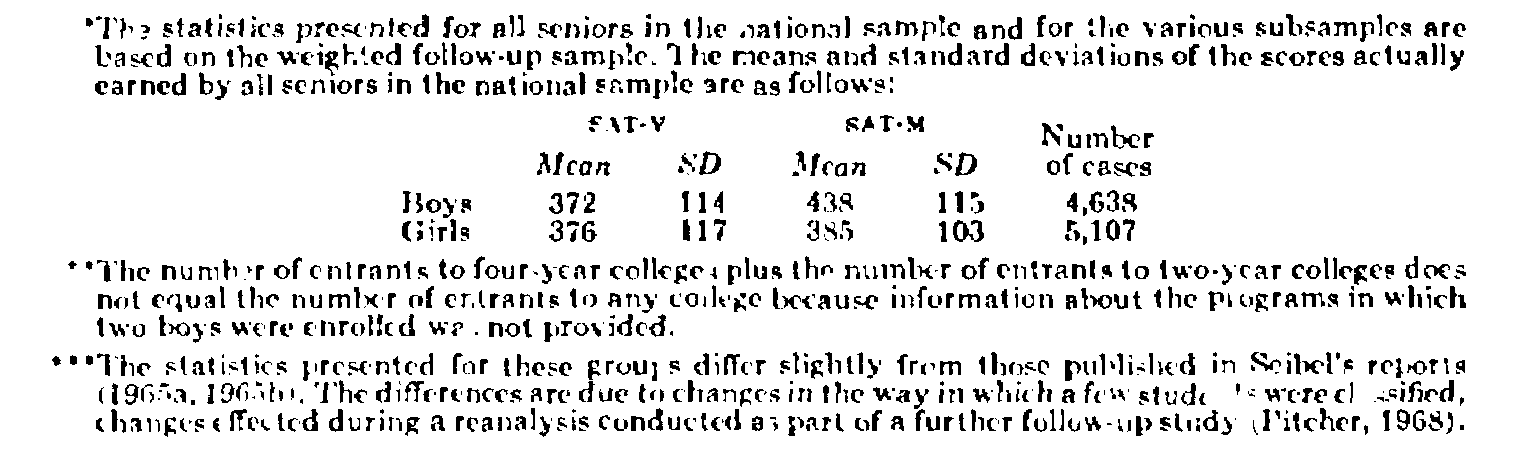
Unfortunately the data is stratified by sex (if they tried that today they’d need categories for non-binary, gender fluid, two spirit). Well to determine the mean of the entire cohort, we take the weighted average (52% female) so verbal mean = 0.52(376) + 0.48(372) = 374. Math mean = 0.52(385) + 0.48(438) = 410.

These figures perfectly match the 1960 figures from The Bell Curve book which I showed at the top of this article so I must have done something right!

Now combining the SDs of men and women is much more difficult (even chat GPT can’t do it!). You can’t just average them because the size of the combined SD is not just a function of the two SDs, but how far apart the two means are. Of course if we assume the male, female, and sex-combined distributions are all perfectly Gaussian it’s kind of easy to estimate, but estimating is very different from actually calculating (and when men and women are too far apart, it’s probably impossible for all three distributions to be Gaussian.

To determine the sex-combined SD we must first determine the Sum of Squares:

Sum of Squares = female n*(female sd^2 + female mean^2) + male n*(male sd^2 + male mean^2)

And then:

sex combined standard deviation is SQRT(Sum of Squares / sex combined N – sex combined mean^2)

And so for 1960, the sex-combined mean and SD for verbal and math respectively were 374; 116 and 410; 114 respectively.

To determine the sex-combined composite mean we just add the verbal + math mean = 784, and assuming the 0.67 correlation between verbal and math and the below formula (Herrnstein & Murray, 1994, page 779), the composite SD was 210.

Share this:

  • Click to share on X (Opens in new window) X
  • Click to share on Facebook (Opens in new window) Facebook
Like Loading...

contact pumpkinperson at easiestquestion@hotmail.ca

Recent Comments

pumpkinperson's avatarpumpkinperson on Which better predicts populati…
RaceRealist's avatarRaceRealist on Which better predicts populati…
Anime's avatarAnime on Which better predicts populati…
RaceRealist's avatarRaceRealist on Which better predicts populati…

Archives

  • December 2025
  • November 2025
  • October 2025
  • September 2025
  • August 2025
  • July 2025
  • June 2025
  • May 2025
  • April 2025
  • March 2025
  • February 2025
  • January 2025
  • December 2024
  • November 2024
  • October 2024
  • September 2024
  • August 2024
  • July 2024
  • June 2024
  • May 2024
  • April 2024
  • March 2024
  • February 2024
  • January 2024
  • December 2023
  • November 2023
  • October 2023
  • September 2023
  • August 2023
  • July 2023
  • June 2023
  • May 2023
  • April 2023
  • March 2023
  • February 2023
  • January 2023
  • December 2022
  • November 2022
  • October 2022
  • September 2022
  • August 2022
  • July 2022
  • June 2022
  • May 2022
  • April 2022
  • March 2022
  • February 2022
  • January 2022
  • December 2021
  • November 2021
  • October 2021
  • September 2021
  • August 2021
  • July 2021
  • June 2021
  • May 2021
  • April 2021
  • March 2021
  • February 2021
  • January 2021
  • December 2020
  • November 2020
  • October 2020
  • September 2020
  • August 2020
  • July 2020
  • May 2020
  • April 2020
  • March 2020
  • February 2020
  • January 2020
  • December 2019
  • November 2019
  • October 2019
  • September 2019
  • August 2019
  • July 2019
  • June 2019
  • May 2019
  • April 2019
  • March 2019
  • February 2019
  • January 2019
  • December 2018
  • November 2018
  • October 2018
  • September 2018
  • August 2018
  • July 2018
  • June 2018
  • May 2018
  • April 2018
  • March 2018
  • February 2018
  • January 2018
  • December 2017
  • November 2017
  • October 2017
  • September 2017
  • August 2017
  • July 2017
  • June 2017
  • May 2017
  • April 2017
  • March 2017
  • February 2017
  • January 2017
  • December 2016
  • November 2016
  • October 2016
  • September 2016
  • August 2016
  • June 2016
  • February 2016
  • January 2016
  • November 2015
  • May 2015
  • January 2015
  • December 2014
  • November 2014
  • October 2014

Categories

  • ethnicity
  • heritability
  • income
  • Oprah
  • Uncategorized

Meta

  • Create account
  • Log in
  • Entries feed
  • Comments feed
  • WordPress.com

Recent Comments

pumpkinperson's avatarpumpkinperson on Which better predicts populati…
RaceRealist's avatarRaceRealist on Which better predicts populati…
Anime's avatarAnime on Which better predicts populati…
RaceRealist's avatarRaceRealist on Which better predicts populati…

Archives

  • December 2025
  • November 2025
  • October 2025
  • September 2025
  • August 2025
  • July 2025
  • June 2025
  • May 2025
  • April 2025
  • March 2025
  • February 2025
  • January 2025
  • December 2024
  • November 2024
  • October 2024
  • September 2024
  • August 2024
  • July 2024
  • June 2024
  • May 2024
  • April 2024
  • March 2024
  • February 2024
  • January 2024
  • December 2023
  • November 2023
  • October 2023
  • September 2023
  • August 2023
  • July 2023
  • June 2023
  • May 2023
  • April 2023
  • March 2023
  • February 2023
  • January 2023
  • December 2022
  • November 2022
  • October 2022
  • September 2022
  • August 2022
  • July 2022
  • June 2022
  • May 2022
  • April 2022
  • March 2022
  • February 2022
  • January 2022
  • December 2021
  • November 2021
  • October 2021
  • September 2021
  • August 2021
  • July 2021
  • June 2021
  • May 2021
  • April 2021
  • March 2021
  • February 2021
  • January 2021
  • December 2020
  • November 2020
  • October 2020
  • September 2020
  • August 2020
  • July 2020
  • May 2020
  • April 2020
  • March 2020
  • February 2020
  • January 2020
  • December 2019
  • November 2019
  • October 2019
  • September 2019
  • August 2019
  • July 2019
  • June 2019
  • May 2019
  • April 2019
  • March 2019
  • February 2019
  • January 2019
  • December 2018
  • November 2018
  • October 2018
  • September 2018
  • August 2018
  • July 2018
  • June 2018
  • May 2018
  • April 2018
  • March 2018
  • February 2018
  • January 2018
  • December 2017
  • November 2017
  • October 2017
  • September 2017
  • August 2017
  • July 2017
  • June 2017
  • May 2017
  • April 2017
  • March 2017
  • February 2017
  • January 2017
  • December 2016
  • November 2016
  • October 2016
  • September 2016
  • August 2016
  • June 2016
  • February 2016
  • January 2016
  • November 2015
  • May 2015
  • January 2015
  • December 2014
  • November 2014
  • October 2014

Categories

  • ethnicity
  • heritability
  • income
  • Oprah
  • Uncategorized

Meta

  • Create account
  • Log in
  • Entries feed
  • Comments feed
  • WordPress.com

Create a free website or blog at WordPress.com.

Privacy & Cookies: This site uses cookies. By continuing to use this website, you agree to their use.
To find out more, including how to control cookies, see here: Cookie Policy
  • Subscribe Subscribed
    • Pumpkin Person
    • Join 686 other subscribers
    • Already have a WordPress.com account? Log in now.
    • Pumpkin Person
    • Subscribe Subscribed
    • Sign up
    • Log in
    • Report this content
    • View site in Reader
    • Manage subscriptions
    • Collapse this bar
 

Loading Comments...
 

    %d