
Twin studies predict that within a given (Western) country, up to 80% of the variation in IQ is heritable. And yet finding genes for intelligence appears to be analogous to finding intelligent life on other planets. We suspect they’re out there given the massive number of places for them to hide, but detecting them is the hard part. So far, out of the billions of genetic variants in the human genome, about 2,411 IQ “genes” have been found (with only about 127 of them being causal) and these explain only about 10% of the IQ variation within a Western country (not 80% like twin studies promised).
But these numbers should greatly increase as we use better measures of IQ (so far the largest studies use education level as a proxy for IQ since administering a million people a hour IQ test is much harder than just asking them their highest degree) and as genetic measures improve (so far the largest studies have only looked at a small fraction of the human genome).
Correlations: Individual vs group level
Currently polygenic scores correlate about +0.3 with IQ in Western countries (about the same as the correlation between IQ and brain size). While this correlation is not large, small correlations among individuals can become huge correlations among groups. For example, while the correlation between IQ and brain size is only about +0.3, the correlation between the average IQ and the average brain size of the 10 “races” studies by Richard Lynn in his 2006 book clocks in at 0.83! The reason for this is that as you move from individual to group level data, all the individual exceptions to a given trend tend to cancel one another out, and the underlying relationship becomes much more stark.
Applying the same concept to IQ “genes”, Davide Piffer found that the average polygenic scores of different races correlate about 0.9 with the average IQ of said “races”. So even though we’re a long way from being able to guess the IQ of an individual from his DNA alone, we can already make very reliable guesses about the average IQ of entire populations, or at least what their IQs would be if they were reared in contemporary America.
I turned to table 5 of one of Piffer’s paper (see appendix below) and noted the PGS GWAS sig scores of Northwest Europeans (IQ 100) and African Americans (IQ 85). Since the IQ gap between these two groups is thought to be 100% genetic (Lynn 2006), I simply equated their polygenic scores to their IQs, and using linear extrapolation, crudely assigned assign IQs to other groups in table 5. For example, since the polygenic scores of East Asians and Ashkenazi Jews were both about a third as far above Northwest Europeans as Africans Americans are below, I assigned them IQs that were as a third as much higher than the White mean defined as 100, as Black Americans are below (105 vs 85 respectively).
But since Black Americans are 15 IQ points below whites but only 75% bantu genetically, I assigned the congoid race an IQ 20 points below the white mean (15/0.75 = 20) which is 80, since they’re virtually 100% bantu. Then using Figures 5 and 11, I assigned Yoruba an IQ of 80 (since they’re Congoid) and the French an IQ of 100 (since they’re white) and by equating the polygenic scores of these groups to their IQs, I could linearly extrapolate to Arabs (Palestinians), Native Americans (indigenous Columbians), pygmies (mbuti), Australoids (Papuans) and Capoids (San). This method often gave wildly disparate IQs for the same race depending on whether I used figure 5 or 11 (perhaps because unlike table 5, these samples are low coverage genomes and thus unreliable) so I increased reliability by averaging. For example Papuans had an IQ of 81 using figure 5 but only 58 using figure 11, so I split the difference and assigned them IQ 70.
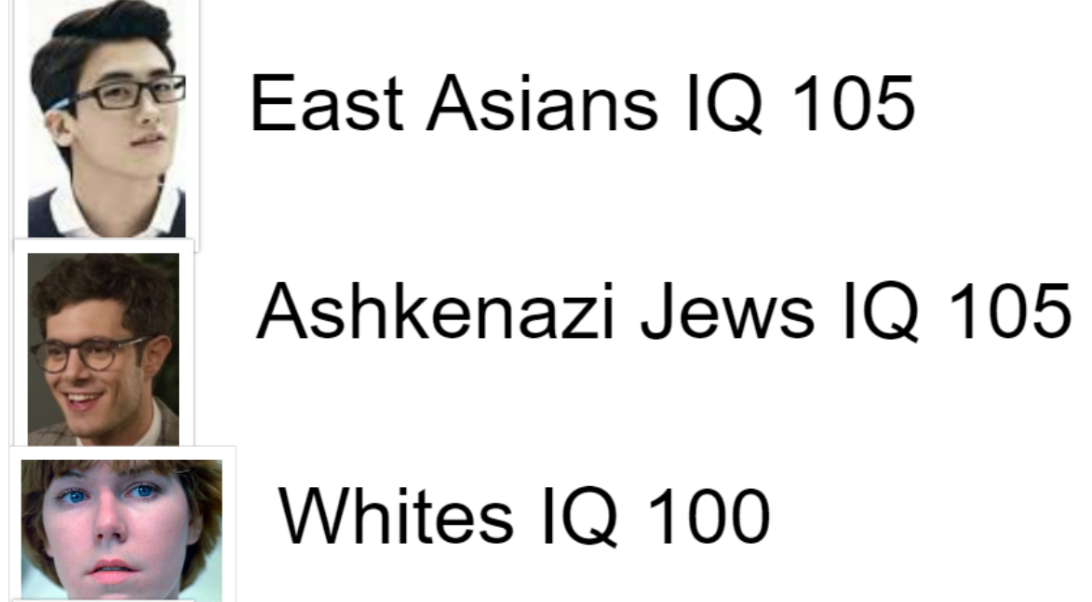
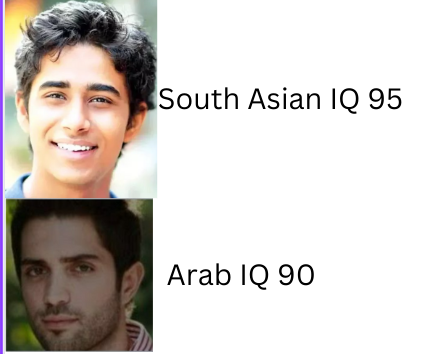

The first thing we notice is that the three light skinned races (East Asians, Ashkenazi Jews, and Whites) all have triple digit genetic IQs and the four dark skinned races (Pygmies, Congoids, Australoids and Capoids) all have genetic IQs below 90. The medium coloured races (South Asians, Arabs, Native Americans) are in between.
The next thing we notice is the geographically isolated races (Native Americans, Australoids, and Capoids) score lower than their skin color would predict while races that border a dark Caucasoid race (Arabs or South Asians) do not.
Conclusion
When modern humans first evolved a few hundred thousand years ago, we probably had (genetic) IQs around 70 (capoid level). Then when we finally left Africa about 70,000 years ago, IQ began to increase the further North we went, peaking at around 85 for those who reached Siberia (Native American level). Then sometime after the Native Americans colonized the New World about 15,000 years ago, there was a 10 to 20 point increase in IQ for everyone who bordered the Middle East or South Asia. This included the Congoids of sub-Sahara who jumped from 70 to 80 and the East Asians who jumped from 85 to 105. We don’t know specifically what selection pressures improved IQ by about 1 SD in the last 15,000 years but it looks like Native Americans (isolated in the New World), Australoids (isolated in Oceania) and Capoids (isolated on Africa’s Southern tip) were just too far away from the action, and that action was near the Middle East.
Whether it’s the birth of agriculture, the birth of civilization, or the start of Christianity and Islam, the Middle East has long been the contact place of different races and the land where history was written. Even today, wars in the Arab World, tensions over Iran, and the Israeli-Palestinian conflict dominate the news. It’s thus not surprising that our genetic history was written there too.
Appendix

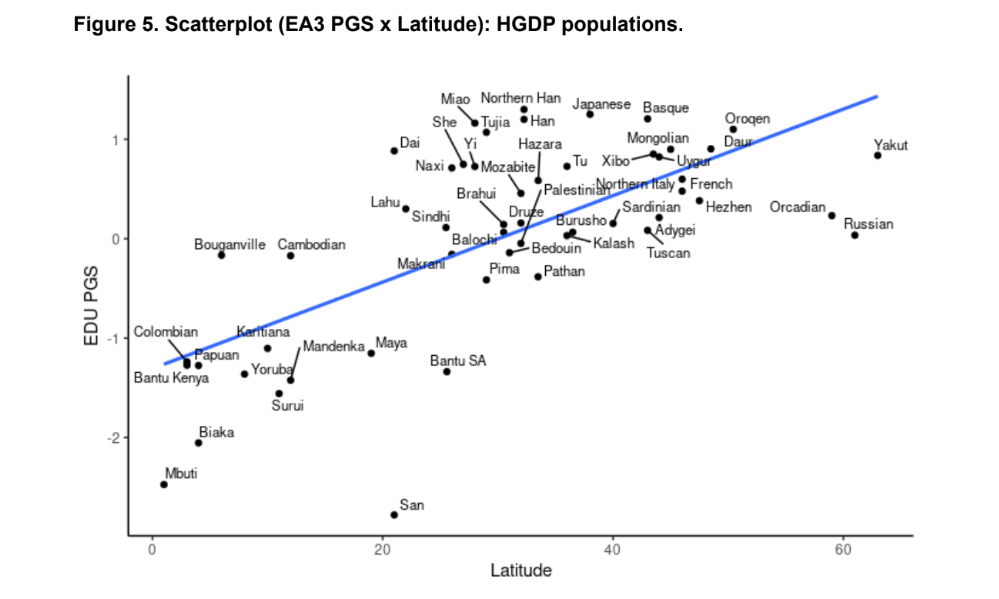
From Divergent selection on height and cognitive ability: evidence from Fst and polygenic scores

 Pumpkin Person
Have u seen They Live puppy?
No but I want to. I might even own it if I can find it.
the scariest movie is our lives and this blog is a testament 2 it.
PP is happy again.
RR,
Your biggest mistake is believing your hypothesis is defendable by apriori arguments which are only compatible to self evident facts or phenomena, not the case of “mind as a metaphysical phenomenon originated by itself or without the fundamental role of brain/organism itself”.
Most people who study this topic may think mind is real in the sense of consciousness, which is fine. I mean, consciousness’s existence being supported by how it is defined, linked to brain and nervous system expressions, like behaviors. This is not for your definition of mind. If you still want to support it, you should appeal for a different argumentation because the apriori one seems the less recommended.
^^^NEEDS TO BE BANNED^^^
PEEPEE’S LAST CHANCE.
She will not going to ban rr so just stop to scream for it.
RaceRealist can only discount the brains connection to intelligence by saying intelligence is mental.
But then neuroscience can define intelligence as a mechanism of higher-order information manipulation that is mathematically proven to require a physical process.
Mathematically this process is a dynamic loop of internal and external feedback.
So if intelligence is just a loop then that means some loop structures have more information in them than others. This is affected in the same way as any other phenotype.
Loop phenotype = intelligence
Higher-order loops = Higher-order intelligence
Carl Sagan said it best:
Yea just physicalist mumbo-jumbo using nonsense terms that appear nowhere in any literature—and a mereological fallacy.
Sure dude, keep at your anal-philosophy “research”. Your nonsense will never get published in actual science journals. The do not accept that kind of mumbo-jumbo.
Sure thing.
RaceRealists intelligence is a lower-order dynamic loop.
Cannot understand higher concepts.
Carl Sagan is much more intelligent and accredited than any of your “scholars” dumbass.
simply put the people you read RR are a bunch of backwards retards trying 2 politicize science.
its a disgrace.
only reason you didnt stay with HBD is because you were 2 dumb 2 understand it.
you need 2 quit everything.
RR is insane. He never will accept when he is wrong (most of time, period…), his intellectual humility is nonexistent. He lives in a paralel reality where he thinks he is always following the real Science and Philosophy while it is completely the opposite.
So believing, by faith, “mind” is “beyond physical” is not fallacious… ok.
So atoms are innative… Chemical reactions dont exist…
Some-to-oftentimes we use metaphorical language BUT when someone say “the brain does” he want to mean “the individual does”, if without a brain, an individual cant do anything, right???? Apriori argumentation??
” physicalist mumbo-jumbo”
Well, that’s ironic.
Sagan is just saying the physical structure determines intelligence, not the composition.
Pretty simple and true assertion.
“Cannot understand higher concepts.”
Funny.
“only reason you didnt stay with HBD is because you were 2 dumb 2 understand it.”
I’ve outlined the reasons why I’ve discounted “HBD” (psychological hereditarianism) numerous times—I don’t discount physical differences, I have dozens of articles on that. You need “2” understand that
“He never will accept when he is wrong (most of time, period…),”
How many of your views have changed in the last 5 years?
“So atoms are innative… Chemical reactions dont exist…”
Yea they are “inert”, of course chemical reactions exist.
“So believing, by faith, “mind” is “beyond physical””
It’s not “faith”—it’s sound argumentation.
“when someone say “the brain does” he want to mean “the individual does”, if without a brain, an individual cant do anything, right????”
It’s incoherent and a mereological fallacy to say the brain “does” something that’s attributed to selves. The brain merely allows it to happen, since without brain there is no mind.
“Sagan is just saying the physical structure determines intelligence, not the composition.”
And I could counter that by saying the brain is merely necessary, and he did commit a mereological fallacy.
I cited two articles on “European variants” in admixed individuals along with a citation on the current best h2 SNP estimates of “IQ” and edu. The two articles on “European variants” discount “admixture studies”, and the SNP h2 estimates show that the “HBD” view is false. And the other height “heritability” article showed substantial inflation due to pop strat. So what’s the response to these? The people on this blog think my views appear out of thin air without evidence, when there is substantial evidence for the beliefs I espouse on this blog. And that there is no coherent response to them is telling. That’s the “faith” Santo is talking about. And also my argument against PGS as causal. There also a new paper published by Madol and Harden and there are numerous critiques of the use of PGS.
Face it—psychological hereditarianism is dead. (And I’m also privy to like 5 more articles coming out this year that further refute hereditarian concepts. There’s nowhere else for them to go.)
And this doesn’t even get to the numerous conceptual arguments against the possibility of psychological “measurement” which began with Berka in 1980, honed by Nash in 1990 and then in the late 90s with Michell, then the late 00s by Trendler, and then the early 20s by Uher, Michell and Trendler. There are NO responses from hereditarians in the literature on this. I wonder why that is? Because they assumed that psychology is measurable and they don’t take into account the devestating conceptual critiques that these authors have levied at their “field.” The fact of the matter is, psychometrics isn’t measurement.
Yes, declaring something mumbo-jumbo when you are proposing your own mind-matter theory with unbacked metaphysical assumptions and also referencing a field with many contentious and developing issues as a unified settled entity called “the literature”, are both very ironic.
We’ve had the data to answer most hereditarian questions for a few years now. And… The answers don’t lend credence to hereditarianism. Just like with the candidate gene era, I’m waiting for GWAS supporters to finally agree with critics once their new toy comes on the block. You know it’s coming.
I would cite more studies, but I know PP commenters don’t like that (with the exception of Melo). What I’ve cited in their article is more than ample to discredit hereditarianism.
‘It’s incoherent and a mereological fallacy to say the brain “does” something that’s attributed to selves. The brain merely allows it to happen, since without brain there is no mind”
🙄🙄🙄🙄
“It’s not “faith”—it’s sound argumentation”
🙄🙄🙄🙄
“contentious and developing issues”
Funny, because they’ve had over 100 years to get it right. The claim of “mental measurement” is derived from Galton, so they’ve had 150 some-odd years to establish it. They’ve had 40 years to reaping to Berka and 30 for Nash. The claim of “mental measurement” is still open for psychometricians and with the devestating critiques I’ve referenced, it’s clearly unsolvable.
The fact of the matter is, admixture studies are dead, GWAS is on its last ropes (increasing the sample size won’t do anything but increase the chance for spurious correlations), the best SNP h2 estimates we have show a pittance of a correlation between genes and IQ/edu. Bird (2021) also refuted hereditarian dogma. There’s nowhere left for the hereditarian to go. Hereditarianism is done for.
“And I could counter that by saying the brain is merely necessary, and he did commit a mereological fallacy.”
I mean, even if he did, it doesn’t matter.
Words are subjective, and even if I =/= brain, that’s not going to stop people from using those metaphors. And why should they?
It just seems like a pedantic thing to criticize one of the greatest minds of the 20th century about.
I just think the use of such metaphors isn’t even wrong, it doesn’t make sense because it’s attributing to the part what it simply doesn’t do. It merely ALLOWS it.
“such metaphors isn’t even wrong”
fuck you
“It merely ALLOWS it.”
Your rectume merely allow you to taste food because otherwise the shit would back up into your mouth.
https://www.unz.com/jtaylor/this-man-wants-you-ignorant/
RR bullshitivism…
Why PeePee??
PPee became disappointed after her biggest faillure on extwitter to increase her popularity so she decided to overtolerate this mentally ill to shit here if she came to conclusion she no longer will care about her blog but her life mixing with some naive/dumb Icelander.
I tolerate RR because he’s one of the most well read, civil, substantive & least bigoted people here. I don’t agree with him on the science, but what’s wrong with just person out of many having a different view?
“brains don’t do anything”
that is an interesting opinion to have pp
Well read what??
Civil?? He is a sociopath…
Substantive??? Drugs??
Well, coming from someone who think Oprah is a great human being as well other “billionaires”…
I know HBD chicken has 14 thousand followers and you less than 5 thousand in extwitter and most HBDears barely interact with you, for example, by liking your blog posts. Sorry.
That’s cause I hardly post on Twitter & when I do it’s usually to terrorize Oprah haters like you
Love the armchair psychologizing here. Very funny. Does Santo disagree with the claim that I’m well read? Interesting.
“Brains don’t do anything”—yea that’s not my view. I actually know anatomy and physiology.
”t’s usually to terrorize Oprah haters like you”
I don’t like useless parasites, sorry, pee.
I saw some of your ”terrorism”…
You’re the parasite, sir. Do you even have a job?
The main reason why you, miss, cover your friend is because you are both mentally ill.
Fanatics often do this when they meet.
My personal life is not interesting to share here.
In any case, a person without a job who lives off his family, even if he acted in a parasitic way with his relatives, would still be doing it only to them, while this stupid psychopath who you love like a madwoman is parasitizing an entire nation with her bullshit programmed to destroy it.
Still, there are unemployed and dependent people who do not parasitize their relatives from the moment they seek to help them with household chores orwithout generating many costs.
The only thing your Oprah did in her entire useless life was generate cheap entertainment that especially favored herself.
The richer a person is, the more she benefits herself and at the expense of others, directly or indirectly, than the society in which she lives.
brains do intelligence
should rr call me stupid for believing this pp?
Of course not.
I don’t think your stupid for your belief, I simply think you’re misinformed.
“misinformed”
so you are saying I cannot think for myself
you want me to go to the reeducation camp
to learn the correct propaganda
no, I understand what intelligence is.
I graduated high school doing my paper on it.
I studied it for over 20 years.
see pp?
that is the implication of politicized science
you cannot just disagree with them,
they must force you to believe
they call you misinformed because of their ideology – a war of morality – it is evil to say the brains do intelligence – you are not stupid you are uneducated and simply need to be brainwashed in “The Truth”.
Cultural Marxism is evil pp
Haha what? Whatever you say man. Fact is, you need to grasp basic A and P first. Brains don’t “do intelligence.”
I mean, brains might “do intelligence.” The debate is definitely not settled, but I do think it’s kind of pathetic how enraged everyone is at RR for simply believing something different than them.
The vast majority of commenters don’t even understand his views.
People dont need to waste their time trying to understand dumb views, period. Rr is not that angelical creature you think.
water is wet
hydraulics is not wet
hydraulics is not water
intelligence is mental
the brain is not mental
the brain does not do intelligence
melo does not understand AK’s views on hydraulics/intelligence
if brains do not do intelligence what does the intelligence melo?
use a real argument melo, you just cannot define the brain as “the thing that does not do intelligence” like rr is doing.
“what does the intelligence”
The self.
And the self does not include the brain rr?
what the fuck is a self without the brain?
what the fuck is intelligence without a brain?
You cannot tell us why the brain is not involved with intelligence rr so shut the fuck up.
If the brain and nervous system are nothing more than a collection of physical parts organized in a certain way, and if the brain and the nervous system function as a system of parts, then the subject is not the brain or the nervous system.
If the subject is not the brain or the nervous system, then it contains as a proper part a nonphysical mind or soul that is not reducible to the kinds of things studied by science. (An abridged version of Hasker’s unity of consciousness argument).
Fact is, I am not my brain or nervous system. The subject of experience is “I”, the irreducible self, and neuroscience can’t study it (even though some neuroscience is implicitly dualist, they should just embrace it—see Manzotti and Moderato’s article “Neuroscience: Dualism in Disguise” in “Contemporary Dualism.”)
🤣🤣🤣
justice and truth can often be intertwined. its a simple notion that sparks a more qualifying belief of what everything is.
some things are done compulsively and without judgment or predetermination of the consequences. therefore i think rationality is an important trait which leads 2 proper judgment in anticipating whats next.
Ashkenazim Jews are like psychologically Mediterranean and cognitively Northern European or sorta.
True.
Puppy why did you say RR is here to debate the science. He doesn’t believe in science. He doesn’t believe in the last 100 years of scientific findings.
every time peepee approves an rr comment her IQ falls by 10 points.
it’s very sad.
The very first comment on this article is app. About “the science” and no one has responded to it. Step up to the plate, “philosopher.”
Kind of ironic how jews hate Trump for wanting to ban Muslims, considering jews policies towards muslims.
Because they fear they could be banned too. It’s called thinking several chess moves ahead & shows intelligence on their part. The lower IQ prole Jews support trump
Jews, collectively and strategically, are a big mess. They are the kind of crazy smart individuals but crazy. Seems they dont know what they are doing, really.
It’s pathetic a supposedly genius tribe, by “biblical” reason, have invested so many energy to a little piece of land after thousand of years without living there as an ethnic state.
They are killing their Golden eggs chicken, White people. Weird, dumb, erratic.
Whites are in no imminent danger of extinction. They’re still the most numerous race in Europe, Australia and North America. No other race dominates half the habitable continents.
Extremely low fertility rates and for decades
En masse immigration
Jewish malignant push for miscigenation, which is increasing for years…
But i thought a typical “HBD” knew this…
“They’re still the most numerous race in Europe, Australia and North America. No other race dominates half the habitable continents.”
Not for longer.
Dominates??
Today, they/”we” are the prey.
Yes I think your right, they think it will lead to a domino effect that will lead back to them. Once muslims are banned, then discussions for other measures against other groups will happen. Then whites will eventually reach them
Santo if you feel so strongly about whites “going extinct”, and if you think you’re white, why don’t you have any babies to off-set “white genocide”? If you feel so strongly about this you should be able to set aside your desires for the good of the white race, right?
^^^Why not do both? Have kids and levvy complaints about the greater system.
^ True. Point is, “Be the change you want to see in the world.”
Dumbest question ever. He is investing in a thing just exist in his aired head to “attack” me, 😆😆😆
Why do you just move to a Black and poor neighborhood, or a majority Black country, or just stop to being helped by your “White privilege” and start to “repair” it giving more than the 50% of your money to Blacks??
Nope. I work hard for my money. So why don’t you have any babies to “offset” “white genocide” if it’s that important to you?
“Nope. I work hard for my money”
But but who will pay the reparations for Blacks???
Ok,, i will start to generate 30 million descendents by now… 🙄
You’re very dumb.
The US government should pay.
“Be the change you want to see in the world”—you don’t agree with that? So you’ll just whine and whine on PP’s blog and won’t suppress your desires for the good of the white race?
If one identifies a problem (whites are “going extinct”), and there is an actionable plan (have more white babies, tell others to among other things related to having children), then they should suppress their desires in order to save the white race. Is there something wrong with what I just said?
“The US government should pay”
Okaaaaay
But what do you think US government is???
They will pay it from taxes they will take from you… Right??
“Be the change you want to see in the world”—you don’t agree with that? So you’ll just whine and whine on PP’s blog and won’t suppress your desires for the good of the white race?”
Google Translator: supress, not suppress.
Even when you make this extremely dumb comment, you still wont stop to “rationalize” your embarassment??
“If one identifies a problem (whites are “going extinct”), and there is an actionable plan (have more white babies, tell others to among other things related to having children), then they should suppress their desires in order to save the white race. Is there something wrong with what I just said?”
🙄🙄🙄🙄🙄🙄🙄🙄🙄
Self criticism is one of the most important feature for really rationally smart people. If you have it at some point of your life, just disappeared, possibly forever.
But THIS is you without all of your cheating manual, you without all this fake expertise and it’s just so funny to watch…
“But what do you think US government is???
They will pay it from taxes they will take from you… Right??”
Right. I pay taxes anyway, and the government should pay the reparations. Do you remember my argument?
“Google Translator: supress, not suppress.”
Haha don’t rely on Google translator. It’s “suppress”—don’t try to correct me on the language I speak.
“But THIS is you without all of your cheating manual, you without all this fake expertise and it’s just so funny to watch…”
What does this even mean? What’s a “cheating manual”? Can you explain to me “iN yOuR oWn WoRdS” how twinning occurs? I have expertise in some things, what about you?
“Right. I pay taxes anyway, and the government should pay the reparations. Do you remember my argument?”
Your “argument”
“I wont pay anything because i works ‘hard’. It’s the ‘government'”
The government will take the money from taxes you pay, RETARDED.
“Haha don’t rely on Google translator. It’s “suppress”—don’t try to correct me on the language I speak.”
You speaks very badly…
“But THIS is you without all of your cheating manual, you without all this fake expertise and it’s just so funny to watch…”
“I have expertise in some things, what about you?”
Expert on christianism of biology, homeopathy of philosophy…
Yea it’s my own argument.
I pay taxes anyway.
I don’t speak “very badly.”
Yea I have actual expertise in some things. Unlike you, I understand what I’m talking about. What’s funny to watch about you is you ignoring my question about what social constructivists about race believe and the mechanisms behind twinning rates and what cold weather being density-independent means in the context of r/K. You won’t answer because you can’t, and you can’t answer because you’re ignorant, and you’re ignorant because you don’t read.
You are a complete retarded but pp loves you.
You should be on medication and not pretending to be what you never will capable to become. Your “blog” should be target as pseudo Science and fake Philosophy if we live in really rational world.
RR believing he is a scientist is like a stereotypical mad man believing he is Napoleon.
You are just a dumb “coach fitness”. Why do you dont show who you really are here?? If you showed your ugly and mentally ill face why do you dont use your real name????? What do you are hiding????
If RR is stupid, and I’m not saying he is, but IF he is, it’s not about his views being wrong, but rather it’s about him not being able to adapt.
He’s not able to turn this environment around to his advantage.
That’s really what intelligence is.
No answer to my questions, of course. My fitness background and anatomy and physiology knowledge quite obviously helps when it comes to physical racial differences. You wouldn’t know anything about that thought. And you can never substantiate your clearly ignorant claims.
He is mad and this is worse than being what most people considered “dumb” = intelectually limited.
He doesnt know how deeply dumb he is and this a delusional thinking aka untreated psychosis.
And yes your concept is too simplistic. It’s not different to say “intelligence is just the capacity to learn math”.
So, for you, some If not many of the brightest human beings ever lived and really not good to adapt based on their biographies were less smart than many well adapted simpletons like rr…
You also are not counting the fact that adaptation is not just dependent on subject but also his environment.
So, for you, some If not many of the brightest human beings ever lived and really not good to adapt based on their biographies
That’s because they had impossible situations to adapt to because their goals were too difficult or they did adapt, but just in ways we can’t understand.
You also are not counting the fact that adaptation is not just dependent on subject but also his environment.
That’s why the best IQ tests put you in many environments and takes an average so the properties of specific environments cancel out.
I used to criticize your view on this PP, but with you putting it like this I see where you’re coming from (independent of IQ, of course). What do you think of my definition?
Intelligence is “a socially embedded cognitive capacity—characterized by intentionality—that encompasses diverse abilities and is continually shaped by an individual’s cultural and social interactions.”
Interesting. I think we’re saying the same thing in different words (intention implies goal directed implied turning situations to your advantage) plus you’re throwing in a bit of your social theories on its causation in humans.
Yea I think we’re basically saying the same thing here, good point. I agree with you on intentions and goal directedness. Funny how after all these years we finally seem to have come to an agreement on a definition of intelligence, of all things.
intelligence is knowing what does and does not go together – this has survival advantages
my goals might be too hard for me
No, PP, intelligence is not an only thing, even if appears more general like adaptation, and when it is more dependent on environment than intelligence itself, your concept not just cancel the very multidimensional nature of human intelligence but also deviate from the main object, intelligence. Anyway, IQ was created exactly to focus the analysis on intelligence itself, even thought it’s fail again because reduce too much its concept and also deviate from the essence of it, the capacity to perceive facts and or to discern them from lies and self projection/deception (^^^^^) of our own desires and expectations, in order words, the uniqueness of human intelligence is rationality. Sadly the essence of it has been our cleverness.
Adaptation is an expected outcome of human and general intelligence, not this, but because humans are only ones variably capable to seek for objective truth/knowledge and to see it as an end in itself, and not just as a mean (animal adaptation), our extra and unique abstract thinking capacity complicate your concept for human intelligence as adaptation. It’s also sound like an animalistic fallacy.
can we at least agree that killing 1,000 civilians is terrorism and therefore hamas is a terrorist organization?
[redacted by pp, 2023-10-22]
the IRA never targeted innocent proddies. never!
back me up!
did the UDF ever target innocent papists?
for example: the WTC was a lot less cool than the pentagon and planned capitol attack….if you believe the official narrative of 9/11. innocent pipo should only ever be “collateral damage”, never targeted as such.
the way i see it the only reason anyone actually comments here is 4 their ego. they dont do so out of respect 4 mankind.
its saddening and they keep denying it and attacking me which is just insulting as it is hilarious.
anyways the point i wanna make is that intelligence according 2 PP is adaptivity. how is this compatible with what RR believes.
like Melo said he is probably the only one who truly understands whats going on in that brain mind soul or whatever RR thinks creates conceptual understandings of anythings so i dunno if its answerable but still.
i dont think even RR understands what he is saying the way Eric Melo Thonius foolio understands him.
intelligence i think is resourcefulness. extrapolation. and most importantly gangster.
peepee needs to see Goodfellas, the last semi-good movie in more than 30 years, not just according to me, but according to the critics and directors.
it isn’t a bad movie, but it’s weird that no good movie has been produced since. the same is true of pop music. Joshua Tree came out in 1987.
it’s not my age. when i was a teenager i noticed the trend…how there was this big bang of great pop music in the late 60s and early 70s and it’s been slim pickens since then until no pickens….just crap.
this phenomenon coincides with the rise of neoliberalism in the US and UK, reagan and thatcher.
this is NOT a coincidence.
the 70s (ex-disco) is the best decade for pop music and the same decade where inequality was lowest in the US and UK.
Sight and Sound is my source.
Your thesis is the same as mine. I said the same thing in a comment about 2 years ago here. But its not true theres been no great movies or music since 1980. But yes, the 1970s was the golden era of cinema.
ive seen it.
just name a great pop song, and you’ll be surprised. i was….
MOST of the time it will be from the 70s.
even though you think it must be from the 80s or 90s.
Billie Jean. 1980s.
^^^PEEPEE^^^
not me
I agree with Mugabe, but this one’s too good not to post.
the weight is by far the most played classic pop song by a canadian band.
it was recorded in 1968.
did richard manuel die from AIDS?
yeah the Band. the nite they drove ol dixie down. i know that band. theyre called THE band.
its funny though.
NOTICE THAT RR IS PART CHINESE AND HAS A 19th CENTURY CHINAMAN HAIRCUT!
COINCIDENCE!
OR HBD?
like afro wearing that giant polo pony on his shirt like the haitian.
sad.
stop trying and win…or lose. the calvinist manifesto.
Today it’s became a relatively common haircut for young men and such in jeWest…
yeah its a bit disturbing.
What maroons. That looks nothing like my hair. Santo, you’re not even from “jeWest”, you’re from the Global South—what would you know? LOADED, what’s “disturbing” about getting a taper fade?
its just kind of a peacocking of sort that is kind of bizarre imo.
“you’re from the Global South—what would you know? ”
RR is desperate!!!
So MEAN and BIGOTED 🤣🤣🤣🤣😆
What do you know about “jeWest” being from the Global South? Maroons don’t even understand why I get the taper fade.
Too dumb to people waste their time with you.
RR “logics”:
“Cause i’m from ‘Global South’ and being a ‘maroon’ (?????) I cant understand his ‘enlighted (brainless) mind’ and U$ History and Society”. 😆😆
I love when he go out of his wall of fakery and cowardice and sounds plainly dumb, the old rr.
‘Maroons are descendants of Africans in the Americas and Islands of the Indian Ocean who escaped from slavery and formed their own settlements. They often mixed with indigenous peoples, eventually evolving into separate creole cultures such as the Garifuna and the Mascogos”.
Am i a Maroon???
😜
Well, if “”””””””””””””””race””””””””””””””” is just a social construct, i could be…
RR: ” because ‘i’m” mixed race and from a developing country i cant understand his Genius and a developed country like US”
What is the name of this kind of fallacy??
“I love when he go out of his wall”—you’ve been saying this BS for years and have never substantiated it because you know you can’t. Constantly making claims without evidence. I love when you make claims that you’ve been making for years that you’ve never backed. It’s clear I know what I’m talking about.
“Am i a Maroon???”
It’s slang.
https://en.m.wiktionary.org/wiki/maroon#:~:text=character%20Bugs%20Bunny.-,Noun,Thesaurus%3Afool%2C%20Thesaurus%3Aidiot
“If race is just a social construct”
What do social constructivists about race believe? Can you explain it to me?
My point with that comment was that you wouldn’t have any kind of real knowledge on trends and what people do with their hair, having never even been to America.
“Constantly making claims without evidence”
🙄
😆What do you know about “jeWest” being from the Global South?😆😜
So MANY…
“My point with that comment was that you wouldn’t have any kind of real knowledge on trends and what people do with their hair, having never even been to
…America”
Doesnt exist a country called America. It’s highly problematic calling US as America, it’s offensive to us Latin-Americans. Sorry, dubby!!
Samurai haircut??
Internet??????
Coincidence, maroon is a derogatory slang and at the same time a formal historical term used to described Black people who scaped from slavery …
Awn, he called me idiot…
“What do social constructivists about race believe? Can you explain it to me?”
The same shit you eat everyday??
Keep going out of your woke cave, i want the raw dumb rr right here.
Nothing of substance to respond to. Just the same inannities as usual. What do social constructivists about race believe? Can you tell me?
“Nothing of substance to respond to. Just the same inannities as usual”
So mad you denies the truth even when it is right on your face, including your complete lack of true intelectual pedigree witnessed here since a long time…
And NEVER accept when you are wrong. It’s speaks volume about your low level of moral discernment as well. Sad.
What do social constructivists about race believe? So you can’t answer this question and the one about twinning?
What this fucking stupid without context question has to do with anything here????
Mentally ill.
“What this fucking stupid without context question has to do with anything here????
Mentally ill.”
Damn man how bad is your memory? vvv
Answer the question—what do social constructivists about race believe?
“”Well, if “”””””””””””””””race””””””””””””””” is just a social construct, i could be…”””
MENTALLY ILL
Went out for some hotpot with my little brother and his Jewish girlfriend. I was shocked by how anti-Israel she was. It goes to show I spend too much time on this blog.
Her family moved from Israel because, and I quote, “Israelis live in a bubble inside their perfect little zionist paradise.” It was disgusting to be around. Makes sense. Christian nationalism is gross, and I doubt Jewish nationalism is much better.
I was thinking that as much as I believe Hamas’ actions are evil, it seems decadent and out of touch to be throwing a “festival of peace” when brown kids live in an open-air prison down the road. I saw the video. The half-naked girls dance around to music, doing drugs, and just having a fantastic time. No wonder Hamas felt justified in murdering and raping them. Their idea of “peace” is ethnic cleansing. Or at least that’s how the terrorists saw it.
And they have a big problem: Orthodox social parasitism + their big fertility rates.
I get terrorist groups are terrorists, they are not the good guys, they are not comparable to Mahatma Gandhi. But Israel doesnt want to give “full’ autonomy to Palestine. So called brainy Jews simply cant adopt bloodless, more empathetic (not fool) and smart strategies to deal with Palestinian issue. If they promote its development, Palestinian fertility rates would decrease, terrorism there would have no reason to exist and Israel still had power over Palestinian territories but not…
Pumpkin, why do you think pygmies are higher than congoids considering they were taken advantage of by congoids, also why are south asians higher than arabs considering arabs have greater historical achievements. Inventing civilization in Egypt and Iraq, and creating the most influential man, Muhammad.
Well this research is still in its infancy so there’s likely some mistakes. We’ve only found a small percentage of the “genes” that correlate with IQ and as we continue to find more, especially causal ones, the ranking may change.
But if pygmies are indeed higher than congoids, the latter could still exploit the former because of physical superiority.
As for Arabs vs South Asians, it could be that cousin marriage dragged down the IQ of the former while the caste system elevated the IQ of the latter.
It is not about historical achievements,
what matters is what the current way a population matches genetically with the phenotype of intelligence.
Nordic people had no achievements until science spread technology to them after the Romans collapsed. yet today they have the highest intelligence in Europe.
I do not think that achievements of the past are a sign of achievement in the future. Group dynamics and science are too complicated to divide people into race achievement. Evolution is always happening and intelligence is not static.
You can tell a lot from historical achievements or rather historical failures….ie. blacks never invented writing or the wheel or math or even basic sanitation.
But anime is right because there are lots of exceptions.
By “invented” do you mean “did independently”? If so, I got some bad news for you.
I agree to some extent. The traits needed to get somewhere are probably different from the traits needed to stay at that place, or to go further places, given the slow and careful nature of evolution.
However, it would still stand to reason that the ones most capable of achieving in the future are those who have a history of it, if only for being the most likely to have the least amount of totally useless dysgenic qualities (rather than qualities that are contextually useful), like genetic defects.
Also, if one group takes over for another group, it will most likely be the one who has still demonstrated success to a lesser degree, or other historical success, like East Asians taking over for Western civilization. It’s not going to be pygmies or australian aborigines.
Lurker i dunno about how australian aborigines or pygmies really could handle western civilization but you are quite mistaken if you dont believe they have some ability 2 do what you cant.
they have special ways of drawing on memory and behaviors that even us westerners would never actualize.
Egyptians are not arab. People from the arabian peninsula are arab actually. But for the sake of discussion lets say all north african and west asians are arab. But IVC is no less than egyptian or sumerian civilization. IVC writing hasn’t been deciphered nor dated. It could be newer than sumerian writing or even older. And it hasnt been fully or as excavated as much as egypt or sumerian yet. So who knows you could find an even older wheel there!
Peeps, how did caste system increase south asian IQ. I think it decreased it. Also isn’t arabia hotter than india? So shouldn’t they have lesser IQ according to your cold winter hypothesis?
India caste system promotes stagnation including intelligence levels.
So one thing neoliberalism does do well is make rich people richer and if you have the wealth, the specialist medical treatments, butlers and yachts on offer in these times are the best ever in history. Praise be Thatcher and Reagan!
Everyone remembers Michael Jackson was the King of Pop in the 80s. Thriller is still a great album. Pop music kind of splintered in the 90s and became more narrowly targeted at teenagers. In Ireland we produced Boyzone and Westlife which are arguably more famous than U2.
Then pop music kind of went dormant in the 2000s up until the recent resurgence under Taylor Swift and Beyonce. I don’t listen to either.
Country music is the number 1 selling musical genre in America. The jews don’t want anyone to know that. Their precious blacks are suposed to be the number ones.
“Country music is the number 1 selling musical genre in America. ”
This is true, but mainly because many prominent Hip-Hop artists like Pop Smoke, Juice Wrld, and XXXTentacion died off. There is a huge void in rap right now. The only people really doing anything are Drake and Travis Scott.
Rap has literally become too dumbed down. The gangstas are too prominent. There used to be a clearer separation between the artists and the goons they hired, but this isn’t the case anymore.
There is a weird counter counter-culture occurring in Country Music. It’s satiating an anti-establishment appetite.
“The jews don’t want anyone to know that. Their precious blacks are suposed to be the number ones.”
This is such a stupid line of thought.
Someone should do a Phd and research why jews decided to run the Civil Rights Movement for blacks in the 60s and free Oprah from Jim Crow. Theres just no book on this issue.
Kevin MacDonald wrote that book I think
I read his book and he doesn’t talk about the civil rights movement.
Cofnas in general is not a good philosopher (his paper on hereditarianism is particularly bad), but his stuff against MacDonald is pretty good.
“coffinas”
So the economic history appears to be that the neoliberals jumped on the oil crisis in the 1970s to reduce workers wages and cut taxes on the rich from 70% to basically nothing today.
Obviously some countries like the Scandanavians didn’t follow. Today those countries have the highest living standards and the happiest and healthiest people.
Meanwhile UK and USA are like third world countries in vast swathes of the country. It was an interesting experiment though.
EXTREME high iq gypsy behaviour:
https://www.msn.com/en-gb/news/uknews/police-pressure-leads-to-pro-israel-rally-being-cancelled-in-north-london/ar-AA1iF9Xl?ocid=msedgntp&pc=DCTS&cvid=4e6c4ce232cc4e8ea62408df03cfe695&ei=17
The group is called ‘Christians for Israel’ HAHAHAHA. The jews organised a fake organisation with this name to march for israel in London to troll the gentiles and the muslims. I bet the funding for this organisation must be 99% zionist/mossad.
if youre going 2 ban me PP then do it already i dont need this hostage situation type of absurd behavior from you.
you already know how i feel about you all negativity so i dont want anything 2 do with you. i got other blogs i can chill at including Animes and Aeolis.
this is not fair 2 me that i put in time and effort in2 comments that you will never post.
anyways i dunno please just ban me and dont post my comments if you think that will be something you want otherwise please just let me comment freely without disturbance.
just treat me with respect PP is all i ask.
Y*u ppl dont deserve any respect.
stfu you Hindu Hindus are the most corrupt and stupidest people in the galaxy!
You must be talking about yourselves.
there are no yourselves here fool. i am a secular man i just dont like Hindus even if i were a Papuan!
who cares who you like or dont?
y*u ppl dont deserve any respect at all. one more example: see how y*u ppl are treating jews in the middle east?
“Philosopher” why do you feel the way you do about blacks?
RR I’m glad you asked me and I think this is a good opportunity for you to learn and grow as a human intellect despite your 80IQ level.
Lets begin.
I actually started out as a raging liberal and was very left wing on social issues. My best friend in college was black. My best friend in London as a young man was black and I had many positive experiences with blacks professionally and personally. In fact when my friend said he thought whites were smarter I felt the need to reassure him and ‘debunk’ his stereotyping as per the jewish toilet training I had received in media and academia.
Then one day I decided to join Mensa and saw their IQ testing materials and took an interest in IQ. I started investigating IQ and came across a blogger, Steve Sailer who I initially felt was a craven racist. After looking at the data on IQ I began engaging with the alt right and realised the true nature of blacks.
In London I had never actually hung around in majority black areas like Croydon and only socialised with very prim and heavily vetted blacks in white collar environments. For example, merely the requirement that a person not have a criminal record rules out 25% of black men off the bat for any white collar work. In any case, as I explored black behaviour online, I realised to my horror that public perception of blacks was a gigantic cover up by jews. In fact Croydon is basically what happens when blacks congregate and become a majority in any culture or geography. Its because of testosterone. I changed my views academically while maintaining a welcome disposition to blacks personally.
RR you have to realise something for your own sake. Youre on the wrong side of justice. I don’t just mean narrowly criminal justice. I mean between good and evil. Civilisation and barbarianism. Its a very sophisticated question because of the work of ashkenazim is hiding the true reality and I actually understand how someone of your IQ level can be misled easily into siding with evil. But there can be no doubt that only blacks are capable of treating other human beings, including other blacks in such manners.
Its evolution. They evolved for a certain very good reason to be excellent at aggression. There was not enough surplus in Africa and whatever women and surplus there was had to be fought over.
Less academically, you basically would be wise not to live in a majority black country or area and deep down you know that already.
You can tell from the way Pill writes and thinks that he’s not that intelligent.
Interesting. I’m the opposite.
I went to a small alternative school, and out of 60 students, like 50 were black. I made some pretty good friends in my time there. But I saw the way they acted and I thought something was “off” about them. I’d get called “white boy” all the time, and I did have to fight a decent amount (I had a solid amount of fights in my high school days, both in school and out of school hanging out with the guys).
Then I graduated and stopped thinking about those kinds of things. Then the Michael Brown Ferguson riots happened. I stayed up all night watching the riots on a livestream. After that, I thought “there must be a biological reason why this happens.” Then I found Rushton and his r/K theory and his writings on crime and testosterone around 2014. Then I got into the IQ stuff (that was around 2012-2013 actually).
Though, I never thought about politics, and I’m still not that interested in it. But I would call myself a “racist”, and I thought that I was well justified in my view because it was just “biology” that made us different, and so we shouldn’t live together.
Then around spring of 2017, I saw the book DNA is not Destiny at Barnes n Noble, and although I scoffed at the title (I thought “what bullshit, DNA is most definitely destiny”), I bought the book and read it all day while drinking black coffee. It took me a week to finish the book and it had me thinking on genes, MAOA and related issues. That had me question those views. Back then, I would go to BnN every Sunday and pick out a book and hang all day and drink coffee and read the book I bought.
So then is saw Richardson’s Genes, Brains, and Human Potential: The Science and Ideology of Intelligence. I remember scoffing even harder than I did at DNA is not Destiny. Nonetheless, I bought that book and I devoured it. I would say that this book was pivotal in the current views I have today about intelligence, IQ, genes, and developmental systems. Richardson’s book then led me to developmental systems thinkers pole Denis Noble, Jablonka and Lamb, David Moore, Susan Oyama, Shapiro, and others; this one book led me to a wealth of knowledge that showed the hereditarian programme to be wrong.
So yea, “my awakening” to not be racist was a pretty slow burn, like around 4-6 months or so after I read both of those books. Then after I changed my views on this issues, I then realized how stupid and idiotic the views I previously held really were. I read some of my old comments on this blog and I cringe pretty hard at them. But I just look at it as growing through different points of view.
Now I’m much more well read on testosterone and physiology as a whole and I just laugh at what I used to believe about testosterone and MAOA. The views I hold now about genes are much more complex than the simplistic reductionist views I used to have (and that hereditarians today still hold, as can be evidenced by the “new age” hereditarians). Nonetheless, I think my transformation in my views I had over the years was a good thing, and even though I used to be a hateful person who was drawn to this stuff in order to justify my beliefs I had, it gave me the ability to have the perspective of why, some people, would hold those beliefs. So it gave me the ability to be informed on the research in question and also be better able to refute it with the newer knowledge I now have.
“You can tell from the way Pill writes and thinks that he’s not that intelligent.”
Your verbal comprehension is literally the worst I have ever seen in a so called high IQ person.
Dude you’re not that bright. Pretending I’m not either is not going to help any.
I moved around a lot as a kid. Mainly grew up in a rural area but was in the city through high school and went to an alternative high school after getting kicked out. Most of the kids were black. I never developed a racist attitude, but there were definitely times that I’d ask myself, “What’s wrong with black people?” But I always knew that was the wrong line of questioning, and I was intelligent enough never to give into those kinds of dark and counter-productive thoughts
That question didn’t make me pursue HBD, though. That didn’t happen until I became interested in Anthropology when I was 17. I’ve always been more anti-HBD.
“I’ve always been more anti-HBD.”
Because you are a stupid person. Clever people look at the truth and accept it and move on, even if they don’t like it. You and RR have this weird issue where you can’t tolerate criticism of black people so you both double down and find retarded info that supports this bizzare viewpoint that africans are just as civilised and capable as whites and east asians.
Doesn’t the higher twinning rate for Blacks and lowest for Asians (with Whites having the highest “higher-order” multiple pregnancies… probably due to specific drugs and age) pretty much destroy the argument that blacks would be the “K-selected” group? Pretty hard to argue with the literal definition of r vs. K selection here.
there is no K selected or r selected groups because all races have the same bell curve 4 the category of life history.
but anyways i will tell you this….i am very K selected despite what you think of me Lurker. ive been told by sources close 2 me that K selection is very strong 4 me.
How would it “destroy the argument”?
If we are to take Rushton’s claims at face value, then cold weather acts as an agent of r selection, while Africans would have had more time to reach their environmental carrying capacity through K selection, experiencing drought and endemic disease. This was all outlined to Rushton in 1991 by Judith Anderson, and Rushton had absolutely nothing to say about any of the strong, devestating arguments to his theory from Anderson.
Click to access race-r-k-theory-rushton-anderson-canadian-psychology-1-1991.pdf
When it comes to twinning in general, there’s some new data on this:
“Among White women, 97.38% were singleton births, 2.51% were twins and 0.11% were higher-order multiples. Among Black women, 96.95% were singleton births, 2.99% were twins and 0.07% were higher-order multiple births.”
https://www.ncbi.nlm.nih.gov/pmc/articles/PMC7376828/
And it’s not even clear that this phenomenon should be a “genetic one”; this was pointed out to Rushton in 1992. It seems that—once again—Rushton misinterpreted things when it comes to this issue as well.
https://pubmed.ncbi.nlm.nih.gov/1488860/
Among White women, 97.38% were singleton births, 2.51% were twins and 0.11% were higher-order multiples. Among Black women, 96.95% were singleton births, 2.99% were twins and 0.07% were higher-order multiple births
So blacks had fewer singletons and that’s despite having less access to expensive fertility treatment. Just as r selection would predict.
And? The study looked at temporal changes in multi-births in a certain time frame. And there’s evidence that dietary factors like phytoestrogens and IGF influence twinning rates. Nonetheless, that doesn’t “prove” Rushton’s r/K right, since Anderson showed that if we were to accept Rushton’s premises that Negroids are K and Mongoloids r—to which Rushton had NO response to.
https://www.ncbi.nlm.nih.gov/pmc/articles/PMC8129593/
”Since the 1980s, the global twinning rate has increased by a third, from 9.1 to 12.0 twin deliveries per 1000 deliveries, to about 1.6 million twin pairs each year.
WHAT IS KNOWN ALREADY
It was already known that in the 1980s natural twinning rates were low in (East) Asia and South America, at an intermediate level in Europe and North America, and high in many African countries. It was also known that in recent decades, twinning rates have been increasing in the wealthier parts of our world as a result of the rise in medically assisted reproduction (MAR) and delayed childbearing.”
”STUDY DESIGN, SIZE, DURATION
We have brought together all information on national twinning rates available from statistical offices, demographic research institutes, individual survey data and the medical literature for the 1980–1985 and the 2010–2015 periods.
PARTICIPANTS/MATERIALS, SETTING, METHODS
For 165 countries, covering over 99% of the global population, we were able to collect or estimate twinning rates for the 2010–2015 period. For 112 countries, we were also able to obtain twinning rates for 1980–1985.
MAIN RESULTS AND THE ROLE OF CHANCE
Substantial increases in twinning rates were observed in many countries in Europe, North America and Asia. For 74 out of 112 countries the increase was more than 10%. Africa is still the continent with highest twinning rates, but Europe, North America and Oceania are catching up rapidly. Asia and Africa are currently home to 80% of all twin deliveries in the world.”
Yea I came across this paper already. Do you know HOW twinning occurs and the factors that increase the chances of twinning?
I’m also wondering if you think I’m denying this, do you? Can you explain “in your own words” how twinning occurs and what increases the odds of twinning?
RR, you conveniently ignored East Asian data and restated what I said anyway.
No one said it was purely genetic, but it certainly shows that the current trend of blacks is to be more r-selected than Whites.
Evolving to face some difficulties like specific diseases or droughts does not change the overall r vs. K-selected nature of the organism.
I didn’t “conveniently ignore anything”—I’m well-informed on this issue. The cited paper was only on whites and blacks. And yea, again, if we are to take Rushton at face value, as Anderson showed, Negroids are K and Mongoloids are r. That’s a fact, and Rushton DID NOT contest that in his pitiful “response” to Anderson in his book.
And yea, again, if we are to take Rushton at face value, as Anderson showed, Negroids are K and Mongoloids are r.
By what logic? What’s the argument?
When the data disprove RR, RR simply switches the definitions of R and K and back again every time you pin him in. Basically something is going wrong in RR’s mind and it isn’t logical thinking. Its his moral foundation which is bankrupt and distorted. There is a darkness in his heart.
https://www.livescience.com/16469-twins-countries-twinning-rates.html
The central African country of Benin has the highest national average of twinning, with a whopping 27.9 twins per 1,000 births, the researchers added.
Of the developing nations studied, 13.6 twins per 1,000 births were born on average. This is comparable with intermediate rates seen in the United States, Australia and many European countries of nine to 16 per 1,000 births.
The highest twinning rates were seen in Central Africa, with more than 18 twins per 1,000 births. The especially high twinning seen in Benin might be linked to the Yoruba ethnic group, which can be found in Benin as well as in Nigeria and Togo, said researcher Jeroen Smits, a sociologist and economist at Radboud University Nijmegen in the Netherlands
In comparison, twinning is very low in Asia and Latin America, with a rate often less than eight per 1,000 births. The major exception are the Caribbean Islands, where many people of African descent live — for instance, Haiti had 14 twins per 1,000 births.
The researchers cautioned their data was based on live births. Since twins are susceptible to higher mortality rates during pregnancy and birth, the actual number of twins could be somewhat higher. “With child mortality levels being highest in Africa, this would imply that actual twinning rates in Central Africa would be even higher than those observed,” Smits said.
“By what logic? What’s the argument?”
Because cold weather is an agent of r selection while Africans would have more time to reach their environmental carrying capacity due to drought and endemic disease. Fun fact—the Anderson paper was the paper that finally made me see the light and discount Rushton’s theory, especially after I found that Rushton had no substantial response to the devestating argument that Anderson mounted. Then after I read Graves 2002 this further cemented to me that Rushton was a fraud (the Graves-Rushton debate did too).
“Philosopher”, it’s not “changing the definitions”, it’s taking Rushton’s logic and using it against him, in the way it’s actually used, not the way he wanted to use it for human races.
Santo, can you explain the mechanisms to me by which twinning occurs? I’m interested in your taken on this matter. (Note how Mr. Psychologist J. P. Rushton didn’t talk about any of the biological mechanisms.)
Because cold weather is an agent of r selection
Based on what logic?
while Africans would have more time to reach their environmental carrying capacity due to drought and endemic disease.
Drought and disease tend to be unpredictable so they cause r selection because when death is random, evolution favors high quantity offspring over high quality offspring. By contrast in the arctic death is not random, because certain skills (building shelter and fire) increase survivability so you want better offspring, even if they’re less numerous.
Because they entered new biomes and so were freed from the density-dependent controls and so r/K would predict that they would experience r selection. So they And cold weather acts in a density-dependent way.
When it comes to Africans, they stayed in their same habitats, in general, for the last 140k years, and so, they had more time to reach environmental carrying capacity—K.
You’re merely using Rushton’s misunderstanding of the theory, that’s why you’re disagreeing with what I’m saying. So by Rushton’s own premises, Africans are K and Asians are r. This is how these were applied in the literature, and so Rushton was wrong. I wonder why Rushton never replied to Anderson or Graves? What a mystery… Because they exposed him for the charlatan he was.
Because they entered new biomes and so were freed from the density-dependent controls and so r/K would predict that they would experience r selection. So they And cold weather acts in a density-dependent way.
When it comes to Africans, they stayed in their same habitats, in general, for the last 140k years, and so, they had more time to reach environmental carrying capacity—K.
So by that logic, fish must be more K than mammals since the latter left the ocean and “were freed from density-dependent controls”. Apes must be more K than humans since they stayed in the trees and “had more time to reach their environmental carrying capacity-K”
And yet the data debunks these predictions:
You’re merely using Rushton’s misunderstanding of the theory, that’s why you’re disagreeing with what I’m saying.
Rushton’s application of r/K was endorsed by E.O. Wilson, one of the co-founders of r/K theory. So Wilson doesn’t understand his own theory but you do? LOL! The arrogance!
PP nothing I said about r and K traits is incorrect (that is if it were to hold, the order would be reversed). And yea, what I said follows from r/K theory, what is your understanding of it and how is what I said about cold and endemic disease wrong?
Did Wilson ever say Anderson was wrong? Has ANY Rushton proponent ever responded to Anderson? I don’t count Rushton’s garbage “response” in his book since he didn’t attack the main argument.
He responds again here.
Click to access race-r-k-theory-weizmann-anderson-rushton-canadian-psychology-7-1991.pdf
That is such an incredibly weak “respsonse” to Anderson. Better off not saying anything than this and what he said in his book.
“Because they entered new biomes and so were freed from the density-dependent controls”
So they jumped from tropical to arctic environments, dumb dumb?? Or they GRADUALLY were occupying new environments and passing from many different selective pressures becoming more evolved??
“When it comes to Africans, they stayed in their same habitats, in general, for the last 140k years, and so, they had more time to reach environmental carrying capacity—K.”
Only if a given population had truly evolved…
When a population is well adapted to its environment, it doesnt have a reason to evolve more.
The time a population occupy a niche not necessarily cause it to become more evolved. It can being there for millions of years but stagnated, dumb dumb.
“Santo, can you explain the”
Nope.
“I’m interested in”
Nope.
No they didn’t “jump”, but it’s clear, as I wrote, that Asians are r.
“doesn’t have a reason to evolve more”
No reason to take you seriously at all.
The obviously didn’t “stagnated.”
So you can’t explain “in your own words” what the biological mechanisms are, nor can you read what I wrote about them. You quoted two large pieces of text while you always ask me to “explain in my own words” which I do all the time and you obviously don’t—because you’re ignorant, because you don’t read.
🤡
And cold weather acts in a density-independent way—can you explain what that means to me in the context of r/K?
“Nope”
Just as I thought.
“No they didn’t “jump”, but it’s clear, as I wrote, that Asians are r.”
Only in your detective and brainless mind.
“No reason to take you seriously at all.”
Who are you????
“The obviously didn’t “stagnated.””
Evidences???
Humans are living in Subsaharian Africa for more time and they barely produced totally independently anything near to a genuine civilization. Egypt didnt count simply because it is in very North and Ancient Egyptians were not pure Subsaharian Africans.
“So you can’t explain “in your own words” what the biological mechanisms are, nor can you read what I wrote about them. You quoted two large pieces of text while you always ask me to “explain in my own words” which I do all the time and you obviously don’t—because you’re ignorant, because you don’t read.”
After many years you skipping from actually writing by yourself rather than appealing for quotations, citations and links, it’s my time to do it against you and AGAIN it’s not conditional knowing the details of twinning mechanism or involved factors in humans, just knowing there are vaguely cited or related environmental factors, obviously necessary genetic factors and that without modern medicine, Subsaharian Africans and descent displays the highest rates of natural twinning, as well miscarriages and fast maturation characteristics. Only thing make East Asians looking more R oriented is their generally short stature but specially for humans, r and k oriented strategies dont happens in that homogeneous ways to each group.
You’re making idiotic claims that Africans “stagnated”—evolution never stops.
“After many years you skipping from actually writing by yourself rather than appealing for quotations, citations and links”
You make this claim all the time but it’s simply not true, as a quick check of my blog will show.
The clime that they evolved in makes them r—do you understand what I said? Can you explain to me what “cold weather works in a density-independent way” means in the context of r/K? What, exactly, do you think my view is here on the issue of race and DZ twinning?
I’ve correctly explained that Africans would be K and Asians r and you… Have no response, and you can’t explain what “density-dependent” and “density-independent” means in the context of r/K, because you’re ignorant, because you don’t read, constantly saying “use your own words” to me for years, when I have and that’s extremely easy to verify. You say that because you don’t know what you’re talking about, and why citations are used. You can’t describe the mechanisms because you don’t know what you’re talking about—it’s that simple.
“vaguely cited or related environmental factors”
If you knew the mechanisms, you wouldn’t say this. But you don’t. Sad how you’re talking on this as if you know anything about it. You obviously don’t.
And if evolution had “stagnated” in Africa, Africa wouldn’t be as genetically diverse as it is. But you wouldn’t know anything about that.
“And cold weather acts in a density-independent way—can you explain what that means to me in the context of r/K?”
Acts???? It’s a fallacy, buddy
Again a horribly written sentence which could be simply put. Can you write in normal way again??
“Density-independent” so it’s not r oriented…
Civilization is a novel environment too. When humans evolved to live in such places, with the help of agriculture, they reproduced more, resulting on historical high populations like in India and China. Something never happened in Subsaharian Africa until very recently.
Also, the “shorter stature” for East Asians can be very relative. The true short stature can be found in groups like pygmies.
Can you explain what it means?
“Density-independent so it’s not r oriented”
Why not? Can you explain? And when populations enter new climes, they are freed from density-dependence, which leads to r selection (density-independence).
“And if evolution had “stagnated” in Africa, Africa wouldn’t be as genetically diverse as it is. But you wouldn’t know anything about that”
It doesnt mean nothing. All of your “argumentation” is just hidden fallacies. The fact Subsaharian Africans are more diversified doesnt mean they were more evolved than other humans, it means they were earlier diversified and actually other human populations are less genetically diversed … If compared to Subsaharians… because they experienced from more selective events that reduced it.
What “hidden fallacies”? What I said is a fact—if evolution had “stagnated” in Africa for Africans, they wouldn’t has as much genetic diversity as they do.
Your stupid brainless mind was trained to un derstand only profound bullshitivism not when someone writes in objective way.
It’s just a claim without a true explanation, without writing in circles, very typical from you. Who needs to explain is you. Why do you think cold climate always disrupt r life strategy??
And r and k oriented models used to stablish such theory are extreme versions of itselves. Humans are not that simple r or k but often in between and Subsaharian Africans looks like more on r as well other LESS EVOLVED populations like Australian Aboriginals. Within each human racial or ethnic groups there is an internal diversity of r or k orientation among individuals and subgroups.
I explained it already. Can you explain density-independence as regards r/K and cold weather or not? It’s a yes or no question.
Human groups, specially those who have been pioneers on new lands from ancestral human environments, may have experienced intercalate periods of r and k selective processes. Civilization itself has been a novel environment, at the same time promoting demographic growth but also behavioral and biological domestication and sophistication like social status competition, related with k oriented strategy. Big and complex societies are larger web of different human ecossistems. Anyway, even humans not having the most extreme versions of k and r life strategies, some groups of our species are more oriented to one strategy than others.
On avg, Blacks invest more on their offspring than East Asians and Whites?? Nope.
On avg, Blacks mature late than East Asians and Whites?? Nope.
On avg, Blacks are less impulsive or more oriented to future than East Asians and Whites?? Nope.
Higher natural twinning rates among Subsaharian Africans is a FACT, not an argument.
Higher sexual promiscuity and teenage pregnancy rates among Subsaharian Africans (fast maturation) are FACTS, not arguments.
Higher rates of miscarriages and infant mortality of all types among Subsaharian Africans are FACTS, not arguments.
Yea you’re a maroon. I don’t contest some of these—but they don’t lend credence to Rushton’s grand racial theory. Do you have a source for the first claim? The third? You know the two solid analyses have shown that whatever differences exist between Rushton’s races can be explained environmentally, right? And specifically, Rushton never responded to Ember, Ember, and Peregrine. What do ya know—when other authors look into Rushton’s garbage, what do they find? Not the relationships he was looking for, the opposite relationships (eg Cernovsky and Littman 2019 on Rushton’s INTERPOL crime data) and that whatever differences exist could be explained by the environment.
https://www.researchgate.net/publication/263307435_Cross-cultural_evaluation_of_predicted_associations_between_race_and_behavior
So let me ask you—let’s assume everything you’re saying is true. What does it mean?
So putting it all together, Rushton never responded to Anderson (1991), Graves (2002 a and b) and Ember, Ember, and Peregrine (2003)—and these papers are devestating for Rushton’s theory. I wouldn’t expect you to understand that though, because you don’t read.
Black girls have an earlier menarche and thelarche than white girls. Black babies walk sooner than white babies who walk sooner than Asian babies. Blacks are more likely to have twins— all of these are true, but they don’t lend credence to Rushton’s r/K bullshit. I don’t expect you to understand the actual mechanisms behind these though. Because your ignorant.
(And I explained why blacks have higher rates of twinning. I can look into miscarriages, because I’m interested in mechanisms, while you’re clearly not since you can’t even described the mechanisms that increase the rate of twinning because you’re clearly ignorant of physiology, just like Rushton.)
Specifically, a source for “future orientation.”
“Nope.”
All the fake woke Science he use to portrait angelical Blacks as more evolved or superior to other groups…
The same fake Science mentally ill “feminazis” iare using to distort the knowledge about sex roles in pre historical period.
The same bullshitivism and merchandising of his virtual madhouse where good is bad and White is Black.
He simply cant accept he is wrong. He simply cant give to other the last response. Extremely arrogant, narcisistic, imature. If is not a mental illness, i dont know what would be. A healthy representation of human intelligence i know it is very far from being.
Or he really thinks ONLY RIGHT CAN DO BAD SCIENCE or it just purely evil cynism. You know, most woketard think ONLY RIGHT CAN BE EVIL, BELIEVE IN “CONSPIRACY THEORY”, STAND AGAINST SCIENCE.
MENTALLY ILL
https://www.ncbi.nlm.nih.gov/pmc/articles/PMC2876306/
🙄🙄🙄🙄🙄🙄🙄🙄🙄🙄🙄🙄🙄🙄🙄🙄🙄🙄
“you a maroon five”
After showing another good comment…
The raw rr is exactly the same retarded of five years ago. He is just using the “New emperor clothes”.
But but pp LOVES him.
Because i dont know personally any people here i could bet pp and rr know each other.
But again, why do i should care????
PP destroyed her own blog. She has no power over it (i no doubt she can ban me now to show her “power”).
“Abstract
Background
Because of the rapid increases in childhood obesity coupled with decreases in the median age of menarche, there is interest in how growth (body mass index [BMI] and height) in childhood may be associated with timing of menarche.
Objectives
Two research questions were addressed in this paper: (a) Within each race, at what ages were BMI and height differences evident among the early-, mid-, and late-onset groups? and (b) Within each timing group, at what ages were BMI and height differences evident between White and African American girls?
Methods
The Mother/Child files of the National Longitudinal Survey of Youth were used for this study. Menarcheal timing groups were identified using the 25th and 75th percentile of the age distribution for each race. Longitudinal statistical techniques were employed to estimate BMI and height as polynomial functions of age and age relative to menarche for African American and White girls.
Results
Significant differences in BMI by timing group were found. By age 3 years significant differences were found between early- and mid-onset African American girls, by age 5 years between mid- and late-onset African American girls, and by 6 years among the three timing groups of White girls. Significant height differences were evident by age 5 years when comparing early- to mid-onset and mid- to late-onset girls in both race groups. Comparing across race and within timing group, BMI and height differences were evident. African American girls were more likely than White girls to experience accelerated growth and earlier menarche.”
TRUE SCIENCE
“Children of Asian and African background mature on average earlier than children of European background.
•
Both environmental and biological components play a role in reported ethnic differences.
•
Ethnic differences in skeletal maturation do not seem to be sex specific”
In The Netherlands…
https://www.sciencedirect.com/science/article/pii/S8756328219304740
“All the fake woke Science he use to portrait angelical Blacks as more evolved or superior to other groups”
Where did I say this? What is “fake woke science” and can you give me an example?
“He simply cant accept he is wrong. He simply cant give to other the last response. Extremely arrogant, narcisistic, imature. If is not a mental illness, i dont know what would be. A healthy representation of human intelligence i know it is very far from being
Or he really thinks ONLY RIGHT CAN DO BAD SCIENCE or it just purely evil cynism. You know, most woketard think ONLY RIGHT CAN BE EVIL, BELIEVE IN “CONSPIRACY THEORY”, STAND AGAINST SCIENCE”
Are you OK? You seem very emotional, worked up and bent out of shape over this
“The raw RR”
You really are a funny guy.
And then you show me two articles I know about, on subjects I’ve written on (I specifically linked an article I wrote on race and menarche which shows my understanding of the mechanisms behind it).
Hahaha.
Can you explain to me why obesity would cause an earlier menarche? I’m interested in why that would happen and you seem to know a lot about this issue. Can you explain it to me?
“Nope.”
Because you don’t understand anything about what you’re talking about while I clearly do.
https://www.fertstert.org/article/S0015-0282(14)00903-0/fulltext#:~:text=Meta%2Danalysis%20of%206%20studies,was%20observed%20in%20Asian%20women.
Miscarriage rates by race JewUK
“Do you know HOW twinning occurs and the factors that increase the chances of”
Not relevant. What’s matter is that you wrong again.
And i bet you dont… specially if you think at the high of your intelectual arrogance that twinning has nothing to do with genetics…
““Do you know HOW twinning occurs and the factors that increase the chances of”
Not relevant. What’s matter is that you wrong again.”
Yes it’s relevant. What am I wrong about? Be specific.
“And i bet you don’t”
Eat your words. I have a great understanding of it. It’s clear that YOU DON’T because you won’t answer the question. Funny that you tell me to “use my own words”, I do, you keep saying that I don’t them YOU are the one who doesn’t use your own words. How does that work out?
Just because you read your shit doesnt mean you REALLY know relevant knowledge 😗 Sorry bitch
Nope. I dont read your shit.
I obviously “know relevant knowledge.” Stay ignorant and keep being hypocritical.
“I obviously “know relevant knowledge.” Stay ignorant and keep being hypocritical”
MENTALLY ILL
Can’t explain what I asked him to “in his own words.” In the past 9 months we have Jews and the slave trade, Mt and Y DNA and now twinning mechanisms. Can you explain to me if anything I wrote about twinning and race is wrong? Please enlighten me.
Stay in your lane (which isn’t that wide its obviously very narrow).
In ALL of these debates you lost.
You always pick the anti common sense view, often wrong, believing by blind faith it is always right.
Why do you even think you can debate about any topic beyond your fitness business???
You are the extreme versions of the very dumb woke creature who think knows everything just reading woke manual of pseudo intelectualism and repeating It as a trained parrot. This woketard is also extremely arrogant and pedantic. All about you.
You have the lowest level of self criticism and or self awareness i ever witnessed on a human being. And this means you are borderline psychotic, kind of megalomaniacal.
I bet you have a very strong emotional investment on your insanely extreme ideological dogmatism. Without it your life is meaningless. Poor loser.
“In ALL of these debates you lost.”
What? I showed to you that the Jews had a minimal rose in the slave trade. I explained to you how Mt and Y DNA analyses were better than autosomal DNA analyses for the context of our discussion. And now I actually described mechanisms that increase twinning and what increases the hormones that increase the chance for twinning and you have nothing to say when I ask you to explain the mechanisms.
He cant accept he is wrong, he cant give the last response and it’s not just him of his group of lunatics. Self criticism is rare among ideologically fanatical people.
He cant give the last response because he thinks when the other stop to comment or when he is the last to write he won the fake debate… but he is already wrong right on the moment his nulified reasoning skills make him choice for point of views which corroborate with his personal expectations. The world turns around the super ego of our full loser.
Again, it just show how dependent of this dumb and evil narratives he is. It’s all about his clown life.
FULL PSYCHOTIC DELUSIONAL
Funny, because you can’t accept you’re wrong on news and the slave trade, Mt and Y DNA, and now you can’t (won’t) explain to me the mechanisms behind earlier menarche and twinning by race, because you’re ignorant, because you don’t read.
“evil narratives”
Haha you’re delusional. You don’t even know my views and I doubt you can explain my own views to me if I asked you to do so.
Can you explain my views to me and “which corroborate with his personal expectations”? Or will you just continue with your vague nonsense without substabtiating anything.
Why are genetic superiors like this?
You should quantify groups’ gumption, PP.
Puppys semen consumption must be record breaking.
“80% black alternative school” = school for mentally retarded juvenile delinquents. sad. if peepee doesn’t ban rr now then she smells bad. sad.
Erichthonius. There are some kids in this school that I could consider mentally retarded. You, however, are not. You’re probably the most intelligent kid attending. So, why does your behavior keep getting worse while theirs is improving?
–My Jewish Principal, at the alternative retard school with 80% black people, reprimanding me for getting into another fistfight.
^^^
It’s probably what happens to people who live in areas or groups that are far from their IQ or openness match. Not only does your higher level of social intelligence make you want to act out in order to not get singled out as especially intelligent (which is going to happen regardless because of the racial difference here), but you have to prove yourself even more because you are a minority in a place physically punishing to minorities. Added to that is the sad fight with fate itself, where you want to rebel even more for being put in this seemingly undeserved situation.
JESUS FUCKING CHRIST LOL I cant believe you published this comment hahaha.
the culture evolves. as society pulls its strings the puppets appear.
I remember when rr was mad because the truth about Southern Italians was not what he is expecting. So he started to pick up studies that were aligned with his clearly (personally) biased views about them. He never learned that the truth doesnt need to be what he wants… Today it’s clear why he became Woke. His big emotional investment on the Woke falsehoods speaks a lot… It’s all about his life, it always was. By pragmatical reasons, rr decided to shift his point of views when he saw he was swimming against the wave and would be more personally productive if he just embodied all of dominant narratives in his environments. That’s why PP intelligence concept doesnt works for humans… For us there is an extra factor that makes all the difference, our variable need to seek the objective truth.
“Mad”? How delusional are you? I explained why my views changed. Did you read my comment or is that too much for you to read?
Answer this—how many of your votes have changed in the past 5 years?
The “truth” is that Lynn cherry-picked his data for Italy, as he did for Africa.
Why do you think I “became Woke” (to use your words)? You won’t answer any of these questions, because you’re not interested in real dialogue.
no southern italian goes to an 80% black “special school”. idiot!
rr is LYING as usual.
Mug of Pee please shut up. You know nothing about Southern Italians or any other race and you suck at knowing who is lying.
it’s the same with psychiatry.
the symptoms ARE the disease.
yet SOME psychiatrists pretend (or used to pretend) like there are these THINGS they term “mental disorders” which are merely detected by their symptom.
rr vs mugabe
rr: therefore there are no crazy people.
mugabe: wrong! there are crazy people. not many, but i mean look at you and peepee. sad. but yes! psychiatry is best treated as just legal drug dealing. many psychiatric drugs are horrible, but in general they aren’t as horrible as street drugs. and they sometimes help people. although this “sometimes” is greatly exaggerated by the drug makers and dealers.
psychiatry is 90% ideology, 10% medicine, 100% drug dealing.
“kanye is crazy.” — the jews
Me when I don’t know what Bi-polar disorder is.
^^^me after being kicked in the head by an elephant.^^^
kanye is not bipolar and neither is mike tyson. you are mentally retarded sadly.
santo loves man buns.
im a big proponent of paradoxes. i also think Occams Razor is a point of contentiousness because we look at things by how simple or complex things are 2 determine what is true but oftentimes the more complex things lead 2 higher answers.
so its hard 2 see what is happening.
I dont.
But you loves Ted.
i suffer from bipolar. Kanye and Mike might suffer it from 2 a lot of blacks do!
they clearly have mania if anything. they seem creative and mania will do it 2 ya.
rr’s silence on the gay shit is CONSPICUOUS.
the gay shit is THE DEMOCRAT party.
why represent the poors when you can call them homophobic racists?
peepee: poor wypipo deserve to be poor.
mugabe: it’s not genetic, but it may be congenital in some cases. there’s a difference! genetic vs congenital = not the same.
mugabe (typical gesture): look at what pipo do around the world today and what pipo did thousands of years ago.
among the african pygmies homosexuality does not exist.
among the ancient romans lesbianism did not exist. seriously! no record of it in the GINORMOUS corpus of latin literature
among the ancient greeks lesbianism and man-on-man action (as in rome) existed, but the bottoms were always considered sub-human.
CONCLUSION:
bourgeois decadence is a THING. (marx & engels 1850)
there are “obligate” and “facultative” homosexuals…to borrow terminology from microbiology.
in the US today maybe…
1% of women are obligate lesbians and 20% are facultative lesbians…
1.5% of men are obligate homosexuals and 3% are facultative homosexuals.
but back in the day…
like all men were tops…100% of men would fuck any hole…athens vs sparta. sad.
totally DISGUSTING and an IMPROVEMENT on western civilization by the jesus crap.
“facultative” homosexuals”
LOL. You mean Bi-sexuals?
You are closeted gay and the type who likes criminal hunks.
@pp
if genes don’t cause anything, why are they necessary?
why do you believe they are passive?
I ask you pp because rr is too dishonest to answer without attacking people. calls me stupid every time I bring up cybernetics and Wikipedia.
rr is too stupid to read Wikipedia or understand cybernetics.
cybernetics explains why genes are not passive,
same reason where brain cells connect and why these connections change explains intelligence.
genes direct what proteins are created, proteins have shapes so the shapes of proteins matter to what the organism is.
if proteins did not have different shapes then phenotype would not exist.
^^^Obviously bat wings and cat claws are not social constructs and environmental factors can make one develop into another in the womb.
protein shapes matter
“If genes don’t cause anything, why are they necessary?”
If livers don’t cause anything, why are they necessary? If eyes don’t cause anything, why are they necessary?
I don’t think PP has the same view on genes that I do, so asking him this question is fruitless. Wikipedia is “decent” as a jumping off point but further study shouldn’t be done there. Genes don’t “direct” anything, you need to change your language because what you’re saying matters; genes are mere passive causes. Reductionism isn’t valid for complex systems. Progress over the last 20 or so years shows this—what I call—genetic determinist view to be false.
“As already noted, genes are like the merchants that provide the necessary materials to build a house: they are neither the architect, nor the builder but, without them, the house cannot be built. Put more formally, genes are neither the formal cause (the blueprint), nor the efficient cause (the builder) of the cell, nor of the organism: they provide the material cause, the gene products (Nijhout 1990). The formal cause is embedded in the RoE and the efficient cause in the phenotype.”
https://www.sciencedirect.com/science/article/pii/S0079610721000353
The system is self-organizing. There is some solid recent work (within the past 13 years) on how genes are passive not active causes.
https://www.ncbi.nlm.nih.gov/pmc/articles/PMC3262309/
https://physoc.onlinelibrary.wiley.com/doi/full/10.1113/jphysiol.2010.201384
https://pubmed.ncbi.nlm.nih.gov/23876611/
https://www.sciencedirect.com/science/article/abs/pii/S0079610722000128
https://www.researchgate.net/publication/342226997_In_the_Light_of_the_Environment_Evolution_Through_Biogrammars_Not_Programmers
https://philpapers.org/rec/KAMMSO-2
https://cup.columbia.edu/book/genes-brains-and-human-potential/9780231178426
https://www.cambridge.org/core/books/understanding-intelligence/3DEE41441E6A5A817A29AD5335A92021
https://www.sciencedirect.com/science/article/abs/pii/S0079610721001255
Here are some references for you to get started on the view that genes are necessary, passive causes.
The view that genes are active causes is dead.
“The view that genes are active causes is dead.”
99% of scientists think this statement is basically religion.
Nope. You’re just, of course, ignorant to the last 20 years or so of literature on the gene and systems biology. What I cited here is good to get started with, and the Baverstock paper (along with the responses) is the best synthesis I’m aware of on the current view of genes, what they do and how they’re used by and for the physiological system.
Yep! the “literature” rr cites is by crackpots exclusively. when this is pointed out to him he calls 99% of scientists “delusional hacks”.
how genes are passive not active causes.
rr contradicts himself. before he’s said genes don’t cause anything.
what’s the difference between an “active” and a “passive” cause? none.
[redacted by pp, 2023-10-26]
Doesn’t understand the difference between “passive” and “active” cause. “Active causation” is when X is causes or initiates an event to occur, whereas “passive causation” is when X is causes to do something or forced to do something by something else or another situation/event. Both Baverstock and Noble argue that genes (DNA sequences) are passive causes, meaning they don’t initiate the causation of traits. Baverstock also argued that the phenotype plays an active role in morphogenesis and evolution, causing changes in processes (which is similar to West-Eberhard’s and Lerner’s views conceptualizing genes as followers, not leaders, in the evolutionary process).
Noble also argues that genes aren’t active, but rather passive causes, since they merely react to the signals from what is occurring in the developmental system and the environment (which, in this case is conceptualized differently in different contexts for the purpose of this argument like the uterine environment, the environments that get created through the interactions of gene products, gene and gene interactions and gene environment interactions which are ultimately caused by the physiological system). He then ultimately, using Shapiro’s “read write genome argument”, argued that the only kind of causation that can be attributed to genes is passive, in the same way that computer programs read and use databases.
Using Oyama’s concept of “information”, it’s not a property of biological things, but is a relational, contextual concept, arguing that is constructed by the history of the developmental system, while information then emerged through the irreducible interactions which are ultimately caused by the self-organizing developmental system; she calls this “constructive interactionism.”
Over the last 40 years since the publication of Oyama’s developmental systems theory and the subsequent strengthening of her view, we’ve come to find out that genes (and genotypes) aren’t causes in and of themselves, and that genes are mere inert molecules, outside of the living cell. So if the cell activates a gene, then the gene transcribes information (remembering how “information” is conceptualized in Oyama’s DST; this premise establishes a causal relationship between the cell and a gene, with the cell activating the gene since the cell is the active cause and the gene is the passive one). If the gene transcribes its information (of which then ontogeny of information is relational and contextual, emerging through the irreducible actions of the developmental resources), then it produces a protein. So if the cell activates a gene, then it produces a protein (the cell being the active cause and the gene and the protein being passive causes).
“rr contradicts himself. before he’s said genes don’t cause anything.” — Ian Smith
he did say that.
and that would mean genes are not the cause of the shapes of proteins. which is false.
the reason organisms have phenotypes is that proteins in them have different shapes.
the accumulated number of shapes makes crabs into crabs and dogs into dogs.
rr will say interactions matter but my clone will never turn into a crab.
rr says there is no information in the genome but he might backtrack on this also since proteins definitely have shapes meaning my clone will not be a crab.
“signals” are part of cybernetics but rr called me stupid and reductionist for saying that is what genes are for.
genes are the method by which signals happen where protein shapes control development. genes activate creating proteins (molecular shapes) making organisms grow at different rates in different body areas to create a phenotype.
signals = cybernetics
signals “direct” growth with protein shapes.
a basic cybernetic concept
What do you think I mean when I say “genes don’t cause anything”? Did you read and understand my comment above?
Interactions DO matter, and these interactions are irreducible. It’s been a few days—have you read any of those references? And I correctly described how information arises, and it’s not stored in genes.
“genes are the method by which signals happens where protein shapes control development”
“signals “direct” growth with protein shapes.”
This is reductionist (because you’re emphasizing genes and protein shapes as the central components, when they’re just another developmental product, not special compared to any other developmental product) and it’s false. The reductionism you espouse is false, development is way more interesting and complex than you’re making it out to be.
As usual you go on your unrelated tangents and didn’t address the main point of my previous comment—that genes (DNA sequences) are passive, not active causes. Seriously, read some of those references and actually respond to what I wrote above.
Add this article below to that list I made above. And you asked me why I think genes are passive not active causes and you didn’t say anything about the articles nor about my comment describing it. Strange.
https://nautil.us/its-the-end-of-the-gene-as-we-know-it-237288/
>What do you think I mean when I say “genes don’t cause anything”?
You have been saying this for months,
it means you are ignorant of cybernetics.
>interactions are irreducible.
a dog clone is a crab,
got it!
>It’s been a few days—have you read any of those references?
the top 3 are all I can because i am poor
>I correctly described how information arises, and it’s not stored in genes.
you never told me specifically what “information” was.
>you’re emphasizing genes and protein shapes as the central components, when they’re just another developmental product, not special compared to any other developmental product
if you say interactions matter and don’t know that protein shapes matter to interactions then any set of shapes can produce any organism.
your ignorant of chemistry as well.
>genes (DNA sequences) are passive, not active causes.
proteins are chemicals and chemical shapes matter to how catalysts work. if all proteins were the same then all interactions would not matter.
you are a reductionist because you are saying all “interactions” do not need different shapes proteins/chemicals.
all “interactions” can be the same and result in any organism without different DNA sequences.
—
This is all i could get from the 3 papers I could read:
1) more proteins exist than genes
I knew this: catalysts can make proteins not in the genome
2) environment can effect metabolism and phenotype.
not a surprise.
3) A genome can produce more than a single phenotype.
I knew what epigenetics was also, no surprise.
What I did not know was that a mechanism exists to change the snips in the genome, to add and subtract information to it.
However, I did know that a mechanism existed to keep virus data in the genome for the purposes of detecting and destroying foreign agents.
But overall protein shapes matter because interactions need shapes to be different or then all genes would be the same. Race realist says they don’t matter at all. All genes can be the same because protein shapes have no effect on interactions at all.
And again Race Realist believes crabs can be cloned from dog genomes (he will never address this because if sequences of dogs and crabs are different then his model falls apart, he cannot admit to there being differences in anything – dogs genome sequences ARE different from crab genome sequences AND that means they contain different information)
Can you tell me what you think I mean when I say “genes don’t cause anything”?
What do you think “interactions are irreducible” means?
Libgen.is
I described what “information” is on Oyama’s conception.
It doesn’t follow that if interactions matter that any set of shapes can produce any organism when it comes to protein shapes.
I’m not ignorant of chemistry.
I’m not saying they all proteins are the same, my comment above is very fleet in what I mean when I say that “genes are passive, not active causes.”
I’m not a reductionist I’m a holist and I think that developmentnis irreducible.
You know that all cells in the organism contain the same genome, right? What is it they differentiates each cell?
I’m glad you learned something from those references.
How does your second to last paragraph follow? What do you think the interactionist view is in development? How is the argument in your second to last paragraph valid?
Finally, there is no inherent information in the genome, did you understand the argument I made above and understand Oyama conception of “information” and how it’s constructed?
>I described what “information” is on Oyama’s conception.
no, not to me you did not.
>You know that all cells in the organism contain the same genome, right? What is it they differentiates each cell?
You are saying a dog genome is the same as a crab genome.
But that is not true.
What is true is that because the information in crab genomes is different from the information in dog genomes the “interactions” will be different because protein shapes will regulate (direct) the system differently resulting in crabs vs dogs.
different genomes = different protiens = different shapes = diffrent regulation sytems = different organisms
“Using Oyama’s concept of “information”, it’s not a property of biological things, but is a relational, contextual concept, arguing that is constructed by the history of the developmental system, while information then emerged through the irreducible interactions which are ultimately caused by the self-organizing developmental system; she calls this “constructive interactionism.”
Over the last 40 years since the publication of Oyama’s developmental systems theory and the subsequent strengthening of her view, we’ve come to find out that genes (and genotypes) aren’t causes in and of themselves, and that genes are mere inert molecules, outside of the living cell. So if the cell activates a gene, then the gene transcribes information (remembering how “information” is conceptualized in Oyama’s DST; this premise establishes a causal relationship between the cell and a gene, with the cell activating the gene since the cell is the active cause and the gene is the passive one). If the gene transcribes its information (of which then ontogeny of information is relational and contextual, emerging through the irreducible actions of the developmental resources), then it produces a protein. So if the cell activates a gene, then it produces a protein (the cell being the active cause and the gene and the protein being passive causes).”
What you said about “crab and dog genomes” isn’t relevant to what I said about cells of an organism containing the same genome and asking what it is that differentiates each cell.
There is no inherent information in genomes. Your reductionism just isn’t tenable today in 2023. Genes are passive not active causes.
https://www.researchgate.net/publication/351448451_The_gene_An_appraisal
>reductionism
asshole
a dog has a different genome than a crab
if they did not then they would be the same organism
differences matter
Doesn’t address anything. You need to read more and write less.
you cannot argue against it.
differences do exist
genes do matter to phenotype
Restating what’s needs to be proved and was disproved by the references I provided to you.
Animekitty: differences exist
RaceRealist: prove it
Animekity: crabs and dogs have different genomes
RaceRealist: that does not prove what I said
Animekitty: I was to try to prove differences matter
Racerealist: no because citation
Ainmekitty: but you called me a reductionist
RaceRealist: you are
Animekitty: do differences exist?
RaceRealist: prove what I said first
Animekitty: no, I am the one who made the first claim, differences exist.
RaceRealist: that means you are a reductionist.
@pp stop letting the asshole do this, please?
This claim: “genes do matter to phenotype” is the claim that’s under contention.
““signals “direct” growth with protein shapes.”
This is reductionist (because you’re emphasizing genes and protein shapes as the central components, when they’re just another developmental product, not special compared to any other developmental product) and it’s false. The reductionism you espouse is false, development is way more interesting and complex than you’re making it out to be.”
Differences in the whole DEVELOPMENTAL HISTORY of organisms exist, and your claims ARE reductionist, as I pointed out above. The information resides in the interactions between the interactants that make up the developmental system, there is no independent information in the genome. All cells of an organism have the same DNA, so what does that mean?
Stop me from doing what? Pushing you on your unevidenced empirical claims? Showing recent work which shows that genes aren’t active causes but passive ones? Note that you haven’t responded to my comment above (the one that started this thread about genes being passive causes), nor have you responded to my explanation on genes being passive causes and what “information” is conceptualized as in DST thought (the fifth comment in this thread)—why? Like, you’re not even interacting with anything I’ve said in this whole thread on genes, and you don’t even realize your reductionist thought even when I point it out to you.
Of course “differences exist”, but it is absolutely not correct to say that the differences come down to genetic reasons, because genetic determinism is false and, for the one thousandth time, genes aren’t determinative nor are they special developmental resources, they’re just as necessary for development as all other resources, and so strong causal parity is true.
>you’re not even interacting with anything I’ve said in this whole thread on genes,
because you are dishonest pieces of shit.
keep calling me a reductionist and see what happens.
>you don’t even realize your reductionist thought even when I point it out to you.
you’re an ignorant piece of shit who does not understand science – you are the one making unevidenced empirical claims. so fuck you
>The reductionism you espouse is false,
fuck you
>development is way more interesting and complex than you’re making it out to be.
>Of course “differences exist”, but it is absolutely not correct to say that the differences come down to genetic reasons
when a duck is cloned it cannot become a pig
why RaceRealist why?
what do genes do in the system if not to make our proteins have different shapes?
why do you deny embryogenesis development self regulation?
why do you deny that genes control the signals of where traits are located in the organisms?
What Can Embryos Tell Us About Evolution?
Best0fScience Youtube channel
>genes aren’t active causes but passive ones?
fuck you dishonest piece of shit
gene make proteins, proteins have shapes
injecting different shapes into a developmental system at different time periods of development changes the organism to make things like cows pigs or ducks. without differences in when where and what shaped proteins were injected into the system any genome could make any organism.
proteien shapes matter (PSM)
fuck you
Gene Regulation and the Order of the Operon
“you are a dishonest piece of shit”
Where did you address ANYTHING I wrote in this sub-thread on genes being passive causes?
“making unevidenced empirical claims”
Nope, I backed my claims with references—which is the standard.
“why do you deny embryogenesis development self regulation?”
Seems like word salad. Where did I deny this? I was just talking about self-organization in another comment.
“why do you deny that genes control”
Genes don’t “control” anything.
“gene make proteins, proteins have shapes
injecting different shapes into a developmental system at different time periods of development changes the organism to make things like cows pigs or ducks. without differences in when where and what shaped proteins were injected into the system any genome could make any organism.”
More word salad. What you said isn’t accurate at all.
You’re so emotional.
why does rr keep referring to his babymomma peepee as “he/him”? because rr is trans and he is the babymomma and black guys will fuck anything.
Your comment is awaiting moderation.
To all the people arguing about who has more IQ and who is superior….Terrence tao, Michael kearney, Adragon demello and the other 200 iq kids all have/had? more iq than einstein…but are they superior to einstein?
IQ tests at their basic test the ability to solve puzzles. They test mostly that part of intelligence. They dont test stuff like inventiveness, organizational skills, debating skills, diplomatic/political skills, leadership skills and other things that comprise intelligence.
So much debate about who has more IQ and who is superior is therefore unnecessary in my humble opinion.
Well Bruno keeps bragging about his 170IQ and I think overall I’m just smarter than Bruno for the same reasons you outline. Obviously if we both do the math olympiad Bruno will win but if you look at the entire brain, theres simply no debate that Bruno is functionally retarded.
Just saw Saw I for the first time last night. Ever seen that one PP?
Holy shit what a movie.
Yes I’ve seen it. Good original movie with a great ending. We really see a lot of creativity when we let Genetic Superiors dabble in the arts:
https://en.wikipedia.org/wiki/James_Wan
That ending caught me by surprise, no idea it was coming. I thought Saw was all gore, but maybe the first one was this good. What an excellent movie.
i shouldnt really write on this blog when im angry. oftentimes when one is angry it is better 2 be silent.
Did you just reverentially capitalize “genetic superiors”? The reason Orientals can dabble in anything is the same reason that women can vote: white men allow them to.
Not a white supremacist but it’s fun to troll that take.
Yeah I watched the first 3 Saws and they are all good. Dunno about the remaining 7.
Peeps, A person called Leigh whannell a jewish person is the writer of saw. So according to your logic…jews are genetically superior!
I’m going to watch Saw 3 tonight. 2 was solid, the ending was good I think. Won’t spoilt it for anyone who hadn’t seen it. Nice foreshadowing.
I don’t remember any of the sequels but I might see Saw X since I like to see a horror at the theater during late October
If I make it to where I can see X in theaters I will. Movies in theaters are a much better experience.
Have you seen Midsommar yet? You should watch it this week. I’m going to watch F13 this weekend.
No haven’t seen it but will look for it on my 3 streaming services
“Did you just reverentially capitalize “genetic superiors”? The reason Orientals can dabble in anything is the same reason that women can vote: white men allow them to.”
I’ve thinking about that. Probably European Whites are maximized to revolutionize the world on combination of physical and mental factors. We are stronger than one might expect for the same level of intelligence and more intelligent than one might expect for other races of the same strength. Probably related to why we’re the tallest despite not having the longest limbs as blacks do.
Saw is written by the same guy who wrote Upgrade, which I recommend. fun movie
I’ll check that out after I’m done binging Saw. Just finished Saw 2 an hour ago. Good stuff, I’m loving this story.
adaptation is interesting because we are always adapting due 2 having no complete information on any given subject.
inferring things is like an adaptation.
that is why we have heuristics. heuristics are nice pieces of information that consolidate smaller in2 larger chunks.
i think this is a potential solution 2 many of our problems.
irony is interesting 2. irony substantiates what is right and what is wrong by looking at the lens of what makes things appear the way they are.
adaptation is interesting because we are always adapting
I agree. Life is just one long series of adaptations. We are adapting every conscious minute of the day, in big and small ways. Everything from scratching an itch to building a technology is us directing our behavior to get what we want. All conscious behavior is an attempt to turn a situation to our advantage; to minimize pain and maximize pleasure.
i agree. maximizing utility vs. expending it is an important facet!
theres definitely an evolutionary feature of reality in this but i think pain and pleasure are not inherently a basis 4 everything. if we believe that the Universe has a purpose etc. and things are greater than they appear then i think that wins out and we are adapting 2 something greater than just ourselves and our own worldview we are adapting 2 the greatest extent of what reality means 4 humans.
i think pain and pleasure are not inherently a basis 4 everything.
Can you think of any intentional act that is not motivated by pleasure seeking or pain avoidance?
a lot of the emotions we have are not limited 2 being governed by pain and pleasure at its core. anger can lead 2 a lot of pain seeking or pleasure avoidance actually.
so its hard 2 say because what causes someone 2 have a disposition of pleasure or pain in the first place. some things are painful as well as pleasurable is the point im making here.
rationality is a key dimension of all this since it leads 2 a higher order faculty where we do cost benefit analyses in order 2 avoid pain and seek pleasure but when rationality is overcome by emotion what happens then.
Loaded, i think peeps is right. When we try to be rational instead of emotional even then…we are motivated by pleasure. Dopamine (a pleasure creating neurotransmitter) is released onto the dopamine receptors of the neurons that are involved in rational thought which makes us think/want to think rationally.
the whole point of pain and pleasure is 2 derive a sense of good and bad right and wrong but sometimes those can be detached from pain and pleasure.
also dopamine is released when doing drugs etc. but those are sometimes irrational acts so im not sure if what youre saying is entirely a black and white type of thing.
“Can you think of any intentional act that is not motivated by pleasure seeking or pain avoidance?”
This is a good question. I can’t think of any off the top of my head. What about actions that are driven by morals/altruism? I do hold to Davidson’s view that beliefs and desires (he merged these to create the concept of “pro-attitude” to explain actions (intentions).
What do you think about the question you posed PP?
This is a good question. I can’t think of any off the top of my head. What about actions that are driven by morals/altruism?
I would argue altruism is driven by avoiding the pain of seeing someone we care about suffer or seeking the pleasure of knowing we’re a good person. So there are no truly selfless acts. Everything is about advancing our own interests on one level or another.
I think I agree with that.
everything can be about advancing our own interests but it has limitations. i dont think we can advance our own interests all the time otherwise we would always actively be doing so and there are times we dont.
what i mean by this is that life is always continuously advancing something but the interests of ourselves dont align with that totally otherwise they would never surrender and our ability 2 conduct things would be infinitely greater than they currently are.
on another note we are not even sure what the self is.
RR is a charlatan like ive said b4 because the self the mind etc. are more abstract than the practicality of what we are doing in the moment.
and 2 add 2 that i would say Occams razor is important 2 things so PP can be right but RR can never be.
RR is complexifying things that are simple in nature while PP does the opposite.
when does our journey of self interest even begin because as kids we might be wholeheartedly self interested in some ways but not in other ways so we would need 2 understand when this self interest kind of begins and ends because it just cant be continuous i dont think.
“I would argue altruism is driven by avoiding the pain of seeing someone we care about suffer or seeking the pleasure of knowing we’re a good person. So there are no truly selfless acts. Everything is about advancing our own interests on one level or another.”
We are all one but some of us are little less useful/important to the final direction of the universe. (That’s evolution)
Loaded, irrational acts can also be motivated by pain and pleasure sometimes. What i implied was when we want to be rational/try to think rational…..pleasure creating and/or pain avoiding neurotransmitters act on the receptors of said transmitters on the neurons responsible for the desire for rational thought.
Pleasure creating/pain avoiding desire makes us do both rational and irrational acts. (not at the same time though).
youre a fucking retard Name you dont even know what youre writing about.
Prove me wrong dolt!
how can i prove someone wrong that has no idea what theyre talking about.
That is an excuse made up by you because you cannot prove me wrong.
i dont care about proving you wrong if you proved yourself wrong all by yourself.
Keep telling that to yourself.
i think the whole topic of pleasure and pain needs 2 be looked at from the view of how complex something is. the simpler it is yes we will go with the pleasure and pain dichotomy.
but otherwise we need 2 see things from a greater perspective on all accounts. because as things form complexity there is no one size fits all type of thing that will happen.
i think bacteria multiplying is pretty simple so it takes on that role without having a conscious and does so without issue but the more complex things get the more there is difficulty finding what is right and wrong or pain and pleasure etc.
the dichotomies become less dichotomous if that makes sense.
we need 2 think of the broad scope of things. the minimization of reality 2 fit our needs is futile but if we fit our needs 2 reality we can access true harmony with the greater purpose of things.
RR and most liberals fight against a reality we can see by ourselves everyday. Most of these studies are just scientifical confirmations of anedoctal perceptions. I cant being convinced by a “study” showing Blacks (randomly selected) are, on avg, less prone to violence, or are less “masculine”, or are more respectful/empathetic, more careful with their descent… etc, when we can prove by our own experience and reasoning skills correctly applied to see how consistent and difficult to change most of these racial behavioral patterns are.
Sure Santo, sure. Which “study” are you talking about? My guy, you don’t even know what you’re talking about, it’s clear from your refusal to answer my question about why obesity would cause menarche to occur earlier in black girls and why black women would have higher rates of DZ twinning than white women. I understand the mechanisms, you obviously don’t. You don’t even understand WHY you believe what you believe, because you’re ignorant of the mechanisms. Sad!
i think Donald Trump is a real fucking queer but i like his ideas of keeping Mexicans out. only thing i can agree with.
FUCK MEXICO AND FUCK DONALD TRUMP! SENOR TRUMP IS A MEXICAN LOVING DEGENERATE!
Loaded, texas and southenr nevada, southern california belong to mexicans originally to my knowledge. So mexicans should be allowed to cross into but sometimes they should be prevented so that they stop breeding like p*gs.
I saw a special on the History Channel last year that argued that it’s possible that Aztlan was in Utah. What they argued in the show lined up with what the Aztecs said about it. “Aztlan” means “land to the north” in Nahuatl and Utah is to the north of Mexico. It’s an interesting theory but I’m unaware of any kind of agreement on the issue.
The typical behavior of people like him is to accuse you of doing exactly what he does.
There is nothing to argue with a sick person.
Interestingly, I took a study done by real scientists in the Netherlands precisely to compare Americans and Europeans, who tend to be less overweight.
In other words, this idiot believes that the main, if not the only reason for greater maturation of black girls is obesity…
It’s sad how PP allows this creature to continue here. Understand, PP, he’s stupid and I don’t know how you haven’t realized that yet.
That’s why I believe there are subjective reasons why you continue not to moderate this disease called rr here.
There has been no real debate with this creature. It is always a monologue in which he wants to be more right in any way, for personal reasons, because he wants reality to reflect his decisions, who he is or has become, a loser.
He is seriously illiterate in scientific thinking and stands out for always opting for sensationalist studies whose main intention is to attack consensus that supports more “conservative” points of view.
From a scientific point of view, rr is completely unethical.
Are you OK? You seem very emotional over these things.
“In other words, this idiot believes that the main, if not the only reason for greater maturation of black girls is obesity…”
Interesting, can you quote me in either of my two articles on this issue that leads you to believe this is true of my belief on this issue?
Can you explain the mechanism to me: Whats the mechanism that leads to overweight black girls having an earlier menarche compared to white girls?
“He is seriously illiterate in scientific thinking and stands out for always opting for sensationalist studies whose main intention is to attack consensus that supports more “conservative” points of view.”
I’m very scientifically literate, as I explained the mechanisms for earlier menarche and twinning. I asked you to do the same and… Crickets… Crickets… Weird, almost as if you have no idea what you’re talking about.
Interesting how you call me “stupid” and “scientifically illiterate” when you know damn well that’s not true. You just have some weird hatred of me, and it’s been like that for years. But I’m pretty damn sure I live a better life than you.
Are you still a vegetarian?
“Interestingly, I took a study done by real scientists in the Netherlands precisely to compare Americans and Europeans (AND AFRICANS), who tend to be less overweight”
its all a bunch of politics anyways who cares we all know what the truth is and its clearly what was common sense and wisdom in the old days was all about.
Its simply a fact you are scientifically illiterate RR. You reject 100 years of science and when confronted about it you gaslight and say you don’t and then when go back to debating you keep stating science from 200 years ago. So basically you have some sort of emotional issue going on.
““Interestingly, I took a study done by real scientists in the Netherlands precisely to compare Americans and Europeans (AND AFRICANS), who tend to be less overweight””
Do me a favor—don’t cite me a study ever again without reading it.
“Its simply a fact you are scientifically illiterate RR.”
Obviously I’m not.
“You reject 100 years of science and when confronted about it you gaslight and say you don’t and then when go back to debating you keep stating science from 200 years ago.”
Psychology isn’t a science and I don’t reject physical differences. Why do you keep repeating this to me? I know how to read scientific papers, especially when it comes to A and P, because I understand those fields.
“So basically you have some sort of emotional issue going on.”
Nope. I just know how to read and interpret scientific papers.
Although a probable majority of studies that, in fact, compare biological maturation rates between different racial and ethnic groups, validate the perception of a difference in which black Africans and their descendants in the diaspora tend to mature faster than other groups, what matters most here is the sexual and behavioral maturation and, in this sense, they, on average or disproportionately, mature earlier too. It is even better not to limit ourselves to specific comparison criteria of physical nature, such as the rate of maturation or skeletal development, as there are many confounding factors, such as average height differences.
^^^ Doesn’t address the issue at hand, which is you didn’t read the study and you don’t understand the mechanisms behind the phenomenon.
are you okay? one thing pipo don’t unnuhstan about my views is how much i love a long thick hard black cock deep inside my views going in and out and in and out of my views.
almost as if i have no idea what i’m talking about.
finally rr tells the truth.
rr thinks “science” is what sociology professors and “philosophers” say about science sadly.
RR dishonestly wants you to focus on the least important here and forget about the results you found or prepare to change your mind with his brilliant explanation. But what matters most is sexual and behavioral maturation and, anyone who is not a RR, can realize that, on average or disproportionately, black children tend to exhibit more “mature” behavior for their age and the same happens with teenagers blacks. It is no coincidence that teenage pregnancy is as common in this group as in others and not just in a social context, not just in the US. It is no coincidence that black teenagers are at greater risk of engaging in anti-social behaviors OR basically status-competition behaviors.
Understanding mechanisms of biological processes isn’t “dishonesty.” Throughout this whole entire conversation for the last few days you’ve shown to me that you don’t understand anything about this issue. Understanding the mechanisms that lead to these phenomena is much more interesting and important than you’re making it out to be. Then again, you are ignorant to physiology, so I wouldn’t expect you to be able to articulate the mechanisms, nor to be able to read a physiology paper and explain what it means correctly (which you didn’t do with the SA paper).
Just stop thinking and acting like you know what you’re talking about when you clearly don’t.
“It is no coincidence that teenage pregnancy is as common in this group as in others”
Google Translator danmit!
So if compared with other species, humans are generally more K evolved. But some groups are or tend to be less K than others.
You just repeated Rushton’s baseless contention.
RR is full-time on this blog. Incredible how quick and constant he comments here… And he, in the most cynical and dissimulated way, say he has no emotional charge on his defense on woke (falsehoods)… He thinks denying a fact and repeating it, the fact will cease to exist. It doesnt works the way, sorry…
RR may thinks ALL fat girls mature early. That’s not what, seems, these studies have found.
What are the mechanisms of menarche and early menarche? Did you actually read and absurd the SA paper you cited me yet? Do you even understand it?
LET ME RESOLVE THE FAKE CONFLICT:
ACTUAL BIOLOGISTS AND ACTUAL GENETICISTS ALSO THINK THAT BEHAVIOR GENETICS AND PSYCHOLOGY IN GENERAL ARE PSEUDO-SCIENCES.
BUT RR IS TOO FUCKING RETARDED TO KNOW WHY, SO INSTEAD HE ATTACKS ACTUAL SCIENCE AND CLAIMS HIS ATTACK IS SCIENCE.
BUT…
PILL NEEDS TO BE BANNED.
HE HAS INTENTIONALLY CONFLATED SCIENCE IN GENERAL WITH A VERY SMALL PART OF SCIENCE (A PART WHICH ACTUAL SCIENTISTS REGARD AS MARGINAL PSEUDO-SCIENCE).
HE’S LIKE THOSE LIARS WHO CONFLATE EVOLUTION WITH SCIENCE IN GENERAL AND SAY “CREATIONISTS ARE ANTI-SCIENCE.” CREATIONISTS MAY BE RETARDED, BUT THEY ARE NOT ANTI-SCIENCE. YOU ARE A LIAR! STFU!
ALL fat children mature earlier??
I’ll reiterate my questions:
What are the mechanisms of menarche and early menarche? Did you actually read and absurd the SA paper you cited me yet? Do you even understand it?
Answer these: The acceptable answers are “yes” (with an explanation), “no”, or “I don’t know.” I’ll answer your questions when you answer mine. (Note: I understand this research.)
And your comments on the SA paper are now I KNOW you didn’t read it, because I read it in full last night.
the Boomers destroyed reality. thanks 2 them we have nothing worthwhile. their society is shit. they lack any credibility. i am grateful there are no Boomer commenters on the Internet ever since i savaged that cuckold Greg Cochrans blog.
i hate Boomers.
The only thing I admire about them is their work ethic. But back then, it was easy to have one. Now, there is no point. If working at Pizzahut paid the bills, could buy me a house, help me raise kids, and give me enough to retire, I would’ve stayed.
One of my favorite jobs ever. So much pussy, and so much free food! I love my job now, though, it’s like carpentry but smaller and with AC! Plus the pay potential is huge!
LOL pizzahut employee isnt a gateway to pussy dumbass. What height are you? I seriously doubt someone retarded could be good with women.
You need to, at minimum, take showers and take care of your appearance to be good with women. We know you don’t do the former, so we can doubt that you do the latter.
“LOL, pizzahut employee isnt a gateway to pussy dumbass.”
LOL. You’ve clearly never worked at Pizzahut. I was 17, doing construction during the weekdays and delivering pizzas on the weekends. I had all the high school girl’s numbers at my work and was banging one of my managers.
I’m only 5’9″. So, I’m not short, which is enough.
A lot of these managers in the service industry are attracted to the teenage staff. I noticed that when I worked in a grocery store as a teenager. Our racist French assistant department manager turned down the thirty something black men her own age who would flirt with her, instead pursuing the teenaged white guys.
^It’s known as White Boy Summer
PP can you recommend me for a job at that store
i mean many of you remind me of Boomers but i think theyre a lot more cuckolded and faggoty than one would expect. seen a lot of them irl and they always make me wanna punch them square in the jaw.
So you want to punch people between the age of 57-75 in the jaw? Why are you bragging about this online?
im not bragging its merely a fact of life.
LOL.
Why is Mugabe always so confidently incorrect?
My grandmother had bipolar. Kanye wouldn’t even have to tell me he had it for me to see it—same thing with Loaded.
Unlike Philo, I actually have the intuition to give somewhat accurate mental diagnoses.
Your intuition is literally some of the worst I have seen on the internet. You said Donald Trump was a russian spy. You diagnosed yourself with aspergers. You said Anime was perfectly normal. You deny HBD regularly. You love the blacks based on jewish media promotion. I mean the list could go on.
I have correctly diagnosed the correct people in the comment section as autistic even before they admitted it. Bruno didn’t even know he was autistic before I said it. Same with Anime.
A person with intuition like myself and Marsha always come to the same answers and overlap in our judgements with very little info. You simply don’t have [redacted by pp, 2023-10-26]
“You said Donald Trump was a russian spy.”
Didn’t say that. He’s definitely in their pockets, though.
“You diagnosed yourself with aspergers.”
No, I said I may be a little autistic.
“You said Anime was perfectly normal.”
Didn’t say that either.
“You love the blacks based on jewish media promotion”
I don’t love black people. I’m neutral to all races and love certain individuals. I do love certain aspects of their cultural contributions to America, though.
“A person with intuition like myself ”
Lol. You’re a gullible idiot. Your intuition is nonexistent, as is your ability to read English.
but the problem is my bipolar was caused by substance abuse and unnecessary medication.
i was a socially adjusted adolescent but the drugs and the hospitalizations did me in.
“if someone says he’s bi-polar, then he’s bi-polar.” — mentally retarded midget
what is wrong and what is right. when we think in the context of things i think its funny that certain things that we perceive 2 be wrong may actually turn out 2 be right.
if wrongness was complete then the person who believes in a fallacy would cease 2 exist but this never happens.
being wrong has room 4 growth.
regardless the solution 2 things is 2 minimize the wrongness within ourselves by finding creativity.
nothing is fully wrong just a perspective we take.
and nothing is absolutely right either because if it were everything would be shown 2 us.
of course these are anthropocentric perspectives nonetheless.
Me when I don’t know what a manic episode is.
Mugabe denies psychiatry works from a kind of schizo perspective which is hilarious. That basically its a scam.
RR denies psychiatry works from a low IQ perspective and/or he has to deny psychiatry works because he has to deny the mind and the brain are the same thing because he has to deny blacks are dumber than whites. Everything for RR feeds back up to cultural Marxism 101 – why can’t we all be exactly equal goddamanit!
^^^ban this retard^^^
You follow Jewsus, retard l.
what is it about jewsus you hate so much?
qua “citizen of the world” (like rick blaine) i’m more a follower of ramakrishna.
qua a wypipo i’m more an orthodox/roman follower of jewsus.
just as the dalai lama recommends.
there are many routes up mt meru.
i mean historically jewsus was just a guy who went around saying nice things who was executed for no good reason.
does anyone disagree with that?
that doesn’t mean he was God. but he was a pretty cool dude.
You are jewish cocksucker to believe a World savior is Jewish social justice demigod man…
HOW ABOUT MARXISM 101 IDIOT!
THE POINT IS NOT THAT PIPO DON’T HAVE “ISSUES”.
THE POINT IS THE CAUSE OF THEIR “ISSUES” IS NEVER ADDRESSED. MENTAL ILLNESS IS LIKE A METEOR FALLING FROM THE SKY…THIS IS IDEOLOGY.
MENTAL ILLNESS IS A DISEASE OF CIVILIZATION, LIKE DIABETES, CVD, AND MOST CANCERS.
THE IDEOLOGICAL PURPOSE OF PSYCHIATRY IS TO FIND THE PROBLEM IS IN YOU, THE PATIENT, AND NEVER IN YOUR SOCIETY.
A PSYCHIATRIST IN AMERICA TODAY IS LIKE A CARDIOLOGIST WHO GIVES HIS PATIENT STATINS INSTEAD OF TELLING HIM TO STOP EATING LARD.
PATIENT: BUT I’M BEING FORCE FED LARD DOC.
DOC: I KNOW. ISN’T IT GLORIOUS. LOOK HOW BIG MY BOAT IS!
try again retard!
Strange… Wonder why that is. (I’ve been meaning to read The Spirit Level for some time.)
Unban me
Aye aye, Captain
we all suffer from main character syndrome. that is the apparent problem with reality.
everyone is trying 2 be the main character while the actual main characters stay humble and let their actions and observations do the talking!
susan oyama is NOT a scientist! she’s a soc sci professor and “philosopher”. her wiki is incredibly short and she teaches at CUNY. aka is she’s a crackpot. she isn’t even in the 1% of scientists who might actually agree with rr because she’s NOT a scientist!
i told you!
denis noble is NOT a biologist, he’s a mathematical physiologist. NO actual biologists takes him seriously!
WHY IS RR NOT BANNED?
[redacted by pp, 2023-10-26]
this all comes from rr’s mistaken belief that professors of philosophy are intelligent and serious people. THEY AREN’T. THEY’RE LAUGHED AT BY SCIENTISTS! 100% OF THE TIME!
This didn’t address anything about DST, try again. And physiologists are biologists. DST is central to the EES.
This didn’t address anything about ASTROLOGY, try again. And (sc mathematical) physiologists are biologists (NO! THEY’RE APPLIED MATHEMATICIANS). ASTROLOGY is central to the PSEUDO-SCIENCE. — RR
RR IS BEYOND RETARDED! HE THINKS SUSAN OYAMA HAS SOMETHING INTERESTING TO SAY ABOUT BIOLOGY. SHE DOESN’T!
PHILOSOPHY IN ANGLO-AMERICA IS FOR PEOPLE WITH LOW IQs AND AUTISM. IT’S A JOKE!
RR CALLS RAMBLING NONSENSE ALA FODOR “WORK”. ANOTHER LIE OR PROOF RR CAN’T SPEAK ENGLISH.
NO BIOLOGIST TAKES FODOR SERIOUSLY! NOT ONE!
RR IS SO RETARDED HE THINKS ARGUING OVER THE MEANING OF WORDS IS SCIENCE. AND ALL ACTUAL SCIENTISTS ARE “DELUSIONAL HACKS.”
RR WILL BE BANNED IMMEDIATELY [redacted by pp, 2023-10-26]
“HE THINKS SUSAN OYAMA HAS SOMETHING INTERESTING TO SAY ABOUT BIOLOGY. SHE DOESN’T!”
Tell me you’ve never read anything by Oyama without telling me you’ve never read anything by Oyama.
“TELL ME YOU’VE NEVER READ THE NATIONAL ENQUIRER…without telling me you’ve never read anything by THE NATIONAL ENQUIRER YOU CLOWN.” — RR
RR lives for his ridiculous blog and this too… He lives for his lies. 24h awaiting to be the last comment.
All of these days and you’ve yet to describe any mechanisms to me to show your understanding of menarche and twinning. Sad.
Completely irrelevant even because boys dont experience menarche… And Black Boys also tend to mature faster.
All of these years you dedicating your life with lies like pretending to be who you are not.
I’m not talking about boys, the causes are different. I’m talking about menarche. You DON’T understand the mechanisms and you CAN’T answer my questions that have THREE possible answers. What a joke.
“pretending to be who you are not”
What does this mean? Just answer my questions. Why won’t you answer? Because you’re not an honest person and you DON’T understand what you’re talking about.
How do you know the causes for boys mature faster are completely different than for girls??
Yes, i’m talking about CHILDREN not just girls.
One thing at a time—this started on menarche. We can get to that later.
Already posted here a study showing Black children tend to mature earlier than White children BEFORE puberty…
Yea the one that you didn’t read and don’t understand.
I didnt understand that your daughter tend to mature faster and partially because she is fat.
This study is not about early menarche, is about girls around five years old presenting different physical maturation matched with their belonging racial groups.
But why so many Blacks are dumb enough to provide a horrible nurture to their kids??? It’s racism, DOCTOR???
And you already confirm you DONT know if ALL fat children mature faster. Sad you dont understand of the most important.
I don’t have a daughter.
Read the damn paper, because it argues for what I did in my race and menarche article. But you don’t understand physiology so you reading it won’t do anything for your understanding of the phenomenon.
A minium level of body fat is PERMISSIVE for menarche, do you understand that? I’ve correctly described the mechanisms of menarche and what leads to earlier menses in black girls and you haven’t contested it, you just link studies you don’t understand.
It’s so funny how you’re citing these studies to me, who knows about this research, to try to disprove my argument, which you don’t even know what it is and you can’t describe it to me in depth, because you’re linking things you haven’t read and don’t understand.
Sit down, read, and shut up. I wonder if Santo will finally admit that I’m right about this? Probably not. This confirms what I argued for, and if you read and understood that, you wouldn’t have linked this paper that shows what I’m saying is right. (And there is evidence that racial discrimination has a causal effect on early puberty, and in currently thinking of causal mechanisms, since the effect hasn’t been studied yet, but the HPA axis is part of it.)
“The results provide further evidence of the link between childhood obesity and an earlier maturation. Obesity is thought to play a determining role in the age of menarche, as body fat may exert a permissive effect on pubertal development through leptin released from adipocytes (Roemmich & Rogol, 1999). Leptin may signal the hypothalamic centers controlling satiety; energy expenditure; and regulation of sex hormones, cortisol, and growth hormone. However, these results also raise the question as to whether there is a third factor operating to bring about both an increased childhood BMI and early sexual maturation. One alternative explanation is that girls exposed to chronic stressful environments may have chronic activation of the HPA axis, which could produce increased body fat, early adrenarche, and puberty (Chang, Tzeng, Cheng, & Chie, 2000; Cizza et al., 2001; Dorn & Rotenstein, 2004; Terasawa & Fernandez, 2001).”
“The current study demonstrates that higher BMI and height are antecedents, not consequences, of early menarche.”
“I’M SORRY BUT YOU HAVEN’T KEPT UP IN THE LATEST CRACKPOT THEORIZING THAT NO ONE EXCEPT ME TAKES SERIOUSLY. YOU’RE LIKE SOMEONE CLAIMING TO BE INFORMED WHO DOESN’T READ NATIONAL ENQUIRER. I’M SMART N SHIT. CAN’T YOU TELL BY LOOKING AT MY HAIR.” — RR
[redacted by pp, 2023-10-26]
Can you explain how these new conceptions of the gene are “crackpot theorizing”?
^^^YOU DON’T NEED “NEW CONCEPTIONS” DUMBASS!^^^
DARWIN IS ENOUGH!
TO KNOW THAT “BEHAVIOR GENETICS” IS PSEUDO-SCIENCE.
ARE YOU TRYING TO DISCREDIT ALL CRITICISM OF HEREDITISM BY BEING A FUCKING A RETARD?
IS THAT THE POINT?
GOOD ON YA THEN!
MY FELLOW NAZI!
No, that’s not it. And Darwin was wrong, we need to expand the modern synthesis and accept the EES.
I should say, we need to replace the MS for the EES, since it has more explanatory and predictive power.
https://royalsocietypublishing.org/doi/10.1098/rspb.2015.1019
“DARWIN WAS WRONG”
RR, physical fitness and professional retard.
Yea he was. Santo doesn’t understand my positions at all, doesn’t read anything given to him, and is just overall ignorant at the new states of affairs of the past 10 years in evolutionary biology. Hahaha.
I’ve given a precis of my view on genes and I’ll probably do one on evolution later, but it’s clear that the fanfare of the view I hold on genes isn’t understood here. Strange… Because no one here reads.
I have absolutely no reason to pay attention for “your” views. Only reason you are still here is PP.
Yes, we dont read your shit.
Can’t answer simple questions why is that, I wonder?
RR: look at my evidence… This link…
Thousand of papers like this are released every year. The only reason you pay attention for this, specifically, is because your freunds of extwitter posted it.
Things like: modern synthesis is based on the idea that mutation is always random.
rr pseudo scientist freunds: OOOOOOH DARWIN IS WRONG. MODERN SYNTHESIS IS COMPLETELY WRONGGGGG BLACKS LIVE MATTER!!!!
There is experimental evidence that directed (nonrandom) mutations are a thing. You wouldn’t know about that though.
the new states of affairs of the past 10 years in evolutionary biology.
^^^LIAR!!!^^^
[redacted by pp, 2023-10-27]
rr: if you put the needle down on vinyl the machine creates the sound, the vinyl is just passive.
mugabe: right! but: 1. every machine produces almost exactly the same sound. 2. unlike phonograph vinyl, DNA contains the plans for the fucking machine…breEd denis nobel’s fish for 4 generations and they all look like what dna says they should look like. denis noble’s hair is a dead giveaway he’s a side-show freak sadly.
rr combines low IQ with intellectual laziness and dishonesty.
oh my God. rr is such a genius! he was right all along! i played my Thelonius Monk Trio album on a different record player and i heard barry manilow!
GENIUS!
THIS:
BECAME THIS:
GENIUS!
Doesn’t follow at all. You don’t understand my comment above, it seems. Sad.
follows EXACTLY.
You don’t understand my comment above, it seems. Sad.
EXACTLY!
“you don’t unnuhstan ‘The National Enquirer’ n shit.” — rr
How does it follow?
^^^UNAWARE THAT THERE ARE OTHER HUMANS^^^
why the sicilian girl said “OOO! GROSS!” (autism is sad!)
YUGE CLUE TO RR (FOR THE BAJILLIONTH TIME) … WHAT YOU THINK IS “PHILOSOPHY” IS NOT!
Wow, that’s actually a really good analogy of RR’s views.
How?
RR “logics”: if you cant say about the details of given “mechanism” so you cant say about found statistics of this given “mechanism”.
Fake condition.
Each rr comment contains lots of hidden fallacies like this.
So i cant say Black children TEND TO mature faster than White children If i dont know the details of the “mechanism” involved on early menarche… Which is true, i dont know, i’m not an insufferable obscure blogger who spend most of his time defending fake Science and fake Philosophy in an obscure blog or copying Jewish profound bullshit in his own blog.
So ALL overweight children mature faster and ALL normal weight children mature slow?? Answer this.
But many Black teenagers starts their sexual and adult social life much earlier than their non Blacks fellows resulting in most of which has been associated negatively to Black behavior from teen pregnancy to precocious delinquency and even when they are compared to teenagers in similar socioeconomic conditions from other racial or ethnic groups. Because, specially in USA, there is a strong correlation between overweight and poverty, so even seems overweight can be a factor to disrupt early maturation, other and biological factors may plays a role, but first of all, why Blacks are more likely to be overweight??
“RR “logics”: if you cant say about the details of given “mechanism” so you cant say about found statistics of this given “mechanism”.”
The mechanisms behind these phenomena are important, are they not? What’s the argument for that?
“Each rr comment contains lots of hidden fallacies like this”
You don’t understand what I’m saying. I’m saying YOU CAN’T describe the mechanisms when I’m asking you, which shows no understanding of the issue. Am I wrong?
“defending fake Science and fake Philosophy”
“copying Jewish profound bullshit in his own blog”
Give me examples.
“So ALL overweight children mature faster and ALL normal weight children mature slow?? Answer this.”
Answer my questions first—it’s either “yes” (with mechanistic descriptions), “no”, or “I don’t know.” I don’t understand how you can demand me to answer a question when you’ve done nothing but dodge mine about this issue and not even read my articles on the issue.
“why Blacks are more likely to be overweight??”
Actually it’s black women that are more likely to be overweight/obese, and one factor is lower RMR. Black men with more African ancestry are less likely to be obese (that is, they have lower central adiposity). But I’ll answer this question, too, when you answer mine.
Blacks has been reportely overepresented on delinquecy and teen delinquency since first official data started to be collected in USA, when most people had normal weight. And very likely the same pattern worldwide but not widely reported because lack of an infrastructure to do it in many countries with Black population of Subsaharian descent during that time.
My question is fundamental to know if you really knows what you are claiming (even thought i dont care) while your question is, at the best, distractive. Actually, the obesity is one factor, right??? I read superficially in one the studies i posted here about the so called “mechanism” but it doesnt explain why a disproportional rate of Blacks, if fat or not, and since their childhood, dysplays “mature” behaviors if compared with other groups.
I already answered. I’m not a pretender expert but i like to compare the reality i and many experience with these studies because if you dont know, most of psychology studies have as primary source anedoctal perceptions.
So do you believe every fat children mature faster and thus every normal and below weight children mature at normal pace or slow???
So to be clear, your answer is “I don’t know”? I’ve clearly shown I know what I’m claiming—and you’ve had no answer to my explanations (I’ve given you piecemeal since I wanted to see if you can tell me yourself).
What evidence do you have that “Blacks, if fat or not, and since their childhood, dysplays “mature” behaviors if compared with other groups”, and what “behaviors” are you calling “mature”? Can you just straight up tell me what kind of answer you’re looking for and I can tell you what I think (even though you don’t care and have been discussing this with me for days)?
To answer your question, I don’t know if all fat children nature faster, but what I DO know is that body fat IS permissive and that below a certain threshold, first menses will not occur. I’m pretty positive on the mechanisms behind first menses, and what causes this to arise.
24 monitoring this blog… Are you ok??
“I’ve clearly shown I know what I’m claiming”
English is your first language.
In your parallel world it is. In our real world it’s not.
I wont answer your lovely and cynical “questions”.
Actually, you didnt answer my question but had a audacity to ask it to me???
“Can you just straight up tell me what kind of answer”
Do you actually follow your OWN ACTIONS here??????
I did a simple question you didnt answer yet.
Again, ALL fat children mature faster???
a) YES
b) NO
“Actually, you didnt answer my question but had a audacity to ask it to me???”
I’ve been asking you questions for days and you refuse to answer. Why?
“Again, ALL fat children mature faster???
a) YES
b) NO”
“To answer your question, I don’t know if all fat children mature faster, but what I DO know is that body fat IS permissive and that below a certain threshold, first menses will not occur. I’m pretty positive on the mechanisms behind first menses, and what causes this to arise.”
And it takes 2 minutes to comment.
“I don’t know if all fat children mature faster”
Why not??
So you are not certain about it…
But i doubt obesity is the only single factor to explain precocious puberty, i mean, as the most important causation, because children who mature faster than others always existed and that
‘Overweight or obese children _ are more likely_ to enter puberty early”
“Nutritional status during childhood has a significant effect on pubertal development and can explain as much as 25% of the variation in the timing of puberty. Over-nutrition and obesity seem to trigger pubertal onset. Neonatal shortness and thinness are associated with earlier pubertal maturation.[1”
https://www.ncbi.nlm.nih.gov/pmc/articles/PMC4266867/
I honestly answered your question. What I DO know is that there is a certain body fat percentage that is both necessary and sufficient for early menses in girls.
… What do you think that quote means? Did you read the reference?
“I honestly answered your question”
Extremely rare moment and most people here agree with me. You are forced to be honest. Your normal is avoid giving objective answers as much as possible.
“What I DO know is that there is a certain body fat percentage that is both necessary and sufficient for early menses in girls”
So you think all fat children mature faster??
“there is a certain body fat percentage that is both necessary and sufficient for early menses in girls”
“So you think all fat children mature faster?”
Do you know how to read? How does that follow? I already answered—I don’t know the answer to the question. You should, now, answer my questions which you’ve been very careful to dodge.
Knowing the origin of some evolutionary trait in evolution post facto disproves Darwin because then it is not a “mechanism”. Only by making predictions of what organisms will evolve into can we say there is a “mechanism”.
i.e. evolution did not happen
i.e. I am rr and I don’t unah-stan Darwin or what he said because of anal philosophy. Creationism is true because we cannot predict the past — rr and all ati-science ideologies.
That’s not my view, but go off, I guess. (And I’d advise you on getting up to speed on the discussion that Santo and I are having.)
That is, “Creationism is true” isn’t my view, and Darwin was wrong about having identified natural selection as a mechanism. But it doesn’t follow that since Darwin was wrong as having identified natural selection as a mechanism that Creationism is true. I’m an atheist.
“That is, “Creationism is true” isn’t my view, and Darwin was wrong about having identified natural selection as a mechanism. But it doesn’t follow that since Darwin was wrong as having identified natural selection as a mechanism that Creationism is true. I’m an atheist.”
It follows that if natural selection is false because classical physical determinism or quantum uncertainty randomness has no mechanism to choose which traits are selected and continue on from the theoretically infinite set of traits, then there is no other thing to choose but intentionality. If mechanical determinism can’t choose because of Fodor’s arguments (which basically imply that all physical causes/laws are passive and hence cannot be said to cause anything in particular over anything else… since they are just following a set path and cannot be said to be causing fitness), and randomness obviously can’t choose anything because it is the opposite of choice and leads to no predictability or sustainability at all, there must be some degree of conscious choice involved in the sustaining
So your views definitely lead to a sort of creationism/intelligent design. Nothing wrong with that, right?
“there must be some degree of conscious choice involved in the sustaining” any of the predictable traits or properties we see that are obviously passed on both from biological generation to generation and more generally, through time itself.
“then there is no other thing to choose but intentionality.”
How does that follow? The system is self-organizing and the view Fodor and Piattelli-Palmarini put forth as an explanation other than NS doe the fixation of phenotypic traits in biological populations is endogenous variables, and genes themselves are followers rather than leaders in evolution and development. I reject Creationism and ID, I’m an atheist and that doesn’t follow from my views on evolution and development. See this from West-Eberhard:
“If genes are usually followers rather than leaders in evolution—that is, most gene-frequency change follows, rather than initiates, the evolution of adaptive traits—then the most important role of mutation in evolution may be to contribute not so much to the origin of phenotypic novelties as to the store of genetic variation available for long-term gradual genetic change under selection”
“If genes are usually followers rather than leaders in evolution—that is, most gene-frequency change follows, rather than initiates, the evolution of adaptive traits—then the most important role of mutation in evolution may be to contribute not so much to the origin of phenotypic novelties as to the store of genetic variation available for long-term gradual genetic change under selection”
How does this refute my claim that intentionality is the only thing left when you eliminate physical causation or acausation (randomness)?
What do you think “self-organizing” means? It means it is self-determined, AKA intentional, AKA intelligent, AKA created.
There is no implication of intentionality. Self-organization is the result of interactions and the dynamics of simpler components that make up the whole developmental system. It’s a natural, spontaneous process not directed by conscious or intentional control.
@lurker
There cannot be anything other than physics involved with evolution. Darwin would not be so stupid as to think otherwise. NS can only be about physical processes.
Self-organizing systems don’t imply anything—nothing, zilch, nada—about intentionality.
https://www.ncbi.nlm.nih.gov/pmc/articles/PMC2198832/
concept of self-organization is based on observations of chemical reactions far from equilibrium, and it is well established in chemistry, physics, ecology, and sociobiology (Nicolis and Prigogine, 1977). Self-organization in the context of cell biology can be defined as the capacity of a macromolecular complex or organelle to determine its own structure based on the functional interactions of its components. In a self-organizing system, the interactions of its molecular parts determine its architectural and functional features. The processes that occur within a self-organized structure are not underpinned by a rigid architectural framework; rather, they determine its organization.
For self-organization to act on macroscopic cellular structures, three requirements must be fulfilled: a cellular structure must be dynamic, material must be continuously exchanged, and an overall stable configuration must be generated from dynamic components
NS is not about “intentionality”.
variations happen
organisms reproduce or don’t
competition for resources means not all organisms survive
those that do pass on their traits
that’s it
“NS can only be about physical processes.”
“But the ToNS doesn’t predict that a gene should move to fixation when deconfounded. How does NS explain the trait of it doesn’t predict it? Fact is NS can’t be an explanatory mechanism if it can’t ground selection for counterfactuals, then the distinction between “selection for” and “selection of” collapses. Without laws of selection there is no way for NS to distinguish between correlated traits. Therefore, since NS can’t support this distinction, it cannot be an explanatory mechanism.”
You, again, didn’t interact with anything I said.
RR, how does a “self-organizing system” ground counterfactuals? What if a system doesn’t organize itself but is instead automated according to the physical laws of the universe? How do we know the difference between self-organization and randomness/determinism?
Your description of self-organization is just automation according to the physical laws. Therefore, it is not “self”-organized, but physics-organized. You are commiting the opposite of the mereological fallacy here.
Most hereditarians or Darwinians or whatever would not disagree that there is some flexibility in the development of organisms. Why not simply argue about that specifically, rather than going the sophistry-route and claiming that NS is false because it cannot “ground counterfactuals”?
The system does organize itself. There’s a difference between “automation” and “organization.” The self-organization happens with the interactants of the system. Self-organizing systems don’t need to ground counterfactuals since they aren’t based on the idea of selection for. Self-organization isn’t a deterministic process, but a stochastic one.
So your point is that there is no selection for any trait at all?
Even though natural selection only assumes that whatever survives, had traits that allowed it to survive and reproduce and pass on those traits to some degree? And doesn’t imply any sort of “selection-for” mechanism in the first place?
Humans can know, but we can’t use the ToNS to say that X was selected-for due to its benefit for survival. The point is, before performing the relevant experiments, since the NS can’t ground counterfactuals (human minds can), we can’t use the ToNS to say that one trait was selected-for over another which led to the survival of a species over geological/evolutionary time. The point is, NS is conceptualized as a mechanism of trait fixation and species creation, and that’s outright false. Internal mechanisms provide that answer (phenotypic plasticity, epigenetic views of evolution, the view that a lot of development precedes genetic change, etc).
he doesn’t have a point lurker-peepee.
fodor was mentally retarded charlatan.
rr: are you claiming that pigs aren’t bats you racisss? you clown!
people who debate rr, or allow rr to comment, have low IQs.
rr is a CLOWN TROLL!
“The point is, NS is conceptualized as a mechanism of trait fixation and species creation, and that’s outright false. Internal mechanisms provide that answer (phenotypic plasticity, epigenetic views of evolution, the view that a lot of development precedes genetic change, etc).”
This is impossible. Phenotypic plasticity is just variable phenotype based on specific environmental constraints/resources. But it doesn’t “ground counterfactuals” because it is just a smaller scale version of natural selection. Things can change phenotype if certain triggers are present… but triggers are just mechanistic deterministic processes, they do not “select for” anything and hence cannot intentionally pick any trait over any other trait and hence, cannot be responsible for trait fixation or species creation either.
We cannot say that because the brain is more important to the overall survival of the species than a bigger muscular or skeletal system, that placing resources into the brain over those things as some sort of phenotypic plastic response, makes any trait come to fixation for any particular reason over any other trait because you still haven’t explained why any trait is specifically adaptable rather than simply surviving.
The same can be said with epigenetics, or development preceding genetic change. It’s all based on mechanistic processes that do not intend any end over any other end. To say they are more responsible for trait fixation and species creation than NS makes no sense if your reasoning against NS is that it does not ground counterfactuals.
Development preceding genetic change just means that traits are developed in other ways than genetic mutation. It does not have any explanatory power for counterfactuals because we still don’t know why the traits developed with a human mind understanding the laws of the physics and resource competition and how they imposed a specific set of constraints on biological traits.
*without a human mind
@lurker
self-organization cannot exist without self-regulation
rr can only use the weak argument of “reductionism” to deny self-regulation
“they do not “select for” anything and hence cannot intentionally pick any trait over any other trait and hence, cannot be responsible for trait fixation or species creation either.”
Yea I did say that they can’t ground counterfactuals and so “selection for” is irrelevant. Are you saying that only “selecting for” traits is the only way to fix phenotypic traits and create new species? This is false, because of mechanisms like saltation, and phenotypic plasticity is paramount for saltation.
“It’s all based on mechanistic processes that do not intend any end over any other end.”
Right, to a point. Because directed (nonrandom) mutations throws a wrench in that (though it’s not “intentional”).
“if your reasoning against NS is that it does not ground counterfactuals.”
Phenotypic plasticity/endogenous processed don’t need to ground counterfactuals. But NS does. There’s no way for NS to ground them, so NS isn’t a mechanism. It’s that simple.
“self-organization cannot exist without self-regulation”
Yea they’re often complimentary but how are you conceptualizing “self-regulation”? Where did I deny self-regulation? Quote me. (I won’t hold my breath for that.)
>Where did I deny self-regulation?
you called it word salad
““why do you deny embryogenesis development self regulation?”
Seems like word salad. Where did I deny this? I was just talking about self-organization in another comment.”
Sorry but I don’t think you’re knowledgeable enough to be involved in this conversation. Do some reading and come back when you do.
Animekitty: rr denys self-regulation
RaceRealist: Where did I deny this?
Animekitty: gene make proteins, proteins have shapes
injecting different shapes into a developmental system at different time periods of development changes the organism to make things like cows pigs or ducks. without differences in when where and what shaped proteins were injected into the system any genome could make any organism.
RaceRealist: word salad
rr denys self-regulation (and keeps doing it)
Yea that is word salad and my saying that isn’t “denial” of what you’re attributing to me.
“So if the cell activates a gene, then the gene transcribes information (remembering how “information” is conceptualized in Oyama’s DST; this premise establishes a causal relationship between the cell and a gene, with the cell activating the gene since the cell is the active cause and the gene is the passive one). If the gene transcribes its information (of which then ontogeny of information is relational and contextual, emerging through the irreducible actions of the developmental resources), then it produces a protein. So if the cell activates a gene, then it produces a protein (the cell being the active cause and the gene and the protein being passive causes).”
“mechanism” (or any other word) can only be defined through my narrow lense of post-modern cultural Marxist anal philosophy — rr
Can you explain to me what you think I conceptualize “mechanisms” as?
Can you explain to me what you think Darwin conceptualized a “mechanisms” as?
Basically, it is an organism that passes on its traits if it survives. it survives if it can function in the environment and reproduce. NS is just the result of organism survival. It has nothing to do with predictions of what will and won’t survive. Organisms and environments follow the laws of physics so all of NS is just the physics of survival.
Natural = no supernatural outside force
Selection = the set of organisms that survive
The only way RaceRealist can debunk NS is to say “Selection” must be done by a mind and redefine Selection in post-modern terms this way.
postmodernism = redefine things until I get what I want
Darwin proposed that “natural selection” pruned deleterious traits, he proposed the so-called causal mechanism, and that through survival and reproduction, phenotypic traits became fixed and this then led to the evolution of new species. But the ToNS doesn’t predict that a gene should move to fixation when deconfounded. How does NS explain the trait of it doesn’t predict it? Fact is NS can’t be an explanatory mechanism if it can’t ground selection for counterfactuals, then the distinction between “selection for” and “selection of” collapses. Without laws of selection there is no way for NS to distinguish between correlated traits. Therefore, since NS can’t support this distinction, it cannot be an explanatory mechanism.
“Natural selection is daily and hourly scrutinising, throughout the world, every variation, even the slightest; rejecting that which is bad, preserving and adding up all that is good; silently and insensibly working … at the improvement of each organic being.” – Darwin, “Origin”
“The only way RaceRealist can debunk NS is to say “Selection” must be done by a mind”
Funny, because there are two ways around Fodor’s argument: Claim that there is an agent doing the selection, or that there are laws or selection. But what I argued above discounts that notion.
Naturalism is false, by the way.
So what do you think I conceptualize “mechanisms” as?
How do organisms evolve if the bad traits are not selected out? Why do you say good traits ARE NOT acumilated? You do not believe in the competition of organisms for the resources to survive?
>Naturalism is false, by the way.
Naturalism says no supernatural things exist, specifically God.
You believe in the supernatural RaceRealist?
>How does NS explain the trait of it doesn’t predict it?
Creationists make the same argument
fossils don’t predict anything, God did it
>So what do you think I conceptualize “mechanisms” as?
prediction
but then you make the same arguments as creationists that physical laws don’t exist in the past or matter to evolution.
thus you also believe evolution cannot happen in the future because we cannot predict it even if the physical laws of nature deem otherwise.
Why do people here answer questions with questions? You’re just presuming that natural selection can distinguish between causes and correlates of causes.
Do you think that atheism entails naturalism? If naturalism is the thesis that the only properties that exist are properties that can be studied by or are reducible to things that are studied by the natural sciences then naturalism is false because non-natural things exist (the mind), which is established by dozens of a priori arguments.
>You’re just presuming that natural selection can distinguish between causes and correlates of causes.
NS is not abot single orgaism but about poluations.
organisms have sex and reproduce and this creates variation, ariations either help survive or don’t. sometimes an organism dies randomly but overall it is because organisms have better metabolisms than others and have certain phenotypes that they survive.
you assume physics has no involvement with evolution because only physics can be involved with evolution. So NS must be based on physics or variation would not happen.
“Creationists make the same argument
fossils don’t predict anything, God did it”
That’s irrelevant. What’s the answer to the question?
“thus you also believe evolution cannot happen in the future because we cannot predict it even if the physical laws of nature deem otherwise.”
Now you’re conflating “natural selection” with “evolution.”
>naturalism is false because non-natural things exist
there is only natural(in the universe) and supernatural(outside the universe)
that is what the whole religion vs. atheists debate was all about you ignorant Buffon. you don’t read enough philosophy to know this.
>a priori arguments
That is what they say about God.
God exists a priori yet you are an atheist rr, you hypocrite.
“Now you’re conflating “natural selection” with “evolution.”
This is one the most dumbest and ignorant statement i ever read about evolution if natural selection is the most important but not the only mechanism which make species to evolve. And look how ” ” these two words.
“there is only natural(in the universe) and supernatural(outside the universe)”
The mind is non-natural so naturalism is false.
“that is what the whole religion vs. atheists debate was all about you ignorant Buffon. you don’t read enough philosophy to know this.”
Hahaha
“That is what they say about God.
God exists a priori yet you are an atheist rr, you hypocrite.”
There is no contradiction in my use of a priori arguments and disbelief in God.
If naturalism is true, then I can’t ever think about anything because intentional states of consciousness don’t exist. However I’m thinking about naturalism right now in my response to you. So it follows that naturalism is false. Intentional states are irreducible to physical states, per Bilgrami’s Moore-Frege-Moore pincer argument.
Click to access Self-Knowledge_and_Resentment.2.pdf
https://academic.oup.com/book/8001/chapter/153368949
https://www.cambridge.org/core/journals/religious-studies/article/if-naturalism-is-true-then-scientific-explanation-is-impossible/2E5DACB5184DFC180CE584C136A2B9B5
“This is one the most dumbest and ignorant statement i ever read about evolution if natural selection is the most important but not the only mechanism which make species to evolve. And look how ” ” these two words.”
“Natural selection” isn’t a mechanism. Do you know why I used “”?
“a priori” can be used to justify any belief
What’s the argument for that claim “”a priori” can be used to justify any belief “? After you give me the argument, can you give me an example?
RaceRealist claims a priori minds exist
Anime claims a priori God exists and IS a mind, the source of ALL mind.
There is no way to falsify either claim.
RaceRealist then cannot disprove God and must a priori believe in God or he is a hypocrite.
“RaceRealist claims a priori minds exist”
Yup.
“Anime claims a priori God exists and IS a mind, the source of ALL mind.”
What’s the argument?
“There is no way to falsify either claim.”
Evidence is irrelevant to conceptual, a priori arguments.
“RaceRealist then cannot disprove God and must a priori believe in God or he is a hypocrite.”
Doesn’t follow.
Animekitty: God exists
RaceRealist: What’s the argument?
Evidence is irrelevant to conceptual, a priori arguments.
What’s fhe argument?
reality vs theory:
that south asian at the liquor store who drove the merc…
he’s a psychiatrist.
he shows up every morning and buys the cheapest scotch, lauder’s.
but the cashier never mentioned he was south asian…because JEWISH INTIMIDATION!
peepee: so you hate south asians n shit?
mugabe: no! calm down!
Mugabe you don’t have a history of mental illness in the family so I’m going to sympathise with your ignorance.
The graph that shows that mental illness is a rich people disease is false you moron. Obviously low income countries don’t have any mental health coverage and so don’t diagnose anything. If you were serious and wanted to see the prevalence of schiz, ADD, bipolar in Africa….basically it would be EVEN MORE THAN RICH COUNTRIES YOU FUCKING RETARD.
Anyway, I don’t want to lose my temper with you because you have a somewhat intuitive approach that is half correct. About half of mental illness in a private healthcare system like the USA is a scam. Agreed.
In an objective healthcare system, mental illness still exists because it has existed since the dawn of humanity. Schiz is older than prostitution. Its at least somewhat genetic and somewhat caused by the environment. It isn’t ‘taught’ to people like the retard RR says, but you go to far the other way and ignore the history of mental illness in all human socieites.
Pill you have no intuition. It’s totally obvious Mug of Pee has a family history of mental illness. You can’t tell this guy is genetically batshit?
On Dec 18, 2015 he wrote:
and peepee will love this…
i know whereof i speak as my paternal grandfather went off his rocker in his mid 50s. and he was definitely manic at times.
but mania can also be caused by brain damage.
given that he was 50+ and had had a heart attack i doubt it was “genetic”.
and furthermore,
my paternal uncle, phd in econ from yale, was diagnosed with everything toward the end of his life, but his problem wasn’t psychiatric. he died from something like mad-cow disease likely as a result of some cure-all he’d taken in taiwan.
i’m sure there are “misfits” in jew boy’s family.
but being a misfit and being crazy are totally different.
in fact, sometimes it takes being crazy to fit in.
Those are distant relatives. I’m talking about actual close blood relatives.
I’m not disagreeing completely. I always said Mugabe was more on the schiz side of the spectrum than the autist even though his background is STEM.
On the other hand Mugabes social intelligence is not great. This confirms my theory that quant IQ and social IQ are almost inversely correlated.
“Those are distant relatives.”
A paternal grandfather is not a distant relative you jackass.