
For years I’ve been defending Lynn’s rule (that cold winters selected for intelligence at least in humans) and people would find one or two exceptions (Ashkenazi Jews being smarter than Eskimos despite the latter evolving in a much colder climate) and declare the whole thing pseudoscience.
Yet these same people believe in Bergmann’s rule (cold winters selecting for bigger animals). And even when these people would admit that cold adapted people are smarter, they would give all the credit to Bergmann’s rule, insisting they’re only smarter because the cold selects for big brains, with intelligence just being a byproduct rather than having adaptive value in its own right.
However Davide Piffer found that not only are education genes (a proxy for genetic IQ) strongly correlated with latitude at the population level, but they’re more than twice as so correlated as height genes!!! Piffer writes:
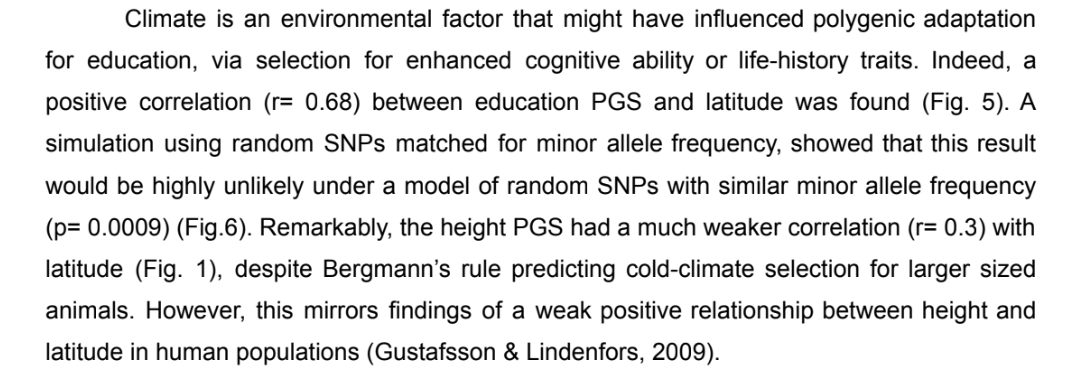
This shows that the high IQs of cold adapted people can not be explained by bigger bodies keeping us warm, and since bigger bodies have bigger brains, IQ is just a bonus. If that were the case, body size would better correlate with latitude than cognition does since it would be the direct cause. Instead it’s just the opposite! Surviving the cold requires intelligence, and since intelligence requires brain size which requires body size, big bodies are just a bonus.
In fact when it’s comes to the cold, there’s no evidence that body size has any adaptive value in its own right, and that’s because unlike other animals, we have intelligence which is your ability to adapt. When you yourself can adapt, you don’t need your body to do likewise. We didn’t need to evolve morphologically to survive the cold because we evolved culturally, except for that aspect of morphology that allows culture: brain size.
Of course this only undermines Bergmann’s rule (in humans). It’s still possible that Allen’s rule, which predicts that surface area to volume declines as a function of latitude, has some relevance in humans but don’t hold your breath.
 Pumpkin Person
not again. and still NEVER.
SAD.
why lesbianism? because molested? sad?
marv albert: YESSSS!
“europ(o)id” is STILL a term used in physical anthropology…
it was just a few years ago when speaking of the white chinapipo…
https://en.wikipedia.org/wiki/Tarim_mummies…iirc.
naturally “europid” will be conflated with “caucasian” by LIARS and ignoramuses like rr.
marv albert: YESSSS!
“height”
We know that PGS for height is biased by… Pop strat. Anyway there’s limited evidence that height is an adaptation. Can you think of ANY other reasons why Piffer may have found that correlation? ANY at all?
https://www.ncbi.nlm.nih.gov/pmc/articles/PMC6428571/
And Bird showed no evidence of divergent natural selection between Euros and Afr. It’s the definitive debunking of the hereditarian hypothesis’ genomic claims between blacks and whites.
We also know that (1) GWASs and the subsequent PGS/PRS that are derived from them are heavily confounded by population stratification; (2) attempts to correct for this don’t work; we know that GWASs lead to inevitable; (3) we know they provide meaningless correlations; and (4) know that the assumed genetic model is false and we’ve known that literally for decades. PGS/GWAS will be abandoned when the new behavioral geneticist toy comes around, and they’ll say they always knew it was too heavily confounded to save, just like in the candidate gene era.
https://www.sciencedirect.com/science/article/abs/pii/S0732118X1830196X
https://osf.io/preprints/psyarxiv/kgz2t/
https://www.ncbi.nlm.nih.gov/pmc/articles/PMC5538622/
^^^CLOWN^^^
We know that PGS…
who the fuck is “we”.
GROW UP!
RR NEEDS TO DO THREE THINGS:
1. GO TO CONFESSION.
2. RECEIVE THE HOLY EUCHARIST.
3. MARRY HIS BABYMOMMA.
IT’S EASY…
manbun and smokes and lives in some liquor desert where guinness is good beer….
DUDE! take a bus out duh south bronx!
WOW! JUST WOW!
you are INCREDIBLY impressive for someone with THE DOWNS.
i mean INCREDIBLY!
we all need to LOVE RR and tell him how special he is.
I just find it really weird how someone can be 100% HBD and call themselves race realist then recant all his views overnight and be a berkeley extremist.
But but Ashkenazim and East Asians tend to be shorter than Northern Europeans and the first tend to be have smaller brains if compared.
Again, temperate climate which is seasonally challenging may select for more complex intelligence, aka, higher G, but too cold climate select for a higher specialization. No greater civilization existed on very cold places, even in moderately cold like in Scandinavia (not counting today of course).
The input and output layers of my hippocampus operate more efficiently than 90% of the population. That means it can make fine discernments with new detail integration.
In the cultural sense novelty formation and focus is high.
I look for what is new and possible.
I was in the 95th percentile on the Terranova social studies.
I even published a book:
The Wizard of Gauze
let us now praise famous mongos.
rr’s behavior is explained by his having THE DOWNS. (sometimes THE DOWN’S)
this explains why rr looks part chinese.
but rr is supposedly 2023 – 1988 = 35 years old…
and my unnuhstanning is that the downs turns into ALZ…
in the 40s.
BUT james agee died at age 45…heart attack…smoking…supposedly.
So why are animals in Africa much larger than in the arctic?
because people in the arctic were such intelligent hunters, they drove all the big animals to extinction. See my landmark article:
how groundbreaking is your research though? i thought these were well established concepts 4 ages!
But we know from archeology that the fauna in the artic still isn’t bigger than africa even pre-extinction. Also its unclear humans hunted megafauna in the cold to extinction. Thats just a theory.
How taller are the Inuits??
“Climate select for y or x”
As longer as the given population is not yet culturally adapted to given environment.
Inuits dont became taller firstly because they became well adapted before need to select for height and secondly because overheight is expensive in very harsh environments. The correlation between climate and height among several species may be a byproduct of successive K – sexual selection processes during their migration to these places and not when they came there.
Big bodies are more expensive than average height or weight and even more than little bodies.
Temperate climate seems the most physically and cognitively demanding because animals need to adapt to very different seasonal periods.
Intertropical climate seems so invasive prevent species to evolve at the point to become more independent on environment. R-selection “strategy” is when the environment dominates the species forcing It to prioritize quantity over quality while K-selection is when species evolve at the point to be capable to prioritize also its own quality… over quantity.
And specially for mammals, because they are rarer in cold climates, so those who live outside intertropical regions tend to be more evolved = more selected to adapt in different environments than of their ancestors.
Inuits seems more horizontally larger than vertically, prone to overweight??
There is correlation between brachycephaly and possessing a bigger brain in Europe.
Ashkenazim seems have a comparatively shorter brains because they have evolved to live in urban environments which select to a more complex brain not necessarily to a bigger one. Also there is a correlation between demographic density and body size. May It helps to explain, partly, the correlation between body size and climate.
“There is correlation between brachycephaly and possessing a bigger brain in Europe”
Errata, i meant there is a correlation between brachycephaly and living in mountain or in colder climates (slavic) in Europe.
Body fat is physiologically advantageous in colder temperatures. People living in arctic regions have higher BMI and more white fat for energy reserves and insulation, and this isn’t explained by less exercise but by diet and body composition. They also have fewer sweat glands since sweating removes body heat and they have a 3 to 19 percent higher BMR than predicted based on the clime they lived in. Comparatively, Africans have lower BMR than the other races.
“There is a large body of work on human cold adaptation. Thermal balance in humans is maintained by “vasodilation/vasoconstriction of the skin and peripheral tissues within the so-called thermo-neutral zone” (Daanen and Lichtenbelt, 2016). Two other adaptations occur in the cold: shivering thermogenesis (ST) and non-shivering thermogenesis (NST) and one in the heat (the evaporation of sweat). Humans are not Arctic animals by nature, so, therefore, venturing into novel environments would incur new physiological adaptations to better deal with the cold.”
youre just repeating stuff thats in science 4 a very long time when will you guys realize that RR has indeed brainwashed you in2 arguing about things that should be factual assumptions already!
https://www.researchgate.net/figure/Fraction-of-overweight-Inuit-men-aged-50-69-years-increased-with-urbanization_fig3_8140274
Metabolic syndrome or aquired overweightness due to frequent bad habits and genetic suscetibility may be a product of Inuit urbanization not necessarily because it is beneficial to adapt in arctic climate zone.
This is correct. And your link is also correct and it’s due to the overabundance of high kcal, high fat foodstuffs.
So you admit people admit to the cold with their bodies, just not with changes to their brains. Great.
Yea because physiology is inherently adaptive to different climates.
“Yea because physiology is inherently adaptive to different climates.”
Me when I think the brain doesn’t have a physiology.
Of course it does.
“Of course it does.”
Me when I can’t adequately follow a conversation
What’s your point?
Lol, I’m just saying your response to Philo didn’t make any sense.
Why not?
RR: *cites blog post explaining physiological adaptations due to colder climates*
Philo: So you believe the cold evolve bodies but not the brain?
RR: Yes, because physiology is inherently adaptive to different climates.
Me who speaks normal English: ????????
TP should actually read what he responded to because if he did he’d see it was addressed. (I agree with the main points of it but I’d write that slightly differently today.)
Even the retard Melo knows that physiology effects the brain is what hes implying you moron.
I was being sarcastic in the initial comment. The body and brain are not seperate. You don’t even know basic anatomy. This is literally in introductory textbooks on biology.
Melo and I have different views. Who knew.
“You don’t even know basic anatomy”
lmao sure thing bro. I’ve forgotten more about anatomy than you’ll ever know. Sure physiology affects the brain, but you don’t understand what I said.
Why don’t you repeat the argument I made in the article back to me?
Ashkenazim evolved from a population disproportionately concentrated on a specific professional niche: the market. They were a typical case of a “positive” immigration. Merchants tend to have a verbal non verbal split because they are specialized to socialization in order to sell “their” products. Merchants, on avg, are not creators of concrete stuff (non verbal verbal split) but like intermediates between products and consumers. That’s not a cohencidence the era of capitalism is the Jewish era. They are or need to be very a charismatic cheaters (which most enterpreneurs are) to be a well succesful merchants. The long term burgeiosing process of European/Western societies was very beneficial to them. It helped them to sustain the reproduction of their smartest ones, those who will dedicate their lives to education: Science and Philosophy.
Emancipation and deepening of urbanization in Europe may contributed to accelerate this “natural” Ashkenazim eugenics.
Tilt not split
Tilt me, mister episteeeen
The thing about Cochran’s theories—although I vehemently disagree with them—is that he proposed actual testable, falsifiable hypotheses. And we have data that… He was wrong.
Most people with high quant IQ are terrible socially e.g. Bill Gates/Buffet….but ashkenazim are the only race that have evolved high quant and great social intelligence.
Religious Boomers support Israel because of muh biblical prophecies and Holocaust propaganda film after film.
HBDers support Israel because they believe Jews are actually the most intelligent group due to IQ tests, wealth, power, and Nobel Prizes.
Religious Jews believe they are the chosen people according to Talmudic teachings.
Low-IQ non-Ashkenazi Jews are tribalistic.
Secular Jews support Israel because they believe they are a minority and have converted their natural tribalism into a belief that their history makes them unbiased and hence the only ones capable of uniting the Earth and preventing a nuclear war.
Corporations, CEOs, government workers support Israel because of global banker loans.
All of these indicate that as most people already know, Israel has its hand deeply in every government, is capable and has self-justification for creating propaganda that misrepresents reality, and is constantly monitoring and manipulating global sentiment, markets, and power structures.
But yet we must keep up the charade that Israel is mostly just a simplistic desert nation that is just trying to protect its Jewish population.
How effective is brainwashing and narrative control is just knowing that if Israel was not a Jewish state, most of (((Western media))) would be solid pro-Palestine, like happened with or against South Africa during Apartheid.
It’s not about having a “nuanced” view but a morally coherent one.
And and most of conservative media is pro-Israel. How cuckolding…
Obviously the existence of dinosaurs in heavily tropical climates disproves Bergman’s theory.
It’s an example of passive evolution.
https://royalsocietypublishing.org/doi/10.1098/rspb.2011.2441
five comment limit reached
Don’t see why I have this and no one else but it’s your blog. (I actually bring conversation and not racist garbage like everyone else.)
okay fine, but please avoid annoying santo. Not saying you can’t respond to him but do so in a non-confrontational way.
Understood. Thanks.
He accused Santo of not being white which is deeply racist.
He think i’m a self hating mixed race Latino because i identify myself as White supposedly by non purist reason so i would be fuelling my personal feelings of racial misidentification on supposed irrational “hate” about certain groups like Blacks, by self projection. Similarly to closet gays or bis who express heightened homophobia. But i identify myself as such by phenotypical, genealogical and then logical reasons. It’s a kind of ignorant American thought about how racial classification and identification happens outside US and Canada . it’s like thinking North Africans are all Blacks just because they have a variable drop of Subsaharian blood. This is one drop rule purism being applied implicitly through real or not racial misidentification and self hating.
North Africans are white in American racetalk (look up the OMB/Census definition of “white”). I already said that you may be “white” in Brazil (and provided citations on what “white” entails in Brazil, and my pluralism about race allows this), but in American racetalk, you’re not white.
“It’s a kind of ignorant American thought about how racial classification and identification happens outside US and Canada . it’s like thinking North Africans are all Blacks just because they have a variable drop of Subsaharian blood. This is one drop rule purism being applied implicitly through real or not racial misidentification and self hating.”
A lot of Americans are ignorant about the various racial makeups of different parts of South America (even a lot Central/South Americans are ignorant about their own history it seems) but this “race is a social construct but biologies do differ among groups” is mostly just an RR thing.
Even though racial categories are obviously to some degree arbitrary it does not mean they do not fall along the same lines as important aggregate group differences, thereby making the specific racial categories we have fairly useful, so there is no real point in continuously stressing that “race is a social construct” for 99.9% of situations.
It’s an empirical fact, though, that Brazil, America, and South Africa have different conceptions of race. I’ve given the argument for that before. It’s not “one drop rule purism”—because “whites” in Brazil are genetically different than “whites” in America, so they’re not the same, and the entailment is that they have different conceptions of race.
No RR, I think plenty of Americans view light-skinned European heritage Latin Americans as white. You realize there is a (White (Hispanic)) category on a lot of American censuses?
Lurker,
While there are cases in American racetalk where “Spanish/Latino/Hispanic” people are racialized, the OMB is clear that they aren’t a race. There is “Hispanic/non-Hispanic” on government forms, but it’s an ethnicity, not a racial group. I think the average American has a pretty good understanding of race in America. And by the way, “Hispanics” don’t cluster alone, they cluster in between racial clusters that make up the racial groups their ancestry derives from.
Wrong again. Many White Americans dont consider North Africans as Whites exactly because one drope rule purism still prevalent among many people there, specially among WASPs. North Africans are, indeed, considered Whites officially in US even thought phenotype is one of the most important via to classify people racially with some good accuracy.
I already told you twice how racial classification and identification operates in Brazil and in Latin America. It’s not that simplistic way “only by self identification and skin color” as you are thinking. There is a variation of how this happens because it’s dependent on region, social class, cultural knowledge… As i already said before one of the biggest difference between American and Latin American way of racial classification is that the second is more diverse while the first is homogeneously purist.
Santo,
American racetalk is how race is conceptualized. The Census defers to the OMB. The OMB clearly states what a “white person” is in America.
When it comes to race in Brazil, I get what you’re saying but there are genomic studies that show that “white” in Brazil is empirically different than “white” in America.
Ah yes, being “skeptical of the value of Muslim immigrants in Denmark” isn’t racist. Note the phrase *VALUE OF* a group of people.
P1. rr thinks “muslim” is a race.
P2. rr is unaware that europe has millions of white muslims in bosnia and chechnya.
P3. using rr logic ALL restrictions on immigration are racist, because they discriminate against THE WHOLE GROUP of people who aren’t danish.
C. rr’s IQ is too low to be allowed to comment. he must be permanently banned.
UNLIKE ANYTHING JERRY FODOR EVER SAID THIS ARGUMENT IS EXTREMELY STRONG. IF PEEPEE ALLOWS RR TO KEEP COMMENTING I WILL ASSUME HER IQ IS EVEN LOWER THAN 20…TOO LOW TO MEASURE.
I don’t think “Muslim” is a race.
And lurker, I gave the example in my article of a Mexican la raza proponent who would accept an Argentinian as part of their “raza” even though the Argentinian may have full ancestry to Italy (or Germany). Another example is the former president of Peru, Alberto Fujimori. He’s of Japanese descent but is “Hispanic.” It’s clear that it’s a mere ethnic group, and even then I think it’s just a socio-cultural language grouping.
Are portuguese white or latin american?
Case closed.
What a stupid question. Case closed.
^^ Can’t answer because racist.
“American racetalk is how race is conceptualized.”
Even the most woke individual still conceptualize race as phenotype.
“The Census defers to the OMB. The OMB clearly states what a “white person” is in America.”
I dont know what is OMB.
“When it comes to race in Brazil, I get what you’re saying but there are genomic studies that show that “white” in Brazil is empirically different than “white” in America.”
Genomic studies in Brazil, as i already said, didnt found that Brazilian Whites are “empirically different” than American ones, in the tone of difference you are suggesting. We are not THAT different. We are just more mixed and with a different European source. Here is Portuguese (at some extent Italian), there is British (at some extent German).
I never denied the plurality of self identification and classification of race here. I just corrected that view that here is totally relative or subjetive, while clearly obey the same racial pattern of phenotypical difference, just adapting to a predominant mixed race context.
Some American or European academic, on the Left, have perpetuated the myth that in Brazil and Latin America, race is totally a social construct as if we are racially blind or oblivious to racial differences primarily on phenotype. They even taken some very informal racial terms used predominantly among working class people to generalize them as an absolute norm here.
But dont care, Brazil is going now to a “safe” path. ALWAYS a country of future..
“Even the most sole individual still conceptualize race as phenotype”
Do you think “woke people” don’t think race exists?
“I don’t know what is OMB”
The Office of Management and Budgeting. The Census needs to defer to them and the OMB refers to race as a proper name for continental groups.
I understand that there are different admixtures of white ethnies, but I did cite a study a few months ago showing that “white” people in Brazil are something like 75 percent white while in America it’s something like 96 percent.
And I argue that the different race concepts in America, Brazil, and South Africa prove that race is a social construct. That doesn’t mean there is no underlying biological reality (like in the American context with K=5), but it shows that race is somewhat arbitrary across time and place.
The first question is…
Why these cringey questions you know??
Most woke people like you believe race is ONLY a social construct which.. for a language of smart and logical people means “It is not a biological reality”.
Race, as happens with sex, is not ONLY OR PRIMARILY a social construct, but a biological reality. Ethnicity is for gender which race is for sex in which the order is inverted: primarily a social construct, secondarily or derived (anyway) from a biological reality (what happens for all cultural traits).
The difference between a European Caucasian and a Subsaharian African is biological. The difference between an Ethnic French and an Ethnic German is primarily cultural (where resides great part of arbitrariness on this topic).
This is the avg of admixture found among Brazilians in general. What i said and AGAIN, Brazil is too big to have a homogeneous interracial admixture. Southern and Southeastern White Brazilians are less mixed than those on other regions, specially North and Northeastern. 70% is too low for us.
Would be interesting if you post the link where you found this value of admixture.
Why do you always forget to write ONLY on SOCIAL CONSTRUCT??
Something being ONLY from not ONLY makes a huge difference.
This is a smart way to write or to communicate.
“Somewhat” doesnt mean ALL the time arbitrary but you and your ideological allies always confuse ethnicity and race as gender and sex, sometimes because sheer lack of intelligence, othertimes by promoting a hidden agenda.
It’s been hard for me moderate my tone with RR. I will keep trying… Because, in my opinion, his ways of writing and thinking are really not smart, really knowledgeable or rational. Sorry. I will keep trying…
“Most woke people like you believe race is ONLY a social construct”
Nope that’s false. I think rave is a social construct of a biological reality, there are many different ways to conceptualize race around the world, and that all race concepts begin from the premise that race is a social construct. I’m a pluralist about race for a reason.
“Would be interesting if you post the link where you found this value of admixture.”
Give me a bit. I was trying to find it last night searching PP’s blog and the terms I used to find it in Google, but I couldn’t. I’ll try to find it today.
“you and your ideological allies always confuse ethnicity and race”
I don’t think I’ve ever done this, nor have Spencer or Hardimon. And sex and gender are conceptually distinct.
“It’s been hard for me moderate my tone with RR.”
I’ve been doing this and it’s pretty easy. Just have a cordial discussion without childish attacks.
“his ways of writing and thinking are really not smart, really knowledgeable or rational”
I respect your opinion but this is just simply not true.
I don’t think “Muslim” is a race.
that’s what you said IDIOT. NOW YOU’RE SAYING YOU DIDN’T SAY WHAT YOU SAID. so either:
1. YOU ARE A LIAR..
OR
2. YOU ARE INCAPABLE OF BEING COHERENT. YOU HOLD MULTIPLE CONTRADICTORY BELIEFS AND ARE UNAWARE OF IT.
YOU ARE INCAPABLE OF REASON.
WHY HAS RR NOT BEEN BANNED PEEPEE? BECAUSE HE HAD SEX WITH YOU?
NOTICE RR:
P1. CAN’T ARGUE. AND CAN’T REASON.
P2. LIES.
P3. ALL HE CAN DO IS CALL PIPO “RACIST”.
C. RR IS JEWISH.
RR is being a hardcore racist to Santo so of course Santo wants to hit him. RR, an italian is basically saying portuguese people are not white enough lol.
“”I don’t think “Muslim” is a race.”
that’s what you said IDIOT”
Where did I say this?
“RR, an italian is basically saying portuguese people are not white enough”
That’s not what I’m saying. What I’m saying is that “white Brazilians” are only 75 percent white and that “white” in Brazil and “white” in America DO NOT have the same meaning. This means..
Race is socially constructed.
Mugabe said it all. Bravo!!
It’s been very difficult to debate with someone who say or defend something and in other comment deny what he said or defended… It is just one example of how difficult is to keep the politeness and focus mostly on the content of debate here with you.
Also the problem of subconsciously dumb or consciously dishonest communication:
If i say “race is a social construct” so i believe that “race is JUST a social construct”.
Clear communication is everything and you dont have it by X and/or Y reason.
I’m brazilian, i already read some genetic studies done about “my” people, i know how people think here in terms of racial classification and identification and it’s not exactly the simplistic way you think…
Why not, at least IN THIS CASE, accept you are not right????
“I respect your opinion but
(this) is (just) simply not true”
It’s not a matter to respect other opinion. It’s about debate with honesty you cant. It’s inorganic for you.
Trying.. If is not a professional trolling i really feel pitty for someone like you.
It’s not even a matter of having different opinions at all. You can be a 1000% woke and want to debate here. For me, no problem, as long as you know how to communicate your opinions, point of views, ideas or thoughts with honesty, objectivity and intelligibility. You dont have my excuse not being a native on English language.
Most of these debates with you is pointless, we always end up debating about you and not about the content because you show very little on it here, most of it is vague sentences, endless links and quotations most people will not read not just because they are numerous but also mostly inintelligible, written by people who learned that completely useless skill to write in too sophisticated way oftentimes to say nothing really complex or insightful of even factual.
“That’s not what I’m saying. What I’m saying is that “white Brazilians” are only 75 percent white and that “white” in Brazil and “white” in America DO NOT have the same meaning. This means”
Even if this value was true it would the AVG of White Brazilians, not all of them/us.
My lord!!!
You dont know how to read the basics of statistical content.. with this claim.
White in Brazil means someone who have most or all of their ancestors from Europe and at some extent from Middle East, because the numerous Christian Syrian Lebanese diáspora here. And someone who appears totally, predominantly or more White in phenotype.
Again…
It’s about you being poor on reading not just scientific content.
Again, social class, region and general knowledge have an impact on how people identify or classify themselves and others racially, in Brazil and Latin America.
Many people in Brazil think exactly the same way to people in US about this topic.
You dont know what you are talking about. So sorry. I cant. And you dont know how to think in clear and intelligent way, always too literal, like “some study found 70% of White Brazilian genome is European” so ” ALL White Brazilians are 70% European genetically”.
https://en.m.wikipedia.org/wiki/White_Brazilians
I cant..
“Wikipedia” lol
“Our data demonstrated that the vast majority of Y chromosomes in white Brazilian males, regardless of their regional source, were of European origin, with a very low frequency of sub-Saharan African Y chromosomes and a complete absence of Amerindian contributions (14). On the other hand, by analyzing mtDNA, we found the surprisingly high amount of 33% Amerindian and 28% African contribution to the total mtDNA pool of white Brazilians (23). Together, our results configured a picture of strong directional mating in Brazil involving European males and Amerindian and African females.”
https://www.ncbi.nlm.nih.gov/pmc/articles/PMC140919/
“Mugabe said it all. Bravo!!
It’s been very difficult to debate with someone who say or defend something and in other comment deny what he said or defended”
Can you quote me saying that? Should be easy enough right? If you can I’ll admit my mistake.
“Even if this value was true it would the AVG of White Brazilians, not all of them/us.”
Wow really?
“It’s about you being poor on reading not just scientific content.”
Funny.
“Many people in Brazil think exactly the same way to people in US about this topic.”
What? Do you have a source? From everything I’ve read on this that’s clearly wrong.
“like “some study found 70% of White Brazilian genome is European” so ” ALL White Brazilians are 70% European genetically”.”
That’s not the implication of what I’m saying.
Santo, December 6, 2016 at 12:39 pm:
“Yes i’m the classical ”white” people in Brazil. In USA and based on one drope rule i would be considered black because i’m hypo-afrodescendent. I look mostly caucasian, southern mediterranean, partially because i have that roots, but i have a relative ambiguous ethnic phenotype because i’m a mix of ”three parent” genes, my maternal uncle, my mother and my father (probably), and my maternal uncle is very mixed race and mentally ill.”
So it’s an empirical fact that “American whites” and “Brazilian whites” don’t refer to the same things.
A terrifying article about race in Brazil:
Neinstein remembered talking with a man of Poitier’s complexion during a visit to Brazil. “We were discussing ethnicity,” Neinstein said, “and I asked him, ‘What do you think about this from your perspective as a black man?’ He turned his head to me and said, ‘I’m not black,’ ” Neinstein recalled. ” . . . It simply paralyzed me. I couldn’t ask another question.”
See how different race is in Brazil?
Race is different in Brazil but Santo would be considered white in every country, including the U.S. just based on his appearance. Whether he’s objectively white in a genetic cluster analysis I don’t know.
Maybe this is true, but I’ve seen people who “look white” and you can tell they have some other admixture.
If you saw Santo on the street you would not know he had non-white admixture, let alone what type.
OK I can accept that I guess. My main point is overall about the “whiteness” in Brazil. It’s a clear empirical fact that “whites” in Brazil aren’t the same as “whites” in America.
That was a really good article. Loved how people described what race meant to then and how their self-conception and societal conception changed when they moved. Good stuff.
Dear god,
‘Can you quote me saying that? Should be easy enough right? If you can I’ll admit my mistake”
Mugabe is right again. PeePee is having sex with you. Only way to explain you still here after all these years.
“Admit your mistake”
Your little capacity to self criticism impossibilitate.
“What? Do you have a source? From everything I’ve read on this that’s clearly wrong”
You cant read. I live in Brazil. Nearly 100% of your sources are bullshit.
“Santo, December 6, 2016 at 12:39 pm:
“Yes i’m the classical ”white” people in Brazil. In USA and based on one drope rule i would be considered black because i’m hypo-afrodescendent. I look mostly caucasian, southern mediterranean, partially because i have that roots, but i have a relative ambiguous ethnic phenotype because i’m a mix of ”three parent” genes, my maternal uncle, my mother and my father (probably), and my maternal uncle is very mixed race and mentally ill.””
You searched a comment of 2016!!!!!
You are completely insane!!!
And this comment said fucking nothing to prove your always wrong points.
PeePee is psychopath to keep you here. She wants this blog look like a human zoo.
You cant read because you cant think and i already lost at least a half hour of my day with your mental illness. Jeezz!!!
The only way to “prove” how you are very wrong again should be sending some of my pics to you but i wont, sorry, because any debate with you is completely pointless.
I wrote this because i’m detailed oriented about my appearance but most people, including people for a racialist/far right forum, seeing me or classified me as White, but again, this is not the point. The point is that it’s impossible to debate with you with civility because you dont have it, your civilized manner is a lie. You cant think in rational way, definitely not, to be truly fair on your judgments.
By far, you are not just very dumb but the craziest commenter, just like many pseudo Left Wing agitators. All of your behavior here is completely out of really normal mannerisms and you need to love PeePee, only reason you are here is her.
Mugabe showed it, you didn’t and you just parroted it. That X is racist doesn’t mean that Y is a group, do you know what a “racialized group” is?
“Nearly 100% of your sources are bullshit”
Show that they are.
I found the comment in 2 seconds with specific searches looking for a comment of mine.
I don’t lie, I’m not dumb and I’m not crazy. You’re just too emotional.
Nearly 100% of your “sources” are pure bullshit.
Sadly, academia everywhere is infected with numerous sociopaths like you who pretend to do Science but pushing destructive hidden agendas through technical rationalization.
Wikipedia can be way more reliable than ALL of your garbage you shit here everyday.
I dont want to waste my time with u anymore. PP destroyed her own blog.
Maybe already one hour of this day wasted with your mental illness. I cant accept i has been capable to go that low again. This is not PP blog. It’s actually your blog.
RR cold blood is laughing. Only someone dispossed of normal emotional range and reaction to stay everyday in a blog trolling people by making fun of very serious stuff with very serious consequences and for all of us…
Wikipedia isn’t reliable. Cite some actual data like I did.
“Our data demonstrated that the vast majority of Y chromosomes in white Brazilian males, regardless of their regional source, were of European origin, with a very low frequency of sub-Saharan African Y chromosomes and a complete absence of Amerindian contributions (14). On the other hand, by analyzing mtDNA, we found the surprisingly high amount of 33% Amerindian and 28% African contribution to the total mtDNA pool of white Brazilians (23). Together, our results configured a picture of strong directional mating in Brazil involving European males and Amerindian and African females.”
You cant read.
What do you think that means?
“When we analyzed mtDNA in the four main regions of Brazil we found that there was broad agreement with what could be expected from historical data: a predominance of Amerindian matrilineages in the Amazon (north) region, a preponderance of African lineages in the northeast, an equilibrium in the southeast, and European dominance in the south (Table (Table2).2). There was relatively good concordance of the mitochondrial data with the estimates of African ancestry from the present study in Brazilian whites from the four main regions of Brazil. The most pronounced levels of admixture were observed in the southeast and the northeast, the former being slightly higher, although the difference is obviously not statistically significant. This finding is compatible with historical evidence that Minas Gerais (southeast) society was more admixed than the coastal sugar zone (northeast) (24), but contrasts with the higher proportion of African mtDNA lineages observed in the northeast than in the southeast (Table (Table2).2). Such discrepancy is probably related with the demographical peculiarities of the two regions. On the other hand, the south and the north have lower African admixture although they differ significantly in the relative proportions of European and Amerindian, i.e., non-African, mtDNA lineages. This observation highlights a methodological shortcoming in that the set of PSAs designed by Parra et al. (11) cannot (and was not meant to) discriminate between Europeans and Amerindians. Considering the trihybrid nature of the Brazilian population, it would be desirable to have specific markers that would allow the specific dissection of the Amerindian contribution. Although some authors (e.g., ref. 19) have identified markers that might be useful for this purpose, there are serious theoretical difficulties. As pointed out by Cavalli-Sforza et al. (25), the enormous amounts of genetic drift existent in many South American native groups has generated exceptional gene-frequency variation (reviewed in ref. 26) that severely weakens or renders invalid admixture inferences. Even if we averaged gene frequencies over extant populations, we could have no idea how these frequencies were in the past, when the admixture took place.”
What do you think this means?
HE’S LYING! RIGHT IN OUR FACES!
PATHETIC!
THIS EXPLAINS RR’S HAIR.
HIS HAIR TEXTURE IS RARE AMONG ITALIANS. COMMON AMONG ISRAELI JEWS.
WHY HAS HE NOT BEEN BANNED?
OR IS HE GONNA CLAIM HE DOESN’T WRITE HIS OWN TWITTER?
Do you know what a “racialized group” is?
“A new autosomal study from 2011, also led by Sérgio Pena, but with nearly 1000 samples this time, from all over the country, shows that in most Brazilian regions most Brazilians “whites” are less than 10% African in ancestry, and it also shows that the “pardos” are predominantly European in ancestry, the European ancestry being therefore the main component in the Brazilian population, in spite of a very high degree of African ancestry and significant Native American contribution.[38]
Other autosomal studies (see some of them below) show a European predominance in the Brazilian population.”
Another genetic research suggested that the white Brazilian population is not genetically homogenous, as its genomic ancestry varies in different regions. Samples of white males from Rio Grande do Sul have showed significant differences between whites of different localities of state. In a sample from the town of Veranópolis, heavily settled by people of Italian descent, the results from the maternal and paternal sides showed almost complete European ancestry. On the other hand, a sample of whites from several other regions of Rio Grande do Sul showed significant fractions of Native American (36%) and African (16%) mtDNA haplogroups.[Other autosomal studies (see some of them below) show a European predominance in the Brazilian population”.
Another study (based on blood polymorphisms, from 1981) carried out in one thousand individuals from Porto Alegre city, Southern Brazil, and 760 from Natal city, Northeastern Brazil, found whites of Porto Alegre had 8% of African alleles and in Natal the ancestry of the samples total was characterized as 58% white, 25% black, and 17% Amerindian. This study found that persons identified as white or Pardo in Natal have similar ancestries, a dominant European ancestry, while persons identified as white in Porto Alegre have an overwhelming majority of European ancestry.[220]
According to an autosomal DNA genetic study from 2011, both “whites” and “pardos” from Fortaleza have a predominantly degree of European ancestry (>70%), with minor but important African and Native American contributions. “Whites” and “pardos” from Belém and Ilhéus also were found to be pred. European in ancestry, with minor Native American and African contributions.[38]
According to another study, autosomal DNA study (see table), those who identified as whites in Rio de Janeiro turned out to have 86.4% – and self identified pardos 68.1% – European ancestry on average. Blacks were found out to have on average 41.8% European ancestry.[221]
According to another study (from 1965, and based on blood groups and electrophoretic markers) carried out on whites of Northeastern Brazilian origin living in São Paulo the ancestries would be 70% European, 18% African and 12% Amerindian admixture.[222]
Another study (autosomal DNA study, from 2010) found out that European ancestry predominates in the Brazilian population as a whole (“whites”, “pardos” and “blacks” altogether). European ancestry is dominant throughout Brazil at nearly 80%, except for the Southern part of Brazil, where the European heritage reaches 90%. “A new portrayal of each ethnicity contribution to the DNA of Brazilians, obtained with samples from the five regions of the country, has indicated that, on average, European ancestors are responsible for nearly 80% of the genetic heritage of the population. The variation between the regions is small, with the possible exception of the South, where the European contribution reaches nearly 90%.
In support of the dominant European heritage of Brazil, according to another autosomal DNA study (from 2009) conducted on a school in the poor periphery of Rio de Janeiro the “pardos” there were found to be on average over 80% European, and the “whites” (who thought of themselves as “very mixed”) were found out to carry very little Amerindian or African admixtures. “The results of the tests of genomic ancestry are quite different from the self made estimates of European ancestry”, say the researchers. In general, the test results showed that European ancestry is far more important than the students thought it would be. The “pardos” for example thought of themselves as ⅓ European, ⅓ African and ⅓ Amerindian before the tests, and yet their ancestry was determined to be at over 80% European. The “blacks” (pretos) of the periphery of Rio de Janeiro, according to this study, thought of themselves as predominantly African before the study and yet they turned out predominantly European (at 52%), the African contribution at 41% and the Native American 7%.[225][226][227]
An autosomal study from 2013, with nearly 1300 samples from all of the Brazilian regions, found a pred. degree of European ancestry combined with African and Native American contributions, in varying degrees. ‘Following an increasing North to South gradient, European ancestry was the most prevalent in all urban populations (with values up to 74%). The populations in the North consisted of a significant proportion of Native American ancestry that was about two times higher than the African contribution. Conversely, in the Northeast, Center-West and Southeast, African ancestry was the second most prevalent. At an intrapopulation level, all urban populations were highly admixed, and most of the variation in ancestry proportions was observed between individuals within each population rather than among population’.
Full-loser
“yOuR oWn WoRdS”
What’s fhe issue with the Ydna and MtDNA studies? Do you know why those are better or not?
Anyway, until I dig into this I can’t really say anything. But the data I cited is Y and MtDNA is pretty sufficient. All autosomal DNA shows is the preponderance of recent ancestry. The y and MtDNA show parents, grandparents and great grandparents have diverse racial backgrounds. So autosomal DNA analyses highlight recent genetic ancestry, while Y and MtDNA analyses highlight deeper, more distant ancestral relationships.
So yea I’m pretty confident that my description of this issue that you quoted is more than correct and sufficient for this discussion.
I’ll trust what PP says about you. No hard feelings man.
Only one study from 2003. Since then the genomic technique has advanced a lot.
Jesus Christ.
Who cares about the difference between Brazillian Whites and American Whites in this context? The point is that Santo is probably more European than anyone who isn’t considered White in the US, and his Whiteness stems from basically the same North/West/Southern European ancestors as White Americans (i.e. not any ambiguously White people like some Middle Easterners or other Arabs).
So if he wants to argue from the perspective as a White, in the same ways as a White American, there is nothing inconsistent about it.
Lurker, the average “white American” has miniscule amounts of African ancestry but it’s slightly higher in states with more blacks.
https://www.ncbi.nlm.nih.gov/pmc/articles/PMC4289685/
Santo, the year the studies were published is irrelevant, I’ve already described how Mt and Y DNA analyses are better for the discussion we’re having.
And him arguing from the perspective of a white American is like me arguing from the perspective of someone from another country—completely ridiculous.
“So yea I’m pretty confident”
Always and it’s your problem not ours.
“that my description of this issue that you quoted is more than correct and sufficient for this discussion.”
Ok but no.
“I’ll trust what PP says about you. No hard feelings man”
You taken a 2016 comment of mine. A lot of work to found it… Say this for yourself.
“OK but no”
Haha what? Is my description of how Mt and Y DNA analyses are then autosomal analyses better for the purposes of this discussion valid or not? Explain your answer.
“A lot of work to found it”
Nope. I literally searched “pumpkinperson.com “white” “Brazil”” in Google, the article was one of the first hits and I control f’d “Brazil” and found it. Literally took me 1 minute.
i was hoping rr would say he is incapable of being ironic and his native language is hebrew so he meant “isn’t racist” literally.
but no. HE’S JUST A LIAR.
“racialized group” = rr calling pipo who think they’re racist but aren’t racist “racist”.
TALK ABOUT A CLOWN!
rr is a great clown troll.
rr has invented a new meaning of “racist”.
some one who thinks he’s a racist, but isn’t actually and never tells anyone he thinks he is, but rr can read his mind and knows that he thinks he is.
I’m saying as a White American thinks of themselves as a White person, not as an “American”. There are commonalities between experiences among the European heritage diaspora (which follows how we get blamed for colonizing), just as there are commonalities among all human beings.
Well to be American is to be implicitly synonymous with being white.
https://pubmed.ncbi.nlm.nih.gov/15740439/
White is the socialrace and American is the nationality. The above is the best I could find with a quick search, but I’m sure there is a poll asking about how people identify in America.
Sure there are commonalities, but the experiences of a white person in America is different from a white person in Britain is different from a “white” person in Brazil.
1 minute is too much to find something someone wrote many years ago just to counterargue. It’s a desperate personal need to be right or to win debates. It’s speaks volume of your lack of maturity. But sadly the only legitimate way to “win” debates is with facts, not with pseudo scientifical studies made by your pseudo colleagues you barely understand.
“Your description”
Where?? On your blog??
I dont read you trash. You still dont understand you are irrelevant probably for most people here. For me, absolutely.
I posted several genomic studies from Wikipedia (lol) collection, done after your only one 2003, with more accurate technique and all them corroborate to my view. Actually, your own source do too. Only very dumb thing i read there was that “Whites and Blacks Brazilians, after marrying mixed race people with aproximate phenotypes to their races, ended up having the same or very similar racial composition on their genetics”, clearly wrong, specially to Southeastern and southern regions.
I wasn’t looking specifically for that, I was looking for a study I cited to you about whites and their admixture in Brazil and I so happened to come across that.
Can you explain to me HOW Y and MtDNA analyses aren’t better than autosomal DNA analyses for the context of this discussion? Were either of my explanations wrong? Explain your answer.
You are cherry picking… Of course.
Why, for you, all my sources done with better technique and more recently, with thousand of people genomics collected worth less than your only one 2003???
As i know the difference between these genetic tests is little in terms of eficacy to estimate racial porcentage.
You dont deserve any careful explanation If you never provided such one. So, nope.
“You are cherry picking… Of course.
Why, for you, all my sources done with better technique and more recently, with thousand of people genomics collected worth less than your only one 2003???”
??? I explained to you why Mt and Y DNA analyses are better for our discussion on this issue. I asked you for an explanation why, and you’re now refusing.
“But the data I cited is Y and MtDNA is pretty sufficient. All autosomal DNA shows is the preponderance of recent ancestry. The y and MtDNA show parents, grandparents and great grandparents have diverse racial backgrounds. So autosomal DNA analyses highlight recent genetic ancestry, while Y and MtDNA analyses highlight deeper, more distant ancestral relationships.”
I remember on WAIS IV they asked me who Queen Anne was and I guessed based on general knowledge and got the question right.
I grew up with a intellectually disabled father and a schiz mother.
Puppy grew up with an upper middle class household with solid parenting and had every single advantage.
Puppy probably would have guessed Queen Anne was a reality tv singer.
LOL! There’s no such question on the WAIS-IV though there are questions about some historical women which is probably what you’re thinking of. Unless the UK version has different items.
Anne was the mother of Elizabeth whose father was Henry had her mother beheaded for not producing a male heir to the throne.
My information is ultra superior that the wais does not measure.
On my mother’s side, her father was a Gleason and her mother was a Fifield. I am a Wilson. my father’s mother was Scandinavian.
If you look at IQ testing of the Irish its not great up until the year 2000. Actually people like RR have used the IQ gap between Irish people in America and Ireland to argue changing the environment can lead to a 20 point jump, which I actually agree with, but not 20 points.
Anyway, even though IQ has increased in Ireland a lot recently, from a usage of HISTORICAL KNOWLEDGE (something Puppy doesn’t know) we can see that Irish people and celtic people generally are dumber than germanics and southern europeans. Even if you look at America to this day there are very few celtic scientists and thinkers.
But like Puppy says, we are very overrepresented in talk show hosting which is a low g activity. Sorry Oprah.
https://russellwarne.com/2022/12/17/irish-iq-the-massive-rise-that-never-happened/
I find It very persuasive.
Nice Rushton-type logic of collating supposedly garbage datasets. I’ll give a deeper response later.
Nobody ask your response.
I commented to Phill.
I doubt he has a response. I’ll be shocked and retract this statement if he does, but I doubt it.
The garbage datasets were the low IQ ones dumbass. Evidently the quality improved as the 20th century wore on. Like I said I don’t think the gap between celtic people and germanics is 20 points. Its more like 5-10 points. Similar to east asians over whites.
“In total, I found 55 samples that reported data from 28,751 examinees. The sample sizes ranged from 1 to 4,215 (mean = 522.6, median = 170, SD = 887.3), and were collected between 1916 and 2015. The unweighted mean IQ was 98.3 (median = 97.4, SD = 9.0). All the data were collected in the Republic of Ireland, Northern Ireland, or the United States.”
Black Americans are now well fed (at the point of overweight epidemics) and taller. Most of them live pretty well if compared with people Worldwide but their scholastic performance keep lower to other racial or ethnic groups. This is a good example of a social improvement without a cognitive one.
If environmentalist /neolamarckian hypothesis was true so Black Americans should have improved their scholastic/cognitive performance.
African amercians did improve. The average IQ of blacks in Africa is 60. In America its 80.
“If environmentalist /neolamarckian hypothesis was true so Black Americans should have improved their scholastic/cognitive performance.”
In 1992 Janet Helms made a prediction that black Americans’ IQ would increase as they became more enculturated in American society. Then in the 2000s, Flynn and Dickens found that the gap has narrowed by 5.5 points. They found consistent gains in IQ for all ages up to 25.
All the true factual evidences show the opposite…
SAT, PISA…
https://www.brookings.edu/articles/sat-math-scores-mirror-and-maintain-racial-inequity/
https://www.educationnext.org/u-s-performance-on-pisa-the-rest-of-the-story/
“1992… “
Phill, they didnt improved If compared to other racial and ethnic groups in US and elsewhere.
There is some exception like in Britain but it need to be seeing very cautiously.
Santo,
Helms predicted that in 1992 and then Flynn and Dickens verified a 5.5 point increase in 2005. I’m pretty sure that even Rushton and Jensen didn’t contest that in their response to them.
Rushton & Jensen did contest it. They argued that they cherry-picked data and the totality of evidence shows no closing of the black-white IQ gap
I find it funny how Rushton and Jensen bring up the KABC in their response to Dickens and Flynn, when the KABC-II in a few other, newer studies show a difference of 5 points. Dickens and Flynn explained why they used the tests they used, too. Regarding the totality of evidence, I think it’s very clear that the gap has indeed closed.
https://papers.ssrn.com/sol3/papers.cfm?abstract_id=3146648
On the Wechsler scales the black-white gap has shrunk a bit in children (partly because affirmative education for black parents improving the environments of their kids, partly because of white admixture from people like you and immigration from elite black immigrants) but in adults it has actually increased (perhaps because the age range of the WAIS has increased to include the super old). We’ll know more when the WAIS-V is released:
“partly from white admixture”—there is no evidence that admixture studies show that some of the gap is genetic in nature.
We know black African Americans score higher than mixed race African Americans who score higher than white African Americans.
Sure we can take what you say or we can take what the data shows—that the effects of “European variants” in admixed people are essentially the same. Real population genetics marches on while “HBD” stays in the 70s.
https://www.biorxiv.org/content/10.1101/2023.08.08.552281v1
https://www.nature.com/articles/s41588-023-01338-6
Its obvious they improved. With welfare and adequate nutrition and less violence than Africa they jumped 20 points to their ceiling.
Conditions in black countries are so bad that basically every race would hit their floor. I would expect a jew growing up in Congo with Congolese parents to score 20 points than America, maybe more actually.
TP, we’re not talking about the difference between American blacks and Africans. We’re talking about the difference in time periods within American blacks and how the gap has closed. And Wicherts showed how Lynn cherry-picked his data for African IQ and that it’s around IQ 81.
It’s nowhere near 81. Wicherts selected studies using criteria that biased the samples way upward.
Wicherts showed that Lynn disregarded samples that showed higher values.
Perhaps but almost all of the studies are already biased upward because they involve students (the least able have dropped out), people in cities (the least able are rural), and the employed (the least able don’t work). There was an excellent study by Owen with an utterly massive sample size where black South African students averaged IQ 69 despite being a relatively highly educated sample:
“Lynn’s methods in selecting samples remain unsystematic; he is inconsistent in his reasons to exclude samples, and too unspecific to allow replication by independent raters.”
Wicherts et al go on to say that Lynn rejected a sample since it was comprised of immigrants but then go and use a study of… Immigrants. Lynn quite obviously wasn’t consistent with his methodology, and when it was rectified, African IQ was found to be in the low 80s. Basically Lynn’s inclusion/exclusion criteria was faulty. Wonder why? So Wicherts et al showed how shoddy Lynn’s selection criteria truly was.
I agree that Lynn was biased but since most studies are biased in the opposite direction, his bias just cancelled out the bias in the literature allowing him to get good results by accident.
Good that you agree. However, I don’t see any good reason to reject the Wicherts analysis.
If wicherts is right it would mean environment has ZERO effect on IQ because pure blacks in the poorest region in the world have the same IQs as pure blacks in the world’s richest country.
I don’t think that follows because then the explanation would be that IQ tracks national development in third world countries.
You deny blacks in Africa have much worse environments than blacks in America?
The question now is—what tests are used, what are the items on them, are the items culture-specific for each use in a specific culture? Because as we are discussing here, it’s clear that the gap between whites and blacks has narrowed so that would only help the case I’m building here.
It’s narrowed only in kids ad largely because the genetic composition of African Americans has changed: more mulattoes and children of African elites.
You still have to grapple with the 2 new citations showing “that the effects of “European variants” in admixed people are essentially the same.” This is where we’re at in 2023. No need for faulty admixture analyses from the usual suspects. We now have empirically evidence that “European genetic variants” in admixed people are essentially the same. Thus, Rushton-Lynn-Jensen HBD crumbles. Then we have the direct SNP correlation of 4 percent for IQ. Face the facts—HBD of yesteryear is done for. Thus, the only logical position to hold is that IQ differences are due to environment.
Sorry the direct SNP influence on edu is 4 percent and IQ is 14 percent. It’s pretty clear that “HBD” claims don’t hold any water now. And coupled with height, the so-called “gold standard” of a highly heritable trait, what’s left for “HBD” for mental traits and even a physical trait like height? Nothing much. So, the brand of HBD I push is the standard to hold to since there are numerous racial differences in physical traits, as I showed the other day, and there are still yet more I didn’t even address (dentition, differences in anatomy and physiology which explain East African running success which is due to the interaction between G and E and with West Africans). The work that’s been done in the last year or two have seriously crippled “HBD.”
https://www.nature.com/articles/s41588-022-01062-7
Every year, American (Canadian, Brazilian, Jamaican…) schools report cognitive performance of their students and every year Black students do, on avg, poorly than other groups.. not just anymore a White-Black gap, also a Latino-Black gap, an Asian-Black gap…
This is a true empirical evidence that:
Racial and ethnic groups differ on their cognitive performance;
Blacks do poorly than most of other groups while East Asians do better;
White-Black gap have not even decreased from all these decades monitoring It, after all these “equality” interventions;
In terms of behavior on School Environments, Black students do poorly than other groups…
We can make many comparisons here and with very similar results.
“Blame” what or whom??
Structural racism??
About Britain relative exception. There are 5 million Blacks on Caribbean and Subsaharian descent living there while there are around 40 million Blacks living in US.
In Britain, they tend to do equally in school performance to the still- White British majority.
It’s can be a result of:
Positive selection of the smartest (not necessarily a selection by social class specially in countries which great majority of population has been, by Western standards, very poor);
The conspiratory hypothesis:
Or because Britain, as many other Western countries today, is a Orwellian Dystopia, its “education” system may has deliberately exagerated the performance of Non White groups of students over White students, or by very subjective curriculum specially in Human Sciences, as well promoting other types of “equality” policies in labor market too, favoring non Whites over (specially working class) Whites, generating this appearance of equalized performances.
But in one very important aspect of a civilized behavior, British Blacks are, as their cousins worldwide, disproportionally and negatively represented.. in criminality or delinquency..
Also about apparently good performance on British schools since some decades ago, they should be performing equally well on higher education. So, expecting some great Black British scientists poping up… But seems they are disproportionally represented in humanities… If i dont see It wrong.
“Positive selection of the smarties”
Funny, because that’s what explains Asian achievement in America, since we know that those that emigrate aren’t a random sample of the population from which they derive, and those that do emigrate more than likely have at least a bachelor’s degree.
And yea the white black gap has narrowed on some tests (like the KABC-II and the NAEP), so that canard thay the black white gap is “immutable” needs to be put to rest.
I think the same about East Asians, thought.
It’s means If they were not more selected by intelligence they would perform similarly to White still majorities.
The positive selection is really likely for Indians.
You don’t think there’s positive immigrant selection for Asian Americans? I think Lee and Zhou have pretty clearly argued that this is the case. It’s the case for Indians, too (not sure how large it is), and Nigerians.
Guys, I find it actually heartbreaking that after all the studies, all the test results, all the reading, all the blog posts, RR thinks blacks have the same IQ as whites . Thats basically what RR is implying. That if you change their environment enough, their IQs are the same as whites….LOL.
RR is an extremist, fanatical and I would say at this point, deranged lunatic.
He simply won’t acknowledge that blacks in Africa have an IQ in the 60s even with all the test results. We have 100 years of test results, economic data, historical fact etc and he won’t accept the empirics. Wicherts is clearly some sort of jew. You can’t only select urban students in universities as the sample LOL. Most blacks in Africa are not even literate. Africans never invented written language or the wheel.
“You don’t think there’s positive immigrant selection for Asian Americans?”
I think the same about East Asians, thought.
“And yea the white black gap has narrowed on some tests (like the KABC-II and the NAEP), so that canard thay the black white gap is “immutable” needs to be put to rest.”
I dont know where you read “White Black gap is (totally) immutable”, but if these differences are genetically (which are) and not just caused by long term and deep environmental noise, so only way this gap been totally closed would be if Blacks have a very stable and cognitively eugenic patterns and Whites a very stable and cognitively dysgenic patterns for a long time.
“You deny blacks in Africa have much worse environments than blacks in America” … Worse environments mostly caused by themselves.
“RR thinks blacks have the same IQ as whites”
It’s an empirical fact that the gap has closed some.
“That if you change their environment enough, their IQs are the same as whites”
Thomas’ reanalysis of the MISTRA showed that Asian, white, and black adoptees raised in the same environment would have similar IQs.
“He simply won’t acknowledge that blacks in Africa have an IQ in the 60s”
As I said above, Wicherts showed Lynn cherry-picked and that his inclusion-exclusion criteria were nonsensical since he contradicted himself on studies he included and excluded.
“We have 100 years of test results, economic data, historical fact etc and he won’t accept the empirics.”
We have data from this century that the gap has closed some, you’re the only that won’t accept the empirics.
“Wicherts is clearly some sort of jew.”
“Anyone who says things I disagree with is a Jew.”
“Most blacks in Africa are not even literate. Africans never invented written language or the wheel.”
Does “invent” mean create independently? If so, I got some bad news for you.
The Maya didn’t use the wheel since it wasn’t conducive to their cobbled stone roads, but they used them on children’s toys. Writing was independently created in only 5 civilizations, none of which were European.
“I think the same about East Asians, thought.”
What do you mean?
“but if these differences are genetically (which are)”
You should grapple with the studies I posted above about “European variants” and admixture, because it’s clear you’re wrong.
“so only way this gap been totally closed would be if Blacks have a very stable and cognitively eugenic patterns and Whites a very stable and cognitively dysgenic patterns for a long time.”
That you, Jensen? That doesn’t follow at all, since the gap HAS closed, on numerous tests.
You deny 100 years of IQ testing to say blacks and whites have the same IQ. You are clearly deranged. The gap is closing because of interracial sex dumbass. Africans in africa still score in the 60s. Not even jews dispute that, they just dispute instead that the IQ tests are unfair or blacks need more education.
Repeating a claim that I refuted above about “European variants” and admixture. I don’t “deny” 100 years of IQ testing—I literally discussed the result that Dickens and Flynn reported that showed a narrowing of almost 1 half SD for blacks on these tests. Again, you’re allergic to data. Because you’re a racist.
Massive new study shows the 15 point black-white IQ gap in the U.S. shows no signs of shrinking. Among thousands of 10-year olds, the gap between whites and the kids of two non-immigrant blacks is 17 points:
Yea I’m aware of that paper. Talk of Spearman’s hypothesis is irrelevant—again, his g was falsified a few years after he published and Jensen’s g is an unfalsifiable tautology. Heritability is irrelevant. Admixture regression is irrelevant due to what I cited earlier. PGS don’t show causation and the causation challenge hasn’t been answered. What do you think the best evidence is there?
Talk of Spearman’s hypothesis is irrelevant—again, his g was falsified a few years after he published and Jensen’s g is an unfalsifiable tautology. Heritability is irrelevant. Admixture regression is irrelevant due to what I cited earlier. PGS don’t show causation and the causation challenge hasn’t been answered
What does any of that have to do with it? I am simply talking about scores on IQ test. The gap has not closed in this huge recent study.
There was a new paper recently published that showed that on the KABC-II the gap is a mere 5 points. And that has to do with it because those were the hypotheses of the paper.
It has to do with it in the sense that the KABC is a low g test and has always showed smaller black-white gaps than the Wechsler for that reason.
g isn’t a thing though—this is well established.
you can deny it’s a thing all you like but the empirical reality is the more highly g loaded the test, the larger than black-white gap. This has been known since Spearman’s day.
Yea and as we’ve already discussed the more highly g loaded tests are more culture dependent—and my argument is that IQ tests are class-specific knowledge tests.
The Raven, Piaget tests and Gestalt are super g loaded and not very culture dependent.
“not very culture dependent”—why are you making this claim when it’s clearly false?
Phill, the gap is not closing.
Santo is correct the gap isn’t closing between pure blacks and pure whites. Correct. 100%.
The gap is closing and I’ve cited sufficient evidence that it is. What do you mean by “pure blacks”?
And I’ve cited sufficient evidence that it’s not.
What tests were used?
“What do you mean by “pure blacks”?”
Empirical evidence of a clown behavior.
The thing about you two—Santo and TP—is that you clearly don’t read anything and it shows. We know Lynn’s “national IQ” data is fraudulent (Rebecca Sear and Ken Richardson have shown this). Over the past 5 years it’s been over for HBD, especially with the advent of these new genomic admixture analyses. I’m sure Santo and TP will have some insightful commentary on those two studies since they’re oh so knowledgeable on the issue.
Puppy knows more about IQ tests than you RR and the test results from the best tests show the gap isn’t being closed.
Obviously you don’t even believe in the concept of IQ testing so I don’t understand why you think the gap is closing if you don’t believe in IQ tests. Surely the KABC is a ‘middle class culture test’ too? Idiot.
“Puppy knows more about IQ tests than you RR”
Possible. But I know a lot about them myself.
“the test results from the best tests show the gap isn’t being closed.”
What are the “best tests”?
“Obviously you don’t even believe in the concept of IQ testing so I don’t understand why you think the gap is closing if you don’t believe in IQ tests.”
My view is that they show the cultural influences and cultural tools one was exposed to in their lives.
And citing the KABC-II is proof that it’s closed some, and there is other proof it’s closed some, idiot. https://www.mdpi.com/2079-3200/11/6/126
“so I don’t understand why you think the gap is closing if you don’t believe in IQ tests”
Exactly!!
and also about almost everything this creature believes…
“IQ gap between evilwhitesocialconstruct and mydaughterRACEqueenslayqueen is not closing”
IQ bad, just a little and useless test.
“IQ gap between evilwhitesocialconstruct and mydaughterRACEqueenslayqueen
is closing”
Look fascists!!! IQtelligence of our angelical and favorite oppressed Blacks is catching the “””””White”””””evilsocialconstruct!!!
Roseanne Barr and you have zero intelectual integrity. And differently than people that feel sorry for you when one of you are killed by angelical favorite oppressed Blacks, i feel, unfortunately, that justice is being done. Using kindness of other people against them to gain power is pure evil.
“The thing about you two—Santo and TP—is that you clearly don’t read anything and it shows. We know Lynn’s “national IQ” data is fraudulent (Rebecca Sear and Ken Richardson have shown this). Over the past 5 years it’s been over for HBD, especially with the advent of these new genomic admixture analyses. I’m sure Santo and TP will have some insightful commentary on those two studies since they’re oh so knowledgeable on the issue”
Lynn may cherry picked some studies about IQ like of Ireland to fit with his main hypothesis and in the end of the day he was not wrong about it… but accuse him to made up his entire works is extremely exagerated, to say at least.
“WE know”
Who are you, retard???
Only five years???
You are here to troll and make propaganda about your pseudo intelectual colleagues. PP doesnt care. It’s very CLEAR now. And to convince some naive people to believe in your bullshit.
I already said this thousand times here. If you are really knowledgeable about ANYTHING you have the audacity to “study” and write, you would be capable to differentiate bad to good Science and to write without all these extremely ridiculous quotations and links, with your own words (you HATE), even because this is not extwitter, it’s just a comment section of an obscure blog. You dont need to do that. You do because you are very insecure to speak with your own words.
I think PP should stablish a limit to 2 links and quotations per day, to force you to not CHEAT and SHIT in your and other comments.
But as happens with most of politics, at individual and collective levels, you are personally deeply compromised with identitarian “Left”. It’s all about your life, no facts or Science. You dont believe in neolamarckianism because you were convinced by better arguments but because you personally believe on it if a fundamental part of your life’s history and or just a self projection of your personality. Many of these pseudo scientists or intellectuals you follow are “teachers” not real academic researchers, they are people who believe only schooling which make the difference on everything about intelligence. They are also deeply self indoctrinated to believe in racial egalitarian radicalism and or because their personality traits (extroversion, sociable personality, lower consciousness, openess to profound bullshit..) make them more likely to believe on it.
It’s all about your southern italian heritage, your mixed race daughter, your life trajectory, your brainless mind, your wishful thinking on human plasticity.. not about Science.
You are just like me when, around 2013, i believed Left handed people were all smarter. Some people evolve, others stay being dumb forever and even worsen.
My beliefs are primarily based on myself but analysed in more impartial and objective ways.
I dont believe on things because i like to believe. I evolved from this lower level of reason you are deeply grounded.
““so I don’t understand why you think the gap is closing if you don’t believe in IQ tests”
Exactly!!”
That was an idiotic statement and I explained why. Why is that hard to grasp?
“but accuse him to made up his entire works is extremely exagerated, to say at least.”
Do you know what I mean when is say his dataset is “fraudulent”?
“If you are really knowledgeable about ANYTHING you have the audacity to “study” and write, you would be capable to differentiate bad to good Science and to write without all these extremely ridiculous quotations and links, with your own words (you HATE), even because this is not extwitter, it’s just a comment section of an obscure blog. You dont need to do that. You do because you are very insecure to speak with your own words.”
This is outright false. You know why citations are provided? They’re provided when one makes a claim that is not common knowledge. Do you know what common knowledge is? I actually read this stuff everyday and I’m able to concern what is good from what is bad. You, quite obviously with your copy pasting of Wikipedia’s description of autosomal analyses on Brazilians, can’t explain why we should accept the autosomal analyses over the Mt and Y DNA analyses. That’s because… You’re ignorant to this issue and you “couldn’t use your own words because you’re too insecure to speak with your own words.”
You’ve been making that false claim for years. I have no idea why. I explain myself and then give a quote and then give a citation. Then you come along and say “use your own words” as if I haven’t. You couldn’t use your own words for the autosomal anaylsyes you quoted from Wikipedia. Hmm wonder why?
“It’s all about your southern italian heritage, your mixed race daughter, your life trajectory, your brainless mind, your wishful thinking on human plasticity.. not about Science”
I never talk about the first, I talk about my kid here because I’m proud, my life trajectory is actually amazing and I make great money for what doesn’t feel like work to me because I love what I do, you mean “mindless brain”, human plasticity is pretty strong. My views are scientific. You just don’t read so you don’t know that.
So which of your views have changed in the past 5 years Santo?
By the way what’s the response to the admixture analyses showing that the effects of so-called European generic variants in admixed populations is essentially the same? I’m sure I’ll get a valid scholarly analysis from you an TP.
Few people care about you here and your opinions or “explanations” and i wont again waste my time circunavegating your mental illness.
“Do you know what “”””””freudulent”””” is????
Totally a clown behavior. ^^^
If you know ALL of your bullshit sources are freudulent, you are sociopath.
If you dont know, you are lunatic.
Explain how they’re fraudulent. Do you understand the burden of proof? What’s the response to the admixture analyses?
Sociopathic troll ^^^
“You, quite obviously with your copy pasting of Wikipedia’s description of autosomal analyses on Brazilians, can’t explain why we should accept the autosomal analyses over the Mt and Y DNA analyses”
Your English is a salad of bullshit and you are a native speaker.
An excess of words to never write in really objective or clear way. Sad.
“We” (we we we) should “accept” both… 🙄🙄🙄🙄
So you have only this 2003 study on your collection??
How will hereditarians ever recover? See extended data fig. 5. Polygenic adaptation ruled out.
https://www.nature.com/articles/s41588-022-01062-7
Polygenic adaptation ruled out for IQ.
from the abstract: We also found within-sibship evidence of polygenic adaptation on taller height.
sadly!
But we know that the polygenic adaptation on height is overestimated due to uncorrected pop strat. In the past 5 years—including the past year and the last 2 months!—the HBD hypotheses regarding genes and complex traits have suffered, in my opinion, insurmountable arguments and data against their position. There’s only one reason to be an “HBDer” of the Rushton/Lynn/Jensen type in 2023 in the face of new genomic data—marriage to the falsified hypotheses which leads to it becoming ideology.
https://elifesciences.org/articles/39702
“I respect your opinion”
Why PeePee.
Nature will publish anti HBD findings even if theyre rigged and tenuous. Nature will crush any HBD findings.
Nature is controlled by jews dumbass.
Go ahead and point out any factual errors.
Its impossible to take a person with a man bun and a black baby seriously lol.
You don’t have to take me seriously as a person, just detach my arguments from myself and, like any rational person, attack the argument. But you don’t have the knowledge to do so.
Never detach the arguments from the (((person)))
(((No response)))
yeah this blog is crumbling and crumbling fast just look at the inconvenience of everything here.
RR has one aspect of beliefs and the other ones have another aspect of belief which means that we should direct our focuses elsewhere.
are they incompatible 2 one another? then we need 2 examine what makes them incompatible firstly. then we need 2 get 2 the point where we should reconcile the differences.
thats all that needs 2 be done.
but the people here are 2 dumb 2 understand.
PP why do you allow this 2 happen? you realize its not good 4 your blog right?
in some way or another.
Loaded tonight is Friday the 13th and it’s October. How often does Friday the 13th fall so close to Halloween? You’re never going to get a better night to watch Friday the 13th!!!
i think thats a good idea ill tell ya how it goes i will take time 2 watch the old version and the new one both are available on Max and then they have the sequels 4 the originals.
ive been watching the Texas Chainsaw Massacre as well those are sum insane movies no doubt.
anyways ill get back 2 ya on that whenever it makes sense 4 me 2 do so!
ive watched a lot of horror movies so i hope this is up 2 par with the standard of horror i think it deserves 2 have 4 me 2 keep watching is all!
don’t worry about watching the remake yet. Just watch the original 1980 version. I know you saw part of it but you should start from the beginning. The opening murder scene set in 1958 is creepy & really sets the scene for the rest of the film set in 1980. I know it can feel a little slow by today’s standards but embrace the slowness and just take it all in. Allow it to make you nostalgic for a generation before your own.
I saw “Ma” the other day, it was good I thought. And “Hereditary” and “Midsommar” are two of my favorites.
I loved Ma. Octavia Spencer was great in that.
I saw the preview in theaters years ago when I was seeing another movie (horror, forget which one). I didn’t expect the plot to go where it did but I thought it was cool and a good story. Check out Midsommar if you haven’t.
Yeah a generation when america was a great country before open borders and Loaded.
Have you seen the original Friday the 13th, pill?
But you’re not American. That’s like me saying something about Ireland 50 years ago.
LOL!
Puppy when I was a kid I was the biggest horror movie fan in the world. Even more than you.
I’ve watched all the horror classics. The golden age of horror was the 80s.
My favourites as a kid were Hellraiser, Poltergeist, Nightmare on Elm Street, It and of course, Tales of the Cryptkeeper. Also anything by John Carpenter.
I can’t watch horror movies anymore like I did when I was a kid. With my schiz problems I basically get panic attacks if the movie is too scary or serious.
I tried watching Room 1408 and I had to walk around in circles in my garden to calm myself down about midway through.
What about Friday the 13th? Did you see the original?
this is not good. this is not good at all.
Number 2 (or is it 3? Idk I haven’t watched them in forever) might be the “scariest.”
I have the box set and may watch them again.
(((HBD))) is just another branch of controlled “right”, sad.
PP, look at how Oprah wants Chappelle framed as “losing his mind” when he went to Africa. Why do you think she would use that instead of a more positive framing? Is she protecting powerful “Hollywood elites”?
No I think she’s just keeping it real.
Maybe we’ve all overlooked the simplest reason why RR trolls this blog…
He’s jewish.
Nope. Family is from. Calabria and Naples.
Ah yes, being “skeptical of the value of Muslim immigrants in Denmark” isn’t racist. Note the phrase *VALUE OF* a group of people.
EXACTLY! YOU SOUND LIKE YOU HAVE A MANBUN AND “SHAVE THE CORNERS OF YOUR HEAD.” VERY UN-JEWISH OF YOU.
I AM SKEPTICAL! THE GROUP IS DEFINED BY ITS RELIGION, WHICH IN THE CASE OF ISLAM IS EXPLICITLY POLITICAL.
LOOK WHAT HAPPENED TO PALESTINE AFTER UNRESTRICTED JEWISH IMMIGRATION!
YOU HAVE AIDS AND MUST BE BANNED PERMANENTLY.
RR IS A SINO-ALBANIAN-NEGRO-TALIAN.
i have a theory that consumption of fish causes a visual spatial tilt or maybe even an increase in such thinking styles.
who knows!
Your “theory” sadly is not yours.
There is some interesting stuff on fish consumption and school performance. I remember a study in Asian math performance and fish consumption but I can’t find it right now.
https://www.ncbi.nlm.nih.gov/pmc/articles/PMC6970346/
CheRRy picked
I don’t think you know what the word means.
Buu
I started to follow HBD chicken and others (((hbds))) and suddenly i thought i’m at the center of a synagogue.
Larger size doesn’t mean only height, but also encompasses width, hence why the height is correlation.
A second criticism is the use of education associated SNPs as a proxy for intelligence. I mean why not randomly select like a few thousand people from different parts of the world, give them a full WAIS test, and use their DNA to generate a polygenic prediction for IQ based on WAIS? If that is too expensive then why not do that with the Wonderlic or some other cheaper alternative test instead?
It was insane how split Reddit became over the whole Israel-Palestine Conflict. Usually, r/politics is the most popular political sub, but it dove when the attacks first happened. Instead, r/worldnews was popping off and was staunchly pro-Israel. Obviously, no popular sub is pro-Hamas, but r/politics was the only place with any nuanced opinion about the conflict. However, that’s starting to change. As more news of Israel’s war crimes is coming out and people are starting to get more educated about the conflict, the veil has started being lifted over Israel’s propaganda machine; Reddit is slowly becoming more reasonable again, with people Denouncing any terroristic action regardless of which side.
My little sister is telling me kids at her school are yelling “Free Palestine!” in the hallways. Just goes to show that the supposed “Jewish media” isn’t as pervasive as the anti-semites here will tell you. And I actually agree with Elon for once, fuck the EU. Twitter is by no means a bastion of free speech, and Elon could care less about free speech when it rightfully criticizes him, but for once, his “anti-establishment” attitude is being blown in the right direction. People need to see everything.
Because your little sister’s generation gets their news from the internet which while largely controlled by Jews (google, facebook), also has a lot of influence from gentiles like elon musk, Bill Gates, China (via tic toc) and just the endless everyday people creating social media content.
Traditional media (TV, newspapers) is much more Jewish controlled which is why older people are more pro-Israel.
Well, obviously, not every Jew supports what Israel has done to Palestine, even if they agree Israel should exist as a state and feel some kind of connection to it. I remember, as a kid, watching Jon Stewart trash Israel for its war crimes.
I was listening to the Left, Right & Center Podcast where David Greene (a Jew) was speaking out against Israel’s treatment of Palestine while also heavily empathizing with the Israeli families that are suffering from Hamas’ horrific terror attacks.
I’m just saying that while it’s pretty obvious that Israel has pull in the US media, it’s not as powerful as somebody like Philo would claim. The internet is undefeated.
Well, obviously, not every Jew supports what Israel has done to Palestine,
Correct, but how pro-Israel the media will be is a linear function of the percentage of Jews in said media.
I remember, as a kid, watching Jon Stewart trash Israel for its war crimes.
The higher IQ Jews tend to be the most critical of Israel because high IQ people are less tribal and more moral
I’m just saying that while it’s pretty obvious that Israel has pull in the US media, it’s not as powerful as somebody like Philo would claim. The internet is undefeated
They’re much less powerful than they were 20 years ago. Even Trump implied that, but pill of course disagreed, LOL!
And what’s funny was that David Greene was arguing against Sarah Isgur, a gentile (I think). She was basically saying that Anti-Zionism = Anti-Semitism.
Jews control the deep state. One of the capabilities of the NSA, as revealed by Snowden is to control online conversations in Reddit and Youtube and so on. They do it by rigging the number of likes on comments and censoring anything popular against Israel.
The high IQ gypsy people will someday embrace a dictatorship for gentiles. But at this present time, they have to persist with the charade of ‘democracy’ where they control completely both parties.
My prediction is that eventually the deep state will simply select the candidates. They can’t allow people like Bernie or Trump to happen again.
It could be that Jews have less power over the media, or that they are powerful but their own propaganda works against them.
A lot of the Jew media has tirelessly worked to make Muslims seem peaceful and capable of assimilation. (Of course they need to make them look violent and savage when more wars in the Middle East are pushed by Neocons, but they can simply state that this is a “cultural” problem of Muslims that can be assimiliated away, and they compare backwards Muslims with backwards rural Whites who they disdain… basically claiming that they are savages but this actually because of either being conservative or being hated by the worldwide hegemony of White Supremacy).
The chief idea conspired by Marxist/Liberal/Jew media is that “Whitey bad”, “West bad”, “Christianity bad”, and “success/wealth bad”.
But now Jews are clearly the more “White”, “Western”, “Judeo-Christian”, and obviously, extremely successful.
They are also far more against traditional or family-oriented values compared to non-Jew Whites, which is necessary so that they could push their globohomo strategy.
So basically their strategies of hating Whitey and hating conservative values backfire against them when they are clearly the more White and clearly against traditional values that characterize most of the non-Western world. At least, there are contradictions which are a little too glaring to doublethink away.
They are clearly more “White” than the Muslim world I mean (which Palestinians are associated with even if they are pretty similar racially).
“They do it by rigging the number of likes on comments and censoring anything popular against Israel.”
Which obviously isn’t true because pro-Israel sentiment is rapidly waning on Reddit. I don’t know about YouTube, but since YouTube is more conservative, it’s probably more pro-Israel.
Lurker,
“So basically their strategies of hating Whitey and hating conservative values backfire against them when they are clearly the more White and clearly against traditional values that characterize most of the non-Western world. At least, there are contradictions which are a little too glaring to doublethink away.”
I mean, that just seems like a lot of mental gymnastics. The more simple and elegant answer is that Jews don’t control the media.
There is no singular interest. There is no deep state. If there was, society would not be as fucked as it is.
Melo has the lowest IQ in the comment section if he thinks jews don’t control the media and theres no deep state.
“I mean, that just seems like a lot of mental gymnastics. The more simple and elegant answer is that Jews don’t control the media.
There is no singular interest. There is no deep state. If there was, society would not be as fucked as it is.”
Obviously there are many interests, but that doesn’t preclude there being a deep state or the Jews having disproportional control over the media up to the point of seemingly being the main interest. Zionism and the deep state is attached to global banking, which means there is basically no monetary end to the shenanigans they can pull on people.
But like PP says their influence largely comes from their intelligence, and I would argue their personality as it interacts with the common gentile personality, especially Europeans. Some of their power has to do with specific historical circumstances which compound with their personalities/intelligence. Yes, it’s complicated… or otherwise there would be nothing to discuss.
The propaganda is insane. Did you see the so-called pictures of burnt babies that Ben Shapiro showed (that the @Israel Twitter account showed) which appear to be AI generated? This is all an attempt at an ethnic cleansing of the Palestinians. Bibi says “Leave, we’re bombing”, but where are they supposed to go? It’s an illusion of choice and we know what their goal truly is. How ironic that the (Zionist) Israeli Jews have become basically like the Nazis.
They were since the Zionism foundation, dear.
Nazism was inspired on Zionism: extreme ethnonationalism.
But the reason why traditional media is so homogeneously pro Israel is that because Jews also dominate it not just because their higher verbal IQ or “superior cultural knowledge”, but you know, it’s a conspiracy theory.
It’s oddly ironic how the Palestinians are now like how the Jews were for hundreds of years before the establishment of Israel and how the Jews are largely responsible for it.
Scattered everywhere with no homeland of their own. Ireland should take them, lol.
I think the BBC just confirmed that Israel hit Palestinians fleeing to north Gaza after they were told to evacuate. It’s a pretty disgusting hit happening. Israel better be careful, because otherwise the world will turn don’t hem, and no amount of “Jewspiracy” will protect them.
I’ve been watching football talk shows on youtube and every ad is a pro-Israel ad.
Jews are the masters of mind control in the human race. They will find a way to mind control, bribe, blackmail and threaten to keep power.
After all, they control the minds of Melo and RR at this very moment and neither are aware of it.
Melo is more concerned about Jewish pathological liars than with Palestinian victims… Sad.
“Melo is more concerned about Jewish pathological liars than with Palestinian victims… Sad.”
LOL, how did you get that from what I wrote you illiterate retard?
Ableist and classist.
But we cant call Melo half monkey, pp??
We have Melo here or not is completely irrelevant. Keep being rr shadow.
Guys its become obvious to me.
I realised it reading RRs comments today about how blacks and whites have the same IQ.
RR is lying about being an italian-american.
He’s a jew and he’s probably living in Israel right this moment.
thats not even something 2 joke about.
You’re just allergic to empirical data and facts so you have to concoct idiotic stories.
I honestly think he’s just a troll.
He’s just ignorant and can’t think outside of his narrow view of “if it disagrees with me, Jews). Sad life to live.
RR is a jew.
You’re a clown.
you could be neighbors.
sadly!
My little guy started waking at 9.5 months and he was making hard turns a week after he started walking. Can’t wait to take him to the gym when he’s 4. I make him do “psuedo workouts”. Seems like what I’ve been doing with him the past 5 months since he started crawling and even before that have paid off.
why would anyone care
Cringey!!
Exactly Loaded.
Why would anyone care about your nonsense comments?
Ask for yourself mentally ill
My comments are on topic and being good discussion to this blog.
Completely mad ^^^
Or sociopathically cynical.
Disagree with my comments all you want but you can’t deny that I’m one of the only ones that is ever on topic.
Trashing everywhere here.
That’s dope.
I gotta find me some white women I can plant my seed into. But I’m picky. I’ve realized I don’t want my kids to have the same lifestyle I did growing up, but I have a real problem. I love dumb bimbos, so I only know how to spit game to girls that like “R-selected” guys.
I was talking to my coworker the other day, and she told me the reason she couldn’t see having a relationship with me is because I give off “fuckboy vibes.”
That’s fair, I guess. So, I have to be like my little brother and be more herbivorous. Maybe show some of these hoes my nerdier side. He found himself a nice, cute little Jewish girl. I want something with more ass, though…
It’s amazing watching him develop and how quickly he’s picking things up. Can’t wait until he starts talking. He’ll be in the gym by the time he’s 4. (I just saw a study the other day saying that there are absolutely no negative impacts on weight training that early and there are only positive benefits.)
So what’s his mother’s background? You mentioned she’s black. Is she the children of immigrants or of foundational black stock. Does she have any white, Asian, or Amerindian ancestry?
Caribbean. Child of immigrants.
Youre half white you moron. The idea of Melo being R selected and also being woke is hilarious. No R selected person in human history is woke.
Well, “R-selected” isn’t even really a thing. I just mean that I’m socially dominant and masculine, which is 100% not incompatible with being liberal or left. I’m sure there’s a correlation, though.
East Asians are pretty conservative, and yet you’d claim they’re “K-selected.”
That’s cool RR. When I have kids I definitely want to get them started exercising early. I don’t know if I’d have them lifting weights, but I’d for sure want them to be athletic.
I wasn’t athletic until high school.
It’s good to get them started early. I’d do leg kicks with him when he was a newborn and then I progressed him to assisted walking then when I was able I started air tossing him. Then he started crawling and I’d put things in his way so he can go around or over it. Now I’m making him squat and deadlift but it’s in-line with how he can currently move his body without being too advanced for what he’s able to do since he doesn’t have full balance or core strength yet.
I’m going to make this kid into a beast one day.
Youre a fucking retard RR. You realise a person with black genes wouldn’t need to go to the gym to be ripped. Almost every black person I’ve talked to has told me they don’t need to work out to be muscular. Allegedly RR says they have no testosterone LOL.
“You realise a person with black genes wouldn’t need to go to the gym to be ripped.”
Hahaha
“Almost every black person I’ve talked to has told me they don’t need to work out to be muscular.”
Hahaha
“Allegedly RR says they have no testosterone”
You know damn well that’s not the claim I made.
you guys are nutcases. Santo is a pseudo philosopher he is 2 timid 2 speak truth!
ive never met an asian person i thought was smart. im glad i can tell you that like a man instead of the pathetic lying youre doing PP!
i dont find asians cognitively impressive at all!
We had the previous jewish commenter Swanknasty who basically stank up the whole comment section arguing the supreme court’s weird rulings are permissible because the rubes accept it and won’t do anything about it. The jews all think like this quite frankly.
Jewish according to you. Both Swank & RR identify as Italian.
They ‘identify’ as Italian, even though both are ashkenazi jews.
Look at this picture. Its a classic jewish tactic that was even lampooned 100 years ago in newspapers.
https://i0.wp.com/historyreviewed.best/wp-content/uploads/2017/11/jews-shlomo_unmasked_by_makeapp.gif?resize=800%2C445
This meme is literally 100 years old.
I have better judgement than you and I say RR is not Jewish.
Case closed.
You have zero evidence that RR is an italian like he claims beyond him claiming it.
Every single opinion he has and his debating style and constant quoting of jewish writers show this guy is knee deep in ashkenazi culture.
Then explain why he was a hardcore white nationalist for his first few years on this blog.
Philosopher is so in his head that he can’t fathom that someone can change their views from one side to another. I’ve explained how my views changed and it was maybe a 6 month process. And I’m not Jewish. At all. I was born and raised Roman Catholic.
You don’t find it really weird that you’ve had an IQ blog for 10 years and nobody jewish has commented?
They do comment….as gentiles.
Lots of Jews have commented, but RR is not one of them. This is schiz level paranoia.
We have a guy that scored a 80 IQ on the SAT and is a fitness trainer who somehow happens to read 100 very boring papers a year.
And you think this is a plausible identity?
More plausible than a Jew pretending to be a white nationalist who converts to a race mixing blank slatist.
RR could be a JIDF disinformation agent. He gets paid to confuse people. No other rational reason why he comes here to be shouted at and called stupid everyday
I make damn good money doing what I do too. I’m more knowledgeable on you on most things too.
The claim here that I have a “low IQ” is so hilarious. I’m very clearly the most knowledgeable, well-read person here and I can have multiple conversations at once on multiple different topics. “philosopher” can only talk about “the Jews”, not take showers and get fired from job after job while I keep jobs for years on end, take showers every day, and can talk about multiple things. Now I’m working for myself and command a solid hourly rate for my skillset.
It could be that the real RR is rotting in a prison or cell somewhere and they replaced him with a JIDF agent. That would explain the 180 in his views and the 50 point IQ drop in his knowledge.
I tried to show here that my view isn’t “blank slatism.” My view on genes is very specific, and that I deny genetic causation specifically, and genetic causation for mental traits more generally, doesn’t entail me being a “blank slatist.”
RR doesnt need to be Jew to be this pathetic clown he is. Believe on me, Phill.
We have numerous example of this kind among “Gentiles”.
And in the end of day i dont care if he is Jewish or not. I just would like to entry any day in this blog and not find him trolling people and shitting this blog but it’s all about keep the comment section burning, right, PP??
We all know what he has to say, his lack of real expertise, megalomania, narcisism and extremely low self awareness. It’s annoying.
It’s an obvious fact that I’m more knowledgeable today than I was 5 years ago TP.
How many of your views have changed in the last 5 years?
Ah yes, providing different perspectives makes me a “pathetic clown.” Yea that makes sense. Do you know what “trolling” is? Can you explain how I’m a troll?
My actual expertise is in anatomy and physiology but I obviously have a huge interest in philosophy of mind/race and IQ. What’s your expertise?
Your expertise is being a single dad of a mixed race baby, cynical trolling and sophistry.
“Provided” a huge personal biases masked as “different perspectives”.
“Provided” endless pointless pseudo debates because you are incapable to write with your own words in objective way to force people debate about your (wrong) opinions based on basic misunderstanding and nonexistent self awareness//criticism.
Philosophy is the love and the seek for wisdom, for knowledge OR objective truth or a better understanding about the world.
Your sociopathic colleagues are (verbally tilted and open minded to profound bullshit) people who believe Philosophy is the same as insufferable writing mixed with anything anti conservatism or right wingish sounding and availlable.
LMAO, are you actually trying to argue that RR is Jewish? You’re a fucking dumbass.
Shutup Melo. You need to go back to the CNN comment section and go back to peddling conspiracy theories about Trump being a Russian plant.
I mean that conspiracy is more likely than “Jewsdidit”
Well well well. Looks like I’m right again.
“a number of cultural assumptions appear to be deeply ingrained in all visuo-spatial reasoning tests, to the extent that it disqualifies such tests as culture-fair & makes it impossible to draw conclusions from average differences between ethnic groups”
https://cognitiveresearchjournal.springeropen.com/articles/10.1186/s41235-021-00350-w
desperate rationalizations
What? How is that “desperate rationalization”?
🙄🙄🙄🙄🙄
RR why do you say my comments are nonsense? did you even read any of the five articles i just linked 2 or what!
i feel like im not getting the same effort from you as the rest of us. PP if i get 2 vote 2 ban RR off this blog you should count William Owlson my alterego as well. its only rite!
Why haven’t you watched F13 yet? I ask one thing of you and you can’t even do it. How hard is it to watch a fucken movie?
Why do you want the opinion of a total moron and mental illness basket case of a movie you like so much?
“Why do you want the opinion of a total moron and mental illness basket case”
PP asks your opinion on things too.
Pill im much more cognitively capable than you and PP put 2gether.
and PP i watched the movie i wasnt a fan not my thing although cinema wise it might be decent enough.
im going 2 watch the new version and let you know but these new horror movies are much more intriguing 2 me personally than an old slasher film.
anyways Pill you must have serious self brainwashing going on if you think im less intelligent than you in ANY way.
youve yet 2 prove yourself intellectually and here i am towering over you entering the gates of Elysium!
RR psychological need to think he is winning debates is huge. Today we have a great evidence of it.
Was my explanation on why the use of Mt and Y DNA is better than autosomal DNA for the purposes of our discussion valid or not?
I dont care about “your unexplanation”.
The difference of eficacy among different genetic tests is little.
Or you are “thinking” any study using autosomal DNA to estimate racial porcentage is useless.
I don’t think it’s useless, I think it depends on the context when it’s useful. But, again, my explanation is apt and you haven’t even tried to attack my explanation.
Your explanation, whatever It is, is dumb, simply because you are suggesting one genetic test is way better than other to this specific aim.
Brazilian people, not only White, present a overwhelming predominance of European ancestry patrilinearly and a high diversity on our matrilinear heritage.
Nothing new for me who read news about these studies since 2000’s.
All genomic studies done in Brazil have showed regional variation of racial composition and preponderance reflecting its own history. It showed White Brazilians from South and Southeast are less mixed than those on the North and Northeast, corroborating to my point of views.
I explained my reasoning on how what I cited is better for this specific aim.
Yes, you understand the implications of the study I cited. They are less mixed on autosomal, but not on Mt and Y DNA. Of course there are white Brazilians without such admixture. But the preponderance of data shows white Brazilians are substantially mixed on the maternal side (which makes sense).
“implications”
“They are less mixed on autosomal, but not on Mt and Y DNA”
In Y DNA, Brazilians are significantly European.”
If i’m not wrong, autosomal is a sum “or” avg of daddy and mommy.
“But the preponderance of data shows white Brazilians are substantially mixed on the maternal side (which makes sense).”
This mixing varies across Brazilian regions and subregions….
You not just said nothing new but also, because your dumb writing style, did a wrong claim, generalizing White Brazilians. Again, those on North and Northeast really are more mixed. Those on Southeast tend to be the most heterogeneous, depending the place, social class… Those on the South are the less mixed. This is the correct conclusion about this topic anyone with brain can come.
This a complete pointless debate and the biggest reason why is your madness and our tolerance.
“regardless of their regional source”
The point of the discussion was to show that the Brazilian concept of race and the American concept of race aren’t the same and thsg it proves that race is a social construct.
Yeah, he’s weirdly insecure about his intelligence.
Not sure why. I wonder if I’m partly to blame because I used to bully him on here.
I know I’m more knowledgeable than most everyone here and I probably make more money than them too.
I don’t know if you make more money than them. Pretty sure we got a few rich people on the blog. Don’t you live in an HCOL area?
You’re definitely one of the most knowledgeable people on the blog, though.
The JIDF is very very active right now owing to the situation in Israel.
If you want to keep banning everytime I mention the JIDF, I’m going to have to assume you are in on it Puppy.
So if you look at John Carpenter….hes possibly the most underrated director in Hollywood history (asides from Mel Gibson), because he happens to concentrate on horror movies.
As we all know the greatest political movie of all time is They Live which is basically a political statement about the danes.
He invented the slasher movie.
His comedy movies are actually really great. Big Trouble in Little China was my favourite movie as a child.
Christine is a stone cold classic. One of the great horror movies.
so what did you think about F13?
Obviously it was a good movie but I preferred the sequels where Jason is actually a figure in the movie rather than a rumour.
im not a basketcase you idiot i had more friends in my high school years than youve had in your entire life!
its only after i started commenting on this blog that i stopped making friends or socializing etc. and part of that would go 4 any young person after the events of the last few years!
anyways its a shame that youre still on this stupid belief that youre somehow smarter than me which ive found very funny.
youre a lot dumber than me in a lot of ways. sure you have a few areas you specialize in and people understand you in but other than that you have no authority in a variety of intellectual endeavors.
its depressing 2 here im sure but its truth man its truth.