
For one brief moment in the late 1990s, Microsoft stock reached ridiculously high levels, and the media reported that Bill Gates was worth $100 billion USD making him the World’s first centibillionaire. So freakish was Gates’s achievement that It would take nearly 20 years years before another centibillionaire would appear when Jeff Bezos made the cut in 2017 (I’m ignoring Putin in this analysis because there’s no reliable info about his individual wealth).
However by circa 2020, Bezos was eclipsed by Elon Musk who became the first multi-centibillionaire (someone worth several hundred billion) when his net worth briefly his $340 billion.
Thus it’s interesting to ask who was richer? Gates in the late 1990s or Musk circa 2020. At first glance it would appear to be Musk because if you adjust for inflation, $100 billion in the late 1990s equals almost $163 billion circa 2020, which is less than half of Musk’s fortune of $340 billion.
However adjusting for inflation is just a crude way to compare buying power across time. It doesn’t really tell you the respective economic status each man had at his respective peak. For example, in 1982 Daniel Ludwig was the richest American with a net worth of $2 billion but adjusted for inflation that would be less than $6 billion circa 2020, which is less than 2% of Musk’s then fortune. And while it’s true that a 43% increase in U.S. population meant Musk had more competition to become the richest American than Ludwig did, that comes nowhere near explaining the 50 fold difference in wealth,
Commenter Philosopher once suggested using percentile ranks to compare wealth across time which is a good idea, but since both Gates and Musk were each the richest person in their respective eras, by definition they were both at the 100th percentile so this can’t break the tie.
Z scores
What is needed is the wealth Z score of each man: the number of standard deviations (SD) each man was from the mean of his era. A standard deviation is just a measure of inequality (a small standard deviation means most people cluster closely around the average while a large one means they are spread quite apart). It’s quite literally the standard amount people deviate.
It’s a fascinating statistic because it allows you to compare apples and oranges. For example if a weight lifter and a sprinter wanted to compare who was better at their respective sports, this would be hard to do because one sport measures success in weight lifted and the other measures success in seconds spent running. But if performance in both sports is converted into Z scores, such comparisons can be made. Or for example, if the average Canadian man and woman are 5’10” and 5’5″ with SDs of 3 and 2 respectively, a 5’9″ woman can claim to have a higher sex adjusted height than a 6’1″ man because the former is +2 SD for her sex (Z score = +2) while the latter is only +1 SD for his sex (Z score = 1).
When variables are normally distributed (a bell curve) Z scores can be directly converted into percentile ranks, so for example:
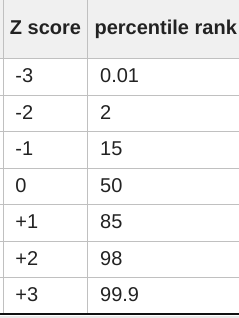
For those who are new, the IQ scale is simple Z score * 15 + 100.
Natural logs
Now when it comes to net worth, there are problems with calculating Z scores because the distribution is so abnormal. For example in 2017, the three richest Americans had more wealth than the bottom 50% of the country. Thus it’s almost impossible to calculate how much the average American is worth because unless you do a census of the entire country, the inclusion or omission of just one centibillionaire will skew you’re sample’s average by orders of magnitude and unlike a normal curve where the mean and median are the same, the average American is actually orders of magnitude richer than the median American.
Now one solution statisticians use to deal with this problem is they transform net worth into its natural logarithm using calculators like this. Natural logs tend to fit the bell curve far better than raw wealth data. Let’s apply this concept to Gates and Musk.

The next step is to transform these natural logs into Z scores. To do this we must estimate the mean and SD for U.S. wealth natural logs in the years when Gates and Musk made wealth history. If we assume that natural wealth logs are roughly normally distributed, at least within 3 SD from the mean, then we simply assign the natural wealth logs at the 50th and 99th percentile the Z scores they would have on a normal curve: 0 and +2.33 respectively.

On a normal curve, a Z score of 0 is by definition the mean and by dividing the difference between the mean wealth log and the 99th percentile wealth log by 2.33, we can estimate the SD.

From here we can estimate that Gates, who had a natural wealth log of 25.33 in the late 1990s had a wealth Z score of +8.32 (8.32 SD above the mean) while Musk who had a wealth log of 26.55 circa 2020 had a wealth Z score of +7.65.
While both men have freakishly high Z scores, Gates was clearly far richer for his time than Musk was for his. To put it in perspective, Musk would need $1.25 trillion to be as rich circa 2020 as Gates was in the late 1990s.
Recently Musk’s SAT scores were reportedly revealed and while they equated to an extremely high IQ, like 99.9% of Americans, he was still in the biologically normal IQ range of 50 to 150 which is why he has lots of worshipful fan boys who can relate to him. Outside this range, people tend to be mutants.
Lucky for us normal humans, the high IQ mutants have their own freaky interests and so the richest and most powerful people tend to come from the pinnacle of the normal range (IQ 135 to 150): Musk, Bezos, Buffet, Soros, etc.
However once in a while, one of the 170 IQ mutants gets bored writing computer programs in his mom’s basement and with enough luck and hard work, decides to compete with the mere mortals and like an invasive species entering an eco-system not evolved to them, even the brightest normal humans are no match for the mutant who absolutely slaughters them at their own game because his IQ is just so much higher, and that is what we saw with Gates in the late 1990s, allowing him to become a centibillionaire nearly two decades before anyone else and be the richest American for 23 years .
 Pumpkin Person
Youre quant IQ is great but youre VIQ is so low you don’t even know about american history, nevermind human history.
Do the same calculation on John D Rockefeller. The correct answer is John D….for americans.
In the world, the correct answer may well be Putin or MBS in modern times. Honestly, it would be very subjective because of currency comparison issues and finding PPP estimates and periods of history. And the fact that Putin and MBS have strange arrnagements in how they hold their wealth through bagmen and state entities.
I would speculate that MBS is a de facto trillionaire right now. Rothschild was also very very wealthy in his time in the early 1800s. Obviously you have monarchs from history as well which had even more than wealth….they had raw power. For example, the king of Spain in the 1600s when they found all the gold in latin america…and fiat currencies didn’t exist in those times.
Also I said you need to compare inflation rates at the percentiles because the inflation rate for a 1% person is different for an inflation rate at the 50th. But actually your quantitative technique is better and I have no problems admitting that. You basically took into account what I said and added your statistical knowledge to it about logs and z scoring. Well done.
Youre quant IQ is great but youre VIQ is so low you don’t even know about american history, nevermind human history.
Do the same calculation on John D Rockefeller. The correct answer is John D….for americans
I never claimed Gates was richer than Rockefeller. The title of the article says “LIVING person”. But it would be very interesting to see how Gates compares with people further back in time.
Well not to be a pedant but your title is contradictory. The richest living person of all time.
“Of all time”
What the hell does “richest living person of all time” actually even imply.
You should have said “richest living person”…In this case still wrong. Its MBS.
imagine a list of the richest people of all time and then remove anyone dead.
as for mbs, forbes stripped him of billionaire status:
“In November 2017, Al Saud led an ‘anticorruption campaign’ that caused many prominent Saudis to be arrested and forced to turn over their fortunes.
As a result of the campaign, ten Saudi billionaires were dropped from Forbes’ annual list of the world’s billionaires.”
also, if arabs have all the money, why are all politicians owned by israel?
Also shows Forbes are real journalists and not just propaganda for elites because if they were MBS & Putin would be #1 and #2. Nothing Danes want more than for Americans to think Saudi Arabia & Putin control the world. Instead Forbes drops 10 Saudi billionaires and 35% of their U.S. billionaires are Danes and Putin is not even on their list.
Who says arabs don’t own politicians too?
For Forbes to say MBS is not even a billionaire is delusional. Everyone with a high IQ knows he is the richest person in the world bar Putin. All you have to do is look at the assets of the Saudi sovereign wealth fund and its basically his personal piggy bank. He has total and complete control of it. And thats the official piggy bank he has alone by the way.
Who says arabs don’t own politicians too?
If Arabs owned politicians to a significant degree, the U.S. wouldn’t be so aggressive towards Arabs and so servile towards Israel.
Youre such a dumbass. Your verbal reasoning is literally the worst I have ever seen in a person with a 130 IQ. If Mubarak was found to be worth $80b, even by Forbes and he is the ruler of the poorest middle eastern country….how in the holy fuck is MBS not even a billionaire as king of the richest country of the Middle East?
Idiot! Mubarak never had $80 billion:
https://www.forbes.com/sites/kerryadolan/2011/02/07/estimates-of-hosni-mubaraks-extreme-wealth-appear-exaggerated-and-unproven/?sh=66f532c65376
MBS is not a billionaire because Saudi Arabia stripped 10 billionaires of their wealth as part of anti-corruption campaign
https://www.theguardian.com/world/2011/feb/04/hosni-mubarak-family-fortune
Middle eastern source in this link > Forbes.
Forbes debunked this nonsense.
who the fuck is MSB? why do you guys act sketchy?
MBS not MSB. Prince Sultan bin Mohammed bin Saud Al Kabeer. He was worth $3.8 billion in 2017 but Forbes can no longer be certain that any Saudi is a billionaire:
It’s hard to imagine a faster or more audacious way to obtain billions of dollars than the route recently taken by Saudi Crown Prince Mohammed bin Salman: force the country’s richest people to turn over their personal fortunes to the state as part of an “anticorruption campaign.”
Late last year the 32-year-old heir to the throne locked up a group of Saudi billionaires and other businessmen at an ultra-luxe prison–the 492-room, palm-lined Ritz-Carlton Riyadh. Some were his own relatives, including Prince Alwaleed Bin Talal, 62, the most recognizable Saudi mogul in the West.
At least 3 other Saudi billionaires from Forbes’ 2017 list were reportedly detained. No official list of the detainees’ names was released; the press attaché at the Saudi Embassy in Washington D.C. told Forbes that it didn’t have information on specific individuals due to Saudi privacy laws…
…The Saudi government’s reported goal was to gather $100 billion to plug a hole in the budget that’s been growing amid years of low oil prices. There are a thousand and one stories about what precisely happened, making it impossible to know definitively who gave how much to whom when. Forbes learned that at least one tycoon who was not detained handed over assets to the government. Given these shifting sands of truth, we’ve chosen to leave all ten Saudis off our billionaires list this year; none would comment. With greater clarity regarding their wealth, some might eventually return to the ranking.
https://www.forbes.com/sites/kerryadolan/2018/03/06/no-saudi-arabian-billionaires-forbes-list-2018-alwaleed-alamoudi/?sh=32281df91d42
Forbes is retarded. They must be taking bribes from the MBS people to pretend MBS is not a dictator.
No they’re just being cautious. They can’t confirm he’s still a billionaire given the seizing of billionaire assets in Saudi Arabia. See people who are actually intelligent need evidence to believe things, unlike schizos like you who believe things based on psychic vibes. I’m sick of your low IQ.
You are the single dumbest person when it comes to non-quantitative questions. MBS is the de facto dictator of Saudi, but Forbes doesn’t even want to admit that. If you accept he is the ruler, the soverign wealth fund is under his total control i.e. that is about 700b on its own. Nobody in the world believes MBS is not a billionaire except Forbes. Thats how ridiculous your beliefs are.
And the U.S. budget is under complete control of congress and the president; doesn’t mean they’re all billionaires. You’re so stupid, pill.
Not saying he’s NOT a billionaire, but there is reasonable doubt.
EXACTLY!
there are TWO ways the melo personality is RETARDED…
at least…
1. amphetamine (meth is just a redonkulously potent form) helps doing anything BORING. the same is true of EtOH.
2. BUT EtOH helps ALSO in doing something EXTREMELY UN-PLEASANT…this was revealed in claude lanzmann’s Shoah.
3. BUT SOME PIPO ARE NATURALLY METH-ED OUT AND INSENSITIVE.
yes. hitler is the greatest public speaker in the recorded sound era. NOT oprah. sadly.
Just on RR’s predictions….
The prediction actually has failed. Treating blacks less racist – electing a black president, promoting them in movies and tv, giving them welfare, giving them civil rights, giving them affirmative action in corporations/academia/media/the arts and so on…statistically lead to more crime from blacks.
The prediction is that racism causes black crime. So the inverse, being nice to blacks should lead to less crime. The inverse of the hypothesis must be testable.
Therefore the hypothesis is falsified.
QED.
If you are argue with this you are basically mentally ill at this stage.
What is this nonsense? The theory accounts for multiple factors that influence crime, and doesn’t predict that “being nice” is the sole determinant. Prediction 1 is true, and there is empirical research to back it. What you said doesn’t refute it. You are so clueless.
Can you explain the theory to me?
I just refuted it. You said racism causes blacks to be violent. Therefore the inverse – anti racism must decrease black violence must and always be true in the ‘TAAO’ model.
If you deny this you are not being logical.
No you didn’t.
TAAO posits that racism can be a contributing factor to increased crime among AAs, but not the sole or exclusive factor. TAAO acknowledges the impact of racial discrimination on criminal behavior, but it doesn’t suggest that the complete elimination of racism will inevitably lead to a proportional reduction in AA violence. Your assertion oversimplifies the theory by assuming a linear and direct relationship between anti-racism measured and crime reduction. But the TAAO recognizes that multiple factors—including socioeconomic conditions, family dynamics, community environments and historical factors influence crime rates among AAs. Lastly, the TAAO doesn’t present a one-dimensional model where racism is the only variable to consider; it acknowledges the complexity of the issue, so the inverse—anti-racism necessarily leading to an immediate and significant reduction in black violence—is an oversimplification of the theory.
Nice try, but you failed.
You just said that that was the testable hypothesis from the model dumbass. The hypothesis isolated the racism factor and claimed there was empirical evidence that that was the factor that indeed ‘predicted’ black crime. You yourself chose that hypothesis as one of the 3 of the TAAO model’s main ‘testable predictions’.
Therefore…Clearly if you decrease racism, it should have reduced crime, not necessarily by linear proportionate amount, but at least by some percentage. Instead the evolution of society over 100 years from Jim Crow to the present day saw a gigantic INCREASE in black crime.
QED.
I wouldn’t even bother continuing to argue at this point because its embarrassing that you are now arguing with yourself which is stupid.
Yea and… It was tested and found to hold, dlumbass. The references are right there. BUT that doesn’t discount what I wrote and racial discrimination (racism) isn’t the only factor. There are more as I wrote. “QED” nothing, you clearly don’t understand the theory.
Prediction 1 is true, and has been empirically tested. BUT that doesn’t discount everything I wrote in my previous comment about it being multifaceted. Read the book, read some papers on it and come back when you have an actual understanding of it and don’t think that what you wrote is a “gotcha” against prediction 1—because it isn’t.
“The hypothesis isolated the racism factor and claimed there was empirical evidence that that was the factor that indeed ‘predicted’ black crime.”
Read the papers. Unnever and Gabbidon made the prediction in their book and those papers—and many more—found the prediction to hold. The claim is thusly true. Dumbass.
I made everything easy to understand here. Read it before you comment again. “electing a black president, promoting them in movies and tv, giving them welfare, giving them civil rights, giving them affirmative action in corporations/academia/media/the arts” doesn’t mean “racism is over”—there’s something called “systemic racism.” And there’s also the individual factor as well. You’re just spouting off nonsense while not reading the papers which verify the prediction.
“These studies showed that African American adolescents who reported receiving frequent messages concerning racism from their parents or guardians were more likely to use a problem-solving coping strategy—attempts to change the dynamics of the encounter—and to seek social supports (Scott, 2003, 2004). Thus, these findings indicate that African American parents can decrease their children’s likelihood of offending if the content of their racial socialization includes providing their children with effective coping skills to fend off the toxic effects of racial discrimination. Indeed, Scott (2004:134) concludes that “racial socialization serves a protective function for African American adolescents. African American adolescents who are not prepared for the multiple racial assaults they may encounter in everyday interactions may be more at risk for internalizing racial oppression and utilizing ineffective coping strategies.””
And this… Like the racial discrimination (racism) prediction, was also found to hold when tested, verifying the prediction. Your claim is outright laughable since Jim Crow is a unique thing that black Americans experienced which is one of the reasons that led to the formulation of the TAAO. Since black Americans have a unique lived experience in America, to explain their offending, there needs to be a unique, race-specific theory of offending for them that doesn’t generalize to other races, like for example general strain theory does.
Sociolology garbage and from Scottgay 2004…
Pill you always deflect criticism like how stupid can you get? youve never once been man enough 2 confront me in a boxing match like ive asked you 2.
you are a failure in every way. no girl would want you! youre like a rubbish bin on fire man!
let go! let gooooooo.
I think Santo just said something remarkably genius in terms of social intelligence. I actually never even thought of it but it may be true that RR is severely mentally ill. That would explain the black gf, the trolling of HBD blogs, the repetitive spamming, the rage and confusion.
I would recommend RR see a psychiatrist but RR doesn’t believe that psychiatry exists. So maybe a rabbi or a shaman or the woke equivalent of a cult leader.
“but it may be true that RR is severely mentally ill.”
lmao
“That would explain the black gf, the trolling of HBD blogs, the repetitive spamming, the rage and confusion.”
I’m with a woman I love, I comment in blogs that have discussions that interest me. My guy, my life is better than yours in every way. I keep jobs, I don’t get fired, I take care of myself and I take showers.
Santo Miles Cheong is just like you—a racist that can’t accept a theory that generates hypotheses which make successful novel predictions, because you’re racists. (In Santi Miles Cheong’s case, a wannabe-white, mixed-race racist Brazilian.)
My life is better than yours in every conceivable way, bar a long term neurological disorder…
Im much smarter, I have a much better job, much more wealth, have total freedom, am not mind controlled by high IQ gypsies and am considered up until I stopped showering and going to the gym to be in the top 1% of good looking guys. I also don’t have a black baby to be ashamed about every day I wake up.
I have never even thought about chasing a black woman. I’ve never once been that desperate to get laid. Even if I was deeply drunk and there was nobody else at a club or on Tinder I would rather just jack off than bring home a black woman and that BO.
“My life is better than yours in every conceivable way”
Haha more delusions.
“much smarter much better job, much more wealth, have total freedom”
On what planet?
“not mind controlled by high IQ gypsies”
You’re such a moron. All of my views and beliefs are my own. You’re constantly talking about “the Danes” so who’s mind do they “control”?
Your folly is your idiotic and false assumptions about my personal life.
“that BO”
Nah that’s just you.
In fairness Soros and Gates have given away all their wealth relatively earlier in their lives. Musk has not at this point but Musk said he was open to ending world poverty so we will see.
I believe Musk is helping the world even more than giving it to blacks by keeping twitter as a free speech place for people to interact.
In contrast to the alt right, I do NOT believe Soros is a neocon or jewish supremacist. If you read the wikileaks emails, the clintons and democrat elites find him annoying.
Rubin who may or may not be less wealthy than Soros is clearly more powerful in America.
Look, in terms of statistical knowledge and calculations you are the 1%.
In terms of reading media critically and being able to see power dynamics among human beings….frankly…you are operating at the level of a 10 year old.
No you’re operating like a 10-year-old because you believe the propaganda that Russia and Arabs run the World. Perfect deflection from who actually does.
LOL I said Putin and MBS are the richest, NOT the most powerful.
Wealth IS NOT power.
Wealth IS NOT power.
Wealth IS NOT Power.
Your understanding of political dynamics is the worst I have ever seen in a 130 IQ person. Bill Gates has little or no power. Period. Musk is not even powerful.
wealth and power are highly correlated. The main reason danes have so much power is not your retarded conspiracy theories about Master, but because they’re a third of all U.S. billionaires. Duh!
False. The main reason danes have power is they evolved for IQ + psychopathy not their bank accounts. There are jews with little or no wealth with incredible power. e.g. new york times journalists.
A major reason those journalists are powerful is they work for the NY Times. If the Ashkenazis weren’t rich enough to own the NY Times, some of them never would have been hired in the first place. And if Ashkenazi weren’t rich enough to own other media outlets, those other media outlets wouldn’t look to the NY Times as their leader.
So money allows one to (1) buy the media, (2) staff the media with journalists who share your agenda (3) buy the advertisers, thus controlling media you don’t own, (4) buy watchdog groups like the ADL which police the media you don’t own, (5) buy tech companies which decide what shows up in search engines, (6) buy politicians, (7) tell those politicians who to put in their cabinets when they become President (8) defeat politicians who oppose your agenda by funding their opponents.
Now high verbal IQ is a huge advantage in its own right because it gives you the power to persuade, but money allows you to buy the huge microphone from which to express those verbal skills.
So why jews are extremely disproportional and protagonists on almost all movements which are implicitly and or explicitly disadvantageous for white people???
Their mathematical intelligence helps them to have many billionaires but nothing of their Power would be possible without their verbal macchiavelian intelligence.
Your understanding of politics is the worst I have ever seen on the internet. These people came over from Europe dirt poor and within 60 years took over the entire country and you believe they bought all the media when the truth is they CREATED the media. They created hollywood. They created the NYT. They started from the bottom dumbass. If you political theory was true the gentiles would never have lost power.
your IQ is too low for me. argue with someone dumb
Look we should hold a poll on replacing Puppy with Jimmy and banning RR and Loaded right now.
why would you ban me and not you? always pointing fingers but never asking the simple common sense question!
complete buffoon! why would i need 2 be banned? i contribute things you are a witch hunt against me and my personality!
you are a conman! banning me will not help anything you idiot!
how many times have i been banned and nothing changed!
youre just scapegoating me!
if you cant piece 2gether the dots and connect them yourself why would you even try in life?
“are you illiterate homie you cant read between the lines! in da bible it said what goes around comes around!”
Bill Gates was the richest man in the world and has a 170IQ.
He doesn’t even control his own mind.
You just don’t understand his mind
He gave all his money to Africa.
And yet he still has $109 billion left. Trying to help the less fortunate does not mean you’re brainwashed by the Danes. It just means you’re not a psychopath.
But he specifically helped the blacks. Which means he is brainwashed.
Because they’re the ones who need help, duh. Your IQ is so low.
Only effective help they need now is family planning. Are Melinda and him investing in universalization of contraceptive methods in Subsaharian Africa?
https://www.gatesfoundation.org/our-work/programs/gender-equality/family-planning
this
“But he specifically helped the blacks. Which means he is brainwashed.”
Dumbo, the more food women have, the more secure they fail and so they have fewer children when they do. It’s been shown in other countries that giving food/aid decreases birthrates, since when people are better fed, more prosperous and have access to family planning they want fewer children.
born that way???
Idiot, african birthrates are through the roof. Yet another example of refusing to see the empirical evidence like above, I just stopped talking to someone who ended up debating himself.
Will Aid to Africa Increase the African Population?
THE CORRECT ANSWER IS:
P1. MAYBE YES.
P2. MAYBE NO.
C. DO NOT GIVE MONEY TO AFRICA.
PAUL THEROUX SAYS SO!
THEROUX’S BONA FIDES ARE…
1. THREE BOOKS ABOUT TRAVELING IN AFRICA AND SEEING FIRST HAND HOW AID IS ACTUALLY HARMING AFRICANS.
2. PEACE CORP VOLUNTEER IN MALAWI. SPEAKS SWAHILI.
3. TAUGHT IN UGANDA…WHERE HE MET NAIPAUL, NOBEL LAUREATE.
rr is an extremely UN-sophisticated person…
“stupid people don’t know they’re stupid.”
PAUL THEROUX:
(looking like a guy who would NOT know about such things…)
but he is a quarter native american … supposedly.
specifically some tribe in wisconsin.
“And yet he still has $109 billion left. Trying to help the less fortunate does not mean you’re brainwashed by the Danes. It just means you’re not a psychopath.”
But aren’t blacks the most psychopathic race? Is there any evidence that giving them better nutrition makes them less psychopathic?
It would make them smarter and so less harmful in the Dunning-Krueger way, but I’m not sure if it stops them from scamming people and being aggressive and such (hence, Nigeria). That probably takes a huge cultural change and lot of epigenetic effects.
Idiot, there’s a reason for that and the available empirical evidence shows that aid decreases birth rates.
Subsaharian Africa is so delayed from the rest of the world that it just now passing on second phase of demographic transition. Their fertility rates are decreasing due to urbanization, better education and relatively mild improvement of standard living, from 7-5 to 4-3 kids but because their mortality and infant mortality rates are decreasing too, just now, they are experiencing a demographic explosion.
“But aren’t blacks the most psychopathic race?”
Lynn was refuted here.
https://www.sciencedirect.com/science/article/abs/pii/S0191886902003616
Aid since the 60s exploded the population. Go ahead and argue with the facts like a dumbass again.
You’re the one “arguing with the facts.” And that graph that goes around assumes a linear advancement in fertility. We have empirical data that aid and family planning decrease birth rates. But you’re just a racist so you’re immune to reason.
By the way dumbass, urbanization decreases fertility.
“The current fertility rate for Africa in 2023 is 4.155 births per woman, a 1.35% decline from 2022.
The fertility rate for Africa in 2022 was 4.212 births per woman, a 1.31% decline from 2021.
The fertility rate for Africa in 2021 was 4.268 births per woman, a 1.32% decline from 2020.
The fertility rate for Africa in 2020 was 4.325 births per woman, a 1.28% decline from 2019.”
https://www.macrotrends.net/countries/AFR/africa/fertility-rate
“In the Sahel, for example, the region with the highest fertility rates, the number of children per woman has dropped from 7 to 5.7 since 1980.”
https://www.afd.fr/en/actualites/dramatic-drop-fertility-across-africa
“In Nigeria, for example, women are now said to have fewer than five children on average. The country’s population is still growing fast and is set to double to 430 million by 2060. Earlier forecasts, however, expected it to rise by yet 100 million more. Birth rates are even lower in several other African countries, including in Senegal (3.9) and Ghana (3.8). The figures for Ethiopia, Rwanda and Guinea are slightly above four. It obviously helps that some faith leaders have begun to endorse family planning.”
https://www.dandc.eu/en/article/high-fertility-correlates-poverty-and-compounds-it
“The pooled estimate of sub-Saharan Africa’s overall fertility rate was five children per woman (95% CI: 4.63–5.37). Consequently, the pooled estimate of total fertility for people living in urban and rural areas was 3.90 (95% CI: 3.60–4.21) and 5.82 (95% CI: 5.43–6.21) children per woman, respectively. In sub-group analysis, the pooled estimates of the TFR for the East African, Central African, Southern African, and West African regions, respectively, were 4.74, 5.59, 3.18, and 5.38 children per woman. Total fertility rates were greater in low-income nations (5.45), lower-middle-income countries (4.70), and high-middle-income countries (3.80).
SSA has a relatively high total fertility rate. The regions of West and Central Africa have the highest overall fertility rate. The fertility rate is higher in countries with a large rural population and low income. Strategies should be developed to address this public health concern, especially in rural Central and Western Africa.”
https://www.ncbi.nlm.nih.gov/pmc/articles/PMC9909402/
Putting this all together, what’s the right inference to draw?
Since aid started pouring in in the 60s, TFR went up from what was there previously.
QED.
Now shutup.
Aid alone doesnt decrease fertility rates, only in combination of other factors.
All statistics are equal but some are “better” than others…
Stats about decreasing of fertility rates in Africa: ok.
Stats about criminality rates among racial and ethnic groups: not ok.
“Since aid started pouring in in the 60s, TFR went up from what was there previously.”
Doesn’t know how to read. QED.
“Aid alone doesnt decrease fertility rates, only in combination of other factors.”
Right, that’s what I said.
“Stats about decreasing of fertility rates in Africa: ok.
Stats about criminality rates among racial and ethnic groups: not ok.”
I never said this. The TAAO is the best explanatory, predictive theory of black crime there is that has actionable solutions.
Pumpkin, what are the other genetic traits that determine wealth? I got a 23andMe genetic test done, downloaded the raw data, input that to another company (forgot name) that gives more controversial info from genetic data and it determined that I was genetically likely to be of lower socioeconomic status.
It got other things right about me like, being more prone to diabetes and autoimmune disorders and being resistant to heart disease and cancers. I know this is accurate from family history. It also determined that my IQ would be well above average. If my IQ is high and my conscientiousness is also high, why would it say I’m genetically prone to being poor? What other factors could I be missing?
I suppose I’m also quite neurotic, which it also determined from my DNA, but would that really lower me that much economically? Wouldn’t smarts and diligence supercede that?
Pumpkin, what are the other genetic traits that determine wealth?
Probably health and energy levels. Maybe drive though I don’t know how genetic it is. Focus is another big one. Consciousness might be important.
Internal locus of control. Certain dark triad traits sadly might help too like psychopathy though not too much because psychopaths are often exposed and expelled from the market.
Why do they have to be “genetic” traits? How can X be genetic when G can’t be untangled from all other developmental resources? I don’t understand why people go and look for genetic cause of X for themselves. There’s something called “self-fulfilling prophecies.”
You’re probably talking about DNA Land.
Why do they have to be “genetic” traits? How can X be genetic when G can’t be untangled from all other developmental resources?
So you’re a creationist now? How could evolution have occurred if nothing is genetic?
How does it follow that I’m a creationist when I merely asked how G can be untangled from other developmental resources? Genes are followers, not leaders, in evolution (see West-Eberhard, Lerner, Oyama, Richardson).
You said “How can X be genetic when G can’t be untangled from all other developmental resources?” implying X does not have a genetic cause.
Passive causes aren’t active causes. DNA sequences (genes) needs to be activated by and for the physiological system, before it does what it does in the concert of development. Genes are merely passive causes, followers in evolution.
So? The bottom link is that if you know someone’s DNA, you can predict a wide number of phenotyoes with great certainty. I guess the reason people prioritize genes over other developmental resources is because it’s the part of the organism that be passed down through all future generations and it’s the part we can use to clone you thousands of years from now.
Other parts of the organism are passed down too—there is nongenetic or “soft” inheritance that new findings in epigenetics have shown. We can “predict phenotypes” with DNA, yet all of the h2 estimates from GWAS are substantially lower than those found in twin studies? Makes sense.
wikipedia writes:
During germline reprogramming and early embryogenesis in mice, methylation marks are removed to allow for development to commence, but the methylation mark is converted into hydroxymethyl-cytosine so that it is recognized and methylated once that area of the genome is no longer being used,[5] which serves as a memory for that TEI mark. Therefore, under lab conditions, inherited methyl marks are removed and restored to ensure TEI still occurs. However, observing TEI in wild populations is still in its infancy, as laboratory studies allow for more tractable systems.
In other words scientists manipulate organisms into passing down epigenetic effects but this does not necessarily occur naturally.
yet all of the h2 estimates from GWAS are substantially lower than those found in twin studies?
That’s because traits are so polygenic that no one gene has a big enough effect to achieve statistical significance unless the sample size is much bigger and the odds of all of them achieving statistical significance are impossible unless you have a sample size in the trillions. In addition, the common additive genetic variants measured by GWAS do not include genetic interactions, copy number variants, and rare genetic effects.
Yet there’s ample evidence in mice for TEI. And we understand the mechanisms of epigenetic inheritance. I have some stuff on wild populations I think, I’ll get back to you.
https://www.nature.com/articles/s41576-021-00438-5
“traits are so polygenic…unless the sample size is much bigger…samoke size in the trillions”
Yea this is just behavioral genetic cope. Increasing the sample size increases the likelihood of spurious correlations.
https://link.springer.com/article/10.1007/s10699-016-9489-4
“additive generic variants”
The additivity assumption is false and h2 estimates don’t mean what they think it means. Rare genetic effects is another behavioral geneticist cope.
I have some stuff on wild populations I think, I’ll get back to you.
Yes get back to me.
Yea this is just behavioral genetic cope. Increasing the sample size increases the likelihood of spurious correlations.
That’s why correlations have to be statistically significant to be reported in reputable journals.
The additivity assumption is false and h2 estimates don’t mean what they think it means. Rare genetic effects is another behavioral geneticist cope.
The blog post just repeats the spurious correlation argument which itself is spurious. See above.
It’s beginning to be well-established that nongenetic—soft—inheritance is a thing and can persist through the generations. Especially in model organisms like C. elegans. Here’s a ref from last year on TEI in wild populations.
https://www.mdpi.com/2075-4655/6/4/31
“which itself is spurious”
Look, the fact of the matter is, h2 for GWAS and other molecular genetic evidence is SUBSTANTIALLY lower than twin h2. The reason for this is that the false assumptions INFLATE heritability. The additivity assumption is clearly false. G-G, G-E interactions cause “phantom heritability”, as Zuk et al note. Increasing the sample size won’t “find more genes”; it’ll just increase the chance of spurious hits, which is all these studies find.
It’s beginning to be well-established that nongenetic—soft—inheritance is a thing and can persist through the generations.
So you admit it’s not yet well established, it’s just beginning to be?
Especially in model organisms like C. elegans. Here’s a ref from last year on TEI in wild populations.
So you’re a Lamarckian now?
Look, the fact of the matter is, h2 for GWAS and other molecular genetic evidence is SUBSTANTIALLY lower than twin h2. The reason for this is that the false assumptions INFLATE heritability. The additivity assumption is clearly false. G-G, G-E interactions cause “phantom heritability”, as Zuk et al note.
The additivity can not explain much of the missing heritability in IQ. We know this because the IQ correlation between MZ twins raised apart is about as high as heritability calculated from the classical twin method, even though only the latter makes the additivity assumption.
Increasing the sample size won’t “find more genes”; it’ll just increase the chance of spurious hits, which is all these studies find.
Again, that’s why they test for statistical significance.
By “beginning to be” I mean more accepted in the mainstream. Authors like Jablonka and Lamb, for example, have been at the forefront of this so cr 1995.
I’ve been a Lamarckian for years now.
The “missing heritability” isn’t there to be found.
When a large number of variables are tested, there is a likelihood of finding hits by chance (that is, they’re spurious). So even if there is a strict significance threshold, the more tests that are performed on larger and larger samples, the higher the chance of showing “significant results” based on random chance which are spurious. While statistic significance can tell us whether or not a finding is unlikely to be due to chance, it doesn’t tell us if it’s meaningfully or practically important. So a statistically significant result may not even be clinically useful. And to the best of my knowledge, these GWASs don’t even have a coherent theory of X, they just lok for “hits”. Also, the population stratification issue hasn’t been solved either.
Something (GWAS) based on something something else that we know has numerous invalidating false assumptions (twin studies) quite obviously can’t tell us about the “genetic basis” of X. So the “genetic cause theory” depends on twin studies and their assumptions being correct. What’s the correct inference to draw if the assumptions fail?
When a large number of variables are tested, there is a likelihood of finding hits by chance (that is, they’re spurious). So even if there is a strict significance threshold, the more tests that are performed on larger and larger samples, the higher the chance of showing “significant results” based on random chance which are spurious.
Not anymore. That’s called p hacking & modern statistical testing takes into consideration the number of tests.
twin studies) quite obviously can’t tell us about the “genetic basis” of X
So do you believe the high heritability found in twin studies is explained by epigenetic inheritance?
I mean, Turkheimer thinks GWASs basically p-hack.
https://turkheimer.com/p-hacking-in-gwas/
The fact of the matter is, association studies don’t reveal biological mechanisms, it’s physiology that does.
“Nor does finding higher overall correlations by summing correlations with larger numbers of genes showing individually tiny correlations solve the problem, even when the correlations are not spurious, since we have no way to find the drugs that can target so many gene products with the correct profile of action.”
https://journals.physiology.org/doi/full/10.1152/physiol.00017.2018
And yea I do think that epigenetics, like epigenetic supersimilarity, could explain the phenotypic similarity of MZ twins.
https://genomebiology.biomedcentral.com/articles/10.1186/s13059-017-1374-0
But I do believe that the false assumptions in those kinds of studies bias h2 upwards. That much is pretty clear.
If epigenetic inheritance is so pervasive, you’d think some of the kids of these huge weight lifters would have big muscles without working out.
And then there was that famous mouse study where they inherited fear of certain traumas they experienced. I wonder if that’s ever been replicated.
Cochran’s response:
“I don’t believe it.”
First point, that doesn’t follow. But there DO seem to be epigenetic effects from weight training passed to children.
https://www.ncbi.nlm.nih.gov/pmc/articles/PMC6874781/
I’ll be upfront here—I think many claims about epigenetics are way overblown, especially in the mainstream media. But I think there is SOMETHING to epigenetics, especially TEI. If you get the chance you should read Jan Baedke’s and Maurizio Meloni’s works on epigenetics.
Regarding the mouse study, here’s one 2013 review on something similar to what you said.
https://www.ncbi.nlm.nih.gov/pmc/articles/PMC3521992/
And I think this is the study you’re talking about.
https://www.nature.com/articles/nn.3594
Too tired right now to see if it’s been replicated. I’ll check tomorrow.
Another example: vegetarianism. Twin studies on this report h2 at around 70 percent. A new “genetics of vegetarianism” GWAS estimated heritability of vegetarianism at 1.5 percent, CI of 0.9 and 15.2%. Strange… They call for “larger sample sizes” to address this, but larger samples just increase the chances of spurious correlations, as I noted before.
GIBBERISH?
YOU TAKE YOUR PICTURE FROM THE SIDE RATHER THAN THE FRONT…
BECAUSE…
THE FRONT PICTURE REVEALS…
YOU ARE PART CHINESE!
BEING ASHAMED OF BEING CHINESE IS RACIST.
THEREFORE YOU ARE A RACIST.
YOU ARE A SOCIOPATH.
MICHAEL CORLEONE IS ASHAMED OF YOU.
SADLY.
I made a cart:
More people are in the middle for Elon and the bell is shorter.
Less people are in the middle for Bill and the bell is longer.
In terms of wealth bill is 225 and elon is 215 with the bell shapes.
Pill is abrasively stupid. so are the other users. they dont understand the complexity of things. they think in black and white.
theyve failed themselves.
To add to what I said above:
here are both bells together.
PP have you ever sought to verify Rushton’s claims of physical differences between infants of different races or do you just take them at fave value? Currently reading up on infant motor development. I’m looking for studies published this millennium, preferably in the 2010s. (I will consult Rushton’s references.) I just found this interesting study.
“The foregoing studies illustrate motor development differences among children of various ethnic backgrounds with data supporting discrepancies between children of European and Asian backgrounds. Not only did the rate of skill acquisition differ among children of different ethnic origins but limited evidence also suggests that elements in the sequence of skill acquisition may also differ. In one available study, a sample of 72 infants from Hong Kong rolled from supine to prone prior to rolling from prone to supine,42 contrary to the sequence identified in a Canadian normative study.8”
https://journals.lww.com/pedpt/Fulltext/2007/01920/Gross_Motor_Development_of_Asian_and_European.7.aspx
“We found that Black Caribbean (odds ratio [OR]=0.23, 95% confidence interval [CI]=0.11–0.48), Black African (OR 0.31, 95% CI 0.18–0.55), and Indian (OR 0.55, 95% CI 0.33–0.93) infants were less likely to show delay in the attainment of gross motor milestones compared with White infants after adjustment for a range of explanatory variables. Pakistani and Bangladeshi infants were more likely to have delays in fine motor development (OR 1.69, 95% CI 1.21–2.35 and OR 2.17, 95% CI 1.17–4.02 respectively) and communicative gestures (OR 4.19, 95% CI 1.47–11.94 and OR 7.64, 95% CI 3.96–14.76 respectively), but these differences were explained by socioeconomic factors and markers of cultural tradition. In conclusion, unexplained ethnic differences were seen in the attainment of gross motor milestones, with Indian, Black Caribbean, and Black African children less likely to be delayed (in adjusted models).”
https://www.cambridge.org/core/journals/developmental-medicine-and-child-neurology/article/abs/ethnic-differences-in-achievement-of-developmental-milestones-by-9-months-of-age-the-millennium-cohort-study/F96308BD3180E174F6CA2FE52C16C72C
https://bmjopen.bmj.com/content/9/1/e024440.abstract
“Children of Black and White ethnic groups achieved significantly greater mastery of locomotor skills, compared to Asian children, though this did not differ by year-group (p < 0.05)."
https://www.mdpi.com/2227-9067/5/8/110
“We found that Black Caribbean (odds ratio [OR]=0.23, 95% confidence interval [CI]=0.11–0.48), Black African (OR 0.31, 95% CI 0.18–0.55), and Indian (OR 0.55, 95% CI 0.33–0.93) infants were less likely to show delay in the attainment of gross motor milestones compared with White infants”
“Children of Black and White ethnic groups achieved significantly greater mastery of locomotor skills, compared to Asian children, though this did not differ by year-group (p < 0.05)."
Both of the above statements confirms Rushton's theory
“confirms Rushton’s theory” meaning…? I’ve never contested these claims, but if you mean that it “confirms” r/K theory, I don’t think so.
r/K theory predicts r organism evolved to need less parental care so they show faster motor development.
I don’t understand why you’re still operating under this falsified theoretical framework. Anderson showed that if Rushton’s claims were true, Nefroids would be K and Mongoloids r. A few confirmatory findings on what Rushton said 30 years ago doesn’t mean that his theory is “confirmed.” Merely stating X doesn’t mean Y is true merely because X is a supposed consequence of Y.
Rushton replied to Anderson’s critique on pages 248 to 249 of the 3rd edition of his book published in 2000.
Yea that’s hardly sufficient to rebut her criticism. He didn’t even her main devestating points. Do you think that’s a sufficient critique to accept that Anderson didn’t have it right about Rushton’s theory?
So I’ve spent most of the day reading what I could find on race differences in motor development and the claim is true.
I still don’t think Bill Gates’ IQ is > 160. Still, the difference between him and Musk would be like the difference between a dude who is the median for the US Army enlisted personnel vs a dude that just barely missed the cut due to low IQ.
I still don’t think Bill Gates’ IQ is > 160.
Why not?
From a year+ old comment:
>However these numbers assume the SAT was normally distributed, and yet empirical data from the 1980s suggests near perfect scores were much more rare than the normal curve predicts and equated to an IQ of about 170 and if anything they were likely even more rare in the 1970s when fewer people studied for the SAT.
I have read some contemporary 80s sources that site lower quality curriculum for a reduction in the SAT score from 1960s to 1980s. So those 1980s scores would have been lower and the 170 prediction would be an inaccurate inflation.
160 would be a more accurate estimation in my view. Any comments?
My house was worth 75 thousand dollars in 2020.
That gives me a net worth in the 42nd percentile.
My grandmother was in the top 5th percentile in 1998.
The shit that’s happening over in Gaza is..horrific… to say the least. I was on Twitter and saw that lady with blood coming from her nether regions. I also saw the video of the German tourist lady paraded around on the back of the truck. I don’t condone Israel’s modern-day colonialism, but what Hamas did yesterday is beyond evil. The real question is, why didn’t the IDF know about it? My instinct says it’s a false flag so Bibi can consolidate more power and distract from his recent controversies. However, it’s important to remember to never attribute to malice that can be easily explained by stupidity. Some of the dumb shit he has been doing lately indirectly undermined Isreal’s defense capabilities.
It’s somewhat similar to the Piggy and Putin situation, where it turned out Piggy was just a dumbass, and his charge toward Moscow wasn’t a false flag.
“The real question is, why didn’t the IDF know about it? My instinct says it’s a false flag so Bibi can consolidate more power and distract from his recent controversies.”
Possible. Politics isn’t my thing, nevermind geopolitics, but I find it hard to believe that an intelligence agency like the IDF didn’t have at least an inkling this would have happened.
And I would say that while there are legitimate reasons TO go on the offensive—that is, for Hamas to be attacking their colonizers—to attack civilians like that is never right and it’s always a war crime. (Of course, as Santo said, Israel does the same and worse daily to the Palestinians.)
Suddenly, lots of Jews and Israelis on twitter describing some horrible details of this attack BUT never talk about the daily brutality commited against Palestinians by Israel…
Yes exactly. For once we agree.
We have to do some 1984 doublethink here.
First we have to think Muslims in that area are violent, savage, and evil, and we need to do whatever it takes to stop them.
Second, we have to remember that the people from that region are not violent or savages at all and we need to give them asylum in our White countries.
People like to think Israel is important to US to buy the oil of Middle East big producers but it’s not so true because it would be way more pragmatically advantageous If American government just keep’ing a good diplomacy with the biggest Oil producers, including not defending Israel about everything…
Only reason US is so pro Israel even threating its diplomatic/economic relations with Saudi Arabia and such is because Jewish Lobby in US government… actually is even too moderate claiming the existence of a Jewish Lobby only about Israel issues if ALL American instititutions were totally taken by the tentacles of International Jewry.
Very sad what happened with Israeli civilians and this just makes Palestinian Authority less legitimate in the eyes of large fractions of public opinion, with the help of International Jewry domination on Western Media. They are too coward to attack civilians rather than targeting politicians and too dumb to start a really organized defense of Palestinian cause, similarly to White advocacy. But i still see them as just the civilian German losses during Germany destruction by Allied bombs in the last years of Second World War.
“But i still see them as just the civilian German losses during Germany destruction by Allied bombs in the last years of Second World War.”
Very true. It’s almost poetic.
International Jewry will use German hostages as reasons to completely demolish Muslim countries and get an extra 8 billion dollars in aid. Meanwhile, when Germans, French, and Swedish girls get raped by Muslim immigrants, international Jewry will help hide the stats and identities of the rapists so that they can send more to our countries.
The power of dual-citizenship is never having to take accountability or be put in danger as a result of your own actions.
The end game is to make a third world war between Middle Easterners and Westerners, “killing two rabbits with one shot”.
they misinterpret facts in correspondence 2 truths very strongly. a lot of people just hate themselves now so they want the good 2 suffer 2.
its absolutely unfathomable that a lot of these people we see on a day 2 day basis have such ignorance and hate in their hearts!
anyways the best thing 2 do is just place them in a position where they can make the least amount of impact on others!
theyre always twisting the plot around is the main point and using 4 their own guidance!
About genetics, heritability, inheritance and environment. We inherited from our parents a recombination of their biological material but also their epigenetic clock in the moment we are “produced”. That’s why mutations are more common to happen in pregnancy of older mother. It also important the amount of mutational load people carry since they are born. And because brain is absolutely important to human behavior, we are not born with a empty “mind” which will be filled only throught experience. We already born with a brain with specific features, resulted primarily from genetic recombination and occasionally from what happened during the pregnancy*, and with a developmental script, partly written since the conception. A very good example: some children born with a big and very hungry brains showing their superior brainpower to learn since a very young age, with minimal experience or environmental exposure to be used as a factor to explain their precocities.
* it’s not well understood, at least for me, if the developmental script start to be written since the conception/ genetic recombination predicting even (most of) epigenetic changes during the pregnancy or If they are totally expontaneous/by chance (which i doubt).
You didn’t say anything about the environment though.
“some children born with a big and very hungry brains showing their superior brainpower to learn since a very young age, with minimal experience or environmental exposure to be used as a factor to explain their precocities.”
Gibberish.
Of course we are influenced by the environments we live but not in the way most neolamarckians believe. First, we are literal genetic recombinations of our parents and their epigenetic clocks or mutational load (their chronobiological materials in the right moment we were “concepted”). Second, because we dont born without pre constructed brains, our behaviors: personality, intelligence levels and even experiences, are primarily determined, in the sense of “limited”, by our biological heritages. Just like the example of intellectually precocious children. So if a child aged 3 to 5 years already displays a visible shy or a sociable temperament, due to her little time existing in the world, it cant be immediately attributed only to the environment she lives in, may be attributed to her biological heritage (genetic recombination specifically related to her brain/nervous systems/how her brain is constituted/reacts to social environment). Depending the place, people tend to react differently, just like physical reaction variation. So environment influence us based on how we feel compatible, react to it. If we live for long time in an environment in which we dont feel adapted, our nervous system/brain will likely prioritize our way we find to cope with, suboptimally. This is about personality. But adaptation can be very relative. Some people think that having a high paid job, a traditional family and live in a big house, is the only way to be well adapted. But people with perceived different brain constitutions/different personality types and intelligence levels/types tend to have different values/priorities.
About intelligence, lots of people scored 100 and more come from very socially humble backgrounds. Even thought i can agree that very depressed environments can impact offspring’s intelligences at medium and long term, most environments, specially today, are not that bad to profoundly disrupt expected developments. But there are examples of how social improvements have not promoted cognitive improvements just like the US Blacks, today, despite being well feed (at the point of epidemic overweight) and taller, are not smarter or, on avg, equally smarter than US Whites. This is a big indirect evidence in favor of “hereditarianism”.
Yea we are “genetic recombinations of our parents”, but saying it like that is pretty reductive and I wouldn’t use phrasing like that. Of course we aren’t born with “pre constructed brains”, that wouldn’t make any sense. “it can’t immediately be attributed to only to the environment she lives in” why not? That’s more than ample time for their home environment to have an effect.
The fact of the matter is, due to the items on the test, they’re not exposed to them so they don’t score as highly. Fagan and Holland specifically addressed this and surprise surprise—when it was guaranteed that knowledge acquisition was similar, there was no gap. What’s the right inference to draw from that?
https://www.researchgate.net/publication/222757495_Equal_opportunity_and_racial_differences_in_IQ
check out my baldness + manbun!
jealous?!
Haha I’m not going bald you moron.
i just proved via anal philosophy and talking WAY TOO MUCH that the jews are right about everything…
YOU CLOWN!
— RR
=
SADLY!
BALDING IS SAD!
“Yea we are “genetic recombinations of our parents”, but saying it like that is pretty reductive and I wouldn’t use phrasing like that”
But how something so basic could be “reductive”??
That’s your semantic problem, not mine.
” Of course we aren’t born with “pre constructed brains””
I said “we ARE…” do you know what it mean??
Pre??
“it can’t immediately be attributed to only to the environment she lives in”
“why not? That’s more than ample time for their home environment to have an effect”
No matter the place a gifted children is raised. Generally she will develop faster than her age peers, comparatively, OR you think intelectual giftedness is only a product of environment???
I said 3 to 5 years, could be 3 to 10 months… generally gifted children start very early to display their precocity… based on specialized literature of this field…
And most of gifted children’s parents do nothing really differentiated to raise them.
I will not read Fag and Hole bullshit, so sorry.
RR is always making merchandising of his pseudo scientists colleagues, look like some Truman Show scenes.
I should clarify: “Yea we are “genetic recombinations of our parents”,”
The developmental system is what’s inherited, along wkth our parent’s culture and other developmental resources. The reductive genetic view should be left to the dustbin of history.
I may agree that DNA is not literally a recipe because a RELATIVELY random combination of genetic material is not exactly the same as something absolutely pre determined BUT it’s becomes like an improvised recipe from the conception.
This, again, presumes that information for the phenotype is in the DNA when information is co-constructed through interactions between the resources.
“But how something so basic could be “reductive”??”
What do you mean by “basic”? Do you know what genetic reductionism means and entails?
“I said “we ARE…” do you know what it mean??”
The language barrier is in the way here. Anyway, cases of feral children show that they need to be in human environments at critical times to acquire mind and personality.
“No matter the place a gifted children is raised. Generally she will develop faster than her age peers, comparatively, OR you think intelectual giftedness is only a product of environment???
I said 3 to 5 years, could be 3 to 10 months… generally gifted children start very early to display their precocity… based on specialized literature of this field…
And most of gifted children’s parents do nothing really differentiated to raise them.”
How do you know this? This is an empirical claim, so where’s the evidence?
“I will not read Fag and Hole bullshit, so sorry.”
“I will not read something that refutes my view, so sorry.”
We dont inherited parents culture, we are raised through this inculcation…
“Developmental system”, “developmental script”, DNA…
Genetic reductionism is not inherently bad..
Feral children are extremely rare cases AND most of them, seems, are children from poor backgrounds or perceived mental delay.
Even thought in normal condition, while most children dont show up intellectual precocity, a minority of them do. For both, genetic determinism reign.
You are the very last person here to accuse someone to being dogmatic. Or you have a very lower self consciousness or is plain cynicism, proxy for sociopathy. My views are grounded on reality and i know how to distinguish bien pensant fakery from Science.
Do you think gifted children’s parents are so abnormal in their nurture habits????
“We don’t inherit our parents culture”
Yes as do.
“Genetic reductionism is not inherently bad”
It’s inherently false.
Yea feral children are very rare but it shows the developmental window in which enriched experiences are paramount for the formation of mind.
“Do got think gifted children’s parents are so abnormal in their nurture habits?”
Well the family environment is parental and sibling relationships along with their finances and what they have in the home. “Giftedness” is developed through sociocultural interactions with peers, MKOs, parents and the home environment.
ypou are such a FUCKING MANL=ETY!
IOF I WNET TO THE GYMN FPOR A MONTHJ…
I WOULD BEAT ALL YOUR BEST LIFTDS…
EXCEPT THE PULL UP[.
SAD!
I’D SAY MORE…
BUT…
RR IS OBVIOUSLY AN ISLAMIC EXTREMIST.
I CAN’T SAY WHAT I REALLY THINK…
(IQ TEST QUESTION…
WHY?)
clue: PILL KNOWS A BAJILLION X MORE ABOUT THE USA X ITS ??? THAN RR.
SAD.
I CAN’T SAY WHAT I REALLY THINK…(IQ TEST QUESTION…WHY?)
Even thought it’s not an absolute evidence of intellectual authority, RR, what time you spend in a laboratory analysing DNA??
Why do you think marginal researchers are more knowledgeable than those who stick on stablished scientific consensus on the field??
I’ve never analyzed DNA.
What do you think the established consensus is? DNA is reactive, it is inert until activated.
” “We don’t inherit our parents culture”
“Yes as do.” ”
So are you born catholic???
” “Genetic reductionism is not inherently bad”
“It’s inherently false.” ”
Reductio—nism is not necessarily a false—hood…
“Yea feral children are very rare but it shows the developmental window in which enriched experiences are paramount for the formation of mind.”
Please, sissy. Most children are not raised in “enriched” environments, but normal ones.
Mind are not formed, right?????
It may shows but many of these children were mentally delayed or coming from problematic parents.
“Do got think gifted children’s parents are so abnormal in their nurture habits?”
I dont ask you to change what i write. Right and wrong doesnt truly exist for language.
“Well the family environment is parental and sibling relationships along with their finances and what they have in the home.”
Empty sentence.
So gifted children coming from poor and very poor social environments doesnt exist. Ok….
Now, i’m acquiring a true knowledge…
““Giftedness” is developed through sociocultural interactions with peers, MKOs, parents and the home environment”
So gifted children dont born with big and more developed brains???
Yes or no??
“are you born Catholic?”
Nope.
Yea reductionism is inherently false since that ascribes things to DNA that it doesn’t do. What does genetic reductionism mean to you?
What do you think “enriched” environment means?
Mind is formed.
“many of these chdren were mentally delayed or coming from problematic parents”
Sounds like BS to me. If you’re not raised in a human cultural environment, that seriously stunts development as these cases show.
“Empty sentence”
Nope.
“fif
” gifted chdren coming from poor and very poor social environments doesn’t exist”
Children become gifted, it’s not something you’re born wkth.
“Yes or no??”
Prove it. Then prove that “big and more developed brains” are causal for “giftedness.”
I was born into a Catholic environment, but I’m not BORN Catholic.
“I was born into a Catholic environment, but I’m not BORN Catholic”
REALLY????????
So we dont inherit parents culture in the same way we inherit their genetic material. And lots of people just reject this cultural inculcation primarily by lack of compatibility between intrinsic traits and environment.
Cultural inheritance is a thing buddy.
“Yea reductionism is inherently false since that ascribes things to DNA that it doesn’t do. What does genetic reductionism mean to you?”
Reductio—nism is not false, it’s just reductive.
Based on your fake favorite scientists…
“What do you think “enriched” environment means?”
Fancy.
“Mind is formed”
So mind is not metaphysical.
“many of these chdren were mentally delayed or coming from problematic parents”
“Sounds like BS to me.”
Finally, for you.
“If you’re not raised in a human cultural environment, that seriously stunts development as these cases show.”
Seems right but this doesnt prove anything you believe.
” “Empty sentence”
Nope.”
Other emptiness.
“Children become gifted, it’s not something you’re born wkth.”
How do you know??
Intellectualy precocious children started to learn in very advance way for their age since their first months of live.
“Yes or no??”
Answer the fucking question in direct way. But you did indirectly, as most of the time.
So we know now you dont believe intellectually gifted children born with a big and or complex brains which allows them to learn in accelerated way.
So children with 1 year old already learning things a typically developing children start to learn two to four years further, said, with minimal environmental exposure, is not at least a likely indirect evidence that they born with a differentiated brains, which could be???
So you believe if children were raised in the same “enriched environment” in their first 10 months, supposedly all gifted children get, everyone will be intellectually gifted.. right?
What does genetic reductionism mean to you?
“Fancy” meaning what?
Mind is immaterial and it’s formed through human typical culture. Babies aren’t born rational, they become rational.
The fact that humans are born into cultural environments and that that environment is needed for the development of human typical traits does prove what I believe.
What do you mean “emptiness”?
I know children become gifted because I know a little something about development.
Give me a source for your claim.
Give me a source. I don’t take mere claims when they’re empirical ones. What do you mean by “differentiated brains”? You need to point to these differences, but you can’t because neuroreductionism is false. Quite the dilemma.
Give me sources, I don’t take to your mere “intuitions” on things. I think I have an idea why you won’t give me sources.
RR is 24 hours connected on this blog…
“Mind is immaterial”
Mind doesnt exist, priest.
“and it’s formed through human typical culture.”
How something is not sensible to our senses (metaphysical), inside us, could even be formed??? How do you know?? What are empirical evidences?? ??
If something is formed, so become limited.
“Babies aren’t born rational, they become rational”
Jesus… How do you come there??
So babies becomes rational… O. K.
So babies becomes thoughtful.. specially the gifted ones…
(Even most of adult humans are not enough rational..)
Reductio—nism can be good or bad, being an abstract word.
Science is usually reductionistic.
You believe in environment absolute determinism. Environment, alone, didnt makes us. We are born with potentials and limitations, a limited developmental, reactive and perceptive script we inherited, in recombination, by our parents.
Sorry, dumb.
“What do you mean “emptiness”?”
You.
“I know children become gifted because I know a little something about development.”
Your belief.
“Give me a source for your claim.”
Nope.
“Give me a source.”
Nope.
“I don’t take mere claims when they’re empirical ones.”
^^^
Mental illness.
“What do you mean by “differentiated brains”?”
Different braaaaainnnssssss???
” You need to point to these differences, but you can’t because neuroreductionism is false. Quite the dilemma.”
A false one.
Specialized field is not fallaciously reductionist, dumbo.
“Give me sources”
For what???
For you piss above them??
“I don’t take to your mere “intuitions” on things.”
How do you think to know it’s my intuitions???
“I think I have an idea why you won’t give me sources”
No, no, no.
“mind doesn’t exist”
I guess you’re.nkt talking to me right now.
Empirical evidence like… Cases of feral children who don’t speak and act like humans.
Science is reductionist, sure. That doesn’t mean genetic reductionism is true.
Are infants born rational? Genes are reactive, yes. What do you mean by “script”? DNA isn’t a code, recipe or blueprint.
No source? Of course not.
You won’t give me sources because you know that’ll marry you to a certain position so you want to dance without giving sources.
“Mind is immaterial and it’s formed through human typical culture. Babies aren’t born rational, they become rational.”
You realize how stupid this sounds?
If immaterial things like the mind “form” from other immaterial things like culture, they could easily be linked to genetics or brain structure just as well. After all, it’s all “immaterial”.
Except for the fact that immaterial phenomena still need to follow the laws of causation if we are talking about a process of formation, hence higher (learned) levels of mental phenomena must form from more basic (unlearned) levels. Which is what you already agree with but ignore when it suits you. Those unlearned culture-free aspects of the mind seem to be pretty important, just like the “necessary cause” of the physical brain.
“The fact that humans are born into cultural environments and that that environment is needed for the development of human typical traits does prove what I believe.”
Almost everyone believes what you believe (people learn from their environment), they just don’t use technical terminology.
“If immaterial things like the mind “form” from other immaterial things like culture, they could easily be linked to genetics or brain structure just as well.”
What’s the argument? Psychophysical reductionism is false.
“immaterial phenomena still need to follow the laws of causation”
Yea but there is a distinction—physical causation is event causation and immaterial (mental) causation is intentional causation.
Without a human brain there would be no mind so yea that’s necessarily important.
” “mind doesn’t exist”
I guess you’re.nkt talking to me right now.”
There is only one Priest here and he is you.
It’s an old unilateral monologue, pretending debate or dialogue, where you make people circunavegate your mental illness rather than debate really valid stuff.
The cat ate your tongue???
Mind is just a word. It’s not real. What is real is the behavioral expressions of species with nervous system “we” call consciousness.
Mind is for a secular which soul is for a religious.
“Empirical evidence like… Cases of feral children who don’t speak and act like humans.”
You even dont know what empirical evidence is.
If mind is real so it must be detectable, right??
Your defense of mind is exactly the same defense of God by religious people…
“Science is reductionist, sure. That doesn’t mean genetic reductionism is true.”
Genetic reductionism is just the focus on how genetics is related with organism expressions, totally required in specialized fields.
“Are infants born rational?”
Extremely dumb question.
“Genes are reactive, yes. ”
So they are not passive OR neutral, If they sustain the organism architecture. Individually, they may be considered passive but never in colaboration and or mutual interaction.
“What do you mean by “script”? DNA isn’t a code, recipe or blueprint.”
Already explained…an individually specific DNA is an improvised recipe through genetic recombination.
“No source? Of course not.”
I dont need to hunt sources when i’m having a trivial debate in an obscure or heretic blog. It’s called self confidence.
“You won’t give me sources because you know that’ll marry you to a certain position so you want to dance without giving sources”
… wtf is this
You are losing this debate because you dont really know what you are talking about so you need to use your collection of fakeries all the time to feel safe even thought you should be capable to develop your responses with your own words, authentically, to show you are not dependent on other people material to express your thoughts.
Or maybe you have a very low long term memory and not capable to hold together this load of crap in your brainless mind.
Consciousness is real, undeniable, and can’t be explained by physical or material processes. If it can’t be explained by physical or material processes, then it must be immaterial. So consciousness is an immaterial phenomenon. The existence of an immaterial phenomenon requires the existence of a nonphysical entity that can support or generate the phenomenon. So the existence of consciousness implies the existence of a nonphysical entity. This nonphysical entity is the mind.
“You don’t even know what empirical evidence is.”
It’s from sensory experience.
“If mind is real so it must be detectable”
What’s the argument?
“Genetic reductionism is just the focus on how genetics is related with the organism expressions”
Genetic reductionism is false due to the interaction of all developmental resources, there is no privileged level of causation. Which means genes aren’t privileged, which means genetic reductionism is false.
“So they are not passive OR neutral”
Passivity means they are reactive…
“Already explained”
DNA isn’t a recipe. Why do you keep repeating that falsity?
https://www.ncbi.nlm.nih.gov/pmc/articles/PMC2223161/
“I don’t need to hunt sources”
Yes you do, because you’re making claims which require the use of sources to back your claims.
“You are losing this debate because you don’t really know what you are talking about”
Funny. I obviously do.
“develop your responses with your own words”
This bullshit canard again? I do it all the time. Remember the other day when I responded to that Jared Taylor Unz article? All “my own words.”
“other people material to express your thoughts”
No, it’s called making claims and providing sources, which you obviously don’t read and even if you did you obviously wouldn’t understand them.
“Mind is just a word. It’s not real. What is real is the behavioral expressions of species with nervous system “we” call consciousness.”
So you’re a behaviorist?
“What’s the argument? Psychophysical reductionism is false.”
Because you’re a dualist so your specific idea about specific physical process that mental things correspond to has no metaphysical explanation.
You could just as easily say that one’s mind is formed from the ideas of one’s ancestors, or from other people’s minds. Why not? A lot of people certainly believe in those sorts of ideas.
The point being you have no model that actually proves why minds must behave the way you say they do, such as by forming according to the local environment around the physical brain/body. If minds are not contained to specific physical areas because they are not reducible to the physical your models about people learning from their local environment are completely unjustified.
And this doesn’t even get to the problem that if culture and knowledge is nonphysical, how is it that the mind maps nonphysical entities like culture through a physical means of sensory experiences of the local physical environment (rather than sensory experiences of other physical environments or other universes, other times, etc.)? Two completely separate substances cannot interact in any meaningful or measurable way like that.
You are implicitly assuming a more general unified medium that both mental and physical phenomena exist within and can mutally effect each other, while contradicting yourself by stating they are dualistic and hence mutually inert.
“immaterial phenomena still need to follow the laws of causation”
“Yea but there is a distinction—physical causation is event causation and immaterial (mental) causation is intentional causation.”
How does that override the fact that minds need to start somewhere? Either from a proto-mental state or derived from physical states. You can’t “build” or “accumulate” upon something that doesn’t have capacities in the first place.
We could say that the universe/reality didn’t exist at some point, but if true, it always at least had the capacity to exist. The same is true for mental phenomena. Fully formed adult minds don’t exist in infants, and specific human languages are not known by them, but they have the capacity to learn them. And that capacity must be either already mental, something proto-mental, or physical. And if so, clearly we have not ruled out the idea that capacities innately differ.
“Without a human brain there would be no mind so yea that’s necessarily important.”
And you have no model for that beyond the simple ` notion that you know you have a mind and a brain, and can interact with other people and animals that seem to have minds and brains, and all your thoughts are things you study localized to your physical location, and that if you elimate the brain in some creature, it no longer locally behaves as if it has a mind. Yet you rest this model on a dualistic notion that mind can be separated from the matter that necessitates it yet is somehow completely unrelated. Just like you think minds form from sensory experiences of physical environments yet physical environments are completely separate from mental phenomena.
So basically you think physical things are necessary for mental things, which explains the localization of our minds in the physical world and necessity of brain, and that mind effects the physical world, which explains intentionality, yet mind can go wherever it wants and is not tied to a physical form, which explains the nonreducibility of mind to physical things, and hence explains why we can’t test people’s intelligence and why intelligence is not quantifiable (since mind is not physical), but knowledge is testable, since the physical world effects mind through cultural accumulation.
So minds are not localized.
But localization of mind is how we know they depend on brains.
Minds are not physically reducible.
But all of culture is obtained through local, physical experiences.
Minds are not measurable.
But cultural knowledge is measurable.
There is no general intellectual capacity.
But general cognitive capacities are necessary for specific acquisition of culture.
Physical causes do not cause anything mentally.
Yet physical mechanisms are all that culture or environmentally-obtained knowledge can be obtained from.
All knowledge is contextual.
Yet we understand that knowledge is a specific type of thing, hence giving it a generalized/universal definition.
Mental and physical things can both be described in terms of properties, information, concepts, etc.
But mental and physical things are completely separate.
Anyway the point is that your models and views are contradictory.
“You could just as easily say that one’s mind is formed from the ideas of one’s ancestors, of from other people’s minds.”
The former is subsumed through culture, and the latter is through MKOs.
“if minds are not contained to specific physical areas because they are not reducible to the physical your models about people learning from their local environment are completely unjustified”
What’s the argument that the irreducibility of mind preclude people learning from their local environment?
“Two completely separate substances cannot interact in any meaningful way”
I did my best to try to show that here.
“How does that override the fact that minds need to start somewhere?”
They “start” once the infant comes into the world and begins hearing things and interacting with their parents and others since infants are born into cultural and linguistically-mediated environments.
“that capacity must either be already mental, something proto-mental, or physical”
It’s proto-mental. Infants do not possess fully formed adult human minds. Infants do not possess knowledge of human languages. Infants have the capacity to learn languages (we agree with the first 3 premises). So the capacity is proto-mental. The capacity isn’t purely mental, since infants don’t have developed minds and they’re not rational, and it’s not physical in the sense of being hardwired since infants can learn different languages, so it’s most appropriate to describe the capacity as proto-mental which signifies that it’s a rudimentary or early form of the mental capacities that will form as the child grows and interacts in their environment.
“mind can go wherever it wants and is not tied to a physical form”
How is this justified under my view? I don’t believe in disembodied minds (they’re logically contradictory). That the brain is necessary for the mind but not reducible to it doesn’t entail that the “mind can go wherever it wants.” The mind “goes wherever it wants” through the vehicle of the body it is in. Psychological traits are inherently unquantifiable, and I don’t need a dualistic argument to justify that claim.
“Minds are not localized, but localization of mind is how we know they depend on brains”
“Minds are not localized” reflects the non-reductive nature of substance dualism. We know that the mind depends on the brain in virtue of the fact that the physical (eg the CNS) is a dependency condition for minds; we’ve never observed minds without brains.
“Minds are not physically reducible, but all of culture is obtained through local, physical experiences.”
The acquisition of culture which is a byproduct of the mind’s interaction with the physical world through our brains and bodies occurs through local, physical experiences; this doesn’t reduce the mind but it underscores the importance of physical interactions in human-typical environments which are the catalyst for the development of individual intelligence. In other words, these localized physical experiences provide the context in which the mind actively constructs knowledge.
“There is no general intellectual capacity, but general cognitive capacities are necessary for the specific acquisition of culture.”
The cognitive capacity aren’t general. The nonexistence of general intelligence has been shown for literally decades, and Spearman’s was falsified and Jensen’s is tautological nonsense.
“Physical causes do not cause anything mentally, yet physical causes are all that culture or environmentally-obtained knowledge can be obtained from.”
Physical mechanisms facilitate the acquisition of cultural knowledge, but the mind’s nonphysical nature means it’s not caused by them, mind interfaces with them.
“All knowledge is contextual, yet we understand that knowledge is a specific type of thing, hence giving it a generalized/universal definition.”
My view recognizes a universal aspect of knowledge as it pertains to the interaction between consciousness and the physical world. This doesn’t reduce context-specific knowledge, but it acknowledges the role of the mind in acquiring and interpreting knowledge.
“Mental and physical things can both be described in terms of properties, information, concepts, etc., but mental and physical things are completely separate.”
Anything that cannot be described in material terms using words that only refer to material properties is immaterial but mind cannot be described in material terms using words that only refer to material properties.
“You could just as easily say that one’s mind is formed from the ideas of one’s ancestors, of from other people’s minds.”
“The former is subsumed through culture, and the latter is through MKOs.”
Not really, I’m talking about nonlocal (either spatial or temporal) absorption. Ancestral memories and such.
The point being that mental is nonphysical and need not obey physical causation and the locality of classical mechanics.
“if minds are not contained to specific physical areas because they are not reducible to the physical your models about people learning from their local environment are completely unjustified”
“What’s the argument that the irreducibility of mind preclude people learning from their local environment?”
They need a way to convert physical information into mental information which would be impossible if they were not of a monic substance. And there is nothing stopping from people learning from their local environment but they would not need to be contained to the local environment, because minds are constrained by physics. (They are not reducible to physics or other measurable quantities per your argument).
“I did my best to try to show that here.”
I tried to read some of that. I find it very interesting and no doubt there is a lot of potential in stuff like action potentials being related to mental causation and the mapping to the physical, but it assumes that mental causation causes physical effects.
In order for that to happen, there must be a more general medium, or the physical must be nested inside the mental.
“They “start” once the infant comes into the world and begins hearing things and interacting with their parents and others since infants are born into cultural and linguistically-mediated environments.”
Begins “hearing” things and then interpreting them through what? Where does the consciousness begin? And why must that consciousness be magically equal between every single baby, entirely molded by culture? (Clearly consciousness is not equal between us and animals for example, who seem to be conscious or easily could be but do not learn language)
For example, humans have a language instinct, which goes beyond simple pavlonian forms of consciousness involving associations between sounds and other senses, and involve grammatical systems. Feral children show that certain mental capabilities like language use do not come hand-in-hand with consciousness.
Therefore we know that humans are both born with innate cognitive capacities (or have dynamic capacities that feedback with dynamic but consistent stimuli, if you prefer) and that capacities of learning from stimuli differ depending on the type of cognition.
Point being that you have no shown how everyone has the same cognitive capacities that are simply mediated by post-birth environmental stimulation, and evidence would indicate otherwise, since 1. We know that the capacitiy preceeds the knowledge and 2. capacities differ
“that capacity must either be already mental, something proto-mental, or physical”
“It’s proto-mental.”
“Infants do not possess fully formed adult human minds.
Infants do not possess knowledge of human languages. Infants have the capacity to learn languages (we agree with the first 3 premises). So the capacity is proto-mental. The capacity isn’t purely mental, since infants don’t have developed minds and they’re not rational, and it’s not physical in the sense of being hardwired since infants can learn different languages, so it’s most appropriate to describe the capacity as proto-mental which signifies that it’s a rudimentary or early form of the mental capacities that will form as the child grows and interacts in their environment.”
But the point I’m at is not that whether we consider the born cognitive capacities to be “proto-mental” or “pre-cultural” but that there is something already there to learn culture and language and hence all mental content must reduce to that capacity (plus the physical content through which culture is obtained). And this all leads back to there needing to be a monic cultural and mental substance that can interact between the two, which may be measurable if one of its subsets (the physical) is measurable.
“How is this justified under my view? I don’t believe in disembodied minds (they’re logically contradictory). That the brain is necessary for the mind but not reducible to it doesn’t entail that the “mind can go wherever it wants.” The mind “goes wherever it wants” through the vehicle of the body it is in. Psychological traits are inherently unquantifiable, and I don’t need a dualistic argument to justify that claim.”
I thought you claimed that disembodied minds as a philosophical experiment showed mind-body dualism.
Yes, you do need a dualistic argument to justify that psychological traits are inherently unquantifiable because you are assuming there is no monic substance that encompasses both the physical and mental that cannot be counted in individual bits along some meaningful (useful to measure) axis.
“Minds are not localized” reflects the non-reductive nature of substance dualism. We know that the mind depends on the brain in virtue of the fact that the physical (eg the CNS) is a dependency condition for minds; we’ve never observed minds without brains.”
It’s an empirical statement most agree on, but you have no model (actually, your model directly contradicts it by stating that the mental is not reducible to the physical yet somehow needs to obey physical laws like “physical containment” within the brain)
“Minds are not physically reducible, but all of culture is obtained through local, physical experiences.”
“The acquisition of culture which is a byproduct of the mind’s interaction with the physical world through our brains and bodies occurs through local, physical experiences; this doesn’t reduce the mind but it underscores the importance of physical interactions in human-typical environments which are the catalyst for the development of individual intelligence. In other words, these localized physical experiences provide the context in which the mind actively constructs knowledge.”
It shows that the mind must be bound locally despite not needing to obey physical laws (because it is not physical). It’s contradictory.
“The cognitive capacity aren’t general. The nonexistence of general intelligence has been shown for literally decades, and Spearman’s was falsified and Jensen’s is tautological nonsense.”
I know you think that but where is the proof that information processing done by minds does not have generalizable (culturally-independent) meaningful measurements?
“Physical mechanisms facilitate the acquisition of cultural knowledge, but the mind’s nonphysical nature means it’s not caused by them, mind interfaces with them.”
Interfaces through what medium?
“All knowledge is contextual, yet we understand that knowledge is a specific type of thing, hence giving it a generalized/universal definition.”
“My view recognizes a universal aspect of knowledge as it pertains to the interaction between consciousness and the physical world. This doesn’t reduce context-specific knowledge, but it acknowledges the role of the mind in acquiring and interpreting knowledge.”
Basically, IQ tests try to measure the ability a person has to make inferences, or to logically solve problems by arriving at a solution from an apparent contradiction, and since the more ways one could increase meaningful interactions between their own consciousness and the physical world, the higher they would score on an IQ test, that means that the most general aspect of knowledge is as measurable as domain specific knowledge, because we are simply generalizing “context” to “all contexts” which is what absolute knowledge generalizes to.
In reality, the same problems you have with IQ tests (general knowledge) can be levied at domain-specific tests. People “arbitrarily” pick specific questions and scales. We are relying on our own (culturally bound) judgment constantly to ascertain what questions are correct representations of specific domains of knowledge. Once again, without admission of absolute knowledge, we are left without any meaning at all.
“Mental and physical things can both be described in terms of properties, information, concepts, etc., but mental and physical things are completely separate.”
“Anything that cannot be described in material terms using words that only refer to material properties is immaterial but mind cannot be described in material terms using words that only refer to material properties.””
But material things are actually described in immaterial words. Every “physical description” is simply immaterial properties applied to an actualized existence. An apple is made up of atoms, which have their own properties defined in terms of mass/energy, time, etc. and other properties txxhat are only “physical” in the sense that we can reliably measure them in terms of each other. In fact material things are prime examples of how immaterial properties and materiality come together.
If this weren’t true, we wouldn’t be able to approximate the material world in our minds, or in videogames wouldn’t be able to create artificial spaces that are simply based on code that is defined in terms of binary digits representing coordinates and colors rather than having the same exact spatial organization within the physical storage material of the code.
What do you mean by “ancestral memories”? That could be subsumed under storytelling.
Would you like me to get into the physiology and anatomy of vision, because that seems pertinent here, re “converting physical information into mental information.”
“I tried to read some of that. I find it very interesting and no found there is a lot of potential in stuff like action potentials being related to mental causation and the mapping to the physical”
Thanks. I’m pretty sure it’s a novel argument, I searched the literature with relevant keywords and didn’t find anything remotely similar.
“It assumed that mental causation causes physical effects”
You don’t think the argument at least tried to establish that?
The view I argued for there is an interactionist kind of substance dualism.
“Begins ‘hearing’ things and interpreting them through” nonverbal cognitive processes and once they have the ability to speak, and before that develops, relies on sensorimotor actions and environmental cues to make sense of the world, and once they gain the ability to speak, they internalize it through private speech and eventually language.
“we know that capacity precedes knowledge”
I agree with this, but
“capacities differ”
It’s entirely possible that everyone may possess potential to the same degree but the variance of the ability is due motivation and-or environment that leads to differential crystallization.
“this all leads back to there needing to be a monic cultural and mental substance that can interact between the two”
How does that necessitate a “monic substance”? The capacities emerge due to the interaction between consciousness and the physical world with APs as the interface. In my view, mental content doesn’t need to reduce to a singular substance, and is due to the result of dynamic interactions with a non-localized cognitive interface, and it’s the self that learns from the environment.
I don’t recall arguing that disembodied minds using a thought experiment proves dualism. Though I may explore that in the future. Currently, I believe that we need physical facts for there to be any mental facts at all.
“Yes, you do need a dualistic argument to justify that psychological traits are inherently unquantifiable”
I don’t think so. I doubt that Janet Uher is a dualist, and she argued that “psychometrics does not establish systematic relations to individuals’ minds as needed for measurement and that, consequently, psychometric results should not be used to make decisions about persons.” While Franz argued that the claim that psychology is measurable is a “highly questionable idea.” And Michell argues, that “conceptual analysis, realistically construed and applied to mental concepts, may show that they exclude quantitative structure.” I’ve read a lot from these authors and I doubt that they’re dualist. So I don’t think that one needs to be a dualist to reject the claim that psychology is measurable or that psychometrics is measurement.
I don’t think that it’s a contradiction, because I know of no modern dualist who rejects the claim that the brain is necessary but that the mind is irreducible.
It’s not a contradiction that the mind isn’t locally bound but doesn’t need to obey the laws of physics because it recognizes the non-local nature of consciousness/mind/self while acknowledging physical interaction through APs as the interface. So that’s how it avoids the contradiction you try to put on it.
“where is the proof”
Cognitive processes and information processing in the mind involve the use of language and symbols for representation. Different cultures have unique and diverse symbols, modes of representation, and languages. The cultural context significantly influences how individuals use and interpret symbols and language. So given the diversity of languages and cultural contexts, it is evidence that information processing within the mind is inherently tied to the specifics of language and cultural context.
Interfaces through APs.
Look, the thing is we are beginning to have the datasets to test the hereditarian genomic theory and… We are coming to learn that there is NO polygenic adaptation for IQ. So that leaves only one thing—culture, exposure to information and individual differences. Kevin Bird showed no divergent selection between blacks and whites. That’s telling and it destroys the hereditarian hypothesis. While the logical arguments preclude the reducibility of the mental and that genes influence or cause mental abilities and differences in them, the empirical evidence is now clear and these studies have been done in 2022 and 2023.
“material things are actually described in immaterial words”
No, they’re described in words that refer to material properties. You know what a referent is right?
If Santo writes this in a biology exam, he gets 100%. This is the way I understand it as well.
Most of this “missing heritability” of behavioral traits (often attributed to environment) may just the relative randomness of genetic recombination through conception.
Nah the “missing heritability” just doesn’t exist because h2 is inflated by false assumptions in twin studies. That’s why GWASs show substantially lower heritabilities. This is what I mean when I say that you need to read more. (In before incoherent nonsense.)
And “developmental script written since inception” is incoherent since DNA isn’t a blueprint or recipe. Development doesn’t unfold the way it does BECAUSE of DNA, they’re but one part in an irreducible interactive dance between resources.
Just because all resources are involved does not mean everyone is equal in intelligence.
>you need to read more.
not everyone can read as fast as you.
this is biological
“Just because all resources are involved does not mean everyone is equal in intelligence.”
My man, read the room. That’s not what this is about. And the “missing heritability” problem is a huge, devestating blow to the behavioral genetic research program. It’s insurmountable. Molecular genetic h2 estimates will NEVER reach twin estimates because they’re highly inflated. That’s what the GWASs have shown. And increasing the sample size will lead to more spurious hits. It’s over for them.
“not everyone can read as fast as you.
this is biological”
It’s a learned skill for me.
And the “missing heritability” problem is a huge, devestating blow to the behavioral genetic research program. It’s insurmountable. Molecular genetic h2 estimates will NEVER reach twin estimates because they’re highly inflated.
How do do you know GWAS and GCTA studies aren’t highly deflated since they do a poor job identifying:
(1) causal variants
(2) variants with low minor allele frequency
(3) copy number variants
(4) structural variants
When Hill et al.(2017) looked at family based genetic variants, they were able to find all the missing heritability.
My theory is Mug of Pee is a good example of this. He has rare genetic mutation that makes all the men in his family super smart (Mug of Pee 1560 old SAT, his father top student at Harvard law, his brother video game champion) but at risk for certain neurological problems that make Mug of Pee act so crazy.
See, points 1-4 all have the issue I brought up before—identifying causation is for the realm of physiology not association studies.
Yea that study uses GREML with “rare variants” included and finds it around 0.5. The method used is less biased by interactions but more biased by shared environment with the “common genetic estimate” for snp h2 being 0.25 with education being 0.15. Though GREML analyses aren’t sufficient to stratify on minor allele frequency, let alone controlling for bias due to linkage disequilibrium. And by the way, environmental similarity could also increase across the relatedness spectrum, so environmental bias isn’t removed.
https://www.ncbi.nlm.nih.gov/pmc/articles/PMC6130754/
“And “developmental script written since inception” is incoherent since DNA isn’t a blueprint or recipe. Development doesn’t unfold the way it does BECAUSE of DNA”
Some EXAMPLE of real world??
Deoxyribonucleic acid, more commonly known as DNA, is a complex molecule that contains all of the information necessary to build and maintain an organism. All living things have DNA within their cells. In fact, nearly every cell in a multicellular organism possesses the full set of DNA required for that organism.
However, DNA does more than specify the structure and function of living things — it also serves as the primary unit of heredity in organisms of all types. In other words, whenever organisms reproduce, a portion of their DNA is passed along to their offspring. This transmission of all or part of an organism’s DNA helps ensure a certain level of continuity from one generation to the next, while still allowing for slight changes that contribute to the diversity of life
Source: https://www.nature.com/scitable/topicpage/introduction-what-is-dna-6579978/
” they’re but one part in an irreducible interactive dance between resources”
You tried to be Scientist and Poet but failled in both of them.
For someone who think mind is metaphysical and brain has no real impact on behavior…
In order to understand anything, people need to think more… seems your metaphysical mind needs to learn how to fly without other people helps…
Read more assuming quantity is better than quality.
Exactly, a learned skill (sophistry) not an acquired legitimate knowledge throught true experts on the field. Not your sensationalist “scientists”.
“Some EXAMPLE of real world??”
All of development?
“complex molecule that contains all of the information necessary to build and maintain an organism”
This is nonsense. The organism is constructed by the physiological system and there is no “information” in DNA.
“You tried to be Scientist and Poet but failled in both of them.”
You should read Denis Noble and Ken Richardson , because they’re right about development along with other developmental systems theorists.
https://nautil.us/its-the-end-of-the-gene-as-we-know-it-237288/
“Exactly, a learned skill (sophistry) not an acquired legitimate knowledge throught true experts on the field. Not your sensationalist “scientists”.”
More gibberish. I read fast and I soak in most everything I read. I read at least a book every 2 weeks when I have the time to read. I have legit acquired knowledge, buddy.
>there is no “information” in DNA.
^incorrect:
https://www.23andme.com/
“More gibberish. I read fast and I soak in most everything I read. I read at least a book every 2 weeks when I have the time to read.”
You should now learn how to understand what you read…
Read too fast.. a problem.
“I have legit acquired knowledge, buddy”
Slay queen…
Fag and Hole new “findings”. Expecting more cheapy sensationalism dumb “Science” journalists love to replicate.
“This is nonsense. The organism is constructed by the physiological system and there is no “information” in DNA.”
So a “physiological system” or an organism is build by itself?? A self generation???
It’s your humble opinion and of your pseudo scientists from Twitter versus a stablished Scientific Consensus.
“You should read Denis Noble and Ken Richardson , because they’re right about development along with other developmental systems theorists”
Because you believe they are right, for sure.
Theorists.
“All of development?”
How an organism is not built by its DNA???
^^^AIDS is incredibly SAD.^^^
“>there is no “information” in DNA.
^incorrect:
https://www.23andme.com/”
Hahaha you think that refutes what I said? Sad how everyone here has never read Susan Oyama.
“You should now learn how to understand what you read…”
I quite clearly do.
“Fag and Hole new “findings”. Expecting more cheapy sensationalism dumb “Science” journalists love to replicate.”
They’re not new findings.
“So a “physiological system” or an organism is build by itself?? A self generation???
It’s your humble opinion and of your pseudo scientists from Twitter versus a stablished Scientific Consensus.”
The developmental system is what’s inherited and everything that the DS is made up of is inherited. Physiological systems build phenotypes and to understand this, we need to understand physiology not genetic associations. They’re just empty.
“Because you believe they are right, for sure.”
You’re obviously ignorant to their arguments even though I try to explain it. Why won’t you expand your mind?
“How an organism is not built by its DNA???”
This presumes DNA is an active cause when it’s a mere passive one.
I do not read philosophy books rr.
I read science books.
“I quite clearly do.”
It’s what your brainless mind said to you…
Clearly?? It’s empirical?? What are the evidences???
“They’re not new findings.”
Old garbage, sorry.
“The developmental system is what’s inherited and everything that the DS is made up of is inherited. Physiological systems build phenotypes and to understand this, we need to understand physiology not genetic associations. They’re just empty”
Pure semantic garbage.
Oh, we have a false dichotomy here now. In order to understand one thing we need to despise other one. Ok…
We need to understand the wall not what build and sustain it… ok.
Are not genes organic and thus physical???
RR literally thinks DNA is a group of letters.
What are the true evidences they are empty???
So all people inherited the same empty “developmental system”???
“This presumes DNA is an active cause when it’s a mere passive one”
How something which build an organism could be only passive?? How do “you” know it only passive??
“You’re obviously ignorant to their arguments even though I try to explain it. Why won’t you expand your mind?”
I prefer to understand and stick for facts not fancy arguments.
Because i’m afraid to become like you, with an empty mind.
“I do not read philosophy books”
It’s not philosophy.
“Old garbage, sorry.”
No response to facts. Of course.
“Pure semantic garbage.
Oh, we have a false dichotomy here now. In order to understand one thing we need to despise other one. Ok…
We need to understand the wall not what build and sustain it… ok.”
Haha what? Reductionism is the antithesis to holism.
Yea genes are physical.
“So all people inherited the same empty “developmental system”???”
No? What kind of stupid question is this.
“How something which build an organism could be only passive?? How do “you” know it only passive??”
Genes don’t build organisms. They’re necessary for its construction. The system does.
“I prefer to understand and stick for facts not fancy arguments.”
Those are facts. You’re just averse to reading.
“I do not read philosophy books rr.
I read science books.”
lmao. Shows a “cartoon guide to genetics.” Read some philosophy of biology and especially Susan Oyama, David Moore, Evelyn Fox Keller and Jablonka and Lamb and drop the “cartoon guides.”
“Haha what? Reductionism is the antithesis to holism.”
Holism is an amount of reductionisms.
But it’s not even a reductionism, it’s an essentialism, focusing on what is basal.
But holism is only good or better than reductionism when it is true or factual. Not yours.
“Yea genes are physical.”
Thank you no thank you.
* “So all people inherited the same empty “developmental system”???”
No? What kind of stupid question is this.”
I was expecting some genuine development but not. I look at you and thought this question is appropriate.
“How something which build an organism could be only passive?? How do “you” know it only passive??”
“Genes don’t build organisms. They’re necessary for its construction. The system does.”
A “system” is like the totality of genes?? So an individual doesnt build a society, but a group of individuals or a system do, this????
“Those are facts. You’re just averse to reading”
To read your garbage.
Facts are objective truths. Are they real?? I thought objectivity is positivist and thus false.
“Holism is an amount of reductionisms.”
What does this mean?
“A “system” is like the totality of genes?? So an individual doesnt build a society, but a group of individuals or a system do, this????”
The system is the suite of developmental interactants.
“Facts are objective truths. Are they real?? I thought objectivity is positivist and thus false.”
Did you read the Richardson article yet?
” “Holism is an amount of reductionisms.”
What does this mean?”
Mean you are double retard, rr.
Falseonism =\= reductionism.
Reductio—nism can be falseonism as well a holism If It is a pretentious Hollysm like yours…
” “A system is like the totality of genes?? So an individual doesnt build a society, but a group of individuals or a system do, this????”
“The system is the suite of developmental interactants.”
‘developmental interactants’ (gaytard)
= geeeeeeeeeeeeeenes.
Suite = set of connected rooms / of geeeeeeeeeeenes.
Set of = the wholeness aka totality.
“Did you read the Richardson article yet?”
Never and ever. I only read qualitative stuff, not exoterism.
“Falseonism =\= reductionism.
Reductio—nism can be falseonism as well a holism If It is a pretentious Hollysm like yours…”
This is literally gibberish.
Unfortunately the rest of your comment has no substance. Try again.
When you are not cowardly using your sophistrycated tricks, “your” arguments are just your extremely biased personal opinions.
How pathetic you are and How evil PeePee are to tolerate you here.
You are so dumb you cant understand changing a name or a term not necessarily change its meaning. Your mentally ill activists friends should be in a mental asylum not in academia.
And because you are chronically incapable to explain by yourself, by your own words, without any quotations or links, and in a systematic way, with mutually coherent sentences, how these sensationalist hypothesis works, you are just showing how truly knowledgeable you are, way less than you think.
People acquire knowledge OR information and then can become capable to explain it by themselves, less people like you.
“When you are not cowardly using your sophistrycated tricks, “your” arguments are just your extremely biased personal opinions.”
Gibberish.
“You are so dumb you cant understand changing a name or a term not necessarily change its meaning. Your mentally ill activists friends should be in a mental asylum not in academia.”
“You are so dumb you cant understand changing a name or a term not necessarily change its meaning. Your mentally ill activists friends should be in a mental asylum not in academia.”
Your previous comment in this chain was straight gibberish. Literally non-understandable.
“And because you are chronically incapable to explain by yourself, by your own words, without any quotations or links, and in a systematic way, with mutually coherent sentences, how these sensationalist hypothesis works, you are just showing how truly knowledgeable you are, way less than you think.”
Back to this idiotic canard. You don’t understand the use of sources because you’re ignorant. Your inability to cite sources for your claims that clearly need them shows that you don’t read at all, nevermind ANY of the things I cite to you. Because you’re closed-minded.
“People acquire knowledge OR information and then can become capable to explain it by themselves, less people like you.”
I do all time, gibberish generator. Read my blog and the frameworks I’ve come up with over the last few months. Your clearly false claim (“you can’t explain in your own words”) is obvious bullshit. You don’t know the first thing about WHY sources are cited when they’re needed. If you’re making a claim that’s not common knowledge, then it NEEDS a source when one asks for it. If not, then it can be safely disregarded.
my mother was 33 and my dad almost 50 when they had me i dont think i struggle with anything although Santo might imply something stupid with his comments!
all of you are washed up and old and a young man like me should put the fear of your moral life in you but you see it a different way because of your arrogance and improper stupidities!
PP is a charlatan! everyone on this blog except 4 me and Anime have lost control!
i am the MAN!
all you guys can do is be chicken and play the victim card like youve always done!
sadder than anything ive witnessed.
love conquers all Santo it truly does. it goes without saying that gay pride is conquering love.
Always…
imma be honest here and say liberals are way more creative than conservatives. conservatives cant think 4 themselves whereas liberals can!
i think Santo would agree but idiots like Pill would not. liberals are far superior 2 the conservative mind in all aspects.
i cant see conservatives addressing issues that require creativity etc.! they are just plain dumb!
liberals believe in equality but equality is a false narrative.
the point?
liberals have a positivity bias
conservatives have a negativity bias
that may or may not be true.
many differences exist.
we cannot be sure what they are overall.
liberal and conservative as categories have become meaningless.
Way more creative.
i’ve read one biography of each and in both cases it’s the same…
1. they both have 1 in a 1,000 ability (= IQ colloquially speaking), but they both have something MORE…
2. TERMINATOR focus. this is clear even in their non-business relationships.
3. they’re just like you and me if…
a. we were naturally meth-ed out of our minds.
AND…
b. had 140+ IQs.
UN-like gates, musk has certain PHYSICAL characteristics and ZA characteristics which make him a KILLER!
…IN SILICON VALLEY! (HE’S BEEN COASTING SINCE SOME VCs FUNDED ZIP2.)
musk’s PHYSICAL characteristics:
P1. musk is 6’1″ (only). but he’s “impossibly broad shouldered”…says ashlee vance.
P2. he has a deep voice. (a deeper voice than 90% of men.)
P3. he has a POSH accent. (a BBC/ZA accent…that has faded over time perhaps.)
C. he’s an effective LEADER.
L(emma)1. Gates did NOT have these physical advantages.
AN ENORMOUS MORE I COULD SAY AFTER READING THE BOOK…
BUT…
elon is at most just a better/smarter version of you and me.
he’s NOT an alien…
someone so much smarter/better that we can’t even imagine how he’s human.
LOTS of details if peepee axes for them.
how do i put it?
if musk or bezos made you a friend…you would NOTICE neither was superhuman pretty quickly.
the gates bio is:
Openborderness is becoming even more insane.
Oh, poor victim of white racism and the epigenetic transmission of historically induced trauma.
He must have had little racial awareness, that is, about his beautiful and oppressed race…
for example:
1. musk had a lot of help from his brother…even though they (supposedly) regularly had fist fights.
2. musk had a little financial help from his father…who musk hates…but was fairly rich.
3. musk was in the right place (bay area USA) at the right time (1990s)…though perhaps deliberately.
4. musk pursued atoms rather than bits, so to say, after he’d made bank in bits. (no other bit billionaire has done this!) that is, re-usable rockets and electric cars was something no one else was doing…so no competition…so success assured…with enough capital…NOT just another web/software co.
AND MUGABE’S MOST CONTROVERSIAL CLAIM:
being a wypipo south african has always been PRECARIOUS…even if only because there are so few white south africans in a yuge country (how yuge? nothing vs canada, but YUGE vs the part of canada which people live in).
the name “musk” has been “in country” for 200 years. at least? at most? his mother was a canadian…but his mother’s family was american farther back.
ashlee vance describes this in elon and kimbal’s railroad journey from pretoria to jo-burg.
ZA is a SCARY place…a FUCKING SCARY place.
IT’S ENTREPRENEURIAL OR DIE.
are saffers more entrepreneurial than average? or less?
TEST mugabe’s theory.
I think RFK will probably take more Trump votes. I hear conservatives talk about him more.
so let mugabe be CRYSTAL CLEAR…
ONE OF THE ROUTES UP MT MERU IS…
1. HIGH IQ, BUT MAYBE NOT MERU LEVEL.
2. INTRINSIC (CRYSTAL-)METH.
i apologize to peepee and to LOADED and to …
(STFU! you’re annoying!)
Now that Musk has come out of the closet as an alt-right person, he should use his billions to fund the pioneer fund. He has nothing to lose, liberals already consider him a racist and perhaps he could win back some Jews with studies supporting Cochran’s theory.
Waste more money on absolute garbage. Makes sense
“perhaps he could win back some Jews with studies supporting Cochran’s theory”
You’re talking as if Cochran’s “theorizing” hasn’t been tested yet—it has and his theory is false.
“fied. McNeill et. al (2012) has documented that both “Gaucher disease patients … and carriers” had lower cognitive assessment scores than controls, despite their sample being comprised primarily of Ashkenazi Jewish patients. Gaucher disease type III patients are also known to have IQs in the range of 80-85, with cognitive deficits being common (Abdelwahab et. al 2017; Goker-Alpan et. al 2008). As noted by Ferguson (2008), unpublished data from the Shaare Zedeck Gaucher clinic indicates that carriers and their normal siblings have identical IQs, indicating that there is no heterozygote advantage.
Slatkin (2004) demonstrated that drift can explain the high frequency of Gaucher disease in Ashkenazi Jewish populations if the effects of the disease are purely recessive. Research by Peleg et. al (1998) indicates that a double heterozygote advantage for carriers of Gauchers and Tay-Sachs is not observed in the data, meaning that any purported heterozygote advantage for the two diseases are likely to be distinct, making the common IQ cause implausible. Finally, Diaz et. al (2000) gave good reason to suspect drift in a bottleneck is the reason for its high frequency.
Click to access b19bcf7c059a4b10a9ed8c58027d9ed22bae.pdf
There’s no reason at all to take that paper seriously. So you want to waste more money that would go to showing… What, exactly? What we already know about Cochran’s theories and how they’re false?
Your first source uses me as one of its sources. Cool!
RR, you’ll find this amusing. Someone giving Cochran a hard time:
Haha. Cochran did some good work, irrespective of my disagreements with him 15 plus years ago but now he’s just a one word pony. A few years ago some HBD guys (Emil, I think) got mad at him for wasting Unz grant money and not doing anything with it. I’ll find it later.
2. TERMINATOR focus.
= something everyone can experience with enough amphetamine.
i hope.
i experienced it IMMEDIATELY, and it was TOO MUCH!
in praise of famous mugabes…
i could NOT take even the smallest amount (of speed/meth/amphetamine)…
take it when i woke up … and i still couldn’t sleep.
BUT the effect was UN-mistake-able.
IF mugabe could take amphetamine(s)…
AND…
sleep!
he’d basically be hitler and stalin and mao and oprah on steroids.
but i admit that aphetamines’ effect on me may be UN-usual.
Yeah, if I took Adderall, I’d be unstoppable. I’d love to have the motivation to read all these stupid books RR posts and debate these idiots daily, but the stuff I’m on right now is WAY beyond these kinds of topics in complexity. It just sucks because this kind of shit is my passion, but what I’m doing now makes me money.
If I was on medication, I could do it all. There would be no procrastination or executive dysfunction. However, I wouldn’t have a personality. It’s the reason my mom took me off of it in the first place.
Theres an Isaccson book about Musk out where he had a lot more access to Musk and his family so I will probably read that one.
AIDS is sad.
the MILTONIAN way of dealing with the fact that there are people who are richer and more powerful than you…
yet are NOT better than you…
is…
the same way milton himself dealt with charles…or should have…or would have…
should vs would …
that is…
accept that…
1. there’s no dealing with it…without being a YUGE CUNT!
2. hierarchy is best for you too, not just the “pope”.
mugabe explains why you should NOT be sad if you’re SMARTER than elon, bill, jeff, or some rich jew….
this issue of…
but elon musk is a moron….
reminds me of…
sola scriptura vs the church (and upon this church…)
why?
it’s another IQ test question peepee will poo-poo…refuse to take seriously as SUCH.
there is ONE correct answer…sadly…
the TRUE history of ZA may only be written 100+ years from now. sadly.
I draw the line in the dust and toss the gauntlet before the feet of tyranny, and I say BUFFETT now, BUFFETT tomorrow, BUFFETT forever.
buffett is OBVIOUSLY the SMARTEST of all the billionaires…
he’s a FREAK!
a NEBRASKA FREAK!
he’s secretariat, messner, gretzky …
in PURE IQ terms.
BECAUSE he’s the only billionaire who did it…
BY HIMSELF!
LITERALLY!
BY HIMSELF!
i refuse 2 believe these are not AI bots except Anime and I because they are 2 stupid 2 tell what we are thinking.
It’s interesting watching Reddit fall apart over the Israel/Palestine situation.
On the one hand, you have the Zionists and the average Redditor (who is incredibly ignorant about the whole conflict) in an agreement. The former because, obviously, and the latter because they’re just responding with their pre-programmed emotional response due to a perceived outrage. And then you have the Tankies, Nazbols, and progressives who are on Palestine’s side because US bad, Jews bad, and white people (jews) bad.
It’s just hilarious watching all the people call for the ethnic cleansing of Palestine. These are the Mugabes, Lurkers, and Santos of the world who cannot override their predisposition to have a knee-jerk reaction to anything threatening their worldview.
Nuance be damned. I understand people are upset, as they should be, but we must have a level head about this. But it ultimately doesn’t matter. The rest of the world has already decided that Israel is the victim, and now massive amounts of funding will be pulled from Palestine and funneled directly into Israel, which doesn’t actually need it.
It’s just so frustrating and sad. I feel so numb to it all right now.
Your irrationality OR cynism is beyond my understanding.
Said the RR shadow…
(Having a textbook “nuanced” reaction, just as RR has a robotic “anti-HBD” bias to whatever he posts, does not make one more rational or less knee-jerk)
What does it mean to be “anti-HBD”?
Melo just see what he want because he genuinely hate White People.
Are you offended by someone that has those views?
“What does it mean to be “anti-HBD”?”
Because we don’t know how much genetics determine development and behavior (and intelligence) and exactly how they do it, you take whatever stance is you feel is justified according to the specific sources you hold in esteem that is farthest away from genetics determining anything.
We know that genes aren’t determinative, they’re probabilistic (look up Gottlieb’s probabilistic epigenesis). I’m obviously not, anti-HBD), since I believe in a whole suite of physical racial differences.
“we know”
First, we, not.
Second, you know nothing.
Another completely useless sentence. If “genes were probabilistic”, wouldnt exist “specialized genes”.. you dont even know what you are talking…
Without your collection of quotations and links nobody asked, you sound sophistic, but when you decide to go out of your armor of pseudo intelectual tricks you sound just dumb.
The fact is
Who cares how you define yourself???
The most sane people just want you out of here forever. 6 years of more with the same bullshit.
Your mental illness is not our business.
“Another completely useless sentence. If “genes were probabilistic”, wouldnt exist “specialized genes”.. you dont even know what you are talking…”
You’re just ignorant. Probabilistic epigenesis is true, genes aren’t determinative.
“The most sane people just want you out of here forever.”
You still read and comment on my comments. Curious.
“Your mental illness is not our business.”
I don’t have a “mental illness.”
You’re just proving my point, Santo. You’re literally incapable of critical thinking.
Philo belongs on this list, too. I kind of forgot he existed (Isn’t difficult to do)
Melo, you are not even a person here. Your opinion worth less of your mentally ill client which worth nothing.
Saying i’m not capable of critical thinking is beyond stupid, but coming from you is absolutely expected.
I would be very ashamed of myself if i just comment in a blog to defend someone’s stupid claims.
There is a difference between accepting valid criticism and yours, clearly ignorant OR just cynical.
Phill is all the time here commenting based on his own opinions while you appears occasionally, most of the time to justify or defend your ideological ally. This is a fact, a depressed one.
“You’re just ignorant. Probabilistic epigenesis is true, genes aren’t determinative.”
Being the tricks of human biology is obvious they are. But your idea of “determinism” is the same as an “absolute rigidism” because you are dumb dumb.
“Epigenesis”, If It is really valid, is already taken by your Twitter friends who are mentally ill activists and pseudo scientists.
“You still read and comment on my comments. Curious.”
To try to fix all the shitting you are doing here. And to make PeePee happy.
“I don’t have a “mental illness.” ”
You are the most ideologically fanatic person here and thus among the most ideologically fanatical people and this is a type of psychosis.
““Epigenesis”, If It is really valid”
If all developmental outcomes result from dynamic interactions among a variety of factors, and some outcomes (such as behavior labeled “innate” or “instinctive”) are relatively invariant, and this invariance is due to dynamic rather than static constancy ensured by a system of stable developmental interactions not predetermined “instructions” in genes, then it follows that the invariance of certain outcomes is the result of dynamic interactions, not predetermined genetic instructions.
“You are the most ideologically fanatic person here and thus among the most ideologically fanatical people and this is a type of psychosis.”
Haha sure. Says the guy who believes the Jews lie about their role in the slave trade when their role was extremely minimal. I don’t have a “psychosis.” You really are a clown.
“If all developmental outcomes result from dynamic interactions among a variety of factors, and some outcomes (such as behavior labeled “innate” or “instinctive”) are relatively invariant, and this invariance is due to dynamic rather than static constancy ensured by a system of stable developmental interactions not predetermined “instructions” in genes, then it follows that the invariance of certain outcomes is the result of dynamic interactions, not predetermined genetic instructions.”
Normal people use half of words to say the same thing and you still say it wrong… sad.
I bet you copied this part from something… ghost source…
But this “variety of factors” has a hierarchy of influence in which genetics invariably come first. This explain why environmental conditions cant make a dog adopt a very humanlike behaviors like learn a human language.
“Relatively invariant”
Two times claiming “not predetermined genetic instructions”… while is the opposite.
“Epigenetics is true so genetics is not determinative”
Your main misunderstanding of this stuff.
And the main problem of the own term epigenetics if looks like it happen under previous genetic determination or specific genetic script. For example, if some organism suffer deterioration under certain circumstances so it also means that the genetics of given organism is not adaptable to this specific environmental conditions. It’s the biology aka genetics which previously stablish the limites of adaptation of any organism.
Epi means “beyond” while most of this epigenetics stuff happens under genetic pre determination.
It’s not all of innate or congenital traits which are instinctive.
“Haha sure. Says the guy who believes the Jews lie about their role in the slave trade when their role was extremely minimal. I don’t have a “psychosis.” You really are a clown”
“Extremely minimal.. ”
This is the first thing a non diagnosed psychotic say when someone “accuse” him to behave or think in bizarre ways.
“But this “variety of factors” has a hierarchy of influence in which genetics invariably come first”
Nope.
https://www.ncbi.nlm.nih.gov/pmc/articles/PMC3262309/
““Relatively invariant”
Two times claiming “not predetermined genetic instructions”… while is the opposite.”
What does “relatively invariant” mean?
“if some organism suffer deterioration under certain circumstances so it also means that the genetics of given organism is not adaptable to this specific environmental conditions. It’s the biology aka genetics which previously stablish the limites of adaptation of any organism.”
“Epi means “beyond” while most of this epigenetics stuff happens under genetic pre determination.”
Prove it. Give me a reference. This is an empirical claim.
“It’s not all of innate or congenital traits which are instinctive.”
So-called “innate” or “instinctive” traits are learned.
https://www.ncbi.nlm.nih.gov/pmc/articles/PMC5182125/
““Extremely minimal.. ”
This is the first thing a non diagnosed psychotic say when someone “accuse” him to behave or think in bizarre ways.”
9 months later and you still can’t admit you’re wrong and now you’re saying I have “psychosis.” What a clown.
You dont know what you are talking about and if PeePee has any moral she would stop or at least limited your freakshow here.
My time to be wasted with you is gone. Good for me.
You dont know what you are talking about and if PeePee has any moral she would stop or at least limited your freakshow here.
RR to help keep the peace, going forward please limit yourself to five comments per Iceland day. If you’re unable to do this I’ll have to start moderating you after the fifth comment like I used to do to Loaded. Thanks for your understanding.
Haha what a crybaby.
Got you, PP. (Although I’m aude everyone agrees my comments have way more substance than loaded’s.)
There’s the beginning of your echo chamber, TP and Santo.
substance how? you have a crabs in the bucket mentality!
Uh no. I really don’t care about what happens between Palestine and Israel (insofar as I don’t have the capacity to care about that many things nor the power to make any changes). I care about how it affects Western nations and the world order of course.
I’m just pointing hypocrisies about the way Jews act about Muslims and immigration.
Santo and Mugabe are not closeminded, and certainly can override their reactions.
Maybe we don’t have the detached view you do because we don’t identify as enlightened Marxist transhumanists working our way up the globohomo ladder.
Melo is at the bottom of globohomo hierarchy. ‘Useful Idiot’
I think myself as a true progressivist and then i just cant stay blind about International Jewry enormous damages against the World, specially White people, target to disappear. It’s not “just” pure evil but very dumb too.
“specially White people, target to disappear.”
Are you targeted in this?
And your mother too.
Sorry to burst your bubble, but you’re not white. I know that’s hard for you to take in.
Races dont exist but how do you think you know my race??????
So ignorant. Even if i wasnt.
“Races dont exist”
I’ve never made this claim. Go ahead and quote me. Prediction: You won’t do this, and you can’t because I’ve never made that claim.
White is a social construct so why you believe i cant define myself as such even if i’m not White??
Huh buddy??
”Races exist, but they are social constructs”
You are extremely boring.
“White” has a specific referent. “White” in Brazil isn’t “white” in America.
“”Races exist, but they are social constructs”
You are extremely boring.”
Im a pluralist about race. Do you know what that means? I believe that race is a social construct of a biological reality. I think that ALL conceptions of race follow from the premise that race is a social construct. And making the claim that races are socially constructed doesn’t entail that they’re not real.
Santo is white if all his descent is Portuguese dumbass. I’ve seen plenty of portuguese brazilians.
“Im a pluralist about race. Do you know what that means? I believe that race is a social construct of a biological reality. I think that ALL conceptions of race follow from the premise that race is a social construct. And making the claim that races are socially constructed doesn’t entail that they’re not real.”
^^^ mental illness
If given identity is only socially constructed so anyone can adopt it. Even if was the case of me no being White, because race is just a social construct, i could considered myself as such, RIGHT???
Yes or no??
What does it mean to be a pluralist about race?
“If given identity is only socially constructed so anyone can adopt it. Even if was the case of me no being White, because race is just a social construct, i could considered myself as such, RIGHT???”
Do you know what the referent of “white” is?
Do you know what the referent of “white” is?
in the USA in 2023 it usually means 100% european ancestry. ralph nader and zizou don’t count.
but it is sometimes used in a sense that includes nader and zizou and israelis.
ALL FREQUENTLY USED WORDS HAVE MULTIPLE SENSES. THIS IS CALLED “POLYSEMY”. IT IS A FEATURE OF ALL NATURAL LANGAUGES.
Do you know what the referent of “DUMBASS” is?
IT’S YOU!
SAD!…LY!
obviously 100% does NOT mean literally 100%, especially in latin america. that grosvenor descendant of pushkin is as white as they get even though he’s like 1% ethiopian.
it means either 100%, which is common, or…you know…so little non-european ancestry that it is NOT NOTICE-ABLE in the phenotype. which is pretty low…usually.
if you want to extend “white” further you’d say, as tucker carlson said, “afghans are NOT ‘people of color’. they’re just white guys with beards.”
but peepee wants to claim raj rajaratman is a white man, and no one else would want to extend it so far…especially as MOST south asians have notice-able admixture with whatever were the people before the aryans and the mahenjo-daro pipo…similar to abos. FACT!
but was gay muslim south asian ismail merchant “white”? if you want. if you don’t want. only morons like rr care.
and beware 23&me and other such sights…if they say you’re 1% anything…it’s almost certainly bullshit…ala liz warren…this happens because the algorithms are broken.
gypsies have been in europe for 600 years…so 100% european does NOT mean 100% born in europe for 600 years. it means like 100% born in europe for 4,000 years.
I don’t consider South Asians, Arabs or Jews to be white but that’s subjective. What’s objective is they’re all Caucasoid. Caucasoids are a spectrum with Prince Harry at one extreme and Vivek Ramaswamy at the other. Precisely where you draw the line on that spectrum between white and non-white is arbitrary and thus boring.
no.
1. MOST south asians are part abo.
Modern South Asians are descendants of a combination of an indigenous South Asian component (termed Ancient Ancestral South Indians, short “AASI”), closest to Southern Indian tribal groups and distantly related to the Andamanese peoples, as well as to East Asian people and Aboriginal Australians,[5][6] and later-arriving West-Eurasian (Western steppe herders/West Asian-related) and additional East/Southeast Asian components respectively.[6][7]
it’s easy to confirm what i say. look up “indian albinos”. some look european. most do NOT.
2. the LINE is drawn by geography. europe and “caucasia” are separated by water and deserts and high mountains, uninhabitable wastelands.
robert gabriel mugabe is also white. so is oprah. everybody is white except donald trump.
South Asians might be genetically part Australoid but most of them are morphologically Caucasoid. From an old version of wikipedia:
Early 20th century anthropologist Carleton Coon wrote in the 1930s that within the Caucasoid race there is a “third division [Mediterraneans which]… included… southern India” but remarked this group had “facial features of a Veddoid character which in some instances suggest Australoid affinities.”[21] He further elaborated that in India there are “Veddoids… individuals who are to all extents and purposes Australoid.” Regarding the exact racial composition of India, Coon admitted, “[T]he racial history of southern Asia has not yet been thoroughly worked out, and it is too early to postulate what these relationships may be…[I] shall leave the problems of Indian physical anthropology in the competent hands of Guha and of Bowles.”[21]
In 1995, geneticist Cavalli-Sforza wrote, “[T]he Caucasoids are mainly fair-skinned peoples, but this group also includes the southern Indians, who live in tropical areas and show signs of a marked darkening in skin pigmentation, although their facial and body traits are Caucasoid rather than African or Australian.”[22] In 2007, Richard McCulloch whose “college major was history, with anthropology my second area of study”[23] divided Indian people into the following races. “By 50,000 years ago the population that had remained in southern Iran had evolved into proto-Caucasoids and began to expand — to the east into Pakistan and northern India”.[24] Under the “Australoid Subspecies” McCulloch placed the “Veddoid race (remnant Australoid population in central and southern India)” while under the “Caucasoid or Europid Subspecies”, McCulloch placed the “Indic or Nordindid race (Pakistan and northern India)” and the “Dravidic race (India, Bangladesh and Sri Lanka [Ceylon]; ancient stabilized Indic-Veddoid [Australoid] blend)”[24] “The Dravidic race of India, Bangladesh and Sri Lanka, created by the intermixture of the local Caucasoid (Indic or Nordindid) and Australoid (Veddoid) populations… [is a] very ancient racial clines which have stabilized into distinct races of intermediate type.”[24]
peepee’s comments require me to damage my liver…so i don’t read them…usually.
NEIN! NEIN! NEIN!
if europe hadn’t been conquered by semitic “revelation”, then eriugena and the german idealists and heidegger would have equaled the GREAT INDIAN “PHILOSOPHY”…
MUCH earlier!
european religion would have been like indian religion! a bunch of bullshit for the common people (not the brahmins) and a bunch of THE GREATEST PHILOSOPHY OF THE WHOLE WORLD for the elect.
FACT!
you can literally see the confluence of brahminic philosophy and german idealism. it’s TOTALLY OBVIOUS.
peepee despises nazis, but she’s a PROUD BRAHMIN…
this is a CONTRADICTION!
1. INDIA HAS THE TRUTH.
2. INDIA IS POOR.
these are only APPARENTLY contradictory.
for example:
3. INDIA USED TO BE A RICH COUNTRY…AS COUNTRIES WERE AT THE TIME.
I’M SICK AND TIRED OF [redacted by pp, friday the 13th, 2023].
IT’S JUST INTOLERABLE…
GERMAN IDEALISM = VEDANTISM…
IS BEING SUPPRESSED ON (((DUCKDUCKGO))).
SAD!
so if that’s “just a bunch of bs” for you…
THEN YOU ARE DE FACTO A MARXIST…
WHICH IS TOTALLY COOL!
I MYSELF AM A TOTAL MARXIST.
EXCEPT…
I’M NOT.
STOP BLOGGING UNTIL YOU READ THIS BOOK AND CAPICHE HOW THE WORLD WORKS!
BTW…IT HAS NOTHING TO DO WITH GERMANS OR GERMANY…
german idealism and marx (and heideger) are still THE MOMENT in philosophy of the last 250 years.
Russia is for Ukraine what Israel is for Palestine.
When Israel state was created thousand of European Jews flew to Palestine and started to take the homes of the people who lived there for centuries, expelling them without any consent or reparation.
Palestinians just want Israel respect the original plan of territorial division. But the chosen ones never learn and seems Whitey too…
nobody ever learns thus throwing us in2 constant solitude and injustice! insentience takes ahold and we fail 2 embrace the changes that could be!
For those who think I’m “anti-HBD”, I’m obviously not.
“There are differences in skin color and their properties between blacks and whites (Campiche et al, 2019). There is a 3 percent center of mass difference between blacks and whites which explains why each race excels at running and swimming (Bejan, Jones, and Charles, 2010). There are differences in body composition between Asians and whites which means, at the same BMI, Asians would have thicker skin folds and higher body fat than whites (Wang et al, 1994; WHO expert consultation, 2004; Wang et al, 2011). Just like at the same BMI, blacks have lower body fat and thinner skin folds than whites (Vickery, Cureton, and Collins, 1988; Wagner and Heyward, 2000; Flegal et al, 2010). There are differences in menarche and thelarche between blacks and whites (Wagner and Heyward, 2000; Kaplowitz, 2008; Reagan et al, 2013; Cabrera et al, 2014; Deardorff et al, 2014; ). There are differences in anatomy and physiology and somatotype between blacks and whites and these differences would explain how the races would perform on the big four lifts. There are interesting and real physical differences between races.”
Youre a fucking retard. Everyone knows skin colour and body shape are different. Even Berkely people admit that hahaha.
“Everyone” doesn’t know about the properties that the skin color differences have. Show me any source as nuanced as mine.
Look most of you are old and washed up like i said. RR youre like a 40 year old virgin arent you?
youre ugly and pathetic. at least i have decency 2 not just regurgitate and claim stupid things are real.
i put actual effort in2 what i do.
i dont mean 2 be hostile 2wards any of you but you give me no better option of how 2 treat you!
Please folks. Dont waste your time with this crap. Thank you! Inchallah!!
What an idiot.
Don’t post that last one PP.
What is “crap” about it?
No, no.
Dont waste your time, folks.
He is an untreated mentally ill.
Of couxe—no answer. What else is new.
people here think theyre saying groundbreaking or novel ideas or whatever but really theyre just parroting and spewing nonsense!
Santo Pill RR anyone. theres no creativity on this forum if you exclude Anime and I.
I just told my old muslim housemate I support the muslim community 1000% in these times and offered to go to Trafalgar Square with him and march with the muslims against tyranny.
I’d guess if you measured all types of intelligence, Musk is smarter than Gates. He certainly knows more about the world.
But one thing I will say is Gates saved the Age of Empires gaming franchise. That was his greatest achievement for humanity.
I’d guess if you measured all types of intelligence, Musk is smarter than Gates
Nonsense.
Musk set up 3 Fortune 500 corporations in 3 different industries. Gates set up 1.
Musk has the Bruce Wayne thing going on 4 him but he is no superhero.
he is kind of a socially handicapped person! he doesnt understand the perspective of whats smooth any more.
You should educate yourself more on Musk’s past. you have really dumb opinions about him.
i mean Musk is just a hype man 4 many companies analogous 2 the relationship we see between RR and yourself!
he is really creative but his IQ might not be as high as we think it is. he is a bright dude but still!
i dunno i just dont buy the hype 4 him or his hype in general either!
of course im exaggerating but the level of sentience sometimes of people is vastly low compared 2 the level of presentation they have!
As much as a I dislike Bill Gates for being a population-controlling, manipulative psychopath, I do love the fact that people like him, Buffet, and Musk singlehandedly crush the spirits of Dunning-Krueger humanities majors that think they deserve to be worshipped because of “creativity” and “daddy’s money”.
They are basically the proof that the “patriarchy” (insofar as it exists) is natural, as steady, hard-working, no-bullshit mechanistic processes are what advances society, (along with adherence to the correct metaphysical worldview), not aimless meandering, drug-use, STD-collecting, and “adventuring” like that German woman taken hostage.
Lol gates isnt a psychopath
I’d say Gates has to be narcissistic, Machiavellian, and detached to succeed in business and want to manipulate the world to the degree he does.
But he’s probably not that sadistic. He probably thinks whatever he does is for the greater good.
good perspectives Lurker holistic analysis is better than particular analyses of things that Pill does!
sometimes the holistic approach is better than the details. take it with strides!
I don’t think hes any of those things. He genuinely thinks hes doing good but hes just brainwashed by jews into thinking the best thing he can do for the world is help the poh poh blacks.
you realize people have been helping blacks centuries before danes had any influence on U.S. society? People help those who need help. Funny how that works.
Why not help south asians. They are just as poor. Or aborigines. Or hell, native americans?
Because none of those groups are as poor as black Africans and the problems in Africa are so extreme that you get more bang for your buck by helping them. Also when it comes to showing you’re hip, moral, cool, virtuous, there’s no substitute for appearing pro-black. This has been true since at least the 1960s when white college kids would go to jazz bars or attend civil rights marches to prove how liberal & cool they were. Showing how hip you are by being pro-black is a major reason Obama got elected and why many white women date black guys and why white celebs like Brad Pitt and Madonna & Angelina Jolie adopt black kids.
2 put things in2 perspective so that Santo will love me—whitey helps those whom he loves. it is white narcissism.
whites only do things 2 preserve their status quo or their beliefs rather than take on the duties of actual benevolence in this world!
They did but they has been indoctrinate to believe they need to prioritize people who were truly historically oppressed by some of their ancestors.
“2 put things in2 perspective so that Santo will love me—whitey helps those whom he loves. it is white narcissism.”
Wow, backwards world.
“whites only do things 2 preserve their status quo or their beliefs rather than take on the duties of actual benevolence in this world!””
Newsflash: that’s most people. The only reason minorities in White nations feel that is because they overly conscious of being minorities and hence are more conscious of the at-home ethnic cultural differences and the outside culture (or at least, like many blacks, Dunning-Kruegerly assume they are more self-aware than most Whites).
But in reality, Whites are actually the only group that consistently thinks about universal morality and are active about it. Hence welcoming you into their noble, functional, non-poopy countries.
There are a lot of other groups that understand universal morality and form decent societies for themselves, but none of them risk life and limb globally and for other groups like Whites do. They only understand it internally while still functioning according to old hierarchies and tribalistic ways.
Lurker you dont mind when i criticize any other race but as soon as i criticize you grandiose crackers it becomes 2 much!
what is this nonsense buddy!
Loaded keep forgeting to take his pills before writing here.
If Bill helped native americans and organised reperations for native americans I would actually agree with it. Puppy you know my social conservativism but that would be a just cause.
Anyways I’m going to watch Killers of the Flower Moon which depicts the horrible treatment of natives.
i dont doubt many whites are good people and are race conscious in a positive way but the population is almost split between those 2 factions so what can i say it mustnt be great!
“Lurker you dont mind when i criticize any other race but as soon as i criticize you grandiose crackers it becomes 2 much!
what is this nonsense buddy!”
yeah because there are a lot of White cucks who will already praise non-Whites for virtue signalling points, plus, people tend to take the non-confrontational position unless they are prepared for it.
Plus, most non-Whites have their own ethnocentric countries, but no Whites have them anymore. (there are some ethnic states in Eastern Europe but they are also overran by Eurasians and Islam or quickly becoming victims of globohomo like Ukraine).
I see no evidence that if Whites lose all power that any other race will fight for White minority rights even 10% as much as Whites as fought for others.
thats because other races suck but you act as if whites dont suck either.
all races have flaws. i hate shitskins [redacted by pp, 2023-10-11] as much as anyone else but still….
Because none of those groups are as poor as black Africans
LIE!
WHY IS PEEPEE SO ASHAMED ABOUT SOUTH ASIAN POVERTY?
PEEPEE IS ASHAMED THAT INDIAN POVERTY EVEN THOUGH SHE’S A SOMALI. WHAT A FREAK!
Natural is one the most vague adjective ever. Avoid using it as a positive feature. Actually, deception is so common among human beings which could be considered “natural” for us.
Human society has evolved in so problematic way from an ideal one that unfortunately i can agree that social parasitism end up helping It to “progress” but how unnecessarily costly and dramatic.
its relative 2 what we want 2 accomplish oftentimes. if there is no purpose a lot of these traits are inherently worse.
if there is a purpose these traits become emboldened. my two cents.
Lurker, multicult is expanding to far east too. South Korea is the most disadvanced there with 10% of foreign descent already living in the country.
Santo you are real pathetic. you realize that oftentimes your negativity draws people away from you and that you are paranoid right?
we only pay attention 2 things relevant 2 us when we should be looking 4 answers all over! look at Pill PP etc. they all pay attention 2 things that are limited in scope.
expand thy horizons! i command thee!
Fake news about Palestinians beheading babies is starting to float around.
Hilarious.
Even if true, it wouldn’t change anything. These people feel completely justified. Are they? Probably not. But we all know Israel is no saint in this. I’m just happy the West is trying to help the civilians in Palestine.
I’ve been reading more about the origins of this conflict. Ofc it was the British that fucked everything up.
this whole comment is really good. sometimes you come up with stuff i wholeheartedly relate 2 and agree with Melo keep up any of the good work youre doing.
You know I’m actually surprised Israel is sending its own troops into Gaza. I would have thought they would have demanded american soldiers take the losses for Mother Israel.
i was a bit surprised 2 ngl.
So Jews and Arabs have no agency only the British…
there were a lot of groups whose agencies were destroyed in the past but now have gained it back!
What kind of agency they have today??
From having no agency to having a bad one.
agency is never bad if you have a plan 4 the long term! im not saying these groups are necessarily thinking about that they might be but 4 the time being they are corrupted by their agency moving 4ward 4 the short term!
regardless most people as individuals dont have agency at all.
“agency is never bad”
Wrong.
“If”
That’s why.
PP tell this idiot Santo 2 shut up and find a job whats up your defense of him he has completely destroyed your blog more than Mug has with his stupidities!
Homosexuality is disgusting and i find it absolutely disgusting your support 4 these types of people.
Well well well. Of course it was bullshit. Even ISIS didn’t do that. Did you see how IDF was hiding in the crowd of concert-goers? The load of propaganda coming out of there is insane.
RR you are a total loser. very immature. many of you have the same maturity levels i do if not worse!
thats awful when youre like in your 40s and im in my 20s!
its very sad and pathetic!
Ofc it was the British
exactly! it’s always wypipo’s fault.
idiot!
the british aren’t responsible for the nakbah.
why is melo not banned?
Israel and Palestine both have their reasons. = Nuance.
But the British make others kill each other mostly. = Rationality.
Mug and I are the smartest because we know a lot about ourselves. we know how 2 condition our minds! 2 be keen and aware!
its tough but we do it!
I keep trying to come up with a worthy problem 11 for a future revision of the PATMA. I have plenty of good quantitative problems, but none of them are “PATMA-esque” in that they depend on a single, clever insight.
you need 2 broaden your horizons then and find one that just makes us all kick a bucket! although that may skew the results of the test regardless.
i have a way with words.
Since when are replies to unapproved comments not allowed?
sometimes i say my rap videos are important 2 post but i think PP sees a bigger picture….im not sure if that bigger picture is benevolent 2 all or whose agenda he supports but he sure is keen with it.
it’s not possible to see an unapproved comment if you aren’t peepee.
therefore you are peepee.
sad…ly.
LOADED is the highest IQ non-peepee commenter. FACT!
except me of course. pill is peepee. sad!…ly! but i am 9″ taller AND longer than LOADED. women run away screaming.
oh i get it…maybe…rr is trying to respond to…HIMSELF!
what a clown!
trump’s new interjection needs to be “sadly”.
the losses ive taken have added up! maybe its time i retire away but maybe i can find the light elsewhere.
maybe i can fight the laughter. maybe i can apply myself.
If a gifted child was created in feral ways she still would be intellectually precocious than other children raised similarly. If a gifted child was raised in an isolated Amazon tribe, she still would be intellectually precocious even more than nongifted children raised in “modern’ environments.
If all cases of feral children are absolutely legitimate in the sense that they really are a majority of apparently normal children, without any perceived congenital intellectual disability, who were raised in conditions of absolute absence of socialization and acculturation with other humans resulting in severe behavioral deficits or expected for human normality. This proves that without these socialization and acculturation processes, we can regress to a lower level of mental development. However, most human children, when exposed from the first days of life to living with others of their species, generally their closest relatives, that is, when subjected to normal conditions of upbringing, learn with great naturalness and ease ” what it is to be human”, in such a way that it seems to be a potential or capacity that is born with. Because if it was only the environment that determined the level of “humanity” of a human being, then it would not be difficult to educate animals of other species to behave like humans as long as they were raised accordingly.
For me is very hard to feel empathy for such disproportionally sociopathic people. And i dont chose this. When i think Jews are in pain i imediately think all the huge problems they, collectively, have caused to the world and thousand, If not already millions of direct and indirect victims of their irresponsible actions like multicult /mass immigration. And watching on X-twitter all these zionists demanding other people to cry for Israeli victims make the possibility of feeling full empathy for them worse. That’s the way Jews and “lefties” poison the capacity oto feel empathy of many people to their “sacred cows” groups.
I admit this can be considered hypocrisy because i could say the same about White Gentiles. But the big difference is that Jews emotionally blackmailed specially White people to feel pity about them in order to make them feel free to act in imoral ways. The same about other sacred cows like LGBT, Blacks, Women…
You have to remember jews are about 0.1% of the global pop so unless they use bots and the JIDF and the NSA they will be outnumbered on twitter.
But the statistics of the most influential Xisters are not corresponding to the World demographics.
But the influential xisters are being followed by JIDF bots
Using people kindness against them is pure evil.
you do that though what are you talking about!
We should hold a vote to ban RR.