
Look at this chart comparing the synaptic density of autistic and non-autistic young people.
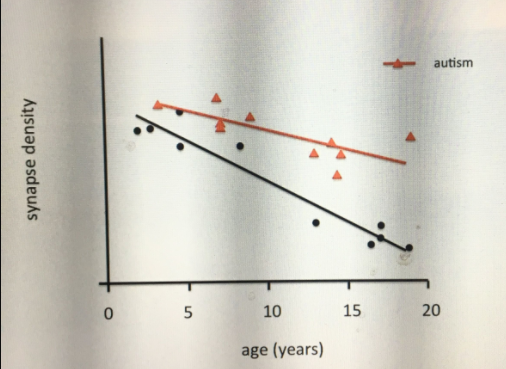
Although the sample size is small (which is understandable given how few people not only die in childhood but also have their brains donated to science and also have an autism diagnosis on file) there is virtually no OVERLAP. Every single autistic person is above the regression line for neurotypicals and every single neurotypical is below the regression line for autistic people. What makes this so striking is you’d expect just from misdiagnosis, some people diagnosed with autism would actually be neurotypical and yet despite such error, we still get virtually no overlap, suggesting age controlled synaptic density is virtually a perfect predictor of autism.
So perhaps autism should simply be defined as which regression line you’re closer to in the above chart. The one for autistic people, or the one for neurotypicals. Just as Downs syndrome is diagnosed by an extra 21st chromosome, without need for questionnaires, autism too could have a nice neat medical definition.
On the other hand, I’ve long argued that brain size is a cause of intelligence and that intelligence is the ability to adapt, so how can I associate synaptic density (a proxy for brain size) with a maladaptive condition like autism?
My guess is there are two kinds of big brained people. Those who have big brains because they have a lot of neurons, and those who have big brains because they have a lot of redundant connections between those neurons. The former will tend to be gifted while the latter will tend to have autism, though many will tend to have both. If we limited our samples to nerotypicals, the correlation between brain size and IQ might jump from perhaps 0.4 (the current estimate) to 0.5 or even 0.6.
How exactly extra connections cause autism is not entirely clear. One idea I heard an Asian researcher suggest (sorry I forget his name) is that connections compete to form in a Darwinian struggle, so if you don’t prune the weak ones, you drag down the fitness of the brain.
But why is social intelligence especially impaired in autism? My guess is that since most brain pruning occurs in late childhood and adolescence, the very years where we acquire the most social skills, it is the social brain that especially fails to prune.
 Pumpkin Person
Well then Anime has the most synapses in the world.
Obviously we are not able to crack open peoples skulls while the live, so the best thing is some sort of questionnaire developed by a non-autist like me.
Santo you didn’t name 5 autistic traits you have. You named 1 – irregular legs. Its a big one I admit, but you are antisemetic so that cancels out the legs. Name some more autistic traits you have.
Obsessive interests, difficulty to lie and to interact socially.
Well maybe youre just nerdy
Whi tied you people on the spectrum cannot be antisemitic? They can hate a particular group of people.
Frankly its easy to see who has autism just based on their comments. Its called using intuition.
ASD lacks biological and construct validity.
https://link.springer.com/article/10.1007/s40489-016-0085-x
Maybe RR lives in a parallel universe where I’ve died so nothing I post gets read.
Maybe PP didn’t read the article to see that the claim I stated holds.
I’ve read a bit of it and used to agree with it until I saw the chart I posted in my article.
Are you claiming it’s causal?
I don’t think anyone knows the causal mechanism, it’s just very significant that this behavioral phenotype we call autism correlates so strongly with synaptic density.
RR is confusing causality with effect.
Just ban him.
There are known differences between autistic brains and Asperger’s brains, but it doesn’t look like anyone has ever looked at pruning in Asperger’s specifically. My guess is that Asperger’s brains have significantly more pruning, perhaps even more than the neurotypical average in gifted subjects, but with a gradient toward the autistic trendline. I say this because, even though I consider the two separate phenomena, autism appears to be a form of brain damage which Asperger’s brains suffer at a high rate with varying severity. Motor control issues is evidence of that: Some aspies like me have very good coordination, but many are distributed between the neurotypical and autistic lines.
(NB: My coordination may be a fluke, because I picked up dual fixations with martial arts and ambidextrity as a child, so I spend a lot more time breaking down physical motions in my mind than normal.)
Yes aspergers seems to be a type of autism wihere verbal and creative skills are preserved or even enhanced. Santo, and perhaps Pill & Mug of Pee might be aspies since they have some autistic traits but don’t quite fit the autistic stereotype.
As Paul Coojman noted they often have rich fantasy lives and grim sadism. And while their verbal IQs are typically much higher than their performance IQs, they struggle with metaphors and take things too literally.
One theory I have is that even though autism and schizophrenia are largely opposites, aspies are just people who have both conditions & so they kind of seem neurotypical, kind of like how an East-Asian black hybrid can seem Caucasian.
Interestingly the most defenseless people in the world, william syndrome people, are very social and music-inclined. The look like people with Pipa Bacca syndrome, i mean, wokedaineists.
I have known about higher-density synapses in autism since 2015.
Because you have it
pill Jimmy dore show now spreading conspiracy theories about george soros:
I stopped watching Jimmy a long time ago.
Just goes to show how strong a force audience capture can be. I can’t imagine him taking that seriously a few years ago.
Great conversation.
”There is something fundamentally wrong with black culture”
We know very well what it is…
Testosterone.
It would be interesting to analyze whether there is not a high degree of correlation between certain personality traits or autistic symptoms and this variable. It would be more accessible, for now, since doing this type of examination is not for everyone.
To be fair, the guy that shot John Lennon was real. But the guys that shot MLK, the Kennedys, and so on….not real.
I think Santo would like this one.
A good one, thanks!
I was obsessed with this too (1984’s movie is so inferior to the book, thought). Sadly, Annie Lennox is just a megaphony clown today.
I’d say Santo would like REM actually.
I like it too, lots of 80’s and 90’s bands but one of my favorite is Foo Fighters, i mean, anglo saxon bands.
Finally some good ole’ Anglo-Saxon music.
My favorite 80’s British song of roughly this type is The Killing Moon by Echo the Bunnymen.
Do you like grunge?
I was to watch this movie but identified reason i didnt.
By*
“Moreover, different domains of creativity require different cognitive profiles, with poetry and art associated with divergent thinking, schizophrenia and affective disorder, and mathematics associated with convergent thinking and autism.”
https://www.sciencedirect.com/science/article/abs/pii/S0092656605000620?via%3Dihub
pp, can you do an article on cognitive profiles?
If this is relevant: https://www.reddit.com/r/science/comments/162w8cw/a_brain_structural_connectivity_biomarker_for/?utm_source=share&utm_medium=android_app&utm_name=androidcss&utm_term=1&utm_content=share_button
Because it is not feasible to annually examine people’s synaptic density, assuming that synaptic density decreases linearly with age and measuring synaptic density at birth and when diagnosing autism may be efficient. Even if one has more synapses at birth than others and synaptic density declines steeply with age, when measured for autism diagnosis, they may have a higher synaptic density than others. I’m curious if synaptic density at birth is related to autism.
I suspect autistics have normal synaptic density at birth, since the problem seems to be a lack of pruning which occurs after birth.
Pingback: Autism should be defined by age controlled synaptic density and NOTHING ELSE! – Autism Love | Autism QIA
According to this theory, the same factors that increase IQ also, in extreme levels, cause autism.
https://www.researchgate.net/publication/271507751_A_Theory_of_General_Reduction_of_Gene-Expression_Manifesting_as_Autism_1993_with_2014_revisions_of_presentation_-_now_2020_rev