I just had a question about what you think the IQ estimates for different civilizations would be, particularly Greek, Roman, Mayan/Aztec, Han Chinese, etc?
Also, do you think Raven’s Matrices is a good indicator of spatial ability? Do you think it is easier to structure concepts using a far more complex framework if you have high spatial ability?
If I have any other questions, Santa Pumpkin, I’ll be sure to ask, because your gift giving this year is giving all of us peace on Earth. Thank you!
I can’t comment on the other groups you mentioned, but my sense is that the ancient Greeks were about as intelligent as the Victorian British. As Anatoly Karlin has noted, they did not have the inbreeding problem other populations have suffered from and their height (and by inference nutrition needed for brain development) was around 5’7″ (in men) which is similar to 19th century Brits. I think the rare combination of being ahead of their contemporaries in both genomic IQ (more outbreeding) and environmental IQ (good health and nutrition) made their phenotypic IQs conspicuously high for their time.
As for the Raven; I I think it measures spatial ability but not especially well. It’s more of a conceptual test. Indeed on the WISC-V it’s not even part of the spatial sub-scale, but instead part of the fluid reasoning index (though that’s a misnomer since spatial ability itself is fluid).
During the 1990s to the early 2010s, it was believed that the brain-size IQ correlation among adults living in developed countries was about 0.4. Then in 2015, a meta-analysis by Jakob Pietschnig, Lars Penke, Jelte M. Wicherts, Michael Zeiler, and Martin Voracek surfaced claiming the brain size-IQ correlation was only 0.24! The paper argued that the 0.4ish figure that was typically cited was inflated by publication bias and these authors went out of their way to counter this.
But then in 2017, a meta-analysis by Gilles E. Gignac and Timothy C. Bates, published in the peer reviewed journal Intelligence showed once again that it was 0.4. The authors reviewed the research cited by Pietschnig et al but corrected for range restriction, test quality, and sample quality and a 0.4 correlation was found.
A positive relationship between brain volume and intelligence has been suspected since the 19th century, and empirical studies seem to support this hypothesis. However, this claim is controversial because of concerns about publication bias and the lack of systematic control for critical confounding factors (e.g., height, population structure). We conducted a preregistered study of the relationship between brain volume and cognitive performance using a new sample of adults from the United Kingdom that is about 70% larger than the combined samples of all previous investigations on this subject (N = 13,608). Our analyses systematically controlled for sex, age, height, socioeconomic status, and population structure, and our analyses were free of publication bias. We found a robust association between total brain volume and fluid intelligence (r = .19), which is consistent with previous findings in the literature after controlling for measurement quality of intelligence in our data. We also found a positive relationship between total brain volume and educational attainment (r = .12). These relationships were mainly driven by gray matter (rather than white matter or fluid volume), and effect sizes were similar for both sexes and across age groups.
This study is important not just because of its colossal sample size, but the fact that it was preregistered, meaning they agreed to publish the results before they knew what said results were. Critics of this research have worried there’s a file drawer effect, where studies not finding the desired result get shelved, and mostly larger positive correlations get published.
Also interesting is that the correlation between intelligence and brain size remained even after controlling for sex, height, population structure and socioeconomic status. One could even argue this is an over-correction, since socioeconomic status is itself a crude measure of intelligence, and yet even after this over-correction, the correlation remained, suggesting the link between brain size and intelligence is causal and not just a byproduct of a shared correlation with body size (i.e. height) or the nutrition that comes from high SES.
However IQ enthusiasts might be disappointed by how low the correlation is. Only 0.19. And as the matrix below shows, even before they corrected for anything, the correlation was only 0.21 (only half the 0.4 correlation long cited by IQ enthusiasts and confirmed by Gilles and Bates, 2017)
The most likely explanation for this low correlation is that in order to get such a huge sample, they needed a really short test. And indeed the Fluid IQ test used in the study is just the two minute Verbal Numerical Reasoning test sometimes administered on more than one occasion to improve reliability. But as we can see from the 0.31 correlation between Fluid IQ and Education Attainment, the test is not that g loaded.
Indeed on tests with near-perfect g loadings like the WAIS-III, IQ correlates 0.55 with education (though this is in America). If we divide the Fluid IQ test’s correlation with education by the WAIS-III’s, we might get a very crude estimate of the Fluid IQ test’s correlation with the WAIS-III and that correlation is 0.56. If we further divide brain size’s 0.21 correlation with the Fluid IQ test by 0.56, we might get a crude estimate of brain size’s correlation with the WAIS-III and that correlation is 0.38. Thus confirming Gilles and Bates, 2017.
Of course Pietschnig et al can counter that brain size in this massive study only correlates 0.14 with education. Dividing 0.14 by the WAIS-III’s 0.55 correlation perfectly confirms their 0.25 correlation between IQ and brain size.
Thus, the only solution is to average 0.38 and 0.25, which gives a 0.32 correlation between IQ and brain size. Still a moderate correlation, but the low end of the moderate range. Indeed long before MRIs, a correlation of 0.3 was considered the best estimate of IQ’s correlation with brain size. The figure was achieved by adjusting the weak correlation between head size and IQ for the fact that head size was only a rough proxy for brain size.
So even though IQ doesn’t correlate quite as well with brain size as IQ enthusiasts would have liked, the good news is that the correlation barely declines when you control (even over-control) for other variables, implying it’s overwhelmingly causal.
Hello PP, I was wondering if you could give a rough approximation of my IQ based on scores from different tests I’ve taken. I’ve never considered myself all that smart, and writing is not something I’m especially fond of so please excuse any grammatical errors. SAT (taken in 2014): Math 660, Reading 630, Writing 620 ASVAB (2016): 96th percentile, GT Score 129 Queendom.com Classical IQ Test (December 23, 2018): 140 Overall, 137 Crystallized Intelligence, 147 Fluid Intelligence
I’m gonna post some pictures of the test scores below.
.
.
.
From the SAT picture you can also see my PSAT scores and a previous SAT score. The other scores are average. For context, I was unfamiliar with nearly all the formulas needed when taking the PSAT both times. I’ve also always been a very anxious test taker; literally shaking and sweating in a 70 degree room. I was also diagnosed with anemia around this time which might also be a factor. Weighing in at about 120 lbs standing 5’10, I was a walking stick. Was also put on free lunch at school and my mom was on food stamps, welfare, the whole gamut. My parents were pretty indifferent. On the first SAT test I took, a friend of mine recommended taking an adderall pill. This led to profuse sweating, blurry vision, frequent bathroom breaks, and uncertainty in all my answers. Before my second round with the SAT I tried studying but was never able to sit down and do it. Instead, I just familiarized myself with the test so I knew what section was gonna come next and knew the time constraints. I know studies show people don’t usually increase their SAT scores by more than 20 points per section, but I’ve personally heard of dozens of people increasing their scores by 100’s of points per section by taking multiple practice tests and learning the tricks on the SAT. Plus, some of my friends started studying for the SAT years in advance. Some as early as middle school.
When I took the ASVAB it was right after a hot and long 2 hour bus ride to the MEPS center. This was in California during the summer, and they didn’t feed us until after we took the test. I also didn’t really put forth my best effort because I was joining the Army and was kinda lackadaisical about it. It was pretty easy in all honesty though.
I heard about Queendom from Aaron Clarey on youtube and he said it gives a pretty good estimate on IQ because it averages from a pool of all people that took it. It also has some studies showing it correlates pretty well with the RAIS test. I took it in about 30 minutes although I’m skeptical because of how high it put me. In short, based on my previous scores where would you rank me? Is it possible my IQ went up from when I was a teenager? I also weigh about 170 now and have adopted the ketogenic diet. That’s one of the main differences between now and then.
Aaron Clarey’s video on Queendom’s IQ test:
Using my formula (IQ = 0.0566(SAT score) + 20.15094) your SAT scores of 1910 and 1660 (out of 2400) equate to IQs of 128 and 114 respectively (U.S. norms). Similarly, your 96th percentile on the ASVAB equates to an IQ of 126.
Given your health issues and test anxiety, I’d probably ignore the IQ 114 you got the first time you took the SAT as an outlier, and judge your teenage IQ based on a composite of your second SAT score (IQ 128) and your ASVAB score (IQ 126). Given the high correlation between these two tests, the composite score would be about 129.
As for your 140 overall IQ on the Queendom; this might be because the Queendom needs to improve its norms. The below chart shows that a sample of college students who took both the RIAS and the Queendom scored 111.12 (SD 8.35) and 117.88 (SD 11.5) respectively.
Given that the RIAS is an extremely well-normed test, this implies that Queendom gives scores that are (a) too high, and (b) too extreme.
To equate Queendom’s distribution with the RIAS distribution we must convert the Queendom score into a Z score with respect to this reference group that took both tests, and then multiply it by the reference group’s RIAS SD (Standard Deviation) and then add to their RIAS mean.
So since your Queendom score of 140 has a Z score of 1.92 in this reference group, it equates to an IQ of 1.92(8.35) + 111.12 = 127
So it seems your IQ has been quite stable and extremely high since your teenage years. An IQ in the high 120s puts you in the same range as U.S. presidents, Fortune 500 CEOs and (on non-college admission tests) the most elite university students on the planet.
A commenter named “Ray” writes in the comment section:
…I’d like to ask you if you can estimate the IQ of a cousin of me based on his intellectual milestones:
-Prior to his 1st birthday he spoke very well and he was very inquisitive
-At age 3 he learned to read and write on his own (my aunt taught him the alphabet, but she never taught him to read per se).
-At age 6 he was reading a college textbook on ondontology and he grasped a great deal of it, though he got bored afterwards-
-At age 6 he used to read textbooks on mathematics (prealgebra), social studies, Spanish Literature and 6th grade physics, chemistry and biology
-At age 12 he began reading Marx’s “Das Kapital” and became obsesed with economics and political philosophy afterwards
He’s currently 17, an avid reader and very well-versed in philosophy, economics and biology (genetics).
Based on this what would you think his IQ is? It’s clear that he has an astounding verbal IQ, though he is depressed because there are better students in math than him.
I hope you answer 🙂
I’ll focus on the three least ambiguous data points.
Research suggests that at first toddlers “will be able to mutter only about four to six words, but at around 18 months, a real spurt in vocabulary will take place, and your Chatty Cathy’s list of go-to words will increase to about 50.”
It sounds like your cousin had acquired the speaking skills of a 1.5-year-old by age 0.9 or so, which would imply he was functioning at 167% of his chronological age and thus a ratio IQ of 167 (1.5/0.9 = 1.67)
Meanwhile reading and writing are not typically acquired until age six, so having achieved this at three implies he was functioning at 200% of his chronological age and thus a 200 ratio IQ (6/3 = 2.00)
Lastly, doing grade six (age 11) physics at age six implies a ratio IQ of 183 (11/6 = 1.83) though doing physics of any kind seems way beyond even 11-year-olds.
Averaging all three ratio IQs together (unlike deviation IQs, ratio IQs can be averaged) gives a ratio IQ of 183.
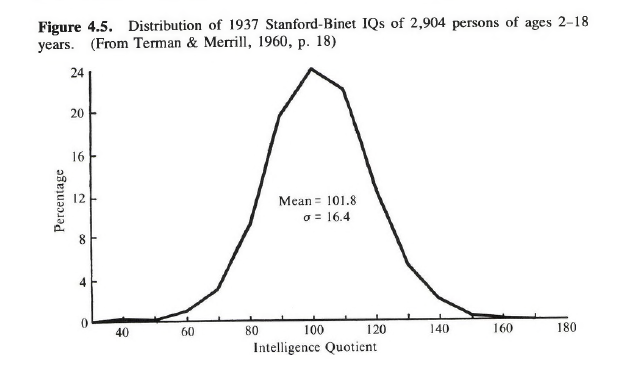
However ratio IQs are only normally distributed from IQ 50 to 150 (though with a slightly inflated mean and SD).
Source: Bias in Mental Testing by Arthur Jensen
Above 150 there is an excess of scores, perhaps because the variance is greater at some ages than others and this becomes noticeable at extremes or perhaps because the linear relationship between age and cognitive development is limited to a narrow range, causing the ratio to become meaningless beyond these limits.
Modern IQ tests get around this problem by forcing scores to fit the bell curve. So since it’s known that only one in 72,000 to 109,000 have ratio IQs in the 180s we can locate the normalized IQ (sigma 15) that fits this rarity, and we end up with an IQ of 164.
Of course this would only reflect your cousin’s early childhood IQ. Given only about a 0.62 correlation between early childhood IQ and late adolescent IQ, the typical IQ 164 child regresses into an IQ 140 young adult ((164 – 100)(0.62)) + 100 = 140 with 95% of cases ranging from 117 to 163.
However by age 10, IQ begins to solidify, and the fact that your cousin was enjoying Marx by age 12 implies his (verbal) IQ had remained above 140 (top 0.5%). Charles Murray notes that just under 10% of even young adults can score high enough on the verbal SAT to likely understand traditional college reading and I’ve found that the top 10% of young adult verbal skill equates to the top 0.5% of age 12 verbal skill. And Marx might be a lot harder than even traditional college material so I might be dramatically underestimating your cuz.
But even 140 (white norms) is incredibly high. It might not sound that impressive when you hear that Harvard’s average SAT score equated to an IQ of 143, but just as your cousin’s childhood IQ of 164 might have regressed to an adult IQ of 140, Harvard’s SAT derived IQ of 143 likely regresses to an IQ in the 120s on official IQ tests.
So even 140 is enough to tower at even the most elite universities on the planet (at least in the non-STEM departments).
140 is to IQ as 6’6″ is to height: Head and shoulders above the competition.


 Pumpkin Person