• About

Pumpkin Person

~ The psychology of horror

Pumpkin Person

Monthly Archives: September 2018

The heritability of education vs IQ

05 Wednesday Sep 2018

Posted by pumpkinperson in Uncategorized

≈ 37 Comments

There’s an interesting 2013 meta-analysis by Branigan et al about the heritability of education attainment as measured by twin studies:

heritabilityeducation2


heritabilityeducation.PNG

Source:  Branigan et al, 2013

If you average all the studies in the US and UK,  the mean heritability is 0.31.

A recent study of 1.1 million people (largely from the U.K. and U.S.) found polygenic scores predicted 0.12 of the variation in education, or roughly 39% of twin studies’ heritability.

Why so much lower than twin studies?  One reason might be that genetic samples suffer from range restriction, since relatively educated people (like our very own G-man!) seem more likely to get genotyped.

I found this quote from the supplemental materials of a 2018 study by Ritchie et al.

A personal measure of socioeconomic status is educational attainment. We compared the distributions of educational attainment in UK Biobank to the data from the 2011 Census for England and Wales (available at the following URL: https://www.nomisweb.co.uk/census/2011; England and Wales makes up the vast majority—around 89%—of the population of the United Kingdom). In the census, for those ages 50+ years, 25.5% of males and 20.5% of females reported having a ‘level 4 qualification’, the category including college/university degrees (we might expect this figure to be slightly higher were it restricted to the 44-77 age group, but that precise age subset was not available from the census data). In the subsample of UK Biobank used here, 48.0% of males and 42.2% of females reported having a college degree. Thus, the sample was not representative in terms of educational attainment: a higher proportion of individuals in general had a degree.

Adjusting for range restriction would perhaps increase the amount of education variance explained by DNA from 0.12 to 0.2 (though that’s just a guess).

0.2 is 65% of the heritability found in twin studies.

Meanwhile twin studies find about a 0.75 heritability for IQ.

That means we might expect polygenic scores to eventually explain 65% of 0.75 of the variance in IQ, or 0.49 at least among whites living in the West.

Of course that might be a huge overestimate of heritability, if much of the genetic variance is not causal (i.e. population stratification, gene environment interaction).

On the other hand it might be a huge underestimate of heritability, if much of the genetic variance in IQ is not capture by the additive effects of common SNPs.

Both possibilities likely cancel each other out to some degree.

But if the heritability of IQ really is 0.49 (one of the fiercest critics of twin studies suggested 0.45) then square rooting the heritability gives a potent 0.7 correlation between DNA and IQ.

Share this:

  • Click to share on X (Opens in new window) X
  • Click to share on Facebook (Opens in new window) Facebook
Like Loading...

Open thread: Excellent discussion on CBC radio

03 Monday Sep 2018

Posted by pumpkinperson in Uncategorized

≈ 76 Comments

Last week I was busy searching the internet when I got a text message urging me to immediately turn on CBC radio because there was an excellent show.  CBC radio puts out a lot of really good shows and this one was no exception.  You can hear the whole episode here.

Here’s the description:

Universities are supposed to be dedicated to the exchange of ideas. But according to social psychologist Jonathan Haidt, campuses now skew so far to the left that they’ve become what he calls “political monocultures” in which voices that stray too far from liberal orthodoxy are shouted down. Paul Kennedy speaks with Professor Haidt – and with other scholars who have been thinking about the complex question of diversity on campus.

Share this:

  • Click to share on X (Opens in new window) X
  • Click to share on Facebook (Opens in new window) Facebook
Like Loading...

RIP Cavalli-Sforza

03 Monday Sep 2018

Posted by pumpkinperson in Uncategorized

≈ 1 Comment

The great Italian geneticists Cavalli-Sforza has passed away.  I can’t even count how many times I’ve posted his genetic trees on this blog.  He will be missed.

sforza.PNG

Cavalli-Sforza: 1922 – 2018


Share this:

  • Click to share on X (Opens in new window) X
  • Click to share on Facebook (Opens in new window) Facebook
Like Loading...

Long-term brain & body size trends

03 Monday Sep 2018

Posted by pumpkinperson in Uncategorized

≈ 5 Comments

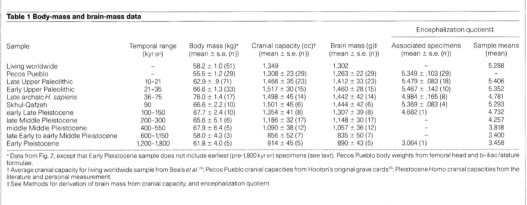
I found a 1997 paper called  Body mass and encephalization in Pleistocene Homo by CB Ruff et al.

We often hear how prehistoric man was so robust and muscular, yet their estimated weights are surprisingly modest (see John Hawks).  Indeed they weigh less than most Americans, though their fat-free body size was probably greater (and that’s what counts when it comes to predicting brain size).

bodymass

Source: Ruff et al. 1997

The chart shows brain size increasing from the Early Pleistocene (890 g) to the Early Upper Paleolithic (1460 g) and then decreasing all the way down to 1302 g in so-called “living people”.

The problem is the sample for  “living” people does not have a date and my guess is these “living” people have been dead for over 80 years, since their brain weights were estimated from cranial capacity and the “living” skulls are likely from museums.  The authors probably just assumed they were recent enough to approximate living people, but given Richard Lynn’s claim that 20th century nutrition & disease reduction has boosted brain size, we need especially recent data.

How would truly living people, especially living young people in the First World compare with the numbers on this chart?  More recent data comes from Ho et al (1980).

brainweight1980

Source: Jensen 1998

Of course people from the United States are not comparable to the Worldwide ancient skulls, however Ruff et al note that about three quarters of their data is from Europe/West Asia and about a quarter is from Africa.  If we use the Ho et al age 25 sex combined means (1455 g for whites and 1333 g for blacks), and do a weighted average where whites are 75% and blacks are 25%, we get 0.75(1455) + 0.25(1333) = 1091.25 = 1425 g.

In other words, people with ancestry from the similar regions of the world as most ancient skulls, seem to have an average brain weight of 1425 g when reared in the First World.  Not far from the peak brain weight of 1460 g in the upper paleolithic. Add to that the fact that people in autopsy studies likely have smaller brains and the likely brain growth that’s occurred since the 1980s, and it seems our brains have arguably made a full recovery, as we’ve finally achieved the great nutrition standards humans enjoyed in the early upper paleolithic!

Indeed nutrition was so good in the Upper Paleolithic, that the elite were morbidly obese, reminding us that wealth inequality has always been with us.

venus.PNG

Share this:

  • Click to share on X (Opens in new window) X
  • Click to share on Facebook (Opens in new window) Facebook
Like Loading...

Have we recovered our paleolithic brain size yet?

02 Sunday Sep 2018

Posted by pumpkinperson in Uncategorized

≈ 2 Comments

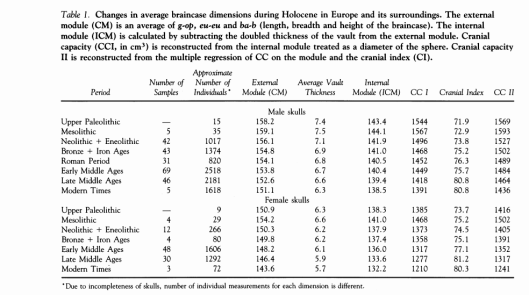
Although brain size roughly tripled as humans evolved from apes, one mystery is the little known brain shrinkage that occurred in the last 10,000 years or so.   The bulk of the evidence for this comes from Maciej Henneberg who published the following table:

cranialcapacityovertime

Source:  Henneberg, 1988

One problem with this table is that cranial capacity is not measured directly by actually filling the skull with mustard seeds, water or beads etc, but rather by using regression equations which may or may not apply to all samples.

However there’s also evidence from directly measured cranial capacity suggesting brains have shrunk since the upper paleolithic.

directlymeasuredcranialcapacity.PNG

Source:  Henneberg, 1988

So it seems that brain size had been shrinking since the stone age until at least the industrial revolution;  the question is what’s happened since?

According to Richard Lynn, brain size has since been increasing because of better health and nutrition,  and this is matched by a similar increase in IQ test performance, known as the Flynn effect.

Unfortunately I don’t know of any directly measured cranial capacities from 21st century young adults.  The closest we have are MRI scans of intracranial volume, but one scientist working in this field recently told me that these can give different results depending on the scanning (MRI) machine and the algorithms used.  For more details, see here and here.

Thus, I turn once again to the Lee and Pearson regression formulas, for estimating cranial capacity from external head measures which Lee and Pearson found agreed with the direct packing method far better than the packing method applied by two different packers!

cranialcapacity

Using 2012 anthropometric data from the U.S. army,  I found that men have a head length, head breadth and head height of 199.5 mm, 154.3 mm and 131.1 mm respectively.  Comparable figures for women are 189.8 mm, 147.8 mm, and 126.5 mm.

Assuming these forumulas are still valid today,  21st century U.S. army men average 1499 cc and their female counterparts average 1337 cc, for a sex-combined average of 1418 cc.

The simplest explanation for the fall and recent rise of brain size is the one advanced by Richard Lynn.  As humans switched from hunting to farming, malnutriton and disease caused brain size (and height) to plummet,  but with 20th century advances in health and nutrition, First World countries have (largely) recovered our former brain size.

But why is the 2012 U.S. army sample still 80 cc lower than people 50 to 30 kya?  I see four reasons:

  • Most of the upper paleolithic samples are probably from Europe, while the U.S. army is more diverse.
  • The U.S. army is slightly shorter than their civilian  counterparts, and so their heads might be slightly smaller.
  • Even in 2012, much of the U.S. still suffered from sub-optimum nutrition and inadequate health care during their prenatal and perinatal development.
  • Upper paleolithic people may have been genetically (if not phenotypically) more robust than people today. For example Richard Klein once claimed that if a paleolithic (but anatomically modern) human walked into the room, the only thing we’d notice about him is that he was extraordinarily well built.  Among 1989 army personnel of the same rank, race, and sex, weight correlates 0.41 with cranial capacity (at least as estimated by the Lee & Pearson formula).  Among the entire army, it correlated 0.66.  Thus, there may have been a slight genetic decrease in brain size related to body size, but the lion’s share of the decrease and all of the increase was likely health and nutrition.

Share this:

  • Click to share on X (Opens in new window) X
  • Click to share on Facebook (Opens in new window) Facebook
Like Loading...
Newer posts →

contact pumpkinperson at easiestquestion@hotmail.ca

Recent Comments

RaceRealist's avatarRaceRealist on Which better predicts populati…
austin slater's avataraustin slater on Which better predicts populati…
RaceRealist's avatarRaceRealist on Which better predicts populati…
God's Word's avatarGod's Word on Which better predicts populati…
pumpkinperson's avatarpumpkinperson on Which better predicts populati…
RaceRealist's avatarRaceRealist on Which better predicts populati…
Anime's avatarAnime on Which better predicts populati…

Archives

  • December 2025
  • November 2025
  • October 2025
  • September 2025
  • August 2025
  • July 2025
  • June 2025
  • May 2025
  • April 2025
  • March 2025
  • February 2025
  • January 2025
  • December 2024
  • November 2024
  • October 2024
  • September 2024
  • August 2024
  • July 2024
  • June 2024
  • May 2024
  • April 2024
  • March 2024
  • February 2024
  • January 2024
  • December 2023
  • November 2023
  • October 2023
  • September 2023
  • August 2023
  • July 2023
  • June 2023
  • May 2023
  • April 2023
  • March 2023
  • February 2023
  • January 2023
  • December 2022
  • November 2022
  • October 2022
  • September 2022
  • August 2022
  • July 2022
  • June 2022
  • May 2022
  • April 2022
  • March 2022
  • February 2022
  • January 2022
  • December 2021
  • November 2021
  • October 2021
  • September 2021
  • August 2021
  • July 2021
  • June 2021
  • May 2021
  • April 2021
  • March 2021
  • February 2021
  • January 2021
  • December 2020
  • November 2020
  • October 2020
  • September 2020
  • August 2020
  • July 2020
  • May 2020
  • April 2020
  • March 2020
  • February 2020
  • January 2020
  • December 2019
  • November 2019
  • October 2019
  • September 2019
  • August 2019
  • July 2019
  • June 2019
  • May 2019
  • April 2019
  • March 2019
  • February 2019
  • January 2019
  • December 2018
  • November 2018
  • October 2018
  • September 2018
  • August 2018
  • July 2018
  • June 2018
  • May 2018
  • April 2018
  • March 2018
  • February 2018
  • January 2018
  • December 2017
  • November 2017
  • October 2017
  • September 2017
  • August 2017
  • July 2017
  • June 2017
  • May 2017
  • April 2017
  • March 2017
  • February 2017
  • January 2017
  • December 2016
  • November 2016
  • October 2016
  • September 2016
  • August 2016
  • June 2016
  • February 2016
  • January 2016
  • November 2015
  • May 2015
  • January 2015
  • December 2014
  • November 2014
  • October 2014

Categories

  • ethnicity
  • heritability
  • income
  • Oprah
  • Uncategorized

Meta

  • Create account
  • Log in
  • Entries feed
  • Comments feed
  • WordPress.com

Recent Comments

RaceRealist's avatarRaceRealist on Which better predicts populati…
austin slater's avataraustin slater on Which better predicts populati…
RaceRealist's avatarRaceRealist on Which better predicts populati…
God's Word's avatarGod's Word on Which better predicts populati…
pumpkinperson's avatarpumpkinperson on Which better predicts populati…
RaceRealist's avatarRaceRealist on Which better predicts populati…
Anime's avatarAnime on Which better predicts populati…

Archives

  • December 2025
  • November 2025
  • October 2025
  • September 2025
  • August 2025
  • July 2025
  • June 2025
  • May 2025
  • April 2025
  • March 2025
  • February 2025
  • January 2025
  • December 2024
  • November 2024
  • October 2024
  • September 2024
  • August 2024
  • July 2024
  • June 2024
  • May 2024
  • April 2024
  • March 2024
  • February 2024
  • January 2024
  • December 2023
  • November 2023
  • October 2023
  • September 2023
  • August 2023
  • July 2023
  • June 2023
  • May 2023
  • April 2023
  • March 2023
  • February 2023
  • January 2023
  • December 2022
  • November 2022
  • October 2022
  • September 2022
  • August 2022
  • July 2022
  • June 2022
  • May 2022
  • April 2022
  • March 2022
  • February 2022
  • January 2022
  • December 2021
  • November 2021
  • October 2021
  • September 2021
  • August 2021
  • July 2021
  • June 2021
  • May 2021
  • April 2021
  • March 2021
  • February 2021
  • January 2021
  • December 2020
  • November 2020
  • October 2020
  • September 2020
  • August 2020
  • July 2020
  • May 2020
  • April 2020
  • March 2020
  • February 2020
  • January 2020
  • December 2019
  • November 2019
  • October 2019
  • September 2019
  • August 2019
  • July 2019
  • June 2019
  • May 2019
  • April 2019
  • March 2019
  • February 2019
  • January 2019
  • December 2018
  • November 2018
  • October 2018
  • September 2018
  • August 2018
  • July 2018
  • June 2018
  • May 2018
  • April 2018
  • March 2018
  • February 2018
  • January 2018
  • December 2017
  • November 2017
  • October 2017
  • September 2017
  • August 2017
  • July 2017
  • June 2017
  • May 2017
  • April 2017
  • March 2017
  • February 2017
  • January 2017
  • December 2016
  • November 2016
  • October 2016
  • September 2016
  • August 2016
  • June 2016
  • February 2016
  • January 2016
  • November 2015
  • May 2015
  • January 2015
  • December 2014
  • November 2014
  • October 2014

Categories

  • ethnicity
  • heritability
  • income
  • Oprah
  • Uncategorized

Meta

  • Create account
  • Log in
  • Entries feed
  • Comments feed
  • WordPress.com

Blog at WordPress.com.

Privacy & Cookies: This site uses cookies. By continuing to use this website, you agree to their use.
To find out more, including how to control cookies, see here: Cookie Policy
  • Subscribe Subscribed
    • Pumpkin Person
    • Join 686 other subscribers
    • Already have a WordPress.com account? Log in now.
    • Pumpkin Person
    • Subscribe Subscribed
    • Sign up
    • Log in
    • Report this content
    • View site in Reader
    • Manage subscriptions
    • Collapse this bar
 

Loading Comments...
 

    %d