
Tags
Of America’s 76 million baby boomers (alive or dead), only three grew up to be President of the United States (so far). If we crudely assume being President is the pinnacle of power, the Presidency puts you at the top one in 25 million level. The median U.S. president would therefore be at the one in 50 million level in power (normalized Z = +5.47). Very tentative data suggests the average IQ of U.S. Presidents is 137 (+2.47), thus suggesting the regression slope predicting IQ from power = +0.45 (very similar to the correlation between IQ and lifetime income).
Biodemographic prediction
As of 2019, there were about 65 million Americans in Generation X, and assuming they resemble Americans as a whole, about 1.8% are Afro-multiracial, which gives 1.17 million people. On a scale where white Americans average IQ 100 with a standard deviation of 15, black Americans average 85, and “pure” U.S. blacks average 80, Afromultiracials would average about 90. If there were a perfect correlation between IQ and power, we’d expect Kamala Harris to have an IQ 72 points higher (one in 1.17 million) than the average Afromultiracial, however since the correlation is only 0.45, we’d expect her to be 72(0.45) = 32 points above the average IQ 90 Afromultiracial, or roughly 122. If true this would put her intelligence in the superior range, though the lower end there of.
However guessing someone’s IQ from only their race and power is unwise. What is needed is actual test data.
Psychometric confirmation?
Harris has no publicly known IQ scores so we’ll have to settle for the bar exam as a crude measure of her intelligence.
Snopes.com reports:

So she scored lower than 72.2% of California law students, suggesting she was in the bottom 27.8% of law students. However the LA Times reports:
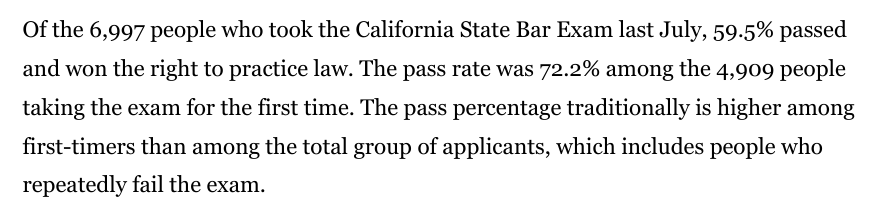
So when we subtract that 4,909 people like Harris who took the test the first time, we see 2,088 were repeat test takers (which Harris would become the next year). How many of the repeat takers passed like Harris would the next year? Subtract 72.2% of 4,909 from 59.5% of 6,997. In other word, 619 out of 2,088 or the top 30%.
So despite being in the bottom 27% of all law students for not passing the first time, Harris was in the top 30% of that bottom 27% for not failing a second time. In other words she’d be around the 19th percentile of law students.
“The average national LSAT score for full-time, first-year JD enrollees for fall 2022 was about 159” according to bestcolleges.com. The 19th percentile would be 0.87 standard deviations less so about 150 given the SD on the LSAT is 10. A 150 LSAT would equate to an IQ of 111 or roughly 116 (U.S. norms) in Harris’s day when the average IQ of college grads and by extension, LSAT takers was higher. This converts to 114 using white norms, so 8 points lower than expected for America’s most powerful hybridized black, but still higher than 82% of white Americans.
Of course the Bar exam is not an actual IQ test so this remains only a rough guestimate.
 Pumpkin Person
The curve I made puts 137 at 1 in 100
Kamala at 114 or 122 these score matches the percentile on my curve as the gaussian.
A slight difference is that 150 is 1 in 1,000
I can see that if I am IQ 121 from my bivariate SAT/ACT scores that Kamala is about this intelligent. I never wanted to be a lawyer though and that’s from personality not intelligence.
Trump is not dumb if he seems that way. It’s a personality thing as well. Not as bright as Obama but Trump is in business not law. Smarter than Bush Jr. Yet not as wise as Kennedy.
It gets fuzzy fast separating IQ from personality. Smart conservatives exist, in military and politics and working class. 115 is midwit range as college education has been inflated. Business owners manufacturer and fix cars and need visual spatial where college people do verbal paperwork. Only the top professors do real mathematics for science. They have spatial too. This is not even actually the case as people complexity factors in greatly.
What I am saying is that Too many factors get involved. I’m just 36 and on welfare and smarter than the average bear. I am going to vote green and if they are not on the ballot not vote at all. But I understand what people based on what personality will vote for who. Intelligence has become irrelevant and schetchy.
Looking at the WAIS 5 it might be better that all IQ tests in accuracy in history. Except for EEG devices at top universities. I need one because poor people don’t get proper neuropsychological evaluations.
Your Law School and bar exams posts made me think I might want to give you a few names on my Smart list who have had amazing achievements on those two “tests.” If you want, you can try to estimate the IQ of at least one of them.
I’d be very interested in hearing about these people, but may take a while before I find time to estimate them
Their impressive intellectual feats I chose from their Wiki articles:
—
Antonin Scalia:
“He became a champion collegiate debater in Georgetown’s Philodemic Society“
” graduated from Georgetown in 1957 as class valedictorian with a Bachelor of Arts, summa cum laude.”
” He graduated in 1960 with a Bachelor of Laws, magna cum laude, among the top of the class.”
—
Louis Brandeis:
“graduated from the Louisville Male High School at age 14 with the highest honors. “
“[at Harvard Law] Brandeis achieved the highest grade point average in the history of the school, a record that stood for eight decades.”
—
Byron White:
“excelled academically in high school, graduating in 1934 as the class valedictorian with the highest grades in the school’s history. “
“returned to Yale Law School, graduating in 1946 ranked first in his class with a Bachelor of Laws degree, magna cum laude“
—
Charles Evans Hughes:
“He then enrolled in Columbia Law School, graduating with a Bachelor of Laws in 1884 ranked first in his class. That same year, he passed the New York bar exam with the highest score ever awarded.”
—
Tom Denning, Baron Denning:
“Both boys won scholarships to Andover Grammar School, where Denning excelled academically, winning four prizes for English essays on the subjects of “The Great Authors”, “Macaulay“, “Carlyle” and “Milton“.”
“At the time Denning wanted to become a mathematician, but none of the new teachers knew enough mathematics to teach him; instead, he taught himself. He qualified to study at University College, Southampton, but was advised to stay at school and apply to Oxford or Cambridge in a few years. He sat the Oxbridge examination when he was sixteen and was awarded a £30 a year exhibition to study mathematics at Magdalen College, Oxford“
“Although he had been accepted by a college he still needed to gain entry to the university as a whole, which meant passing exams including Greek – which had not been taught at Andover Grammar School. Denning managed to teach himself enough of the subject to pass, and matriculated to Oxford in 1916.”
“obtained a First in Mathematical Moderations, the first half of his mathematics degree”
“Denning was demobilised on 6 February 1919, and returned to Magdalen College four days later. He initially thought about turning to applied mathematics, but decided on pure mathematics. He studied hard, not participating in any of the university’s numerous societies or clubs so that he could better focus on his work, and graduated in 1920, placing in the first class of the Mathematical Greats (the final undergraduate examinations for the subject).[20] He was offered a job teaching mathematics at Winchester College for £350 a year, which he accepted. As well as mathematics, he taught geology, despite not having studied it; instead, he “read up on [it] the night before”. He found the job boring, and after viewing the Assize Court at Winchester Castle decided he would like to be a barrister.”
“Denning gained a high grade in all his subjects except jurisprudence, which he described as “too abstract a subject for my liking”.”
“Margaret Thatcher said that Denning was “probably the greatest English judge of modern times”.”
—
Peter W. Huber:
” entered the Massachusetts Institute of Technology (MIT) at age 17. He received a Ph.D. in mechanical engineering in 1976 at the age of 23 and joined the MIT faculty as a professor, receiving tenure two years later.”
“While a professor at MIT, Huber began attending Harvard Law School. He was an editor of the Harvard Law Review and graduated in 1982 with a Juris Doctor, summa cum laude. Huber was the only Harvard Law graduate between 1975 and 1996 who received the summa cum laude distinction.”
—
Kannon Shanmugam:
” graduated as co-valedictorian in 1989 at age 16. He then went to Harvard University, where he was editor-in-chief of The Harvard Independent. He graduated in 1993 with a Bachelor of Arts, summa cum laude, in classics.”
” returned to the United States to attend Harvard Law School, where he was an executive editor of the Harvard Law Review and argued the case for the winning side in the Ames Moot Court Competition.[9] He graduated in 1998 with a Juris Doctor magna cum laude.”
Lewis Sargentich:
“He attended Alhambra High School, where he was an acclaimed student orator. He won both the prestigious National Forensic League Boys Domestic Extemporaneous Speaking tournament and the Lions Club National Speaker Contest in 1961. He then attended and graduated from Occidental College. He received a Marshall Scholarship to study at Sussex University then graduated from Harvard Law School in 1965.
Sargentich was one of only eight Harvard Law School students to receive the summa cum laude designation at Harvard Law from 1969-2007 when the designation was determined by a Grade Point Average threshold.”
very interesting. I’ll have to read this carefully
yes…because ‘tarded and because chinapipo don’t score so high on it peepee thinks VIQ is fake and gay. but it’s a thing. even if it’s a useless and/or parasitic thing, it’s a thing. it’s a cognitive ability some are very noticeably better at than others.
Of course it’s a thing. Jewish Americans are 36% of the Forbes 400 despite being 2% of America not because they have an average Performance IQ of 96, but because they have an average verbal IQ of 120.
110-114 sounds reasonable. She’s much smarter than the average African-American. By leaps and bounds.
SHE’S NOT AFRICAN AMERICAN
So despite being in the bottom 27% of all law students for not passing the first time, Harris was in the top 30% of that bottom 27% for not failing a second time. In other words she’d be around the 19th percentile of law students.
Assumes her LSAT score the second time was in this bottom percentile.
Correction: Assumes CA Bar Examine taken the second time was in the 19th percentile. Without knowing her score this is too speculative.